Vice president
discusses WTO, Cabinet
The major reason for our industries' exodus to China lies
in the laziness of the people, who are afraid to face up to
the challenge of using English."
-- Annette Lu, vice president
Vice President Annette
Lu will lead a special delegation to visit two of Taiwan's allies,
Nicaragua and Paraguay, by attending the inauguration ceremonies
of their newly elected presidents. Before leaving Taiwan, Lu
spoke with reporters Lin Chieh-yu and Lee Chi-Kuang about the
goals of her trip, the selection of Taiwan's representative
to WTO and an impending Cabinet reshuffle
2002/01/06
TAIPEI TIMES
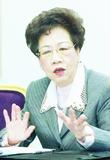
Vice President Annette Lu says the country
needs to keep talent in Taiwan.
PHOTO: FANG
PIN-CHAO, TAIPEI TIMES
Question: What are the primary objectives of your delegation
during its stopover in the US?
Annette Lu (呂秀蓮): The delegation will stay in New York
for three days at the Waldorf Hotel. We are scheduled to meet
with think tank members, US business leaders and overseas Taiwanese.
We will not attend any official meetings but I
do plan to meet with some members of Congress. I will also visit
the Metropolitan Museum and the "Ground Zero" area
around the World Trade Center."
Many of Taiwan's top graduates and
engineers have moved to China and Taiwan has also seen many
of its key businesses invest in China. Because of these problems,
I have arranged a meeting with aerospace and telecommunication
industry financiers on Wall Street. We want to attract businesses
from the international community.
We also intend to transform Taiwan into a global logistics
center, but domestic capital alone is not enough. So we need
to convince international entrepreneurs that Taiwan can serve
as a springboard to the Chinese market.
On the return trip, the delegation will stay in Los Angles
for two days and I will do the same thing [try to attract foreign
investments] there.
In addition to foreign investment, I want to recruit talent
for Taiwan. Taiwan is in great need of high-tech experience
for developing the information technology and bio-tech industries.
Though these talents need to be actively cultivated at home,
the process is too time-consuming to meet our immediate needs.
Thus, we need to attract talent from abroad.
While we can recruit from China and other foreign countries,
overseas Taiwanese have great potential and we intend to focus
on them.
Q: Who do you think should be Taiwan's representative to
the WTO?
Lu: Privately I have recommended two qualified people
to the president for the post. But at the moment it is better
not to disclose their names. I don't have any personal connections
with these two; my recommendation is based purely on their merit.
They both have very good credentials. One was a former director
of the Board of Foreign Trade as well as a seasoned diplomat.
This person had been living in Europe for a long time and is
very familiar with European affairs.
In particular, the person once served as our representative
in Geneva.
In addition, I have also recommended
a person who is very experienced at cross-strait negotiations.
This person has played a very active role in cross-strait talks.
Any problems that the WTO would pose to us would pale in comparison
to the problems that China confronts us with.
Thus, someone who has more than 10 years of experience in cross-strait
talks should be qualified to serve as the WTO representative.
I believe that President Chen is now giving very serious thought
to the WTO representative issue. We should be patient.
Q: After Taiwan enters the WTO, what should Taiwanese do
to enhance their competitiveness? What trends should the government
come to grips with?
Lu: Taiwan has become an official participant in globalization
with its entry into the WTO.
Our people should emphasize their skills in information technology
and English. The major reason for our industries' exodus to
China lies in the laziness of the people, who are afraid to
face up to the challenge of using English.
It is easier for people to go to China where people speak the
same language as people in Taiwan.
What's even more worrisome is the fact that more and more parents
are sending their children to receive an education in China
in order to protect them from the challenges of English or globalization
in general.
If this trend goes on, the quality of our country's future
talent could become a cause for concern.
If parents continue to find the easiest path for their children,
Taiwan will only go backward. If Taiwan continues to lag behind,
it will end up like Penghu -- economically marginalized.
I call on our people not to seek an
easy life, but to send their children to study in the most advanced
countries.
I also want to warn against a situation in which our culture
and publication industries are compromised by Chinese capital.
This is happening more and more often. The government should
take some precautions lest someday China should write Taiwan's
textbooks for us. Wouldn't that be ridiculous?
Q: Have you made any suggestions to the president regarding
the Cabinet reshuffle?
Lu: The president is responsible for this and I have
not discussed it with him.
In my view, all the Cabinet members
in the last year or so have been working very hard.
But the general public may have different opinions. So we might
as well have some professional and objective opinion polls on
the performance of each Cabinet member.
For example, lawmakers could be asked to give an evaluation
of each Cabinet member.
Alternatively, questionnaires could be distributed among business
and academic circles for their views about Cabinet members'
performances.
I believe this would generate even more reliable results.