20040101
=======
Reports on Jan. 1, 2004 ……
KMT urged to change its name
NAME RECTIFICATION: A pro-Taiwan group called on the Chinese Nationalist Party and other organizations in the country to drop the `Chinese' from their names
By Huang Tai-lin, STAFF REPORTER
The Alliance to Campaign for Rectifying the Name of Taiwan lodged a protest in front of the Chinese Nationalist Party's (KMT) headquarters in Taipei yesterday over the word "Chinese" in the party's name.
Saying that the new year is beginning with many organizations still unreasonably using "Chinese" in their titles, alliance members called on the party and businesses to do away with the "absurd" word.
The pro-Taiwan supporters chanted slogans and carried posters saying, "Taiwanese should be in charge of themselves."
In related news, KMT Chairman Lien Chan yesterday turned down President Chen Shui-bian's invitation to join him side-by-side in front of the Presidential Office for the New Year's Day national flag-raising ceremony.
"I will stand with people who love the Republic of China fervently," Lien said.
Lien said he refused the invitation with thanks and that he will attend the event by walking with a crowd to the square in front of the Presidential Office after attending a KMT flag-raising ceremony at 5:50am.
The flag-raising ceremony in front of the Presidential Office takes place at 6am.
Lien, along with his running-mate in the March presidential election, People First Party (PFP) Chairman James Soong, had turned down Chen's invitations over the past three years to participate in the ceremony.
Chen said on Tuesday night that if Lien does show up for the flag-raising event, he would arrange to have the KMT chairman stand next to him.
According to Presidential Office spokesman James Huang, Chen had also instructed staff to contact Lien's and Soong's offices to invite the two party chairmen to the Presidential Office for a brief stay before taking part in the national flag-raising ceremony.
PFP spokesman Hwang Yih-jiau said yesterday that Soong will not visit the Presidential Office, as he also wishes to be among the crowd for the ceremony.
"We appreciate President Chen's goodwill, but we do not wish to create a disturbance at such an early hour," Hwang said. "Besides, given that the flag-raising ceremony is an event sponsored by civic groups, it is somehow inappropriate that some get to visit the Presidential Office while others don't."
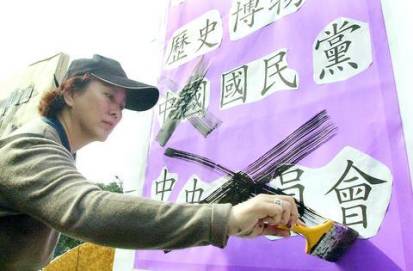
A member of the Alliance to Campaign for Rectifying the Name of Taiwan crosses out the characters for ``Chinese'' from ``Chinese Nationalist Party'' during a demonstration in front of KMT headquarters yesterday. The group was demonstrating against the KMT's pro-China ideology.
-----------------------------------------
On Jan. 1, 2004 ……
-----------------------------------------
On Jan. 1, 2004 ……
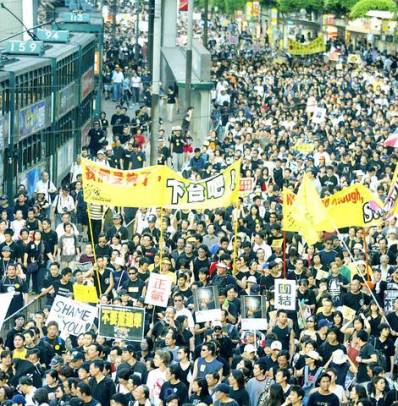
``We've had enough, step down!'' reads a banner, as thousands of people block Hong Kong's streets in a huge protest march against Tung Chee-hwa's anti-subversion law on July 1.
-----------------------------------------
On Jan. 1, 2004 ……
Soong must account for his many misdeeds
By Chuang Po-lin
Chan Tsai-hung, a former auditing chief at the Bank of Taiwan, recently revealed that during his tenure as provincial governor, People First Party Chairman James Soong had asked for loans totaling more than NT$870 billion from the Bank of Taiwan, which was under the provincial government at that time. The bank had no other way but to borrow money from the Central Bank of China. After the transfer of political power in 2000 and the downsizing of the provincial government, this huge debt was transferred to the central government and became a big burden for the administration of President Chen Shui-bian.
Soong earned a reputation for giving money away during his time as provincial governor, but what Soong gave away was not his own wealth, but taxpayers' money. He traveled around the nation to fulfill his presidential dream.
Chinese Nationalist Party (KMT) Chairman Lien Chan was right to criticize Soong as "ungrateful and heartless" and "buying the presidency with the public's money" when the two were running against each other in the 2000 presidential election.
But the provincial coffers had no spare money and had to borrow from the Bank of Taiwan, which in turn had to borrow money from the Central Bank of China.
A deep-rooted habit is hard to change. Apart from using the huge funds that the outside world had donated to the KMT, Soong dug another big hole when he entered the provincial government after leaving his post as KMT secretary general on March 9, 1993. He did not return the money he had embezzled from the KMT, but, furthermore, used the money the provincial government had borrowed to build connections with his "vote captains" in his pursuit of the presidency.
This is a systemic flaw. Why was it that the provincial governor could single-handedly decide how much money would subsidize local governments? According to newspaper reports, Soong at times gave 10 times the requested amount, and in many cases double the amount. Was that much money really needed?
Didn't the budgets have to be evaluated in advance and verified by the auditing and accounting agencies? Why didn't investigators or the Control Yuan look into his illegal acts and dereliction of duty? Was a single government chief allowed to squander the public wealth? Didn't he have to be supervised by the provincial assembly or the Ministry of Finance? There must have been negligence, but why hasn't it become a legal case?
Regarding the Chung Hsing Bills Finance embezzlement scandal, which Soong has not been able to clarify, I put forth eight points in the Liberty Times on Dec. 8 and six points on Dec. 11 to prove that Soong is guilty. Neither Soong, his spokesperson or his lawyer have responded so far. It is all too clear that he embezzled public funds when he was serving as KMT secretary general. Based on this logic, he played the same old trick when he was the provincial governor. Was the money legally spent on his "vote captains"?
Although not all NT$870 billion Soong loaned from the Bank of Taiwan was given to his "vote captains," the real figure for building his personal connections should stand at NT$500 billion, according to Lien's criticism in the 2000 presidential election. This amount is sufficient for the central government to build another Ten Key Infrastructure Projects.
Could Soong's pocketing of the public funds stand the judicial test? Burdened with the NT$500 billion debt because of Soong's pursuit of his personal dream, shouldn't the Chen government and Taiwanese people investigate and clarify the matter?
Chuang Po-lin is a national policy adviser.
-----------------------------------------