20040102-3
=========
Reported on Jan. 2, 2004 ……
TSU shuns flag-raising event
ODD ONE OUT: The Taiwan Solidarity Union this year was the only opposition party that did not attend yesterday's ceremony in front of the Presidential Office in Taipei
By Fiona Lu, STAFF REPORTER
As the leaders of the nation's major political parties gathered yesterday for the flag-raising ceremony in front of the Presidential Office, members of the pro-independent Taiwan Solidarity Union (TSU) were conspicuous in their absence.
The TSU instead held a press conference at the Legislative Yuan, reiterating its wish to found a new nation called the Republic of Taiwan in 2008.
"We are determined to stay away from the ceremony in front of the Presidential Office. The ceremony was held by the Republic of China [ROC] government, which represents a nonexistent country," said TSU Chairman Huang Chu-wen.
The TSU was the only absentee among the four major political parties at yesterday's ceremony outside the Presidential Office.
Thousands of the pan-blue Chinese Nationalist Party (KMT), People First Party (PFP) and New Party supporters attended the flag-raising ritual in the company of their party chairmen. This was the first time since the Democratic Progressive Party (DPP) came into power in 2000 that opposition leaders attended the ceremony.
The pan-blue leaders decided to join in the ceremony this year to demonstrate their patriotism, despite rejecting the DPP government's invitation to attend the ceremony in previous years.
Huang said that the ROC, which claims sovereignty over Taiwan, China and Mongolia, became nonexistent after Resolution No. 2758 was passed by the UN General Assembly in 1971 resolving that the People's Republic of China replaced the ROC in international politics.
"We decided to have our own celebration of the first day of 2004 by exposing the lie of the ROC's existence. The TSU calls for a concerted effort by Taiwanese people to establish a new nation called the Republic of Taiwan," Huang said.
The TSU also called for pan-blue supporters to carry the war into China to recover land that was taken by the Chinese Communist Party in 1949.
The pan-blue supporters should side with the TSU to establish the Republic of Taiwan once they realise they cannot recover the lost land, the TSU said, adding that eliminating the Communist regime and recapturing China were the only two ways to revive the ROC.
The press conference was attended by most TSU heavyweights, except its legislative leader, Liao Pen-yen.
A magazine report on Wednesday claimed that Liao had sexually assaulted a middle-aged woman in September.
Liao denied the accusation, vowing that he would sue for defamation.
Huang said yesterday that the party headquarters would wait for the ruling of a judicial investigation before deciding on disciplinary measures, if any, against Liao.
-----------------------------------------
On Jan. 2, 2004 ……
US official again voices opposition to referendum
By Charles Snyder, STAFF REPORTER IN WASHINGTON
With the Presidential Office planning to send a high-ranking delegation to Washington in mid-January, the US government has reiterated its opposition to President Chen Shui-bian's plan to hold a referendum and has again urged Chen to stick to the "five noes" pledge he made when he became president in 2000.
"Clearly, we've said that we oppose any unilateral measures that affect the status quo, including this referendum," State Department spokesman Adam Ereli said during his daily press briefing.
"We have made our concerns very well known. I think they're a matter of public record and private discussions. And we would urge the government of Taiwan to heed them," he said.
One day after Chen signed the Referendum Law, the Presidential Office yesterday confirmed the planned visit to Washington to assure the US government that Chen's proposed March 20 referendum will not violate his " five noes" pledge, but said the visit has yet to be agreed by both sides.
The administration of US President George W. Bush has repeatedly voiced its opposition to the referendum over the past several weeks, as Chen has pressed his intention to go ahead with the vote in the face of increased saber-rattling by Beijing and US concerns over maintaining good relations with China.
These concerns came to a head on Dec. 9, when Bush met visiting Chinese Premier Wen Jiabao in the Oval Office. Bush took Chen to task for planning the referendum, which Bush warned could endanger the "status quo" in the Taiwan Strait.
The delegation's trip is expected to be an attempt to allay US fears over the referendum, and to explain that it would not endanger US interests or the status quo.
Mainland Affairs Council Chairperson Tsai Ing-wen and several other officials in Chen's administration visited the US capital in mid-November, when the issue of Chen's plans for a referendum and a new constitution for Taiwan began to raise hackles in Washington.
-----------------------------------------
On Jan. 2, 2004 ……
Chen tells US he'll stick to `five noes'
REFERENDUM PLAN: While reassuring Washington, the president said pressure from the US and China would not prevent him from pursuing democracy
By Lin Chieh-yu, STAFF REPORTER WITH AFP
President Chen Shui-bian reassured the US government yesterday he would abide by his "five noes" promise, but insisted on going ahead with a "defensive referendum."
Chen also urged the international community, especially China, to respect Taiwan's democratic development and to accept the choices of Taiwan's people.
"In my inaugural address, I declared very clearly the contents and preconditions of the `five noes.' It is my pledge as well as the common wish of the majority of the people," Chen said in his New Year speech.
"As long as China is willing to accept the democratic choice made by the people of Taiwan in the upcoming presidential election, leaders of both Taiwan and China will have a historic opportunity to demonstrate their wisdom in creating a brand new vision for economic cooperation and political reconciliation across the Strait," Chen said.
Chen made his speech at the Presidential Office yesterday morning, a few hours after a US State Department official again stated opposition to Chen's referendum plan.
Deputy State Department spokesman Adam Ereli said on Wednesday that Washington opposed any unilateral measures by either China or Taiwan to change the status quo, "including this referendum."
But Chen said he would resist pressure from Washington and Beijing.
"In the course of democratic transformation, opposing powers and external threats may temporarily disrupt our progress, but the Taiwanese people's pursuit of democracy will not falter," he said.
Chen also asked China to commit to peace and democracy.
"The world has recognized our democratic achievements, bestowing upon us numerous international awards and honors for our contribution to human rights and freedom," Chen said.
"Nevertheless, our greatest aspiration remains to be able to work hand in hand with the people on the other side of the Strait and together obtain the perhaps intangible but most precious award of peace," he said.
Chen asked the world to trust Taiwan's ability to pursue peace and stability.
"No one has the right to demand that we accept a military threat as part of life," he said. "It would be an even bigger mistake to interpret, in any way, efforts by the Taiwanese people to realize democracy and maintain peace as some kind of provocation."
Chen stressed the significance of Taiwan's first transfer of power in 2000, saying that due to his victory, substantial progress has been made in four areas: dignity and rights, equality and justice, prosperity, and security and peace.
He said Taiwan is an independent country and that its 23 million people have the right to enjoy the dignity of a sovereign state and the status of citizens of the international community.
"The pursuit of the universal values of freedom, democracy and human rights is a fundamental right of which they should never be deprived," he said.
"As the leader of the country, I must safeguard the nation's sovereignty, security and dignity," Chen said. "Our country is not, by any definition, a local government or special administrative region of another country."
Chen also touched on the issue of assets stolen by the Chinese Nationalist Party (KMT).
"A settling of accounts is not the primary intent of this government, nor do we seek to stir conflict between political parties," he said. "Instead, the focus is to restore social equality and justice, rectify past mistakes and return wealth and property to the people.
"We call for sincerity and urge the party in error to engage in the settlement of this important issue, for assets which have been acquired through seizures and theft cannot be considered `legitimately owned.' These are burdens and will bring scorn from the people," Chen said.
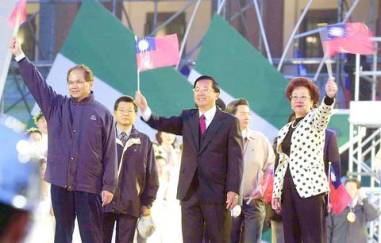
President Chen Shui-bian, center, Vice President Annette Lu, right, and Premier Yu Shyi-kun, left, wave Republic of China flags at the New Year's Day national flag-raising ceremony in front of the Presidential Office.
-----------------------------------------
On Jan. 2, 2004 ……
Thousands in HK march for democracy
AP , HONG KONG
Thousands of people marched through downtown Hong Kong on New Year's Day to demand full democracy in this former British colony, the biggest rally since a mass protest in July that threw the government into crisis.
Chanting "return power to the people," about 100,000 protesters marched from an urban park to the government headquarters, according to organizers. Police declined to provide their own crowd-size estimate, and there was no way to confirm the figure.
The demonstration was seen as a crucial barometer of public sentiment, exactly six months after a half-million people took to the streets denouncing an anti-subversion bill proposed by the Hong Kong government, and backed by Beijing, as a threat to freedom.
"We have made history again!" said rally spokesman Richard Tsoi.
Yesterday's turnout exceeded predictions by organizers, who said earlier that people would have less impetus to protest this time.
The government's controversial proposal was shelved in October, and Hong Kong's economy -- another source of public discontent -- appears to be on the rebound.
Marchers -- many of whom also protested on July 1 -- said that wasn't enough.
"Democracy is something we need to maintain a fair society," said 40-year-old Connie Yau, a civil servant.
Since coming under Chinese rule in 1997, Hong Kong has enjoyed Western-style freedoms unheard of on the mainland, but remains only partially democratic.
Hong Kong's top leader Tung Chee-hwa was picked by an 800-person elite committee loyal to Beijing. Ordinary people choose only 24 of 60 sitting lawmakers, with the rest filled by special interest groups and the committee that selected Tung.
Protesters yesterday heaped criticism on Tung, who has faced calls for his resignation over the anti-subversion bill and alleged economic mismanagement.
"Tung hasn't listened enough," said businessman Steve Lee.
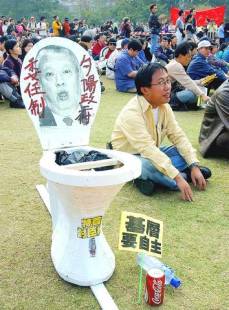
A mock toilet with a picture of Hong Kong's Chief Executive Tung
Chee-hwa and the words ``Sunset Government'' is on display during a New Year's
Day rally in a Hong Kong park to push for full democracy in the territory.
-----------------------------------------