20040102
=======
Reported on Jan. 2, 2004 ……
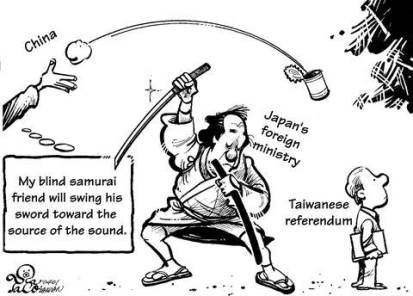
-----------------------------------------
On Jan. 4, 2004 ……
US says Chen admin inconsistent
"I'm not in a position to
comment on the latest form of the referendum that's being discussed. That's a
moving target, frankly." --- Adam Ereli, US State
Department spokesman
NO CLARIFICATION: A US State Department official says the referendum that has been discussed seems to change every day, which makes comment impossible
By Charles Snyder, STAFF REPORTER IN WASHINGTON
The US on Friday accused the Chen Shui-bian administration of sending an inconsistent message on its plans for a referendum in March, and said that as a result, it could not clarify the administration's position on the planned vote.
"The referendum that has been discussed seems to change every day," State Department spokesman Adam Ereli told reporters at his regular daily press briefing.
"I think the point that we make consistently and that is not going to change is that referendums that are aimed at changing the status quo are something that we oppose," he said.
However, he refused to go into the sensitive matter of whether the referendum on China's missile buildup opposite Taiwan, which Chen plans to hold coincidentally with the presidential election is, in fact, one that would change the status quo.
"If there's confusion, I'm not in a position to clarify things at this point," the George W. Bush administration's foreign policy spokesman said.
"I'm not in a position to comment on the latest form of the referendum that's being discussed. That's a moving target, frankly," he said.
He added that cross-strait dialogue "is the way to solve this issue."
While President Bush delivered a personal snub to Chen's plans for a referendum after the US leader's meeting with Chinese premier Wen Jiabao in the Oval Office last month, the US administration has never specified what its objections are to the anti-missile referendum, or how it feels such a poll would upset the cross-strait status quo.
Administration officials in recent weeks have tried to differentiate between what they see as different forms of referendums: those dealing with independence and unification, on the one hand, and those dealing with internal political matters and national security issues, on the other.
While they clearly oppose any independence-unification polls, their position on other types of referendums has not been made clear.
Indeed, it was in an attempt to clarify just such questions that Bush late last year sent top National Security Council official James Moriarty to Taipei to present a personal letter from Bush to Chen complaining about the planned referendum.
Nevertheless, Taiwan officials continue to complain about their lack of clear understanding of the US position, and US officials continue to complain about Taiwan's lack of response to Washington's position in a clear and consistent manner.
-----------------------------------------
On Jan. 4, 2004 ……
DPP heats up campaign in three counties in north
NEW OUTLOOK: Leaving other campaign themes for the time being, President Chen Shiu-bian and his team focused on the country's future economic well-being
By Lin Chieh-yu, STAFF REPORTER
Shifting focus from the election campaign themes of referendums and political parties' assets, President Chen Shui-bian yesterday championed the accomplishments of his presidency, claiming that Taiwan's economy is on the mend and urging the public to retain their trust in the Democratic Progressive Party's (DPP) rule.
"On the stock market's first day of trading in 2004, it increased by 150 points. I want everybody to know that, in fact, last year alone, the stock market went up by almost 1500 points. This represents a total national estate worth NT$1 trillion, which means that the assets of each of Taiwan's 23 million people increased by NT$164,000 on average. This is a good omen," he said.
"The property market is moving upwards again for the first time in four-and-a-half years, thanks to the government's sound policies and improved efforts. As we can see, the good times are returning; our hopes and dreams are being satisfied," Chen said.
"And yet, there are still people blowing their own trumpets, seeing only a bleak future. Let me tell everybody; the worst, the bitterest days, are over," he said.
The DPP's presidential election campaign yesterday centered on northern Taiwan, combining forces in Taipei, Keelung and Ilan Counties for a congress of supporters of the Chen-Lu presidential ticket. Together, Chen and his running mate, Vice President Annette Lu, emphasized the recovering economy and robustly promoted the achievements and on-going reforms of their administration.
Chen stressed that because of the international economic decline, continuous provocation from China as well as Taiwan's own structural problems, "We have really had a tough time."
But, he said, in the true spirit of children of Taiwan, we created endless possibilities and completed many tasks, even in difficult circumstances.
By way of example, Chen said that in the four years of his administration, there had been no collapse of economic institutions and no pilfering of economic institutions' assets like during the years of KMT rule.
Vice President Annette Lu urged the public to believe in Taiwan's strength and potential and support the government.
"We rank No. 5 out of 195 countries in the global competitiveness report of the World Economic Forum and we are No. 1 in Asia. Therefore, Taiwanese people should be confident about us and keep faith in Taiwan. How can anyone say Taiwan doesn't have a future?" Lu said.
She described this year's presidential election as the most difficult campaign ever facing the DPP because it is a battle between "one DPP" versus an alliance of "three and one" parties, which means the pan-blue camp's Chinese Nationalist Party (KMT), the People First Party (PFP) and the New Party, and the world's most arbitrary party -- the Chinese Communist Party (CCP).
"Fortunately, we have the support of the Taiwan Solidarity Union (TSU), former President Lee Teng-hui and the Taiwanese people, who are all cherishing the hard-obtained fruits of democracy and refuse to buckle under China's threats," Lu said.
In order to promote Chen's resolution
to hold a national referendum on election day to ask China to withdraw all
ballistic missiles aimed at Taiwan, Lu said that she would push for a national
movement of "saving Taiwan with peace," and demand the UN act
according to its charter and take seriously Taiwan's justified request for
China to remove its missiles.
"Taiwan doesn't belong only to Taiwanese, but to everyone in the world. Taiwan's pursuit of democracy is like a climb up Jade Mountain. We hope the Taiwanese public would continue to support us, in order to reach the summit," Lu said.
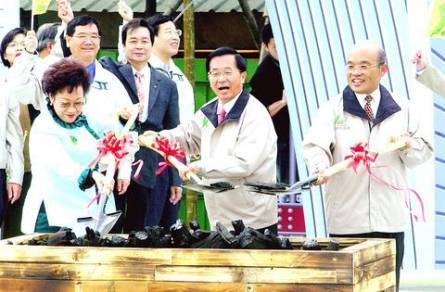
President Chen Shui-bian, middle, Vice President Annette Lu and Taipei County Commissioner Su Tseng-chang shovel coal for a symbolic campaign locomotive as the Taipei County headquarters for the DPP's presidential election campaign were set up yesterday.
-----------------------------------------
On Jan. 4, 2004 ……
Interparty reconciliation isn't likely
With the presidential election rapidly approaching, "reconciliation" is a topic that has been mentioned quite frequently recently by both the pan-green camp, including President Chen Shui-bian, and the pan-blue camp, including Chinese Nationalist Party (KMT) Chairman Lien Chan. But in view of recent events, especially the interparty tension and hostility displayed on the first day of 2004 during the annual New Year's Day national flag-raising ceremony in front of the Presidential Office, one cannot help but feel less than optimistic about the prospect of a genuine reconciliation.
The pan-blue camp obviously equated the flag-raising ceremony with a campaign rally, and mobilized more than 10,000 supporters to attend the ceremony with Lien and People First Party (PFP) Chairman James Soong, who attended the occasion for the first time since their election defeat in 2000.
In contrast, from the ruling Democratic Progressive Party (DPP), only a small number of government and party officials accompanied Chen and Vice President Annette Lu at the ceremony. The sight of the police preventing some pan-blue supporters from charging toward Chen and Lu while provocatively chanting "Step down," and some pan-green supporters responding with "Victory to A-bian," serve as a stark contrast to Chen and Lien's comments on "reconciliation" in recent days.
About two weeks ago, during a televised talk on the economic policies of the KMT and PFP, Lien indicated that the "illusory" political status of Taiwan as defined by the DPP conflicted with the economic status of Taiwan, obstructing the economic development of the country. Lien also said that in the future the pan-blue camp proposes to facilitate stability and prosperity with economic policies based on major "reconciliation," development and construction.
Around the same time, Chen indicated during a meeting with party representatives that after the election the DPP will open its heart and leave behind all the hatred and grudges developed during the election.
Unfortunately, despite the rosy picture painted by the both camps, and the genuine need of Taiwan for heartfelt reconciliation -- not only between political parties and camps but also between ethnic groups -- it is probably naive to think that everyone can let bygones be bygones once the election is over.
If the goal of interparty reconciliation is truly attainable, why didn't it happen after the 2000 presidential election? The reason is that the KMT, and as a matter of fact the entire pan-blue camp, was incapable of accepting defeat.
The so-called "reconciliation" between the KMT and PFP is no reconciliation at all. Instead, it is a marriage of convenience and for mutual survival and interests.
In view of the fact that this time the vote margin might be even smaller than last time, the likelihood of reconciliation seems more remote than it did after the last election. And this is not to mention that the wounds the parties have inflicted on each other over the past four years have only made things worse.
Then there is the issue of ethnic rivalry, which continues to be deeply embedded in Taiwan's politics. Interestingly enough, things are different here from how they are in other ethnically or racially diverse countries, where the majority and the minority groups tend to vote for members of their own groups.
In Taiwan, the ethnic majority -- the local Taiwanese people -- often vote across ethnic lines, as evidenced by the high level of popular support for Taipei City Mayor Ma Ying-jeou among ethnic Taiwanese.
However, the minority group -- the
ethnic mainlanders -- perhaps feel intimidated and rarely vote outside of their
group.
How much time will it take to resolve this inter-group rivalry and animosity? No one knows. But these problems will not vanish overnight on March 20.
-----------------------------------------
On Jan. 2, 2004 ……
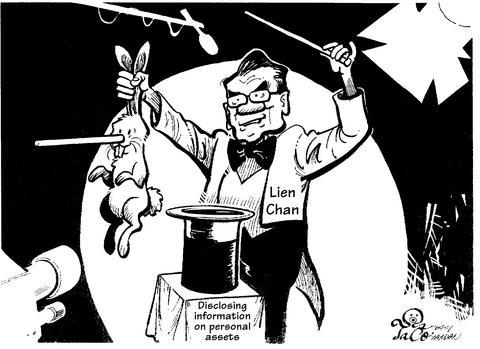
-----------------------------------------
On Jan. 2, 2004 ……
Why oppose democracy?
Sing Young, Taoyuan City
As a Taiwanese, I am sincerely puzzled by the pressure the international democratic community puts on Taiwan to halt the plan to voice our opposition to the Chinese aggression through a peaceful popular vote.
I would like to pose three questions.
First, why are the Western
democracies and Japan trying to interfere with the natural course of
democratization in Taiwan? They seem to believe that Taiwan's democracy should
be contained. How sincere are the US and the EU when they claim a love for
democracy? Would they tell China where to stop once democratization, which they
claim to support, has begun there?
Second, what constitutes the "status quo" that, according to US President George W. Bush, neither Taiwan nor China can unilaterally change?
Does increasing the current deployment of 496 Chinese missiles pointed at Taiwan to the expected 600 by the end of this year constitute a change to the "status quo"? If not, what about an increase to 1,000, 2,000 or 10,000 missiles? For that matter, what "status quo" in life can be "maintained" for more than a minute?
Third, if the Japanese don't like having North Korean missiles pointed at them, why is it so hard to understand that the Taiwanese are facing a more serious treat?
-----------------------------------------