20040103
=======
Reports said on Jan. 3, 2004 ……
Probing mainlander identity
By Debby Wu, STAFF REPORTER
Taipei Times: Could you talk about
mainlanders and reunification?
Stephane Corcuff: I have a very strong interest in [the issue of] reunification in my research because it is central to Taiwan's future, identity and political debates. In my questionnaire [conducted in 1997], I asked a few questions about that.
One of the most important findings in the book was the question of the attitude of mainlanders regarding national reunification.
The first question was about their position in principle regarding reunification: Do you think the ROC [Republic of China] government should absolutely insist on the policy of reunification?
The first surprise was that I expected maybe 70 percent of mainlanders would have said yes, but in fact only 50.3 percent said so. Over one-third said no.
We can analyze this further with different generations. 78.3 percent of the first-generation mainlander said yes, and that's no surprise. When it comes to the second generation, the figure is much less [41.7 percent]. And then we come to the third generation [34.7 percent] -- and look at the discrepancy between the first and the third generation, it's huge -- over 40 percent.
I asked the second question intentionally from a different angle. This is one of the ... most important findings in my research.
I put the objective of reunification in perspective with other priorities in Taiwan society -- getting rid of the mafia and corruption, administration reform, economic development, environmental protection and Taiwan's international visibility.
It's extremely interesting to see that only 5.4 percent of the mainlanders choose reunification as their first priority. Over 80 percent choose reunification as their fifth or sixth priority among the six issues.
What they choose as their top priority is getting rid of the mafia and corruption, then administration reform, economic development and environmental protection. Reunification comes even after environmental protection.
Everyone knows what is more urgent is not reunification, but these [other] things. This shows very clearly that mainlanders in Taiwan are Taiwanized, or rooted in Taiwan.
Secondly, it shows the importance of political socialization. When [they] put things into perspective, they logically say that reunification is a priority, but the last priority.
But when you ask the question straightforwardly, over half say that we cannot give up reunification.
So is this a contradiction? If yes, it can be explained by the remaining impact of past political socialization and electoral politics.
One of the main findings of this research is that the Taiwanization of mainlanders in Taiwan cannot be denied and it is an inevitable process. It's a natural movement, but politics constantly interferes with it.
TT: Is there anything else you would
like to highlight from your book?
Corcuff: We have to make it clear that not all mainlanders support reunification. So why do so many "new inhabitants" [Corcuff's preferred term for mainlanders] vote for other "new inhabitants?"
I propose an answer to this: Mainlanders have a pluralistic national identification, which comprises of China and Taiwan both at different degrees, changing from one person to another, but changing also in the same person at different moments.
PLURALITY
Taiwan's mainlanders come from China, so they have this identification with China. But they have spent their life in Taiwan for so many years, so who would dare to deny that they also identify with Taiwan? The fact can be seen clearly from the statistics. So it's pluralistic.
If you have two elements, the China part and the Taiwan part, then are the things static? No. Depending on the situation, they would stress this or that.
If they go to America, will they be pleased to be called Chinese, knowing that people in America would understand the word "Chinese" as PRC citizens? Probably no. They would say, "No, I come from Taiwan." Even in certain cases, they would say, "No, I am Taiwanese." In some instance, they would say, "I am a Chinese from Taiwan."
You already see the pluralistic identification with the case that, in Taiwan, they may stress, "I am a mainlander."
In China, what will they say? "I come from Taiwan." They can't say "I am Chinese" because they are different from local Chinese. This shows the plurality of their national identification. This is a phenomenon in daily life, but when it comes to voting, it's a different situation.
When it comes to voting, you have to make a choice because you cannot choose both A-bian [President Chen Shui-bian] and [Chinese Nationalist Party (KMT) chairman] Lien Chan at the same time.
Even though most, if not all, mainlanders do identify with Taiwan, when they have to vote, they make a choice for mainlanders. When you make a choice, you have to give up your plurality because you cannot vote for two people at the same time. But why would they then choose mainlanders and not Taiwanese since Taiwan is also a part of their identification?
First, it's the result of the past,
the past political socialization.
Second, it's a habit to vote KMT. To vote DPP [Democratic Progressive Party] they need to make an identification adjustment. It's a rationalization of identity pluralism. This is something human beings can do, but very few people do it. For example, there are mainlanders who support independence.
Meanwhile, old mainlanders still have fears about Taiwan. They feel ill at ease. They are concerned about their future, and they don't know whether they would still have a future if Taiwan changes its national name.
Of course they have a future. It is not possible that Taiwanese would throw them into the sea or send them back to China if Taiwan changes its name. But they still do not face the fact, and they are still worried. Naturally they vote for someone who is good at manipulating their national identification crisis.
I am not talking about Lien Chan here, but all pro-reunification politicians. Though they are Taiwanized already, they still give their votes to mainlanders' parties.
WAR
Then there is a third situation not many people think about: the situation of war. If there is a war between China and Taiwan, what will mainlanders do? Will they choose China? Will they choose Taiwan? Will they choose to emigrate?
In a way, this is a question of life and death for many people. This is a situation we call in French une situation limite: you have to make a choice that you always fear to do, that you always hope you will never have to make.
In this situation many people assume mainlanders will choose China, but I don't think so. Because then mainlanders have to choose between China and Taiwan for good. That's not political rhetoric or political ideology anymore -- this is the question of their own daily future.
I suppose many mainlanders will choose Taiwan, especially the young. Probably the old too, because they will have no other possibility.
TT: You said that Taiwan's future
should be decided by its 23 million people. Your words actually match the
ideology of the DPP. Your thoughts?
Corcuff: I don't think the KMT, PFP [People First Party] or the New Party would dare to oppose this idea. Basically it's their idea too, but for political reasons they have to differentiate [themselves] from the DPP, so they don't stress it as much. They are ill at ease. Basically they can't oppose it.
I am not pro-independence as people might think because I have this discourse. This is because I am not Taiwanese, I am not mainlander, and I am not Chinese.
I just want to promote one idea -- the only thing I am in favor of is to let all Taiwanese, including mainlanders, or the "new inhabitants," to choose their own future.
TT: You mention in your book that you
sympathize with China too. Where exactly does that sympathy lie?
Corcuff: With its history, language and culture.
But not necessarily with every aspect of its society or politics. I love Chinese history, literature and language. I really like China, but the China I like maybe has disappeared already.
It's the same problem for the mainlanders -- they identify with a lost China in their imagination but not the real China.
When many mainlanders go to China, they find that the China they see is very different from the China they imagined. Because they identify with China, they are too embarrassed to give up their original identification just because the real China isn't the imagined one.
So when they see problems in front of them in China, some still act as if China was still a great place to unify with. This kind of compromise is a big problem.
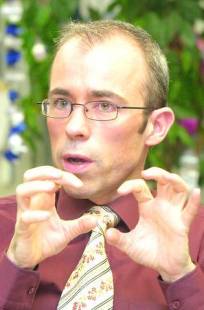
Stephane Corcuff says mainlanders have a complex national identity
which tends to be obscured by electoral processes.
-----------------------------------------
On Jan. 3, 2004 ……
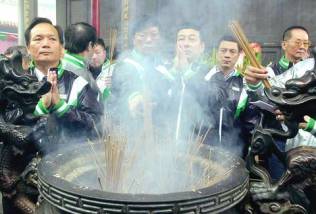
Political Prayer
DPP borough wardens from Taipei City burn incense and pray for success in the presidential election at Longshan Temple in Taipei yesterday.
-----------------------------------------
On Jan. 3, 2004 ……
China is a nation of terrorists, says VP Annette Lu
CNA , TAIPEI
Vice President Annette Lu yesterday called on the Taiwanese public to cast their referendum votes to say "no" to China, the "peace-breaker" across the Taiwan Strait.
Addressing a symposium on general political, economic and social issues, Lu said that China, which has nearly 500 ballistic missiles aimed at Taiwan, is a "peace-breaker" and a "nation of terrorists."
Noting that peace is a prerequisite for any solution to disputes across the Taiwan Strait, Lu urged the public not to be indecisive on the referendum issue. She said the public should, via their referendum votes, let the world know which side of the Taiwan Strait is undermining international peace.
Paraphrasing a famous quote championed by Sun Yat-sen nearly a century ago that "only peace can salvage China," Lu said that in today's Taiwan, the people should champion the phrase: "Only peace can salvage Taiwan."
Lu said peace is the only way out for Taiwan, adding that she would soon push for the establishment of a "Saving Taiwan with Peace" promotion alliance, under the auspices of which academics and experts from Taiwan and abroad will be invited to make concerted efforts for the cause.
-----------------------------------------
On Jan. 3, 2004 ……
An old China hand knew the story
`Holdridge ... admitted the difference of views between the two groups in Taiwan and the necessity of changing the wording of the communique at the last minute.'
By James Wang
US officials used to admonish China after the Tiananmen Square massacre that enduring stability could only be achieved through democracy. They argued that in the modern world no democratic countries have ever gone to war against each other.
That was then, under the administration of George Herbert Walker Bush. The US leaders of the time took a stand on principle and promoted the values embodied in the UN Charter and relevant treaties.
Now, in the name of stability, the administration of George W. Bush has recently warned Taiwan to restrain its moves toward democracy.
Bush, sitting side by side with Chinese Premier Wen Jiabao, criticized President Chen Shui-bian for promoting a referendum in March. US officials said it is "dangerous, dangerous and dangerous" to take actions that may move toward a unilateral decision to change the status quo in the Taiwan Strait.
They argued that referendums are not of the essence of democracy. That is as absurd as some liberal scholars arguing in the 1960s that only communist systems were perfect democracies.
Of course, the US is not against democracy in Taiwan. It was under pressure from and with the encouragement of the US that Taiwan moved toward democracy.
The US is worried because the Communist regime in China is sabre-rattling in response to democratization.
Obviously the problem is not Taiwan's democratization, but the hegemonism embraced by China, which has never learned to respect or practice democracy.
The right approach for the US in the region is to warn China against the use of force and encourage it to move toward democracy -- not to restrain democracy in Taiwan.
It should not be surprising that US officials and some journalists in the US media, most of them educated during the Cold War, are uncomfortable dealing with Chen's Democratic Progressive Party (DPP) government. The nature and the visions of the old Chinese Nationalist Party (KMT) and the DPP are radically different.
The old KMT regime ruled without the consent of the people. Facing military threats from China and increasing challenges from Taiwanese people, the KMT regime was happy to accommodate US demands as long as that would allow them to continue to rule Taiwan under a fiction of "one China."
Taiwanese people appreciated US efforts to hinder Chiang Kai-shek's ambitions to launch military action against China, and later to encourage Chiang Ching-kuo's democratization in the 1980s.
In fact, people in the opposition movement in Taiwan -- whether mainlanders such as Lei Cheng or Taiwanese such as Li Wan-chu or Peng Ming-min -- all advocated maintaining Taiwan separate from China and establishing Taiwan as a democratic state.
The KMT regime and its followers maintain a fiction of "one China" -- the Republic of China. That is not a view shared by a Taiwanese population that has been ruled by two non-indigenous regimes in the past century.
When US President Richard Nixon acknowledged in the Shanghai Communique in 1972 that "all Chinese on either side of the Taiwan Strait maintain there is but one China and that Taiwan is a part of China," a group of young Taiwanese lawyers protested to the US embassy in Taipei.
In fact, John Holdridge, an old China hand who accompanied Henry Kissinger to Beijing in 1971, and was his aide at the National Security Council, admitted the difference of views between the two groups in Taiwan and the necessity of changing the wording of the communique at the last minute.
He explained to professor Nancy Tucker of Georgetown University that the US side in the final session of negotiation had asked to change the words "all people" to "all Chinese," because "there were many people in Taiwan who did not call themselves Chinese. They called themselves Taiwanese. If we had said `all people,' this would mean that Taiwanese also maintained a position of `one China' and Taiwan as part of it, which is not necessarily the case. If you said `all Chinese,' this gets you into something else again."
Holdridge was honest and correct in his assessment.
As another US diplomat, O.V. Armstrong, predicted in the 1970s, democratization in Taiwan would inevitably lead to the Taiwanization of the Republic of China. That was what happened in 1999 when former President Lee Teng-hui talked about the ROC's state-to-state relationship with China and Chen insisted that there is one country on each side of the Strait.
Taiwan's nationalism has been suppressed for so long that it has now become an irresistible force. Taiwanese leaders with backgrounds in the opposition movement admired US democracy and appreciated US assistance in promoting democracy in Taiwan.
However, they were also disappointed that the US failed to give the people in Taiwan an opportunity to decide their own future after World War II.
They will react strongly if the US tries to stand in the way of efforts to solidify Taiwan's separate identity through the democratic process.
Bush announced his repackaging of policy toward Taiwan and China as "opposing any unilateral decision either by China or Taiwan to change the status quo."
The problem is how the US defines "status quo." The "one China" notion has never had an agreed-upon definition and the US has never recognized Taiwan as part of China. The term "status quo" adds one more layer of ambiguity.
As far as Taiwan is concerned, the status quo is one country on each side of the Taiwan Strait, and Taiwan welcomes the US to maintain status quo.
But if the status quo means that whatever Taiwan tries to do is subject to China's approval, the people will not accept it. It is simply wrong for the US to allow itself to be told by China to bully Taiwan at the expense of the nation's democracy.
Just as the US recognized both East Germany and West Germany, it should also recognize both China and Taiwan and deal with the status quo that has existed for more than half a century.
I am particularly impressed by the statement made in the communique by the Chinese side:
"Whenever there is oppression,
there is resistance. Countries want independence, nations want liberation and
the people want revolution -- this has become the irresistible trend of
history.
"All nations, big or small, should be equal; big countries should not bully the small and strong nations should not bully the weak. China will never be a superpower and it opposes hegemony and power politics of any kind.
"The Chinese side states that it firmly supports the struggles of all the oppressed people and nations for freedom and liberation and that the people of all countries have the right to choose their social systems according to their own wishes and the right to safeguard the independence, sovereignty and territorial integrity of their own countries and oppose foreign aggression, interference, control and subversion."
John Holdridge knew all the tricks in the Shanghai Communique and he was right about them.
When Bush reiterates his willingness to observe the "three communiques," he should also remind the Chinese side of what they proclaimed in the Shanghai Communique.
James Wang is a journalist based in Washington.
-----------------------------------------
On Jan. 3, 2004 ……
-----------------------------------------
On Jan. 3, 2004 ……
Candidates trade claims over assets
PRE-ELECTION SPARRING: KMT Chairman Lien Chan sued his DPP counterpart for claims made about his family's wealth and in turn questioned Chen's assets
By Huang Tai-lin, STAFF REPORTER
Chinese Nationalist Party (KMT) Chairman Lien Chan yesterday filed a libel suit against President Chen Shui-bian and three other Democratic Progressive Party (DPP) officials over the DPP's accusation that Lien's family had amassed its wealth through illegal means.
Lien, who is challenging Chen in the upcoming presidential election, argued that the DPP had falsely claimed that his personal assets were worth NT$20 billion, while the true value was NT$1.34 billion.
"With the election approaching, the DPP recently attacked me personally with an array of false accusations with regard to my family's assets and how they were acquired," Lien said at a press conference accompanied by lawyers and accountants.
Lien was referring to the DPP's latest television advertising campaign, which called into question how Lien and his father were able to accumulate their fortune while just civil servants.
The DPP also distributed 500,000 campaign pamphlets last Monday accusing the Lien family of illegally accumulating assets worth NT$20 billion.
"I can no longer sit in silence in view of the acts that undermine my reputation and negatively influence the people's trust in politics ... I have no choice but to take legal action against the DPP," Lien said before proceeding to file the suit at the Taipei Prosecutors' Office.
This is the first time in Taiwan's political history that an opposition leader has filed a lawsuit against the incumbent president.
Chen's being president protects him from criminal prosecution unless he is charged with committing an act of rebellion or treason. However, the Taipei Prosecutors' Office will process the suits against the other three defendants: DPP Secretary-General Chang Chun-hsiung, DPP Legislator Lin Cho-shui and DPP campaign headquarters chief Wu Nai-jen.
In a bid to rebut the DPP's claims concerning the Lien family's assets, Alex Tsai, spokesman for the KMT-People First Party (PFP), revealed detailed accounts of Lien's personal assets broken down into cash saving, stocks, bonds, real estate and others.
Tsai also presented figures for Chen's assets, saying that the value of Chen's stocks and bonds had increased 125 percent between 2000 and 2002, while Lien's had decreased by 22 percent from 1999 to 2003.
Tsai said he wondered "whether any secret deals were involved that enabled Chen to make such a rewarding investment in stocks and bonds."
Noting that Lien and his wife had together donated 15 percent of their assets, worth NT$250 million, to reconstruction efforts following the Sept. 21, 1999, earthquake, while Chen and his wife donated only 2 percent of their assets, worth NT$2 million, Tsai asked, "Who of the two really loves Taiwan more?"
Another alliance spokesman, Yu Tzu-shiang, accused the DPP of exaggerating the value of Lien's personal assets by 15 times and the size of his real estate holdings in Taipei City by 106 times.
"Lien's property amounts to a mere 189 ping, yet the DPP exaggerated it 106 times in its campaign pamphlet and said it is big enough to build five Tienmu baseball fields on," Yu said. "The public should abandon a party that resorts to such negative campaigning."
-----------------------------------------
On Jan. 3, 2004 ……
DPP steps up pressure on Lien to explain his wealth
By Cody Yiu, STAFF REPORTER
The Democratic Progressive Party (DPP) yesterday released more details about Chinese Nationalist Party (KMT) Chairman Lien Chan's assets, saying he had concealed many family investments from the public, including NT$1 billion invested in seven companies.
The DPP has claimed that Lien and his father, both formerly civil servants, started their careers from scratch and yet were able to accumulate NT$20 billion thanks to their abuse of office when the KMT ran the country.
Yesterday, the KMT claimed that Lien's wealth amounted to only NT$1.3 billion and went on the offensive, questioning how DPP Chairman Chen Shui-bian could increase his wealth by 125 percent over the past three years.
According to Taipei County Commissioner Su Tseng-chang, who is Chen's campaign manager, the NT$20 billion estimate of Lien's wealth was backed by news reports in major news magazines.
In response to Lien's assertion that his wealth, as reported to the Control Yuan, was only NT$1.3 billion, Su said, "This report only includes those assets which are registered under Lien, his wife, Lien Fang Yu, and his youngest daughter, Lien Yung-hsin. Assets under the names of Lien's eldest daughter, Lien Hui-hsin, and two sons, Lien Sheng-wen and Lien Sheng-wu, and the assets belonging to the two foundations and seven investment companies" were not included.
Su added that the boards of Lien's seven associate enterprises consist of Lien's wife and daughter and other relatives and confidants.
"It is impossible to calculate the amount of assets related to these individuals in the enterprises. However, the registered capital assets of these companies is as high as NT$1.02 billion. Therefore, Lien's total assets should amount to over NT2.3 billion," Su said.
Su also suggested that Lien had not been honest in his previous submissions about his wealth. According to Su, Lien once received a fine of NT$300,000 for omitting a loan of NT$36 million to Wu Tse-yuan, a former member of the KMT, in a report.
"Furthermore, in 1999 and 2000,
Lien made two major payments, which included the purchase of a NT$50 million
house and a NT$200 million donation to the 921 earthquake reconstruction
efforts. These two payouts were not listed on Lien's asset reports in those two
years," Su said.
As well as stepping up the attacks on
Lien, the DPP also defended their leader from counterattacks from the pan-blue
camp.
"The KMT claimed that the securities that President Chen owns had increased to NT$63.60 billion in 2002 from NT$18.38 in 2000," Presidential Office Secretary-General Chiou I-jen said. "In reality, the KMT's calculation included NT$48.51 million in campaign fund subsidies, which have been used for social welfare purposes, such as donations to the Ketagalan Academy."
Presidential election candidates who get more than 5 percent of the vote are eligible to claim NT$30 for every vote.
According to Chiou, Chen's securities in 2002 were worth only NT$15.09 million, down from NT$18.38 million in 2000.
In response to the KMT's accusation, first lady Wu Shu-chen said that if her and her husband's assets totalled NT$4 billion, as the KMT claimed, Chen would donate the entire amount to the KMT.
Wu has agreed to file a lawsuit next week against the KMT, Chiou said.
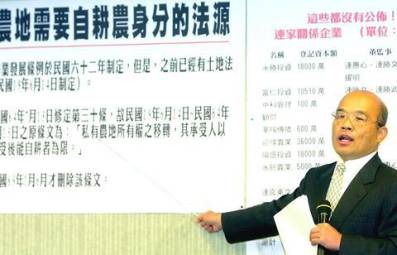
Taipei County Commissioner Su Tseng-chang, who is President Chen Shui-bian's campaign manager, claims that Chinese Nationalist Party (KMT) Chairman Lien Chan's personal assets are more than NT$1.34 billion at a press conference yesterday. Su argued that Lien is either a prodigal son or a liar.
-----------------------------------------