20040105
=======
Reported on Jan. 5, 2004 ……
WHO, UN not Taiwan's only options
"What I find difficult to accept is that the world is ready to accept Taiwan as a very important economic and trading partner, but that it is reluctant, because of PRC pressure, to open the barriers on the political zone."
Lord Faulkner of Worcester visited Taiwan last week. As vice chairman of the British-Taiwan parliamentary friendship group, he spoke to President Chen Shui-bian and Minister of Foreign Affairs Eugene Chieh, who explained government's referendum agenda to Faulkner's delegation. He shared his thoughts with 'Taipei Times' reporter Melody Chen
By Melody Chen, STAFF REORTER
Taipei Times: Japan and the US have voiced concern about the proposed "defensive referendum." Do you believe the referendum can deepen Taiwan's democracy or that it could encourage China to renounce the use of force against Taiwan? What are the UK and the EU's views on the issue?
Lord Faulkner: I think on the question of whether referendums in principle can enhance democracy, I answer yes, they can. We have referendums in the United Kingdom on issues of significance.
Taiwan is a new democracy. It [the vote] seems perfectly reasonable given the fact the referendum is supported in your parliament, I gather by all political parties. It is a perfectly reasonable part of the democratic process for a referendum to be possible.
As far as the referendum that has been approved by Parliament relating to the Chinese missiles, I can understand why [US] President George W. Bush is unhappy about anything that upsets the People's Republic of China (PRC).
But, on the other hand, the people of Taiwan have a legitimate right to say whether or not they want to have the missiles ... pointing at their cities.
If there are stated questions and given answers, given the fact that it is an advisory referendum, I cannot see why the EU or the British government should object to that.
TT: If you know 99 percent of people in Taiwan will vote `yes' in this referendum, do you think it is still necessary to carry out the referendum? The US and some people here have insinuated that President Chen Shui-bian is using the referendum as a campaign ploy to draw support for himself.
Faulkner: As far as I am concerned, the referendum has been approved by your parliament and by all political parties. I certainly don't want to be drawn into a debate about the president's tactics for re-election. We had a very good meeting with the president earlier in the week and another excellent meeting with the foreign minister today. They explained to us in great detail the thinking behind the referendum, and I think all members in this delegation were satisfied with what they were told.
TT: Do you expect your government to
express its views on Taiwan's referendum issue?
Faulkner: I have no idea. I did not speak for the British government. I am here as vice chairman of the British-Taiwan parliamentary friendship group.
I know that as far as our members are concerned, and as far as my delegation is concerned on this visit, we are satisfied with the answer we have been given on why this referendum is taking place. But above all, it is a matter for Taiwan and the Taiwanese people.
TT: Taiwan has repeatedly applied to
become a UN member. In September, our latest attempt to join the world body
failed. The UK and France spoke on the application, saying their stance on this
issue remained the same, which means they oppose it. If you believe Taiwan
deserves entrance into the UN, is it possible for your government to take
concrete steps to help Taiwan's bid?
Faulkner: That's the sort of issue my colleagues in the British-Taiwan group and I have been raising in Parliament. We accept the presence of a common policy inside the EU and on the part of the US administration of the "one China" policy. I have raised questions on a number of occasions hoping the British government and the others will be prepared to modify that.
In the short term, it is unlikely they will modify that. However, that doesn't mean there are not things that can be done that can improve Taiwan's position in the world.
For example, ascension to the World Trade Organization is a big step forward. I campaigned hard earlier at a particular time during the SARS outbreak to press the case of Taiwan being admitted to the WHO. For the very practical reason that if Taiwan is not a member of the WHO, it would not be possible for the SARS outbreak to be dealt with properly.
There are other world bodies which Taiwan should be a member of, in my view. One of those is the Inter-Parliamentary Union, which is the world association of sovereign parliaments.
The criteria to qualify for membership in the IPU is not government recognition, but the credibility of the parliament and a democratically elected government. In the view of the members of the British-Taiwan parliamentary group, we believe that Taiwan certainly fulfills these requirements.
What I find difficult to accept is that the world is ready to accept Taiwan as a very important economic and trading partner, but that it is reluctant, because of PRC pressure, to open the barriers on the political zone. One of the things we are trying to do is to move the barriers as much as we can.
TT: In the WHO's General Assembly,
Taiwan was only supported by 27 countries in its bid to enter the body. Is it
possible the UK will be changing its stance on this issue?
Faulkner: I honestly don't know. I would like to think so. In the British parliament I have asked for Britain to change its position on Taiwan's acceptance into the WHO. I will do that again. I will press again for Taiwan to be admitted. But I think until there is some relaxation of the "one China" policy, it is going to be difficult.
TT: Taiwanese high-level visits to
the US have become relatively easier over the years. Is it difficult to arrange
Taiwanese high-level visits to the UK?
Faulkner: It is difficult, but it shouldn't be, in my view. We said to President Chen this week that it will be difficult for him to visit Britain in the event of his re-election as president of this country.
It seems to me that restricting these visits again is to treat Taiwan in a way that is not fair and is not right.
One of the things we should be trying to do is to see if it is possible to get some relaxation. I think obviously we have to wait and see what the outcome of the public election will be, because you are in the election atmosphere now.
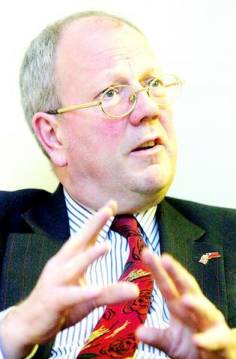
Lord Faulkner of Worcester, vice chairman of the British-Taiwan parliamentary friendship group, recently visited Taiwan to talk to local officials about the government's referendum agenda.
-----------------------------------------
On Jan. 5, 2004 ……
Lin takes anti-nuclear message south
RIGHT TO DECIDE: Lin Yi-hsiung, a former DPP chairman, says a vote on the Fourth Nuclear Power Plant would raise people's awareness that they are masters in their country
By Chiu Yu-Tzu, STAFF REPORTER
Former Democratic Progressive Party (DPP) chairman and staunch anti-nuclear activist Lin Yi-hsiung distributed flyers promoting his anti-nuclear stance yesterday.
Lin said people should express their opposition to the establishment of the Fourth Nuclear Power Plant through a nationwide referendum because Taiwan already has abundant sources of power generation.
Lin said people's consciousness of being the masters of this land should be awakened.
"The referendum aims to awaken residents to the right to decide a common future on their own and to the responsibilities people living on this land should take," Lin said.
He said the referendum would be the first step to prevent Taiwan from facing a dangerous situation.
"The operation of the Fourth Nuclear Power Plant, which affects the safety of future generations, should be decided by the public," Lin said.
He said he visited Chinese Nationalist Party (KMT) Chairman Lien Chan and stressed that his stance on supporting a referendum on the plant would never change.
"I will keep my eyes on the follow-up actions to be taken by KMT," Lin said.
He said the referendum shows that people have the right to make decisions on major public policies. This right cannot be manipulated by any political party or political figure, he said.
Lin's promotion in Kaohsiung of building a nuclear-free country was supported by another former DPP chairman, Kaohsiung Mayor Frank Hsieh. Hsieh helped distribute flyers to passengers on the street in the city's Tsoying District.
"Reviewing all of Lin's efforts made on the promotion of a referendum, I truly admire his persistence," Hsieh said.
Hsieh said he has been dedicated to the anti-nuclear movement since 1986 and that the ongoing referendum campaign would eventually leave a democratic legacy for the country.
Last week, activists demonstrated in front of the legislature, saying a referendum should not be held in March without comprehensive preparation.
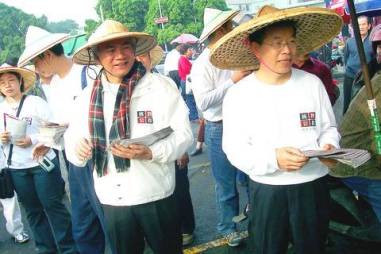
Former DPP chairman Lin Yi-hsiung, left, and Kaohsiung Mayor Frank Hsieh distribute leaflets calling for a nuclear-free Taiwan at a market in the city's Tsoying district yesterday. Lin is pushing for a referendum on the fate of the Fourth Nuclear Power Plant, currently under construction.
-----------------------------------------
On Jan. 5, 2004 ……
DPP wants nuclear-plant issue put to rest
By Fiona Lu, STAFF REPORTER
Democratic Progressive Party (DPP) lawmakers plan to distribute 1 million leaflets around the nation to promote holding referendums on the Fourth Nuclear Plant and legislative reforms, a DPP lawmaker said this week.
"The DPP is going to mobilize party officials and legislators to send out 1 million leaflets nationwide this month to promote the goal of solving the Fourth Nuclear Power Plant construction controversy and pushing legislative reforms," said DPP whip Chen Chi-mai.
DPP officials plan to distribute the leaflets in local markets and meeting places in various towns, cities and counties to educate people on the meaning and importance of the task, Chen said.
The DPP announced the promotional event after their pan-blue opponents confirmed a lack of willingness to push ahead with a referendum to decide the fate of the half-finished nuclear power plant by this legislative session.
Caucus members of the Chinese Nationalist Party (KMT) and People First Party (PFP) also said they would not endorse former DPP chairman Lin Yi-hsiung's request to file a resolution to stop nuclear power generation in the country.
Lin made the request last month when he visited the Legislative Yuan, after his meeting with KMT Chairman Lien Chan, who assured him that the KMT would consider whether to side with Lin on the issues of abolishing the Fourth Nuclear Power Plant and overhauling the Referendum Law.
Lin looked for help from pan-blue lawmakers, who have a majority in the 223-seat legislature, to help abolish the government's policy on nuclear power.
He asked the legislature to pass a resolution stating that the policy of nuclear energy generation should be suspended as long as the country is free from the threat of power shortages and the government is unable to settle the issue of nuclear waste.
But KMT Legislator Wu Den-yih said the KMT-PFP alliance could not approve Lin's request.
The blue camp decided the resolution would conflict with the fact that the legislature had already given its go-ahead to the construction.
Wu suggested Lin press President Chen Shui-bian on the issue.
The PFP was also against a referendum on the nuclear plant, despite PFP Legislator Chou Yi's effort to gather signatures for a petition demanding such a referendum.
"We are opposed to any referendum proposal based on election motives, no matter whether they are about the nuclear plant issue or the defensive referendum," PFP whip Chou Hsi-wei said.
Chou Yi said he started the petition to press the DPP on the issue. The petition has 33 pan-blue lawmakers' signatures, already passing the threshold needed to put it on the legislative agenda.
The DPP does not support pan-blue members since "the opposition parties obviously exploit the nuclear-power dispute for campaign purposes," the DPP whip said.
"It is illogical for a pan-blue member, whose parties uphold the nuclear policy, to initiate a referendum on halting the plant. The opposition parties' manipulation of the nuclear plant dispute was playing with the fire that would finally destroy them," Chen said.
The KMT and PFP caucus members will decide today on whether they are going to file during this session a referendum on the number of legislators. The session is set to end next week.
-----------------------------------------
On Jan. 5, 2004 ……
Much room for media, politicians, to improve
By Yeh Hai-yen
The year 2003 is over, but the political clamor in Taiwan is the same as ever.
A new opportunity has come, as the nation is now moving again following various pains after the transition of power in 2000 -- just like a phoenix, the mythical bird that rises from its own ashes.
The presidential election seems to be a main focus of people's attention, as if the year 2003 was merely a transitional period, during which people's attention was mostly taken up by disturbances and unease.
I believe that it is impossible for Taiwan to step backward. The people have marched steadily forward over the past four years. Statistics speak for themselves, and no one should be suspicious of them.
Of course, some people just do not believe in Taiwan. Nor do they believe in their own people and government.
More pathetic, the Chinese people's attitude of "speaking without the slightest hesitation" is everywhere in Chinese society.
As a result, the thinking of some people in China is so muddled that they do not even know what a country really is. They also have an unhealthy mind and are mentally ill, as they recklessly do whatever they want while violating laws, morals and common sense.
At the moment, those who should do the most introspection are the nation's politicians. They strengthen their influence by supporting major political parties -- which enjoy power and wealth and use public affairs for private gain.
All political parties should serve democratic politics, and should be viewed as public property.
However, some of them have damaged both democracy and Taiwan by pursuing their own interests.
Obviously, it is still necessary for us to carry out political and social reforms through direct democratic methods.
The Taiwanese people are both well-cultivated and law-abiding, and we cannot be easily taken advantage of anymore. Although some politicians acted arrogantly last year, sober voters will reject these dirty politicians this year.
Moreover, it is time for us to review the local media's performance. The media were filled with blood and filth during the last year, as they deceived both themselves and others with their reports.
They also covered up and lied about the truth, or hypnotized their audience so that no one knew what truth was.
Truth is what we need in Taiwan. We have to thoroughly examine the media, and demand self-respect and self-discipline based on the premise of press freedom.
I believe that Taiwan will be able to improve itself, and get rid of all evil forces. The people long for peace and purity. The media's self-discipline is a main force in the birth of a democratic society. This principle should not be broken.
Although the uproar over the Special Report VCDs has quieted down, the public has learned how to attack the hegemonic media.
Perhaps this is another inspirational moment for Taiwan's culture.
I believe that Taiwan will escape from its current predicament. This is not only our shared hope, but it can also consolidate our national consensus and strengthen our will, helping the 23 million people of Taiwan to fearlessly decide their own future.
Not only can the people cast their ballots bravely, but they can also force politicians and the media to stop making idle noise, while the people speak with the true voice of Taiwan.
Yeh Hai-yen is the director of the department of philosophy at Soochow
University.
-----------------------------------------
On Jan. 5, 2004 ……
'KMT secret agents' are now 'spies'
By Lee Shiao-feng
Fourteen years ago, after the Tiananmen Square incident, the Chinese communist authorities purged the activists and blamed "KMT secret agents" for the democratic protest. At that time, I wrote an article in the Capital Morning Post. I said in the article:
"The strife between the Chinese Nationalist Party (KMT) and the Chinese Communist Party (CCP) has resulted in many `bandit spies' and `KMT secret agents'. The KMT refers to CCP secret agents as `bandit spies,' while the CCP calls those sent by the KMT `KMT secret agents.'
Over the past 40 years, the KMT has caught many `bandit spies' and the CCP has captured many `KMT secret agents.' Some of course were real spies, while many others were not.
The KMT awarded the `bandit spy' title to dissidents or those it felt uncomfortable with. It was a convenient excuse to arrest people and put them away. The other trick the KMT used was to post a `bandit spy' near someone it wanted to arrest so it could accuse him or her of not reporting the spy.
"Similarly, the CCP has created many fake KMT secret agents to purge dissidents. It blamed the KMT for the Tiananmen Square incident and arrested many `KMT secret agents' who had allegedly incited people to rise up in rebellion. The KMT and the CCP have in fact helped each other with excuses to do away with dissidents so as to solidify their power. Their symbiotic relationship can be seen from this."
That was what I wrote 14 years ago. Today the KMT is no longer in a position to make up stories about bandit spies, but the CCP has not stopped using the method. The only difference is that the "KMT secret agents" are now called "Taiwanese spies". It is not surprising that the Chinese communist authorities continue to make up stories about KMT secret agents or Taiwanese spies as the party has little respect for human rights and the rule of law anyway. But pathetically, the KMT (or the pan-KMT to be more specific, as it has gone through a split-up and then reunited as the pan-blue group) still has a symbiotic relationship with the CCP.
In the past, the KMT used the CCP to level false charges against dissidents. It was a dirty trick, but it still made some sense. Now the party is blaming President Chen Shui-bian for the arrest of Taiwanese businesspeople. This is not only dirty but also ridiculous. Does the pan-KMT try to say that Chen is responsible for China's oppression of human rights?
It is a widely known fact that China has deployed more than 400 missiles along the coast pointing at Taiwan. So I was not surprised at all when Chen announced that there were, in fact, 496 missiles, since this number was not far from what we had already known.
The pan-blue politicians, however, seized the opportunity to criticize Chen for leaking military secrets, a move that could kill "our intelligence personnel."
I was surprised to hear that. When did these pro-China politicians, who asked us not to irritate China, start caring about "our intelligence personnel"?
Aren't the pan-blues worried that they would irritate China by pointing out that so many of "our intelligence personnel" are working in China?
They accused Chen of leaking military secrets by disclosing the number of missiles. But in my opinion, they were the ones leaking military secrets regarding the fact that we had so many agents working in China. After all, if Chen unveiled any military secrets, they were China's military secrets, while the secrets the pan-blue politicians revealed were Taiwan's.
In view of the noises made by the pan-KMT politicians, Beijing would of course cooperate by creating a few stories about "Taiwanese spies."
And that's exactly what happened. Taiwanese businesspeople in China disappeared.
Pan-blue politicians and the pro-China media again seized the chance to blame Chen as if their prophecy had come true.
Businesspeople disappear in China every year.
No disappearances happened as a result of Chen's disclosure.
The pan-KMT group did not condemn the Chinese communist authorities for trampling human rights and the rule of law.
Instead, it used the spy case as an excuse to attack the Chen administration. I do not know how to look at the party anymore. In the past, they got rid of dissidents with Chinese bandit spy stories; now, they still use China's dictatorship to fight against their political rivals. It is another kind of cooperation between the KMT and the CCP.
I feel sorry for some ignorant and servile Taiwanese people who believe in the propaganda of the old forces. Aren't they afraid of China's ridicule and the censure of their future generations?
Lee Shiao-feng is a professor at Shih Hsin University.
-----------------------------------------
On Jan. 5, 2004 ……
New era for cross-strait economy
By Hong Chi-chang
China and Hong Kong signed a Closer Economic Partnership Arrangement (CEPA) on June 30 last year. They also signed six annexes to the CEPA on Sept. 29, finalizing the CEPA's framework and details. The agreement went into effect on Jan. 1.
The CEPA carries extraordinary significance under the current highly divergent realities of the cross-strait political situation and economic development.
From the perspective of industry, not only should they think about how to seek survival space and a niche in the new cross-strait trade and economic situation, but the ruling and opposition parties, intoxicated as they are with the election race, should also propose policy visions for the major, ongoing cross-strait trade and economic issues.
The CEPA covers three major areas: trade in goods, trade in services and trade and investment facilitation.
In the manufacturing industry, Hong Kong primarily produces labor-intensive products such as time pieces, toys, garments and hardware -- vastly different from Taiwan's emphasis on electrical devices, mechanical appliances and optical instruments. The impact is therefore small. Even in industries that overlap with Hong Kong's prime types of industry, Taiwanese businesses have long developed many products inside China and that development is maturing. These products will not be affected as the CEPA takes effect.
Manufacturing accounts for only around 5 percent of Hong Kong's economy. The service industry makes up the mainstay, accounting for 90 percent of GDP. In the "Trade in Services" section of the CEPA, China is opening up more than 60 service industries to Hong Kong businesses this year.
According to the agreement on China's WTO entry, these industries will not be fully opened up [to the rest of the world] until four or five years later. These relaxations cover controls on investment access and stock ownership arrangements. Obviously, the CEPA will add wings to Hong Kong's service industry as it goes into effect by allowing Hong Kong businesses to enter the China market two or three years earlier than the rest of the world.
The main battlefield, therefore, is in the service industry.
For Taiwanese businesses, the CEPA will increase the difficulty of their future competition with Hong Kong businesses in service industries such as legal services, medical services, banking and insurance, given the current cross-strait trade and economic framework. Hong Kong's most competitive industry also happens to be the service industry. Given that Hong Kong businesses have the same language and cultural advantages as their Taiwanese counterparts in the competition, Taiwanese businesses will predictably lose massive business opportunities in China's market. On the other hand, Taiwan's manufacturing industry accounted for 30.54 percent of GDP last year, down from 46.27 percent in 1985.
The service industry accounted for 67.67 percent last year, up from 47.94 percent in 1985. The figure is rising every year. This means that Taiwan is entering a standard "service-oriented" mode of economic development after the migration of manufacturing industries.
However, Taiwan will not accept an arrangement for closer trade and economic relations under the "one country, two systems" premise. How then to safeguard and increase the competitiveness of the service industry after the CEPA takes effect?
I believe new coordinates for Taiwan in the new cross-strait trade and economic situation can be found in these two points.
One, in terms of industrial operations, Hong Kong is a new investment destination to be considered. Banks, for example, can consider strategic alliances with Hong Kong banks by way of indirect stock holdings, or they can consider directly acquiring Hong Kong banks.
In the long run, from the perspective of the transparency of information, a cross-strait financial supervision agreement will be necessary. But there is no hope of signing such an agreement, because the cross-strait political deadlock is not yet resolved. Therefore, we should utilize Hong Kong's financial supervision mechanism and allow the Hong Kong branches of Taiwanese banks to set up branches in China.
By using Hong Kong's advantage under the CEPA, Taiwan's financial institutions can benefit from the CEPA too.
Other service industries should also think about whether they need to enter the China market via Hong Kong after the CEPA takes effect.
Two, from the perspective of separating politics from trade and economic issues, Taiwan cannot accept a CEPA model under "one country, two systems."
Vincent Siew, convener of the President's economic advisory group and Chairman of the Chung-hua Institution for Economic Research, has proposed a Closer Economic Operation Framework. This is a worthwhile proposal.
It is true that the cross-strait political situation and economic and industrial development have diverged seriously. For example, when it comes to the literal meanings of "arrangement" and "agreement," some contend that "arrangement" is a product of "one country, two systems" and that "agreement" should be used on grounds of equality and dignity.
I have no intention of refuting this idea, but from the perspective of industrial development, negotiations on the cross-strait division of labor and trade-economic cooperation should be treated as more important than formal nomenclature.
It is worth thinking twice about whether seeking a correct name for everything will hinder economic development and business opportunities.
Hong Chi-chang is a Democratic Progressive Party legislator.
-----------------------------------------
On Jan. 5, 2004 ……
Time for US to lay out its reasoning
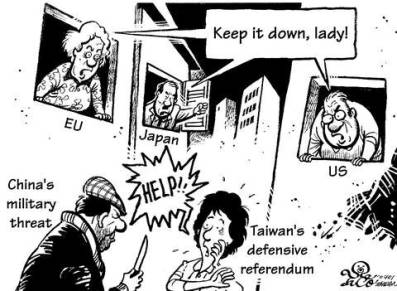
Just what is it about the proposed defensive referendum the US government does not understand? The press briefing for reporters by US State Department spokesman Adam Ereli reported in this newspaper yesterday, coming as it does after Washington envoy Chen Chien-jen's comment last week, leaves us deeply puzzled.
Let us take two basic premises on which both Taipei and Washington agree: The Bush administration is opposed to any referendum that would unilaterally change the status quo. It is not however opposed to the idea of referendums per se.
Add to this the premise that the administration of US President George W. Bush appears opposed to the referendum proposed by President Chen Shui-bian and what conclusions can we reach? That the US sees the defensive referendum as an attempt to change the cross-strait status quo. Why? How?
So far the Bush administration refuses to say. We glean from what various officials have said since the defensive referendum was announced that Washington sees a difference between referendums dealing with independence and unification, which it opposes, and referendums dealing with internal political matters and national security issues, which are apparently OK.
So can we assume that the defensive referendum is seen as being about independence or unification? Why on earth would that be? The question of whether Taiwanese like China's missiles pointed at them or not has nothing to do with unification or independence whatsoever. It is plainly a security issue.
And, let us be frank, it is not even a very serious security issue. Instead, "Should Taiwan have its own nuclear strike capability?" is a serious security issue, or perhaps a question about whether people are prepared to pay more tax to see the professionalization of the armed forces.
So why is the Bush administration so opposed to the planned referendum? We think that it should say. Not only that, but it should say so clearly and openly -- no secret notes from secret visitors to Taipei -- so that its reasons for opposing Taiwan's exercise of popular democracy might be judged against its zeal for spreading democracy elsewhere.
How can we take US reservations into account if we know not what they are? How can we judge how well-founded they may be?
How might they not be well-founded?
Well, Washington may simply be not well-informed. Since the world's media, profoundly ignorant of Taiwan's affairs as it usually is, mistakenly thinks that any referendum in Taiwan must be about independence, it would be no surprise to find that Washington bureaucrats are similarly mistaken. And we note that Ereli said that he thought Taipei's idea of what the referendum would be was in a state of flux. This is simply false.
The government's ideas on the referendum have been fixed since the first week of last month. So either Ereli was being duplicitous -- not wanting to acknowledge what the referendum was so he wouldn't have to answer the harder questions about it -- such as what was wrong with it -- or there is still a lack of understanding of this issue in Washington.
Or the Bush administration might be being deliberately misinformed by China and its allies -- the pan-blue camp here in Taiwan and the so called Red Team of pro-China foreign policy mavens in the US itself.
Or it is even possible that China has issued threats to Taiwan -- it is, after all, desperately important to Beijing that Taiwan's referendum not take place and there is no knowing how high the stakes have -- in private -- been raised. US coyness might be a way to avoid the appearance of having caved in to China.
So we need to know. Tell us what your reservations are. Let us see that they are well-founded. Until that happens it is hard to know what more can be expected of Taiwan.
-----------------------------------------
On Jan. 5, 2004 ……
-----------------------------------------
On Jan. 5, 2004 ……
International body accepts `Taiwan'
NAME GAME: The International Association of Chiefs of Police, ignoring a possible backlash from China, accepted the official change from `Taiwan, China' to `Taiwan'
By Ko Shu-ling, STAFF REPORTER
Despite China's audacious political maneuvers, Taiwan has managed to change its national title at the International Association of Chiefs of Police (IACP) from "Taiwan, China" to "Taiwan."
"Due to China's pressure and maneuvers, our group members at the IACP were forced to change the name of their country of origin from the `Republic of China' to `Taiwan, China' in November, 2001," said a Cabinet official who asked not to be named.
"The use of our national flag was also denied at all occasions," he said.
To voice the nation's utmost displeasure with China's audacity, the official said that the Cabinet ordered a boycott of the organization's annual conference in 2002 and filed a letter of protest.
After months of haggling and negotiations, members finally managed to change the national title and the use of national flags was restored during the IACP's last annual conference in Philadelphia in October last year, the official said.
"We've been keeping a very low profile in a bid to avert any further unnecessary hassles from China," the Cabinet official said.
Founded in 1893, the IACP is the world's oldest and largest non-profit organization of police executives. The organization has over 19,000 members and its membership now represents 101 countries.
The organization holds observer status with the International Criminal Police Organization, or Interpol, and consultative status with the UN.
Taiwan joined the IACP in 1985, one
year after the nation was elbowed out of Interpol by China in September, 1984
when China became a member state.
Established in 1923, Interpol's
headquarters was located in Vienna and comprised of the General Assembly, the
Executive Committee, the General Secretariat, the National Central Bureaus, and
the Advisers.
The headquarters of Interpol moved to
Paris, France in 1946 and then relocated to Lyons in October, 1989, where it
remains to this day. The number of its member states has reached more than 181.
Taiwan joined Interpol in 1961 and formed the Criminal Investigation Bureau under the National Police Administration in 1979.
Despite the upsetting withdrawal from Interpol, the Criminal Investigation Bureau is still in close contact with the organization.
Interpol's fundamental role is to facilitate communication, which is accomplished by fostering a continuing exchange between countries and circulating new messages, memos and notices on a daily basis.
According to Chris Chang, International Criminal Affairs Division chief of the Criminal Investigation Bureau under the National Police Administration, the administration is a member of two international organizations: the IACP and the International Association of Airport and Seaport Police (IAASP).
The IAASP was formed in 1969 as a non-governmental and non-profit association. It is registered in the province of British Columbia, Canada and Washington state in the US.
The organization is dedicated to bringing together representatives of police administrations, other enforcement agencies and sectors of the transportation industry involved in the movement of cargo at airports and seaports around the world.
The association has served in a consultative capacity with the UN, the US Senate and the Canadian Ministry of Transport as well as other organizations.
-----------------------------------------
On Jan. 5, 2004 ……
Marshalling His Troops
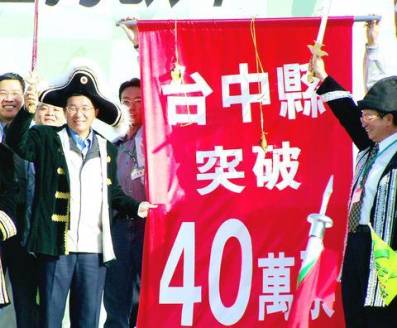
President Chen Shui-bian, left, greets the crowd in a Napoleonic outfit during the launching ceremony for a campaign support group in Fengyuan yesterday. The banner says ``Taichung County [shall] exceed 400,000 votes.''
-----------------------------------------