20040106
=======
Reported on Jan. 6, 2004 ……
The campaign circus staggers on
"Wrongful incrimination," "slander," "smears," "conjuring things out of the blue," "shameless," "calling a deer a horse" and "distortion." A person accused of such deeds does sound rather objectionable. Yet these were the words used by the campaign headquarters of the Chinese Nationalist Party (KMT) and the People First Party (PFP) in an advertisement criticizing President Chen Shui-bian.
It is language that would be considered by the average person to be excessive, not to mention the fact that it was directed at the head of state. If this does not constitute the crime of slandering the head of state, as spelled out in the Criminal Code, then what does?
On Saturday, the pan-blue campaign headquarters issued a copy of a speech by KMT Chairman Lien Chan. It contained the expression "kickback-taking president", insinuating that Chen is corrupt. Lien did not actually use this in his speech, but local media still quoted it in their reports.
To defend Chen's reputation and counter the blue camp's accusation, first lady Wu Shu-chen yesterday went to the Taipei District Prosecutors' Office to file suit against Lien for libel and for using illegitimate means in the course of an election campaign.
Even though Lien did not use the words "kickback-taking president," his headquarters did distribute the handouts. Even if Lien can get away scot-free, the campaign office certainly should not. And even if the law cannot punish Lien, his crew cannot escape the damage their integrity has sustained.
As election day draws closer, both the pan-blue and pan-green camps are trying hard to distinguish themselves. Campaign language is also becoming more vitriolic as the race picks up its pace. The dignity befitting political figures and the style and propriety befitting democratic politics have all been overwhelmed by the desire for victory.
The language used by the pan-blue camp to criticize Chen could act as an apt description of the pan-blue camp as well. Chen's camp has also been indiscreet in its investigation and accusations regarding the Lien family's assets. The crude performances of both sides have dragged this election down to the level of a township representative brawl.
The election campaign has not officially begun, but attacks between the candidates and their parties, saturation media coverage and the over-engagement of the public have resulted in political and social schisms. Candidates should be debating their vision for the nation's future, but now the campaign has gone totally off track. Presidential candidates engage in groundless character assassination. And even if someone has the luck to escape from these killing fields, the winner will be left bereft of dignity. How can someone with so many wounds to his person be able to lead the country?
More and more people are hoping that election season will be over soon. Some are even organizing a group calling on voters to cast invalid votes. Repulsion over the election is spreading quickly. It is a warning sign that both camps should take note of.
It is hoped one of the presidential candidates can set an example by stepping forward and saying, "I would rather lose the election than lose our democracy. Let's end negative campaigning now."
-----------------------------------------
On Jan. 6, 2004 ……
First lady files suit against KMT
EVIDENCE? Accusations of insider
trading and kickbacks were too much for the first lady, who called on Lien Chan
to provide proof or step down
By Lin Chieh-yu, STAFF REPORTER
First lady Wu Shu-chen filed a suit for defamation yesterday against the pan-blue camp's presidential candidate Lien Chan after a Chinese Nationalist Party (KMT) campaign speech accused President Chen Shui-bian of taking kickbacks and being involved in corruption.
"If Mr. Lien has any evidence, show it and prove the KMT's accusations and I, as well as the Democratic Progressive Party (DPP), will immediately ask Chen to resign from the presidential election," Wu said during a press conference at DPP headquarters.
"In the meantime, I urge Mr. Lien to make the same promise -- that if he lacks proof he should drop out of the race himself," Wu said.
In the past couple of weeks that pan-blue camp has tried to draw fire from pressure for the KMT to give back public assets the party stole while in power, and from questions about the origin of the wealth of the Lien family.
In two generations of service as government officials, Lien's family has amassed a fortune of NT$20 billion.
The KMT has run a number of ads and held press conferences accusing the president and his wife of being involved in insider trading and receiving illegal political donations from business conglomerates by promising to return them favors via the government's policies.
On Sunday, media reported on the draft of a speech Lien was to give that day at a campaign rally. The draft accuses Chen of being a "kickback president" and taking a 10 percent skim from government construction projects.
According to the DPP's campaign headquarters, the first lady was infuriated by this accusation and she decided to personally challenge Lien.
During yesterday's press conference, an angry Wu stressed that the things about Chen of which she was proudest were his integrity and incorruptibility.
"What upset me most was that the KMT and Lien said the president took kickbacks and was corrupt without any evidence," she said.
"These groundless allegations and smears on his reputation are worse than killing him [Chen]," Wu said.
"You [Lien] who once served as the country's vice president, how could you make those indiscriminate attacks?" she said.
After the press conference, the first lady, who has been wheelchair-bound since a KMT-organized political assassination attempt in the 1980s, went to the Taipei Distinct Prosecutors' Office in the company of some DPP heavyweights where she filed a suit against Lien for violating both the Criminal Code and the Election and Recall Law.
Asked by the media to respond to Wu's action, Lien said that he never called Chen a "kickback president" but just questioned how the first couple could double the value of its assets in the past three years.
"I have no idea about what she [Wu] means [about the `kickback president'], I did not say so personally," Lien told reporters.
"It is the entire society, the public, not only the KMT, which feels that the first couple has inappropriate connections to business syndicates," Lien said.
The KMT has claimed that during the past three years, the value of Chen's family assets has increased 125 percent, in particular the total value of the first couple's stock holdings has more than doubled to NT$74.9 million (US$2.2 million) because of insider trading.
But Wu defended her family yesterday pointing out that the KMT mistakenly added NT$48.5 million (US$1.4 million), which were government election subsidies provided under the Election and Recall Law.
"We have explained many times that the president has already donated this money for public services and to charities," Wu said.
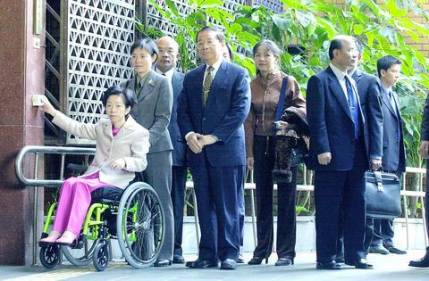
First lady Wu Shu-chen presses the door bell at the Taipei District Prosecutors' Office yesterday to submit a defamation lawsuit against KMT Chairman Lien Chan.
-----------------------------------------
On Jan. 6, 2004 ……
KMT denies having made allegations
By Huang Tai-lin, STAFF REPORTER
Chinese Nationalist Party (KMT) Chairman Lien Chan never called President Chen Shui-bian a "kickback president," he said yesterday.
Rather, his campaign staff wrote it instead.
Hwang Yih-jiau, spokesman for the pan-blue alliance presidential campaign, said yesterday that "The draft campaign speech was prepared by campaign staff merely as a reference for Lien. But Lien did not use it [in his actual speech delivered that night]."
First lady Wu Shu-chen's defamation suit, filed yesterday, should not be allowed by prosecutors to proceed, Hwang said.
The draft campaign speech was faxed by the alliance to media organizations on Saturday. It described Chen as a "10 percent president" who levied kickbacks of 10 percent of the value on major infrastructure projects.
Hwang did not explain, however, how circulating a draft speech containing the allegation to media outlets was in any way less defamatory than voicing the allegations at a campaign rally.
Instead he claimed that the alliance was simply asking questions about the president's probity that were in the public interest and frequently asked by ordinary people.
Whether a president has been involved in any insider trading or accepted illegal political donations are issues that fall within the scope of public discussion as they are matters of concern to the public, Hwang said.
These are issues which all citizens can call into question and that the president should not shy away from addressing, he said.
The alliance also launched a new ad campaign yesterday attempting to rebut accusations from the DPP that the Lien family's immense wealth -- estimated at NT$20 billion -- was the result Lien family members using their political connections during the era of the martial law dictatorship to illegally both acquire land and change that land's designated use.
The ad branded the DPP's charges as "false accusations," "smearing," "shameless," "distorted" and "purely fictitious."
-----------------------------------------
On Jan. 6, 2004 ……
On Sisy Chen's trilogy of craziness
By Ruan Ming
On Dec. 27, Chinese Nationalist Party (KMT) Chairman Lien Chan gave a speech in Tainan in which he claimed Taiwan was in more serious danger of war now than it has been in 50 years. This was an attempt to raise public fears, but the public has not been duped.
The Apple Daily ran an article by independent Legislator Sisy Chen entitled "Unprecedented." She wrote: "The whole country has gone crazy, reaching unprecedented levels of craziness! China is showing unprecedented unity, the US is showing unprecedented unwillingness to send soldiers to protect Taiwan and Taiwan is showing unprecedented levels of daring."
The whole country has not, in fact, gone crazy. China does not show unprecedented levels of unity, nor does the US show unprecedented unwillingness to send soldiers to protect Taiwan.
Chen was right on one count only: Taiwan really does show unprecedented levels of daring. Why? Because the country hasn't gone crazy, it just doesn't believe in the crazy ramblings of lunatics.
First, on Dec. 9, US President George W. Bush told Chinese Premier Wen Jiabao: "Look, you know, if you force us to, if you try to use force or coercion against the Taiwanese, we're going to be there." Can the will to protect Taiwan be expressed any clearer than that?
On the same occasion, Bush also warned Taiwan that the US opposes any statements or actions by Taiwan's leaders that may lead to a change in the status quo. Taiwan's representative to the US, Chen Chien-jen, was also very clear when he said that US policy had not changed, Taiwan-US relations were very friendly, and that we had rarely heard such strong words as those concerning differences over the referendum.
The US' position is very simple. Of the three kinds of referendum discussed, the US has no problem with topics related to domestic matters. However, it opposes any poll that would change the status quo. Nor does it support fuzzy or ineffective referendums.
The problem is that the US cannot understand why Taiwan would hold an ineffective referendum if it doesn't plan to change the status quo. "What are you guys up to," they are thinking, "and what's next?"
The US wants Taiwan to think things through and be clear. And, indeed, Taiwan needs to do just this.
Second, China is not showing unprecedented levels of unity, and it is not so united that the most serious prospect of war in 50 years can be brought about.
What does this mean, this "50 years?" Recall the 1954 artillery attack, or the Chinese occupation of Ichiangshan Island in 1955 which resulted in the deaths of 720 Nationalist soldiers, or the KMT's retreat from the Tachen islands, or the Battle of the Taiwan Strait on Aug. 23, 1958, or the severing of diplomatic ties with the US in 1979, or even the "test" missiles that landed off Keelung and Kaohsiung in 1996. Is the current situation really more serious than all of these?
During Bush's meeting with Wen, the Chinese premier approved of Bush clearly stating his opposition to either China or Taiwan unilaterally changing the status quo, indicating that China's new leadership is more pragmatic than under previous Chinese president Jiang Zemin and premier Zhu Rongji. Wen discovered that using arms or threats to change the status quo is not in the interests of China. Attempts by Lien Chan and Sisy Chen to exploit China's military threat by instilling the fear of war in the Taiwanese public is doomed to fail.
Third, Taiwan's international outlook and view of China are indeed encouraging. Looking back eight or nine years, there was another "lunatic" on the loose, one by the name of Cheng Lang-ping. He wrote a book called T Day in 1994, which also sought to instill fear. At the time, his crazy ramblings frightened quite a few people, some to the extent that they left the country. Even the defense minister was duped. He wrote a foreword and made the book recommended reading for soldiers. With the help of China's propaganda offensive, the military threat and missile exercises, the stock market fell 4,000 points.
Cheng's book frightened many people, but despite Lien and Chen warming up their propaganda machinery, the people of Taiwan fear nothing. Consider this a lesson in how fast the Taiwanese public have learned to differentiate between truth and lies.
Eight or nine years of democratic progress has made the whole nation understand that when looking at the international community or at China, one has to rely on one's own experience and draw conclusions from that experience with a free mind and an independent spirit. We no longer believe in the crazy ramblings of would-be foreigners and self-appointed China specialists.
Instilling the fear of war is a crime of sorts in civilized countries, because it violates one of the four great freedoms -- the freedom from fear. I hope that the new year will be one in which democracy progresses still further in Taiwan, a year when the nation can bid farewell to fear, lunatics and liars instilling the fear of war, and a year of rapid progress toward freedom, glory, peace and rationality.
Ruan Ming is a visiting professor at Tamkang University and was a special assistant to Hu Yaobang, Chinese Communist Party secretary-general.
-----------------------------------------
On Jan 6, 2004 ……
Independence is the real status quo
By JosephWu
US president George W. Bush made a statement last month opposing "any unilateral change to the status quo" when he met Chinese Premier Wen Jiabao. The general interpretation of it was that it was a warning in light of President Chen Shui-bian's decision to hold a defensive referendum on March 20.
For a while, Bush's statement, together with the explicit misgivings of the Japanese government, seemed to have turned the world against Taiwan. As a good friend of the US, Japan and many other democracies, Taiwan is quite serious about these concerns and will take them into consideration. But is Taiwan painting itself into a corner as one report described? Not necessarily.
The recently passed Referendum Law gives the president the exclusive power to conduct a defensive referendum in the face of an external threat. That power is also viewed as a presidential responsibility to safeguard national security.
The purpose of having the defensive referendum in March is to raise international and domestic awareness of the growing danger of China's missile deployment and its determination to use force. The referendum is legitimate, appropriate and not at all provocative.
A large and steadily growing number of ballistic missiles is the most visible threat against Taiwan. In addition, cruise missiles and multiple independently targetable re-entry vehicles are both at the stage of deployment and there is no defense available against them.
The Chinese air force also has a large number of newly acquired Su-27 and Su-30 fighters. The J-10, one of the newest fighters to be developed, has been rolling off the assembly line. Sovremenny-class destroyers, together with Kilo-class and Song-class submarines, have also been deployed.
Further, Chinese assault strategies have been modified to include surprise attacks, pre-emptive strikes, asymmetric war and even all-out war.
Taiwan's call for help through a defensive referendum is certainly warranted under such circumstances, but there will be no need for it if China promises peace. The international community, if it is concerned with peace and stability in the region, should urge China to cease with its threats and begin a process of building a long-lasting peace.
But what is this "status quo" that the Chinese government has tried to bully other countries into believing?
The first democratic presidential election in 1996 has been recognized as a milestone in Taiwan's democratization. But more significant than this was that this election was a symbol of sovereignty -- held within specified boundaries by specified citizens for a government exercising exclusive control over a territory. Every four years, Taiwan reaffirms the new status quo -- that it is independent.
Taiwan treasures this reality and it is the reason why there is no longer any need to declare independence. Taiwan's adherence to the status quo, in turn, has become an important foundation for stability in the region.
This status quo was the real reason
behind China's missile tests in Taiwan's waters in 1996. It was why the Chinese
government released the white paper on the "one China" principle and
the Taiwan problem in 2000, which claimed that Taiwan's second presidential
election was nothing but a local Chinese election. It is also why Chinese
leaders now travel the world telling other countries to oppose "Taiwanese
independence." But this is a reality that China cannot change.
Since an independent Taiwan is the status quo, any opposition to it or attempt to force a change in it -- such as "one country, two systems" -- constitutes a change in the status quo. The more China opposes "Taiwanese independence" in the international arena, the more awkward its assertion becomes. China's determination to incorporate Taiwan is how a unilateral change in the status quo is now defined.
This does not mean that differences between Taiwan and China are irreconcilable. There are matters on which the two can work together to reach a compromise. But whatever compromises there may be, peace should be the essential principle in achieving that end.
As the president said when reiterating his commitment to the "five noes" policy in his New Year address, it is time for China to make a hard decision on peace.
The president's New Year wish is that the two sides of the strait can jointly win an international peace prize.
It is a sincere wish of the people of Taiwan as well. It may not be difficult to realize if China demonstrates a commitment to peace.
Joseph Wu is deputy secretary-general of the Presidential Office.
-----------------------------------------
On Jan 6, 2004 ……
-----------------------------------------