20040107
=======
Reported on Jan. 7, 2004 ……
PRC agenda in Pacific starts with unification
By Paul Lin
After trying strategies such as propaganda attacks and military threats to block Taiwan's democratization, and having seen all of them prove ineffective, China has recently resorted to a different strategy -- internationalizing the Taiwan issue.
Under the banner of opposing Taiwanese independence, Beijing is in effect trying to deprive Taiwanese people of the right to hold referendums, rewrite the Constitution and become their own masters.
A Washington Post report published on Jan. 2 pointed out that a new national identity has emerged in Taiwan after more than 50 years of democratic advances. Politicians in major Western nations, however, have apparently failed to sense this change. Therefore, China's strategy of mobilizing international forces to "besiege" Taiwan has proven effective.
US President George W. Bush, the EU
and Katsuhisa Uchida, director of the Taipei Office of Japan's Interchange Association,
have expressed strong concern over Taiwan's plan to hold a "defensive
referendum."
Predictably, other small nations, especially some in the Asia-Pacific region, will express their concerns as well. But the expression of delight on Chinese Premier Wen Jiabao's face after Bush's recent comments on Taiwan at the White House, and the statement of satisfaction with Japan made by Liu Jianchao, spokesperson for China's Ministry of Foreign Affairs, have revealed that China is calling the shots behind the scenes.
Isn't it farcical for Western leaders to end up becoming protagonists in a play directed by authoritarian China?
Taiwan should understand the difficulties that these leaders face but cannot mention. I believe they have not given up their faith in democracy; rather, they are only perfunctorily satisfying China's demands.
Nations with an important interest in the Asia-Pacific region care about peace and stability in the Taiwan Strait. If we look back at wars after World War II, either the expansion of autocratic nations led to military conflicts with democratic nations, or autocracies waged war against one another. It was extremely rare for democracies to resort to military force against other democracies to resolve problems.
For Western nations to maintain peace in the Taiwan Strait, the key lies in helping China peacefully transform itself into a democracy. Taiwan's democratic achievements serve as the best contrast to and containment of China's authoritarian rule.
For Western nations to isolate Taiwan as it democratizes, and give in to China's military buildup and meet its demands in exchange for temporary peace, would be an appeasement strategy similar to the one Neville Chamberlain adopted to feed Adolf Hitler's arrogance. This ultimately would bring disaster to democracies.
To a certain degree, the US and Japan have accommodated themselves to China because they need help from China on North Korea's nuclear problem. But they should realize that Beijing is on much closer terms with North Korea than with the US and Japan. They should not be bewildered by China's facade of sincerity.
In an interview published in the Chinese newspaper Global Times on Dec. 29, Chinese military expert Jiang Zhijun said that the first mission for the Chinese navy is to accomplish the unification task -- to resolve the Taiwan issue. If Taiwan were in China's hand, he said, China's path eastward into the Pacific would be wide open.
Apparently, Beijing has an ulterior motive in its unification mission. If it occupies Taiwan, the vast Pacific Ocean will be its next goal. China will target not only Japan but also the US.
Paul Lin is a political commentator based in New York.
-----------------------------------------
On Jan. 7, 2004 ……
The status quo's true foe is China
By Michael J. Fonte
The frog in increasingly hot water is an apt metaphor for where Taiwan sits today vis-a-vis China and its military buildup.
Slowly, slowly the water is being heated: 496 missiles lined up on the coast of Fujian all aimed at Taiwan, with 75 more added yearly; heavy weapons systems regularly procured from Russia -- in the form of advanced aircraft and blue-water capable ships armed with sophisticated weaponry; and intense development of asymmetrical warfare possibilities designed to attack Taiwan's nerve centers.
President Chen Shui-bian has offered olive branch after olive branch to Chinese leaders engaged in this scenario of intimidation. Caught up in their own internal jockeying for power, none of the old or current leaders seems either willing or able to make any serious response.
Instead, after every statement by officials like Qian Qichen that seem to open a door ever so slightly, there is a qualification by others that the only negotiating stance China is willing to accept from Taiwan is one of surrender -- or else.
What is the democratically elected leader of Taiwan to do in the face of such intimidation? Sit back and watch as his country is boiled alive and eaten?
Chen is not a passive person. He and his Democratic Progressive Party (DPP) did not beat back 40 years of the Chinese Nationalist Party's (KMT) martial law by meekly turning the other cheek.
They demonstrated in the streets and pushed the envelope for change until the KMT could no longer resist. They are doing the same thing now that they are faced with the Chinese Communist Party's threats.
Chen and the DPP are the peacemakers
in the region and have dared Chinese President Hu Jintao to back off his
threats. With no response forthcoming from the Chinese leaders, Chen wants to
hold a referendum on the Chinese threat to show how deep Taiwanese antipathy
toward China runs.
For this, Chen was publicly rebuked by President George W. Bush.
"We oppose any unilateral decision, by either China or Taiwan, to change the status quo," Bush said on Dec. 10, as he sat next to Chinese Premier Wen Jiabao.
"And the comments and actions made by the leader of Taiwan indicate that he may be willing to make decisions unilaterally that change the status quo, which we oppose," he said.
Hu Jintao expressed his gratitude to Bush in a Dec. 20 telephone call for opposing any "words and actions" by Taiwan to alter its status quo, and again warned that China would not tolerate independence.
Chen has been roundly condemned as a troublemaker by US analysts as disparate as Ross Munro and Ralph Cossa.
Cossa, president of the Pacific Forum, wrote in the Japan Times on Dec. 19: "When the Bush administration looks at the cross-strait situation today, it is Taiwan, not the mainland, that seems most intent on rocking the boat ? While Taiwan President Chen Shui-bian's recent talk of referendums and constitutional revisions may serve his domestic political agenda -- Chen is in the middle of a hotly contested re-election campaign -- his efforts to disrupt the status quo do not serve US national security interests."
Munro, director of Asian studies at the conservative Center for Security Studies, is even more blunt.
In the Dec. 18 issue of the National Review, Munro declares: "President Chen … betrayed the United States. He did so by recklessly yet quite consciously promoting his own political fortunes at the expense of the vital national interests of the US."
How do the status quo in the Taiwan Strait and US interests intersect? US policy is quite clear and consistent: the status quo today is that there are two entities on either side of the Strait and any resolution of their differences must result in a peacefully and mutually agreed-upon "one China."
If this resolution produces the People's Republic of China (PRC) as the "one China" with Taiwan as a separate, independent nation, fine by the US.
If it means some confederated entity that unites Taiwan and the PRC, fine as well. US administrations are committed by law -- the Taiwan Relations Act -- to seeing this peaceful resolution through to its completion.
The act also clearly connects US interests in the peace and security of East Asia to this peaceful resolution.
The Congress "finds the enactment of this Act is necessary … (4) to consider any effort to determine the future of Taiwan by other than peaceful means, including by boycotts or embargoes, a threat to the peace and security of the Western Pacific area and of grave concern to the United States; [and] … (6) to maintain the capacity of the United States to resist any resort to force or other forms of coercion that would jeopardize the security, or the social or economic system, of the people of Taiwan. ? The preservation and enhancement of the human rights of all the people of Taiwan are hereby affirmed as objectives of the United States."
So the gnawing question remains, which side is jeopardizing the status quo across the Taiwan Strait -- democratic Taiwan, with its constant calls for dialogue based on mutual respect, or autocratic China, with its military buildup aimed at intimidation, at best, and eventual subjugation of Taiwan?
Clearly, China's leaders do not accept this status quo, continuing to insist Taiwan is already an integral part of their "one China," a wayward province to be integrated with the "motherland" by force if necessary. Their military modernization program is designed to change the status quo, by intimidation if possible, or force.
It is the Chinese leadership, and not the leader of Taiwan, that "betrayed" US trust and US interests.
As the Pentagon's July 30 report on Chinese military power notes: "While seeing opportunity and benefit in interactions with the United States -- primarily in terms of trade and technology -- Beijing apparently believes that the United States poses a significant long-term challenge … China has embarked upon a force modernization program intended to diversify its options for use of force against potential United States intervention in a Taiwan Strait conflict … In response to external intervention in a regional conflict involving China, the PLA would attempt to weaken [the] US or other third party's resolve by demonstrating the capability to hold at risk -- or actually striking -- high value assets."
At this point in history, the Bush administration rightly wants a candid, constructive and cooperative relationship with China.
Taiwan has no quarrel with such a relationship for it wants the very same thing.
But the Taiwanese people, staring across the strait at those 496 missiles, would like to see more emphasis on the "candid" side of the equation.
Bush should have turned to Wen on Dec. 10 and told him that the US opposes the decisions the leaders of China are making to change the status quo. China is the culprit in upsetting the balanced US position regarding the Taiwan Strait, not Taiwan.
Michael J. Fonte is the Washington liaison for the Democratic
Progressive Party.
-----------------------------------------
On Jan. 7, 2004 ……
Some won't fight for freedom
By Chen Ming-chung, Chicago
A true friend comes through when a friend is in need. As Richard Kagan points out, Taiwan recently honored 30 foreign human rights activists for their contributions to democracy and independence (Letters, Jan. 2, page 8). I would like to salute those true friends of the Taiwanese.
If Taiwan must defend itself alone, it will, as polls have indicated. Eighty percent of Taiwanese will fight if China invades Taiwan, and do not think the US will help.
Shame on the UN, shame on those who should have taken a stand, and will not, and those who would only pay lip service but do not put their words into action. The saying goes: "If one is lost, all is lost." Pity those who will allow liberty to be lost for all of us.
Kagan, Mike and Judy Thornberry and many others remind us that Taiwan will not be alone. Indeed, we shall overcome. The likes of Ma Ying-jeou, Lien Chan, James Soong, and some people in the US and Japan, who think like the dictatorial, terrorizing Chinese communists, obviously still see Taiwan as a second-class world citizen that does not deserve the rights that they enjoy.
Some say the hottest spot in hell is reserved for those who should have taken a position, and would not. For them I can only say: May God forgive them, for they know not what they do.
-----------------------------------------
On Jan. 7, 2004 ……
Chen should not fear China
By George Dukes, Sunderland, UK
I couldn't agree more with the point Gerrit van der Wees makes in his editorial ("Instead of `five noes,' `three yeses,'" Jan. 2, page 8), that the conditions underpinning President Chen Shui-bian's five noes have all but disappeared, killed off entirely by China's bullying antics and by the steady increase of missiles aimed at Taiwan.
I would like to add that these missiles are only a small part of China's strategy of swallowing Taiwan, and not even the most effective.
In fact, even if all the missiles were dismantled, the diplomatic embargo would be the weapon in China's arsenal that the Taiwanese would have to fear most.
Some Taiwanese might still believe that as long as they still have food on the table and as long as they still enjoy freedom, peace and stability, it doesn't matter that their own country is constantly humiliated and belittled by China in the international arena, or that their president is forbidden from visiting most countries.
But this idea is wrong: China's diplomatic embargo will also hurt Taiwan's economy, and the free trade agreements with other countries is the most obvious example. Without free trade agreements with either large countries, like the US and Japan, or large trading blocs, like the EU or ASEAN, Taiwan's economy will be held to ransom by the Chinese dictators, and will become just a second Hong Kong, with all the imaginable consequences.
This shows that the best way to defend Taiwan's status quo of de facto independence is to pursue de jure independence, and no matter how much the Chinese dictators huff and puff or how much the US or Japan choose to kowtow to China, Chen should not only go ahead with the planned referendum, but even better, he would widen its scope.
-----------------------------------------
On Jan. 7, 2004 ……
The pan-blues' tit-for tat strategy
The current issue of The Economist describes this year's US presidential election as "America's angry election." This is because former Vermont governor Howard Dean, who resolutely opposed the war in Iraq, is likely to run as the Democratic candidate against US President George W. Bush.
But in terms of angry elections, Taiwan has always had the edge on the US.
The Democratic Progressive Party (DPP), the opposition Chinese Nationalist Party (KMT) and its ally the People First Party (PFP) have long engaged in negative campaigning.
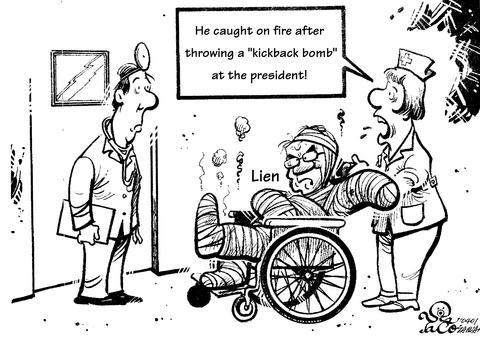
As the election draws near, the two sides are escalating their attacks against each other. A few days into the new year, the KMT has started using the phrase "kickback-taking president" to cast doubt on President Chen Shui-bian's integrity.
That has forced the normally cheerful first lady Wu Shu-chen to file a libel lawsuit against KMT Chairman Lien Chan.
In addition, Lien has filed a lawsuit against Chen over the DPP's allegations about how he and his father amassed their wealth. Add to this the fact that the two camps are running neck and neck in public opinion polls, and the result is that the people will have to brace themselves for an unusually divisive three months.
This presidential campaign sometimes seems like fight in the mud between elementary school students.
We are not surprised to see the presidential election become so vulgar. Rumors have long circulated that the KMT-PFP camp, lacking the ability to lead a debate on policy, was preparing to run a "retaliatory" campaign.
This campaign has long smelled of cordite.
When Chen's administration proposed a NT$550 billion five-year national construction project, the KMT immediately proposed a NT$2 trillion four-year project.
When Chen promised to conduct a "defensive referendum" and draft a new constitution by 2006, the KMT said it would amend the current Constitution two years earlier and would not oppose the "one country on each side" paradigm.
After the Referendum Law was passed, the KMT initially imitated the DPP's strong advocacy of holding referendums, but now that the US and Japan have expressed concerns about that prospect, the KMT has dropped the issue.
Another example of the KMT's tit-for-tat strategy is that after the DPP released information casting doubt on PFP Chairman James Soong's integrity and the Lien family's assets, the opposition camp felt obligated to retaliate with their charges of taking kickbacks.
The opposition camp has spent all its energy escalating its attacks, and has not been able to propose a decent political platform. This is the most worrisome issue in the campaign.
Governing a country requires more than nasty language and trickery.
Another example of the pan-blue camp's strategy is that they have promised an advantageous 18-percent interest rate on deposits made by retired laborers, which would be on a par with the preferential treatment given to servicemen, teachers and civil servants. This is an attempt to cheat laborers of their votes by offering a policy that the pan-blue camp knows perfectly well is unfeasible.
Eventually the two US presidential candidates will begin to "get angry" at each other over Iraq policy. But Taiwan's two presidential candidates are getting angry now, and getting involved in lawsuits for personal reasons, thereby providing the international community a good laugh at the nation's expense.
All this is the result of the opposition camp's retaliatory campaign strategy. We will find out on election day whether or not the strategy is a winner.
-----------------------------------------
On Jan. 7, 2004 ……
Kennedy nephew gives referendum a boost
HELPING HAND: A relative of former US president John F. Kennedy, Patrick J. Kennedy is a Rhode Island congressman and a backer of President Chen's policy
By Melody Chen, STAFF REPORTER
The people of Taiwan have the opportunity to express their opinion and support for their democratic principles and political system through a "defensive referendum," visiting US Congressman Patrick J. Kennedy said yesterday.
A nephew of former US president John F. Kennedy, the congressman for the First District of Rhode Island said that the US recognizes and celebrates Taiwan's democratic process.
"That is why we are so supportive politically and militarily to Taiwan, because we know you are sisters and brothers in the democratic experiment," he said.
Kennedy was speaking at a ceremony at which he received four dragon boats from Minister of Foreign Affairs Eugene Chien. The ceremony took place prior to a meeting with President Chen Shui-bian at the Presidential Office.
Commenting on the government's "defensive referendum," of which the US apparently disapproves, Kennedy said the US committed itself to supporting the aspirations of all human beings in their desire to be free.
"I think the president of the United States, in his talking about the future of American foreign policy, needs to align with democracies and freely democratic governments, as opposed to dictatorships and regimes that too often our country has aligned itself with simply out of political expediency," Kennedy said.
The US sometimes aligned itself with dictatorships and undemocratic regimes because it wanted to maintain the status quo, Kennedy said, but he did not specify if he was referring to US President George W. Bush's rebuke of Chen during a meeting with Chinese Premier Wen Jiabao in Washington.
Although the wording of any question to be put to a referendum has yet to be finalized, Kennedy said he was not concerned that the poll would cause undue trouble.
"We do not see the referendum as a declaration of independence," he said.
"We see the referendum as an annunciation of support for the democratic principles, autonomy and political system that Taiwan has now. People have an expression [about them] that this is something they are looking forward to continuing," he added.
Reliable sources have said that China, unnerved by Taiwan's decision to go ahead with the referendum despite the concerns of the US and Japan, two of its most important allies, has secretively dispatched envoys to other Asian countries, urging them to oppose the poll.
Taiwan's National Security Council has itself been coordinating high-level delegations, which are preparing to leave for the US, Europe, Japan and Southeast Asia to explain the referendum plan.
Stressing the US government was not doing anything to fan the flames of discord between Taiwan and China, Kennedy said that the US would try to promote more dialogue and diplomacy to ease cross-strait tension.
"Taiwan does a much better job at guaranteeing freedom than we have seen in China," he said.
"I don't see there's any equivocation from the US that we prefer the democratic system of Taiwan over the totalitarian system of China," Kennedy added.
The congressman said that his uncle, President Kennedy, always believed in a people's ability to cast off colonialism and the kind of domination that communism often represented.
President Kennedy also believed in a people's ability to embrace freedom and the free-market system, like the people of Taiwan had done, he said.
"That is something that even to this day we need to embrace," he said.
The dragon boats presented to Kennedy will be used in a dragon-boat race in Rhode Island on Taiwan Festival Day on Sept. 11. The cultural event attracted more than 10,000 participants last year and has become a prime tourism attraction in the city of Pawtucket, Kennedy said.
-----------------------------------------
On Jan. 7, 2004 ……
Chen tells US delegation he will not sway
By Lin Chieh-yu, STAFF REPORTER
President Chen Shui-bian yesterday said that Chinese interference will not stop him from going ahead with a planned national referendum.
"To criticize our efforts to pursue the universal value of democracy and peace again proves that Beijing is the real trouble-maker," Chen told visiting members of a US think tank at the Presidential Office.
"The crucial problem of the cross-strait issue is Beijing's insistence on the `one China' principle, while the US government has the `one China' policy and Taiwan defines `one China' as an `issue,'" Chen said.
"If Beijing insists that `one China' is a precondition, then it is difficult for both sides to sit down and talk," the president said. "If `one China' is just an issue, then we can discuss it, and even set it aside to focus on economic and trade subjects."
Chen was meeting with a delegation from the National Committee on US-China Relations, which is regarded as a "red-team," or pro-China, think tank.
Opposition parties described on Monday this delegation as Washington's unofficial channel of communication to Taiwan and claimed that the delegation was set to deliver the US government's opposition to Chen's referendum plan.
Chen yesterday asked the US visitors three questions: Were they coming to oppose the referendum; did they shoulder any political mission; and were they representing the US government to deliver any message?
Head of the delegation, J. Stapleton Roy -- former US ambassador in Beijing -- replied that they were not the US government's special envoys and were here to collect information and to further understand the president's idea.
Roy said that "regarding US-Taiwan relationships, the committee's stand tallies with that of the US government."
"The US consistently supports Taiwan's democratization and will never interfere in Taiwan's democracy," Roy said.
Chen also said that his call for a new constitution and the country's first ever "national referendum" would both achieve and deepen democracy.
"The passage of the Referendum Law was the first step to consolidating Taiwan's democracy," Chen said. "My idea of holding a `peaceful referendum' has no relation with independence and does not violate my `five noes' promise."
"Facing Beijing's threats, the people of Taiwan have the right to say `no' to China," Chen said.
-----------------------------------------
On Jan. 7, 2004 ……
-----------------------------------------