20040108
=======
Reported on Jan. 8, 2004 ……
-----------------------------------------
On Jan. 8, 2004 ……
Bush failed Taiwan: Lieberman
CNA , WASHINGTON
US Senator Joseph Lieberman blasted President George W. Bush on Tuesday for "turning his back on Taiwan," which he said was an "outrageously unprincipled position for a president of the United States to take."
Speaking with five other Democrat presidential candidates in a radio debate, Lieberman, a Democrat candidate for this year's presidential primaries, said that Taiwan's plans to hold a "defensive referendum" is not a declaration of independence.
"This was not a declaration of independence by the Taiwanese. This was a call for a referendum on whether the Chinese should remove the missiles from across the Taiwan Strait. And for the president [Bush], when China griped about it, to knuckle under, that's not what the leader of the greatest democracy in the world does," Lieberman said.
Lieberman, a senior senator who has served for over 16 years, was Al Gore's running mate in the 2000 presidential election.
He has been a staunch supporter of Taiwan since the early 1980s.
On the referendum issue, John Kerry said that "the United States has always had a `one China' policy, not withstanding how terrible we may understand their regime to be. And that has been a Republican president, Democrat president policy alike. I think it is the right policy."
At the same time, Kerry said, no president could possibly allow Taiwan to slip backward from the democracy it has achieved.
"And what we have succeeded in doing through the years is to maintain a balance, what people have called a purposeful, constructive ambiguity, where we've left it uncertain as to precisely what steps we'd take."
"But we've made it clear we will not tolerate any kind of invasion, any kind of effort to move backwards," he said, adding that "I think now is the time for us to also be strong with Taiwan and to make it clear that while we are supportive of the democracy, and while we recognize the society they've built in a capitalist society, we are not going to permit them to declare independence; that would be unacceptable."
Kerry made the remarks in response to a question by Neal Conan, moderator of the debate, who asked: "Taiwan has scheduled what some are describing as a provocative referendum as a sign of restiveness, and some fear that it could lead them to a policy of independence. When it comes down to it, will you stand with the rambunctious democrats in Taipei? Or with the autocrats in Beijing?"
Responding to the same question, Lieberman said: "America is always strongest in the world when we stand by our principles, and the bedrock principle is freedom and democracy.
"So yes, China's big. We have to work to manage our relations with them. Taiwan is small, but China is not a democracy; Taiwan is. And we have to stand with that rambunctious democracy," Lieberman said.
-----------------------------------------
On Jan. 8, 2004 ……

Lucky Mascot
President Chen Shui-bian and first lady Wu Shu-chen meet with supporters and play with mascots during a press conference yesterday announcing the release of the DPP's campaign paraphernalia.
-----------------------------------------
On Jan. 8, 2004 ……
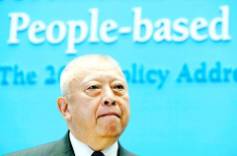
Tung dodges democracy-reform calls
"I have decided to establish a
task force ... to seriously examine these issues." --- Tung
Chee-hwa, Hong Kong chief executive
BESIEGED: The increasingly unpopular Hong Kong leader said Beijing would have to make a final decision on the progress of democracy in the territory
REUTERS , HONG KONG
Besieged by growing calls for more democracy and high unemployment, Hong Kong's deeply unpopular leader pledged yesterday to forge tighter economic links with China but ducked calls for faster political reforms.
Ignoring demands by pro-democracy activists to speed up changes, Chief Executive Tung Chee-hwa said his government would have to consult Beijing first before addressing mounting demands for more voting rights.
Tung's comments were the clearest confirmation yet that he would not make a move on more democracy without getting explicit instructions from Beijing, and likely set the stage for more confrontations with an increasingly demanding population.
Democracy activists had warned they would stage more massive street protests if Tung didn't commit to faster reforms in his speech.
Hong Kong's constitution, the Basic Law, gives the city a high degree of autonomy under Chinese rule. But it also stipulates that Beijing has the final say over any major electoral changes in the former British colony it took back in 1997.
China's leaders are clearly worried that calls for more democracy in Hong Kong will spark similar demands in China.
Nearly 100,000 people marched to demand full democracy on New Year's Day in the biggest protest since half a million people took to the streets last July, shocking Tung and leaders in Beijing, who said they worried about the stability of the Asian financial powerhouse.
"I have decided to establish a task force ... to seriously examine these issues, particularly those concerning the understanding of the relevant provisions of the Basic Law and to consult relevant authorities of the central people's government," Tung said in his annual policy speech.
As he spoke to lawmakers, hundreds of people gathered outside the legislature shouting "Tung Chee-hwa resign" and demanding the right to elect their own leader and all of their legislators.
Tung, who was selected by China to run the city after the handover, devoted most of his speech to reminding Hong Kong people that their fortunes were becoming increasingly tied to China's.
He forecast that the city's gross domestic product would quadruple from US$1 trillion in 2000 to US$4 trillion by 2020 as the Chinese economy boomed.
Hong Kong has traditionally been a gateway for goods from China to the rest of the world, and a key entry point into China for foreign investors. Growing world demand for cheap Chinese goods helped pull Hong Kong's economy out of recession last year.
China's leaders hoped that political discontent would begin to evaporate as the economy improved but Tung has become so deeply unpopular that demands for more democracy have continued to grow.
He offered no major new initiatives to spur economic growth in his policy address but announced some temporary job creation measures.
"We expect to see sustained economic growth and a continued decline in unemployment this year," Tung said.
He also said the government's huge fiscal deficit remained a serious problem that needed to be resolved.
The government has forecast the deficit is on course to hit a record HK$78 billion (US$10 billion) in the fiscal year ending March.
Tung raised the possibility of new taxes and higher government fees but said the government did not want to endanger people's livelihoods.
-----------------------------------------
On Jan. 8, 2004 ……
President says `yes' to prosecutors
"The president immediately
decided to cancel all activities in his original schedule for that day and will
be present at the interrogation. " --- James Huang,
Presidential Office spokesman
INVESTIGATION: Hualien prosecutors will quiz the president next Wednesday on vote-buying in the county's commissioner by-election after Chen was issued with a subpoena
By Lin Chieh-yu, STAFF REPORTER
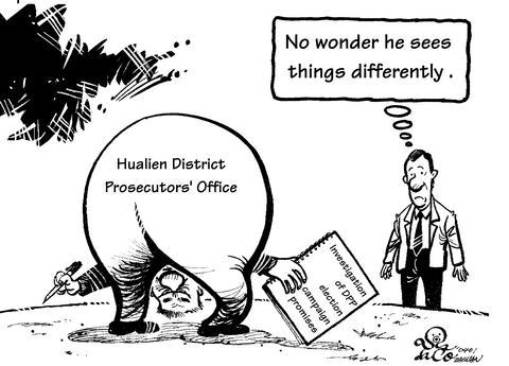
President Chen Shui-bian will attend a hearing at the Hualien District Prosecutors' Office next Wednesday to serve as a witness in a vote-buying investigation.
"President Chen has received the subpoena, which asks the president to attend the closed-door interrogation on Jan. 14 at 9:30am," Presidential Office spokesman James Huang said.
"The president immediately decided to cancel all activities in his original schedule for that day and will be present at the interrogation," Huang said.
On Tuesday, Hualien prosecutor Lee Tzu-chun issued a subpoena to Chen in the president's capacity as the DPP chairman, ordering him to assist in the investigation into a campaign promise made by the Democratic Progressive Party's (DPP's) candidate for the Hualien County commissioner by-election You Ying-lung.
You said on July 27 last year that the DPP would provide a monthly stipend to Aboriginal communities leaders if he won the election.
"Though President Chen only served as a campaigner and had no connection to any particular campaign promise, he will do what he is asked of by the Hualien District Prosecutors' Office," Huang said.
Huang also read a statement from the Presidential Office stating that during the by-election Chen had carried out his presidential duties in the correct and proper manner.
The summons is the first ever delivered to a head of state in Taiwan.
"Since the subpoena ... is a legitimate procedure, President Chen, who is a firm advocate of judicial reform, is willing to show his respect to the Hualien District Prosecutors' Office," Presidential Office Secretary General Chiou I-jen said at a press conference.
"We respect the legal system and will honor our obligation to abide by the rules," Chiou said. "But this do not mean we see the subpoena as a reasonable move [by the prosecutors' office."]
Chiou refused to comment on whether the subpoena would affect the presidential election campaign, saying that such an unexpected development was not on the DPP's campaign schedule and therefore it was difficult to make an evaluation.
-----------------------------------------
On Jan. 8, 2004 ……
US will never understand referendum, academic says
EXPLANATIONS: Heritage Foundation research fellow John Tkacik said that even though a delegation to the US would probably fail in its mission, it may not matter
By Melody Chen, STAFF REPORTER
The US will not endorse Taiwan's "defensive referendum" no matter what the government's high-level delegation prepares to say in the US next week, a visiting American academic said yesterday.
John J. Tkacik, research fellow at the Asian Studies Center of the Washington-based think tank the Heritage Foundation, warned the Taiwanese delegation of the possible outcome of its US trip, but nevertheless believed now "is the right time to send a delegation."
Members of the delegation, led by Deputy Presidential Office Secretary-General Joseph Wu, includes Democratic Progressive Party Legislator Chen Tang-shan, director of Taiwan Thinktank's foreign policy studies Lai I-chung and Academia Sinica research fellow Joanne Chang.
The National Security Council, which is coordinating three delegations to the US, Europe and Asian countries, has not revealed details of the delegations' itineraries.
Previous visits by government officials to the US failed to convince Washington of the thinking behind the referendum. The US delegation will leave for the US this Saturday and is scheduled to return on Jan. 20.
Tkacik, however, said the communications problem was on the American rather the Taiwanese side. The US government wholly expects Taiwan to have a missile referendum on March 20, also the day of the presidential election.
"My understanding is that the US government has not planned any reaction. The US has made its position known that no matter what the Taiwan delegation says next week, the US government will not endorse this [referendum]," Tkacik said.
Nevertheless, he said, it was worthwhile for the delegation to make a government-to-government presentation on what the referendum is really about, the academic said.
The delegation needs to make it clear that Taiwan's government understands Washington's concerns about its obligations in defending Taiwan, Tkacik said.
"The US government then is owed the courtesy of some consultation ahead of time on the wording of the referendum," he said.
The delegation also has a responsibility to let the US realize that Taiwan's government has taken into account US concerns and that the referendum is not about independence or unification, Tkacik said.
"What we are talking about is a national demonstration by Taiwan of the indignation of the people of Taiwan at being targeted by 500 missiles from mainland China," he said.
Challenging some people's perception that President Chen Shui-bian had not consulted with the US before announcing sensitive issues such as the referendum and a new constitution, Tkacik said Taiwan has done its best to communicate.
Tkacik and key participants of the closed-door US-Japan-Taiwan Trilateral Strategic Dialogue conference in Taipei met with Chen in the Presidential Office yesterday.
"President Chen has made an effort to craft the concept of the defensive referendum to meet the American concerns," Tkacik said.
Some senior US government officials understand Chen's efforts, he said, but the understanding has not gone through to US President George W. Bush because "iron guards" surrounding the president led him to be "misinformed" of Taiwan's referendum plan, Tkacik said.
Taiwan-US ties have been through worse times than this, according to the academic. Relations were worse when former president Lee Teng-hui pronounced his "state-to-state" theory in 1999, he said.
Meanwhile, Hisahiko Okazaki, former Japanese ambassador to Thailand and Saudi Arabia, who also met with Chen yesterday, said that Japan was keeping out of the referendum issue.
-----------------------------------------
On Jan. 8, 2004 ……
Chinese planes can get here faster than previously thought
MISJUDGED: The air force yesterday said Chinese fighter planes could reach Taiwan in 10 minutes and not 17 minutes, except if they were intercepted
By Brian Hsu, STAFF REPORTER
The air force yesterday corrected a misbelief that Chinese fighter planes could reach Taiwan in 17 minutes, saying they could do so in just 10 minutes.
The correction was made by the Taichung-based 427th Fighter Wing, which is composed solely of domestically built Indigenous Defense Fighters (IDF), during a trip arranged by the Ministry of National Defense for the media.
The 427th wing is based in Tai-chung County's Chinchuankang air base, the largest in Southeast Asia.
"The base sits at a distance of 126 miles [203km] and 163 miles [262km] away from the two nearest air bases across the Taiwan Strait in China. Chinese fighter planes can reach Taiwan within 10 minutes if they are not intercepted from our side," said Major Lin Kuo-yu, a pilot with the wing.
Over the past few weeks, several reports have quoted the 17-minute figure, which originated in a research report written by a group of academics that the Democratic Progressive Party (DPP) used as the basis for its assessment of Chinese military power.
"The IDF is the only fighter in the air force that is capable of scrambling within five minutes," Lin said.
"If they are airborne within five minutes, our IDFs should be able to intercept Chinese fighter planes before they reach the middle line of the Taiwan Strait," another pilot said, referring to the unofficial border that runs along the Taiwan Strait equidistant between the two countries.
The 427th wing yesterday showed off to the press the five-minute emergency take-off of the IDF, a procedure that must be completed without any margin for error.
Two single-seat IDFs demonstrated the whole procedure, starting from receiving orders to leaving the ground.
The Chinchuankang-based 427th wing is one of only two IDF wings of the air force. The other is the Tainan-based 443rd wing.
The IDF is one of the second-generation fighter planes of the air force which went into service in 1990s.
Other second-generation fighters include the US-made F-16 A/B and French-built Mirage 2000-5.
The IDF has the highest combat readiness ratio and lowest crash rate among the second-generation fighters, even though two of the two-seat versions of the plane crashed last year during training missions.
To the relief of the Aerospace Industrial Development Corporation, which developed the IDF, investigations by the air force showed that the two crashes were the result of human error more than any other factors.
One of the two senior pilots who were instructing trainees when the fighters crashed has been grounded.
The IDF's current role is interception using beyond-visual-range weapons such as the locally-developed Tien ChienII medium-range air-to-air missile. The Tien ChienII is claimed by many air force officials to be equivalent to the US-made AIM-120 missile.
In the future, the IDF will be armed with several other locally-developed weapons, such as a missile capable of destroying airport runways.
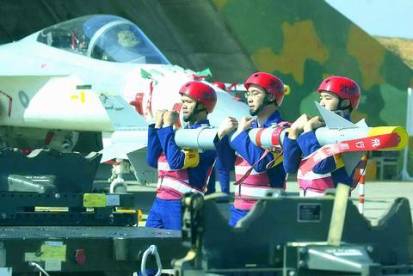
Three ground crew from the 427th fighter wing demonstrate the loading of missiles onto an IDF fighter jet during a military exercise held at an air base in Taichung, yesterday.
-----------------------------------------
On Jan. 8, 2004 ……
Missiles not part of the status quo
During a meeting on Tuesday with a US think tank delegation led by former US ambassador to China Stapleton Roy, President Chen Shui-bian reiterated that the "defensive referendum" he is planning to hold alongside the March 20 presidential election has nothing to do with the independence-unification issue. Chen also pointed out that referendums are a basic human right and universal value, and that he hoped to use the referendum to say "no" to China's military threat. The international community cannot accuse Taiwan of being a troublemaker just because it wants to say "no" to military threats, Chen said.
Chen's remarks gave voice to a humble wish of the Taiwanese people. We only want to be free from fear, as do the people of other free countries. But even a small action has invited groundless accusations from the international community.
For a long time, the Taiwanese people have lived in the shadow of China's military threats. In past elections, the Chinese Nationalist Party (KMT) and People First Party (PFP) always tried to magnify China's military threat and thereby hold Taiwanese voters hostage and restrict their choices. United as they are on the issue of military threats, China and the KMT-PFP forces have also used each other, thereby shaping a unique mechanism in Taiwanese politics: The KMT-PFP camp uses China's military threat to suppress the Democratic Progressive Party (DPP), thereby restricting the ability of Taiwan to enact political reform.
Because the KMT-PFP camp has a vested interest in China's military threats, it has long been an accomplice and even mouthpiece conveying such threats. When it comes to exhorting China to lay down the cleaver, the Taiwanese people can only rely on the reformist forces led by the DPP.
We are grateful that we can hold free elections in which parties can present their platforms at campaign events. Chen has now shone the spotlight on China's military threat -- the biggest psychological fetter for the Taiwanese people -- and asked the international community to voice its support for justice.
Unfortunately, the Taiwanese people's wish has not been understood. The US, Japan and the EU have all expressed concern about the referendum plan because they fear China's military might.
During the 50 years of KMT rule, the Taiwanese people never had a chance to say no to China. Over time, the international community seems to have taken any Chinese bullying of Taiwan for granted. When the Taiwanese people voice their fears, they are called "provocative" by the international community and Taiwan's own pro-unification camp.
Any visit by the head of state to countries that have no diplomatic ties with Taiwan is provocative. Even former president Lee Teng-hui's visits are provocative. Perhaps the very existence of the Taiwanese people is provocative.
US President George W. Bush said many times that he opposed any referendum aimed at changing the status quo. If Taiwan's anti-missile referendum is an attempt to change the status quo, then apparently the international community believes China's missile deployments against Taiwan are a reasonable status quo -- the Taiwanese people therefore should work hard to maintain it. It is simply absurd to view China's missile deployments as the cross-strait status quo and to discourage any change to it. The international community should show more understanding for the precarious situation facing the Taiwanese people.
-----------------------------------------
On Jan. 8, 2004 ……
Missile crisis worse than Cuba
Charles Hong, Columbus, Ohio
Your editorial ("Allies need to show some spine," Jan. 1, page 8) offers good advice to allies on how to deal with the referendum on China's missiles. As the Taiwanese expression goes, China is "an assailant calling for assistance" from Taiwan's allies.
Taiwan is under constant threat from China's ballistic missiles, which can reach their targets in seven minutes.
This situation is much graver than the Cuban missile crisis.
If US President John F. Kennedy could ask Russia to dismantle its Cuban-based missiles, why can't President Chen Shui-bian have a defensive referendum to ask China to dismantle theirs?
This referendum can prevent the missiles from altering the status quo.
If Taiwan's allies discourage this peaceful and democratic referendum from taking place, China will get the wrong impression and deploy more missiles, even targeting Japan and probably the west coast of the US.
Japan therefore should ask the UN to sponsor a plebiscite in Taiwan based on the principle of self-determination. In addition, Japan should support Taiwan's defensive referendum because this will stabilize the entire Asia-Pacific region, including Japan.
Taiwan will be happy to cancel its defensive referendum on March 20 if China dismantles its missiles, just like Libya is voluntarily dismantling its program for weapons of mass destruction.
The US, Japan and the EU should ask China, through a UN resolution, to renounce the use of force against Taiwan.
-----------------------------------------