20040109
=======
Reported on Jan. 9, 2004 ……
New SARS case feared in China
EPIDEMIC TERROR: Minutes after China's first SARS case this season had left hospital, authorities said a woman was suspected of having caught the atypical pneumonia
REUTERS , GUANGZHOU, CHINA
A waitress in southern China was declared a suspected SARS case yesterday, and in Hong Kong two members of a TV crew tested negative for the deadly virus, amid fears of an outbreak days ahead of Asia's biggest holiday.
China's Health Ministry said the 20-year-old waitress in Guangzhou, capital of Guangdong Province, was suspected of having severe acute respiratory syndrome after having been in hospital for nearly two weeks. A seafood restaurant was besieged by reporters after media reports identified it as the establishment where she worked.
"Forty-eight people who had close contact with her have been isolated and 52 others who had normal contacts have been observed," the provincial health department said.
None displayed SARS symptoms, which include a high fever and dry cough.
A 32-year-old television producer confirmed this week as China's first SARS case since last year and identified only as Luo has recovered and left hospital yesterday.
Three television workers from Hong Kong station TVB had visited an animal market and a hospital where Luo had been treated before they returned to Hong Kong on Dec. 30 with fevers. They were held in hospital isolation wards.
Two have since tested negative for SARS, a Hong Kong government spokesman said. Test results on the third were pending, he added.
The SARS scare is emerging just ahead of the Lunar New Year holidays, when an estimated 1.89 billion journeys are forecast to be made by rail, road, ship and air around China.
SARS killed about 800 people worldwide last year, nearly 350 of them in China.
Luo's case has been linked to a coronavirus also found in wild civet cats, prized as a delicacy in southern China and sold in crowded markets. He denies eating civet and the source of his infection remains a mystery, complicating the larger question of whether the virus has begun to spread again.
"They are still searching. They still have no answers," Beijing-based World Health Organization (WHO) spokesman Roy Wadia said.
Health officials this week banned the sale of civet cats and began a cull to prevent the spread of the disease, which has led to stepped up health screening at airports and border crossings in Asia.
Media reports said the waitress from the central province of Henan had been serving wild game, but provincial health officials declined to comment.
The woman first reported a fever on Dec. 26 and was receiving treatment under quarantine at the Guangzhou No. 8 People's Hospital, one of three city hospitals designated to handle SARS patients.
Shopkeepers near the seafood restaurant reported seeing men in white protective gear moving into the downtown building and of co-workers being held in a nearby shophouse before being taken away by bus.
The operators of the restaurant denied she worked there.
Authorities have stepped up protective measures for medical staff, provincial health officials said. A WHO team was on its way to Guangzhou to investigate.
"We think that there is at this
point no significant public health threat," said the WHO's Robert Breiman.
"What our interest is in now is to determine what sort of steps can be
taken to maintain that low public health risk."
China has given a Saturday deadline
for the slaughter of about 10,000 civet cats and has launched a rat and
cockroach extermination campaign.
With the return of the northern winter, health officials have been watching closely for a re-emergence of SARS, which experts say is spread by droplets in coughs and sneezes.
Two previous cases, in Singapore and Taiwan, were linked to medical research accidents.
Neighbors in Luo's apartment building at Riverview Gardens, a leafy 10,000-unit haven in a middle-class Guangzhou suburb, seemed unconcerned at his return.
"You read the papers and people say `wah, SARS,' but I say it's just another kind of flu," said Chen Qiuyou, a front desk guard. "So we don't know where it came from. What's the big deal?"
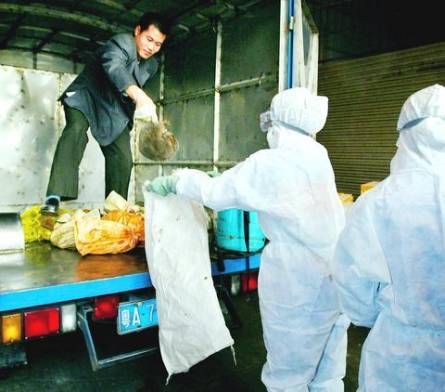
Chinese health workers conduct a rat extermination exercise at a wildlife market in Guangzhou, the capital of Guangdong Province, yesterday.
-----------------------------------------
On Jan. 9, 2004 ……
China has one SARS strategy: Slaughter every civet in sight
By Jim Yardley, NY TIMES NEWS SERVICE , GUANGZHOU, CHINA
The Xinyuan wild game market reeks of animal waste and death. Trucks arrive daily with animals jammed into cages -- cats, dogs, pigeons, boars, ostriches, even rats. The people who work in the market live in cages, too. They sleep above their shops, in tiny lofts with bars for walls.
When they awoke on Tuesday they ran squarely into the local government's new war against SARS. Animal-control officers in masks and smocks confiscated 148 animals, including civets, which some scientists believe are SARS carriers. The animals, relatives of the mongoose that would have ended up as a stew on local menus, earned no reprieve.
"All of them will be killed today," said Lian Junhang, a local forestry bureau official overseeing the roundup at Xinyuan.
The resolve of officials here in Guangdong Province to slaughter an estimated 10,000 civets and other animals as a preventive measure against SARS was on vivid display. Even as international health officials urged caution, Chinese media reported that local health workers in protective suits and goggles were plunging caged civets into pools of water and drowning them.
The extermination campaign, expected to be finished by tomorrow, came as state media announced that the 32-year-old SARS patient here whose case rekindled fears of another outbreak was to be released from hospital yesterday. He has recovered, though experts still do not know how he contracted the virus.
Guangdong officials decided on Monday to kill the civets hours after Chinese researchers announced that the local SARS patient had a new strain of SARS similar to one found in the ferret-like animal. But here at Xinyuan, the largest wild-game market in this provincial capital, people refuse to believe civets can spread SARS, just as few believe the government can totally prevent people here from eating them.
"It's going to continue," predicted Zhou Guanghong, who raises civets at a farm and sells them at Xinyuan.
"People will still eat them," he said.
His fellow merchants, playing cards on a day with no customers, shared his disgust with the government.
"I don't understand the government," complained a man who identified himself only as Mr. Tang.
"If it was for the sake of my health, I've been working here and I haven't had any problems. We're eating and living beside civets, and all of us are in good health," he said.
Nor were the merchants alone in their skepticism. On Monday night, experts from the World Health Organization cautioned that more scientific research was needed to definitively prove that SARS had spread to humans from civets. The health group, which has long called for strict regulation of wild-game markets, nonetheless warned that Guangdong should fully assess all risks to avoid infecting the people carrying out the slaughter.
But Guangdong officials, perhaps motivated by the harsh criticism they received for their botched handling of the initial outbreak last year, seemed determined to act aggressively. Officials reportedly even set up roadblocks on highways to catch anyone trying to smuggle civets out of the province.
"Guangdong is entering an extraordinary period and extraordinary measures are called for," Feng Liuxiang, deputy director of the provincial health bureau, told the Guangzhou Daily.
Lian, the forestry official at the Xinyuan market, said three animals -- not only civets but two lesser-known animals that Chinese health officials have linked to SARS, raccoon dogs and hog badgers -- had been singled out for extermination. All three were confiscated from the market on Tuesday.
National health officials have announced plans to further regulate wild-game markets and register people who work in them. But how long they will maintain their interest remains to be seen. A previous ban on selling civets in Guangdong, imposed last year after the SARS outbreak, was quietly removed in late summer under pressure from merchants after the virus was no longer deemed a threat.
The effort to better regulate workers was apparently under way at the market on Tuesday, though limitations were evident. Local medical workers took blood samples while the workers filled out questionnaires about which animals they handled and whether they had suffered from SARS symptoms.
One man, Li Zheng, 27, stood holding his arm.
"This is the fourth time I've given blood as part of a test around here," he said. He said that at the height of the SARS epidemic, as many as 80 percent of the workers gave blood samples, but that most had dropped out. He said he keeps doing it not because he fears SARS but because "it's a free medical checkup."
Workers like Li repeatedly point out that no one in the Xinyuan market, not even those bitten by civets, had ever contracted SARS. But the market would seem to make an ideal breeding ground for any number of diseases.
One employee estimated that over 1,000 people live and work at Xinyuan, and the proximity between people and animals is very close. A young mother nursed her infant in a plastic chair not far from animal cages. Toddlers ran on concrete littered with animal entrails, bird droppings and even dead chickens and rabbits. At one shop, a man skinned a dog as blood trickled onto the ground.
The one visible effort at hygiene came at the end of the day when two men in smocks passed through the market, spraying disinfectant.
The conditions endured by the animals at Xinyuan and other wild-animal markets have long been condemned as barbaric by animal rights activists. On Tuesday, a large truck delivered a shipment of dogs from Henan province that eventually will be eaten. Dealers had jammed as many as three dogs, some large, into cages roughly 30cm by 90cm.
There were hundreds of cats that also would be sold for meat, many of them pressed so tightly into cages that they seemed indistinguishable from one another. A dealer bringing in a shipment of cats simply hurled the cages off the top of a truck down onto the ground.
Winter is considered the peak season for civet sales. The price of civets rose during the 1990s as more wealth poured into Guangdong, and dealers say they can make a nice profit on the animals. In all, dealers selling civets to restaurants might earn more than US$200 a month, far more than they could earn from farming.
But they say SARS has devastated the civet market and also badly damaged sales for wild food.
"I've got to go back to farming again," said Tang, the man playing cards.
"There is no more business anymore. Business stopped a few days ago," he said.
The large amounts of money involved -- one estimate valued the wild-game market in China at US$100 million annually -- leads many experts to worry that an unregulated black market could emerge. The difficulties for Guangzhou in enforcing its ban are obvious: Many civets are farmed in neighboring provinces with no such restrictions.
Meanwhile, dealers at Xinyuan believe the government has simply gone too far.
"Are you still eating beef?" asked Xiong Xianming, a dealer.
"You're an American and you've got mad cow disease in America? Does this mean you're going to kill every cow in America?" he asked.
-----------------------------------------
On Jan. 9, 2004 ……
Analyst says that US will accept Chen's referendum
William Kristol, chairman of the Project for a New American Century, a US thick tank, and also the editor of the influential Washington-based political magazine 'The Weekly Standard,' is in Taipei for the US-Japan-Taiwan Trilateral Strategic Dialogue conference, Recognized as one of the US' leading political analysts, Kristol spoke to 'Taipei Times' reporter Stephaine Wen on the current status of the US-Taiwan relationship and the prospect of a new US policy on Taiwan
By Stephaine Wen, STAFF REPORTER
Taipei Times: No doubt you've been asked about the defensive referendum issue. Now, the content and wording of the defensive referendum are not yet finalized. When the referendum is finalized at the end of this month, and should the content not seek to affect the status quo, do you think the US administration will support it?
William Kristol: I think the US administration will accept it. I think that is an important distinction. Taiwan is a democracy and the US is a democracy. Taiwan should make its own decisions about referendums on matters that the US really shouldn't pass judgments on and intervene in, unless it crosses some line, unless it changes the fundamental premise of the US-Taiwan relationship or causes policy troubles for the US. But this is a defensive referendum, it doesn't challenge the status quo, it doesn't involve independence. And it seems certain to happen.
[President Chen Shui-bian] will go ahead with the referendum and he will decide on the language. I hope he decides sooner than later because I think the uncertainty does some damage. People who don't wish the US-Taiwan relationship well can put a negative interpretation on what's going to happen.
Once we have the language I think everyone will see that it is defensive, and there is nothing to be alarmed about.
I think the US administration will say, `Fine, go ahead with the referendum.' I don't think you should expect the US administration to praise it, but I think they will accept it. And I think they will tell Asia that any use of force is unacceptable.
TT: According to an article a few
days ago, the Presidential Office thinks that the US administration is less
concerned about the defensive referendum now than the new constitution which
Chen has proposed, because it is closer to the presidential election in US.
What is your view on that?
Kristol: Well, I think now we should get over the misunderstandings on the defensive referendum. I think you should get your election done and we should get our election done.
I think there has to be a general rethinking of US policy, or the "one China" policy that was left over from another era. Taiwan was not a democracy when the world was a different place an era ago.
It's time for fresh thinking. But I think that is the agenda for 2005 more than for 2004.
I think the US administration will aim to keep things stable and Taiwan will progress with its democracy. But the question of looking into the future, at whether [the US'] China policy still makes sense, I don't think it's an issue that people will want to address this year really.
TT: So, say Chen gets re-elected and
he has already proposed a new constitution which will require a reconsideration
of the structure of Taiwan...
Kristol: I think that will force us then to have some fresh thinking in 2005. And that will be a healthy thing.
You can't feed the past. And you shouldn't try to. I don't think that's a debate we have to have in the next two or three months. I think that will become a big issue in 2005 and 2006.
The Bush administration will end up deciding that of course Taiwan is entitled to have a new constitution.
It's ridiculous for Taiwan to have a Constitution from 50 years ago which is not suited to the current Taiwan. I think the US will be happy to work with Taiwan whenever we are needed but I don't think we are going to have a problem with a new constitution.
TT: You met with Chen this morning.
Were you satisfied with his explanation [of his position]?
Kristol: Very much so. I think President Bush would be satisfied. Because I think there were some uncertainties and misunderstandings a few weeks ago as to what the referendum would be about. Chen made it clear that the defensive referendum would not change the status quo.
I think when that's communicated directly to Bush in the next few weeks, I think that will help resolve the uncertainties in the relationship. I thought Chen was very strong on that and certainly made a very strong case for why the referendum is appropriate, and made the point that after all the threat to peace was not from the democratic referendum but from the 500 missiles.
TT: Last year Chen shocked the
international media and the Bush administration with the announcement of
"one country on each side of the Strait," a referendum on entry into
the World Health Organization, a new constitution and then the defensive
referendum. What do you think the current status of the relationship between
the US and Taiwanese governments is? Is the Bush administration still able to trust
Chen's administration?
Kristol: I think very much so. President Chen has held to his commitments. This referendum issue shouldn't tear us apart. The reason for this controversy is because some people were surprised by President Chen, and Beijing obviously saw this as an opportunity to set up discord between the US and Taiwan. And I think unfortunately it succeeded to a small degree in confusing some people in the US who keep thinking that President Chen was trying to disrupt the situation, without realizing that it's not true.
I don't think this is a crisis and I strongly reject the notion that there is a crisis in the US-Taiwan relationship. No one I talk to in Washington believes that. I would expect this moderate problem to pass in the next few weeks. You will go ahead with your election, we will go ahead with ours.
TT: Some people think that because of
the role China plays in the six-party talks on the nuclear issue in North
Korea, power relations between the US, China and other nations have tilted
slightly. Is the US being friendly toward China because of their role in the
talks?
Kristol: A little bit. I think the US would want China's cooperation with [North] Korea, and generally the Bush administration has its hands full with the situation in the Middle East and Iraq. I think the Bush administration understands that the worst thing in East Asia would be to invite adventurism, or to give the impression that bullying works or that you can intimidate Taiwan or intimidate the US.
We'll see what happens with North Korea. It's not so clear that China is very helpful.
TT: Do you think democratization in
Taiwan has anything to do with security in the Taiwan Strait and thus the
security of the Asia-Pacific region?
Kristol: Yes, well, I think a democratized Taiwan is a much more stable partner for the US. I think that's true for a lot of countries as well. Therefore, not only with the Taiwan Strait but more importantly for the region as a whole, we now have a network of democracies with Japan, Taiwan, the Philippines, Australia and others. I think the US commitment is very important in supporting this democracy ... and ultimately extending this democracy. I think democratization in Taiwan is one of the most important facts about East Asia in the last 25 years.
It may not yet be reflected in the official policy, which is still left over from the period of pre-democratic Taiwan.
And that's why I say it's got to change.
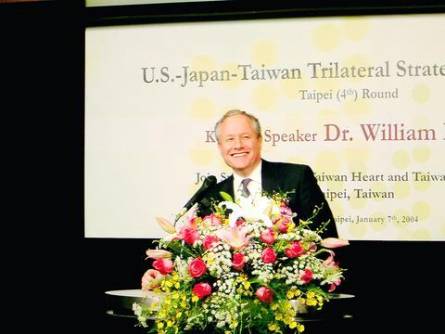
William Kristol, editor of 'The Weekly Standard' and a well-known foreign policy analyst, speaks on US-Taiwan relations at the US-Japan-Taiwan Trilateral Strategic Dialogue conference in Taipei on Wednesday.
-----------------------------------------
On Jan. 9, 2004 ……
At conference, Kristol calls US' Taiwan policy `outdated'
IN WITH THE NEW: The prominent US analyst spoke at the US-Japan-Taiwan Trilateral Strategic Dialogue Conference, saying that US policy on Taiwan has failed to adapt
By Stephanie Wen, STAFF REPORTER
The confusion and uncertainty in the US' policy toward China and Taiwan are only transitional, according to William Kristol, one of the keynote speakers who appeared at Wednesday night's session of the US-Japan-Taiwan Trilateral Strategic Dialogue conference in Taipei.
Kristol made the remark during a speech on "the Bush doctrine and its implications for Taiwan's democracy," in which Kristol discussed his belief that the US upholds democracy in other parts of the world but not in this part of Asia.
Kristol said the attacks of Sept. 11, 2001 began a new historical era and that in response to the attacks, US President George W. Bush has articulated what is called "the Bush doctrine" of US foreign policy.
"The two main aspects of the doctrine are strength and democracy. Strength -- because of the lessons of Sept. 11 -- not that the US has become too imperial but whether the US has become too weak or slow to react. And secondly, democracy is closely tied to peace."
"The US administration is most focused on issues that are most urgent," Kristol said, referring to the Middle East. "But in other parts of the world, the US administration aims to stabilize regions rather than adjusting its policies according to new realities."
Kristol said the US' policy toward China and Taiwan needs reconsideration in light of the development of Taiwan's democracy.
Referring to a speech made by US Secretary of State Colin Powell two weeks before the US visit of Chinese Premier Wen Jiabao last November, in which Powell said that the US remains committed to the "one-China" policy and its own responsibilities according to the Taiwan Relations Act, and that the US does not support Taiwanese independence -- Kristol said that the US's policy toward China and Taiwan is outdated.
"China and Taiwan in the past
were very different from how they are today. The world has changed a whole lot
and Taiwan has changed a lot. We will have to adjust our policy in the new
century.
"But we can only do so much at once," Kristol said. "Principles we stand by so strongly in other parts of the world -- strength and democracy -- we don't comply with so strongly in this part of the world. But for now, we are committed to the status quo of the region, and that's not such a bad thing.
"Policy will change in the next few years in a positive way because the status quo has changed, "Kristol predicted.
-----------------------------------------
On Jan. 9, 2004 ……
-----------------------------------------
On Jan. 9, 2004 ……
Taiwan is not China's concubine
By Liu Kuan-teh
President Chen Shui-bian has said on several occasions that he will hold a "defensive referendum" as scheduled on the day of the presidential election on March 20, despite the pressure on him to call it off.
While the opposition parties have portrayed Chen's moves to hold a referendum as walking on a tightrope and pushing the nation's 23 million people to the brink of war with China, more attention must be paid to Chen's New Year address.
There are four main messages contained in the speech.
First, Chen emphasized that over the past three years, with the utmost sincerity and goodwill, his administration has made efforts to create a positive environment for cross-strait relations, based on the principles of reconciliation, cooperation and peace. Most people tend to overlook how little goodwill Chen has received from his counterparts in Beijing in response.
Despite the absence of a response from China, the Chen administration has consistently taken the approach of a "firm position advanced pragmatically" in its constant promotion of cultural, economic and political interaction. In this regard, when it comes to the question of how to break the cross-strait deadlock, the international community, including the US, should take into account how China has ignored Chen's olive branch.
Second, Chen stated the fact that
people in both countries share common ancestors, a similar cultural heritage
and closely related history. This constitutes the basis for people across the
Taiwan Strait to pursue reconciliation, instead of political confrontation.
This is another goodwill gesture on the part of Taiwan's president that could
open a window of opportunity for cross-strait rapprochement.
Third, Chen called on Beijing to accept the democratic choice made by the people of Taiwan in the upcoming presidential election. China has adopted a strategy of watching Chen's words and actions while bypassing his administration in cross-strait interaction, but there is no chance that the Chinese leadership can avoid reopening bilateral talks with Taiwan -- even if Chen is re-elected.
Finally, and most importantly, Chen answered questions raised by some people about the legitimacy of the defensive referendum. While some contend that there is no need to ask the Taiwanese people to vote on a question that might attract 99 percent support, Chen's message has both symbolic and policy implications.
Not only would it demonstrate that the referendum is a manifestation of the people's will to urge China to renounce the use of force and its missile threat, it is also consistent with his emerging cross-strait plan.
Chen stressed that "leaders of both Taiwan and China will have a historic opportunity to demonstrate their wisdom in creating a brand new vision for economic cooperation and political reconciliation across the Strait, thereby making the greatest contribution to the prosperity of the peoples on both sides." This may be an unsurprising statement, but it comes with new meaning.
It suggests that a "window of opportunity" will reopen after the election, when China will have no choice but to deal with the re-elected Chen. Even if it has to deal with a resurgent Lien Chan, Beijing will have to grasp the new reality of Taiwan's political situation. That is, a growing independent consciousness and a democratic free society.
Whoever wins the presidential election must listen to the new voice of Taiwan. And the fact is, the pan-blue camp has been tilting toward the pan-green camp on issues of national identification. Lien Chan even publicly endorsed the notion of "one country on each side" of the Taiwan Strait. The pan-blue camp also called for Beijing to withdraw the missiles aimed at Taiwan. What Beijing must recognize is the new mandate that exists in Taiwan. It can no longer treat the nation like a concubine.
Liu Kuan-teh is a Taipei-based political commentator.
-----------------------------------------
On Jan. 9, 2004 ……
Bush's shift is all politics
By Jason Lee Boon Hong, Singapore
I am disappointed with the US' accusation that President Chen Shui-bian is being inconsistent on his referendum planned for March 20 ("US says Chen admin inconsistent," Jan. 4, page 1).
While I supported former US vice president Al Gore's election bid in November 2000, I was heartened after President George W. Bush seemed cordial and warm in his approach toward Taiwan, especially in the first two years after assuming office.
However, Bush's administration seems to have shifted its approach in recent months.
Isn't it crystal clear that Chen's referendum is solely to let the Taiwanese people determine if China's missiles seem threatening?
How can anyone in his or her right mind perceive that as a step toward altering the status quo?
The Bush administration should instead warn the Chinese against any threat toward the nation, whether verbal, virtual or simulated.
As an advocate of democracy and freedom, it is ironic that the US has downplayed the significance and importance of Chen's planned referendum. But in reality, are the recent actions of the Bush administration a true reflection of its beliefs and ideologies?
I doubt it. Bush is facing an election in 10 months' time. The economic gloom and high rate of unemployment in the US, as well as mass opposition to the wars in Afghanistan and Iraq, might help his Democratic rival win more votes.
While Bush can do little to salvage the political setbacks he has suffered as a result of the wars, he is aware that he could do much more to lift the US economy and reduce the unemployment rate.
One approach is to maintain positive trade ties with China.
Any retaliatory trade moves from China would only be detrimental to improving the US economy, which in turn would help the Democratic candidate.
As such, the Bush administration is conveniently muting, for the time being, its staunch belief in democracy and freedom to serve its own political objectives.
Indeed, from Bush's viewpoint, now is certainly not the time to antagonize the Chinese Communists.
Perhaps Taiwanese voters should take the warnings from the US and China with a grain of salt.
Former president Lee Teng-hui has said, "Taiwan's democratic development depends on the public will" ("Lee takes aim at pan-blue ticket," Jan. 4, page 2). I could not agree more.
It is indeed the right of the Taiwanese to chart their own political, economic and social destiny.
The presidential election on March 20 offers the voters the opportunity to do so.
They should vote for the candidates whose character and conduct have been exemplary, and not for the those who conveniently shift their beliefs to win votes.
Most importantly, voters must not base their choice on actions by China or the US, but on what has occurred in Taiwan over the past few years. On this note, I would personally agree with Lee that "Only with A-bian can an administration be established that takes Taiwan as its starting point. This is the direction in which Taiwan should head."
My own observation is that the US administration shares this thinking.
However, for the sake of Bush's political career, the US administration has little choice but to adhere to the wishes of China.
Nonetheless, the Chinese government has failed to comprehend that it is Taiwanese people who will decide on their future, and no amount of pressure or threats from any external party can affect their decision.
Prove me right, Taiwanese voters.
-----------------------------------------
On Jan. 9, 2004 ……
Democracy groups blast Tung
COMMUNIST PUPPET: Activists are furious after the unpopular Hong Kong leader said in a speech that any reforms would have to be approved by Beijing
AFP , HONG KONG
Pro-democracy groups lashed out at Hong Kong's government yesterday, accusing Chief Executive Tung Chee-hwa of kowtowing to China over political reforms and "totally disregarding" public opinion.
Campaigners demanding a swift transition to full democracy in the territory received a stinging setback on Wednesday, after Tung skirted around the issue in his annual policy address.
Tung revealed in his address that he had consulted China's rulers over any political reforms in the territory and announced the setting up of a task force charged with addressing Beijing's concerns.
The move infuriated pro-democracy campaigners, saying the decision to consult Beijing threatened Hong Kong's autonomy under its post-1997 constitution.
Lawmaker Lee Cheuk-ywan said Tung's failure to issue a timetable for reform showed he was "hopelessly out of touch" with public sentiment in Hong Kong, where hundreds of thousands of protesters have rallied in recent months.
"The speech did not offer one concrete measure to address the demands of the people who turned out on July 1 and the New Year's Day rally calling for direct elections for the chief executive and a timetable for change, not one," Lee fumed.
Tung's failure to address public demands and the confirmation that Beijing will be consulted first on reforms "shows Beijing's views are far more important than those of the public," Lee added.
China hailed Tung's address as "reliable and feasible," and took the unusual step of issuing a statement after the speech emphasizing that any changes to Hong Kong's constitution must be cleared by Beijing.
The statement drew fierce criticism from the pro-democracy camp. Democratic Party chairman Yeung Sum said the move was a huge blow and a major "snub to the wishes of the public."
"The announcement has left a black cloud hanging over constitutional reform. We can't believe Tung said the issue of whether we can or cannot have universal suffrage in Hong Kong needs to be first cleared by Beijing," Yeung said.
"That [statement] has put a brake on the move toward full democracy."
Hong Kong university analyst Sonny Lo said Tung's decision had further worsened the chief executive's credibility, who has seen his popularity plunge over the SARS crisis last year and proposed security legislation.
More than 500,000 protesters rallied last July to denounce the Beijing-backed security bill, which critics said would curtail freedoms and rights, forcing Tung to withdraw the legislation indefinitely.
"If the government consults with Beijing first on reforms, there is a real risk Hong Kong could undermine its own autonomy under `one country two systems,'" Lo said.
"Tung has to be careful not to do this ... but the government is politically sandwiched between the demands of one country and those of two systems," Lo added.
The pro-democracy camp wants the government and Beijing to commit to a firm timetable for implementing reforms.
This would include direct elections of Hong Kong's next leader by 2007 and the legislature a year later, the earliest dates permitted under the city's post-1997 constitution.
Tung, selected by an 800-member election committee loyal to Beijing, currently heads a legislature in which only 30 of the 60 seats are directly elected -- ensuring pro-government lawmakers dominate.
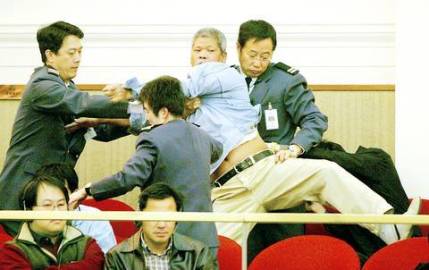
A protester is dragged away by security guards at Hong Kong's Legislative Council after chanting slogans at Hong Kong Chief Executive Tung Chee-hwa during a question-and-answer session yesterday. Hong Kong's deeply unpopular leader ducked growing calls for full democracy on Wednesday and said he would have to first consult Beijing, setting the stage for more protests by an increasingly angry public.
-----------------------------------------
On Jan. 9, 2004 ……
US Congress set to affirm Taiwan ties
FRIENDS IN THE US: Following US President George W. Bush's stern words for Taiwan's leader, the US Congress is preparing a wide-ranging resolution supporting Chen
By Charles Snyder, STAFF REPORTER
Taiwan supporters in the US Congress are preparing to introduce a sweeping resolution in support of Taiwan when they reassemble later this month after an extended year-end holiday break.
Prospects for such a bill have unnerved China, prompting its US ambassador last month to send a letter to all members of Congress urging them to reject the planned legislation.
The resolution will endorse President Chen Shui-bian's plan for an election-day referendum on China's missile threat, demand China renounce the use of force against Taiwan and recognize Taiwan's separate status from China, according to people familiar with the efforts to frame the resolution.
The measure will be based on a bill approved nearly unanimously by the House of Representatives in July 1998 in response to then president Bill Clinton's declaration of his "three noes" policy during a visit to Shanghai the previous month.
Many in Washington at the time felt that Clinton's declaration marked a sharp departure in America's underlying support for Taiwan and a basic shift in US policy.
The "three noes" rejected Taiwan independence, a "one China, one Taiwan" policy and Taiwan membership in international bodies requiring statehood for membership.
The planned bill will respond to President George W. Bush's public personal rebuke of Chen and his referendum plan after his Dec. 9 White House meeting with visiting Chinese premier Wen Jiabao, which came just as Congress was wrapping up last year's session.
That statement, many Taiwan backers in Washington -- including Bush's conservative supporters -- felt, marked an unsavory accommodation of Beijing's wishes at the expense of Taiwan. Many saw parallels between Bush's and Clinton's pronouncements.
What will be different from the 1998 resolution will be a statement of support for the referendum and the condemnation of the Chinese missile buildup across the Strait from Taiwan, which were not present as issues in 1998.
While the wording of the planned referendum is not yet finalized, the 1998 measure recognized that at no time since the People's Republic of China was established in 1949 has Taiwan been under its control.
It affirmed US commitment to Taiwan under the Taiwan Relations Act, called for settlement of cross-strait relations by peaceful means, committed Washington to supply Taiwan with arms sufficient for its self defense, sought a renunciation of the use of force by China and supported Taiwan's membership in international organizations. The 1998 bill also referred to Taiwan as "one of the world's premier democracies."
In addition to the planned resolution, a separate resolution introduced last November in support of the referendum is now before the House International Relations Committee, but it's fate is uncertain.
In his letter, dated Dec. 30, Chinese Ambassador Yang Jiechi urged the members of Congress to "prevent the above-mentioned draft resolution from passage in the US Congress."
He said the bill "runs counter to the relevant commitment of the United States Government" in its "one China" policy, and its commitments in the three US-China communiques.
"Facts have shown," Yang wrote, "that Chen Shui-bian is a trouble-maker. He cares about nothing but his own political agenda, ie `Taiwan independence' and his own re-election."
The letter appears to be unprecedented. No previous Chinese ambassador is known to have made such a direct lobbying effort to Congress to reject a legislative initiative involving Taiwan.
Yang also made reference to a possible meeting with members of Congress, but the Chinese Embassy's spokesman, Sun Weide, said he knew of no such meeting. Sun also denied knowledge of Yang's letter.
Meanwhile, a group of House members are expected to clarify US policy toward Taiwan when they visit Taipei next week to attend an international parliamentary exchange meeting that is expected to bring legislators from some 50 countries to the city.
Florida Democrat Robert Wexler, a co-chairman of the Congressional Taiwan Caucus, will lead the group and will present an address to the assembly at a luncheon with Vice President Annette Lu on Wednesday. In addition to Wexler, Ohio Republican Steve Chabot, another caucus co-chairman, will be part of the delegation, as will Gary Acker-man, a New York Democrat.
Congress reconvenes on Jan. 20.
-----------------------------------------