20040110
=======
Reported on Jan. 10, 2004 ……
Powell defends Bush's handling of referendum
"When Premier Wen was here, the
president gave him a solid message of reassurance with respect to our
policies." --- Colin Powell, US secretary of state
`HEARD AND RECEIVED': The US secretary of state insisted George W. Bush's message to Chen Shui-bian on Dec. 9 was clear, but did not state any specifics of US concerns
By Charles Snyder, STAFF REPORTER IN WASHINGTON
US Secretary of State Colin Powell Thursday defended President George W. Bush's handling of the Taiwan referendum issue, saying the message that Bush gave President Chen Shui-bian last month had been "heard and received."
Powell made his comment in response to a question at a Department of State press conference.
"The president spoke so clearly and forcefully in support of our `one China' policy" in his comments during a meeting with Chinese Premier Wen Jiabao on Dec. 9 that "the message was heard and received" by Chen, Powell said.
"We will see how Taiwan works itself through the referendum idea a little later on in the spring," Powell said.
"I think we've handled this very well. And when Premier Wen was here, the president gave him a solid message of reassurance with respect to our policies and what we thought the right solution was," he said.
Powell's remarks were intended to answer criticism of Bush's handling of the referendum issue by Kenneth Lieberthal, the top Asia expert in the National Security Council under the Clinton administration.
In an op-ed piece in Thursday's Washington Post, Lieberthal, now a University of Michigan professor, complained that Bush's warning during the Wen meeting "has had no discernible effect on Chen's thinking or actions. Almost immediately after the statement, Chen declared that in essence Bush did not mean what he said."
Lieberthal accused the Bush administration of sending mixed messages to Taiwan and, as a result, increasing the possibility of a disastrous blowup in the Taiwan Strait that could lead to armed conflict between the US and China.
"Unfortunately, the White House has had no visible follow-up strategy since its warning to Chen," Lieberthal wrote.
In response, Powell said that Bush's message was so clear that, "I don't know that he had to repeat the message."
During a meeting with Wen on Dec. 9, Bush said, "We oppose any unilateral decision by either China or Taiwan to change the status quo."
And, in a direct rebuke to Chen, Bush added, "The comments and actions made by the leader of Taiwan indicate that he may be willing to make decisions unilaterally to change the status quo, which we oppose."
At the same briefing, Bush did not object or correct Wen when he said that Bush told him the administration "opposes" Taiwan independence.
Bush and other members of his administration have avoided using that word, saying rather that the US "does not support" independence.
-----------------------------------------
On Jan. 10, 2004 ……
Referendum delegation postpones trip
By Cody Yiu, STAFF REPORTER , WITH REUTERS
The nation has postponed sending a delegation to the US to explain the "defensive referendum."
Presidential Office Deputy Secretary-General Joseph Wu said yesterday there was no need for the delegation, which was set to depart today, to go to the US because relations between the two countries are stable and the visit would not have had much effect.
According to Wu, the head of the delegation, there has been constant and effective communication between the Taiwanese and US governments and many Washington-based think tanks have sent experts to Taiwan.
"I believe that once the referendum questions have been revealed, the US will not take an opposing stand. The US' utmost concern is whether Taiwan is conducting an independence referendum, and we have already assured the US that such a referendum will not take place," Wu said.
Wu said Taiwan hopes the referendum will win the support of the US government.
The delegation had planned to set off this weekend and make stops in New York, Boston, Washington and San Francisco. The purpose was to meet with media, think tanks and possibly US government officials.
Wu dismissed speculation that US officials had refused to receive the group.
According to a Chinese-language newspaper, sources at the Presidential Office said the visit was not to include official meetings with US officials; however, if unofficial meetings were to take place, the officials should not be in high-ranking positions.
Wu said the trip had the potential to touch off a media frenzy.
According to Wu, the US was concerned that if news regarding the delegation became overexposed, American officials would have been put on the spot and faced a barrage of questions by the media.
Wu said the while the US sees the big picture with regard to the referendum, it does not yet know the details.
"The US is concerned with whether any of its responses will meet the expectations of or benefit Taiwan. Furthermore, prior to the presidential election in Taiwan, anything the US government states might be used to the advantage of the pan-blue or pan-green camps," Wu said.
According to Wu, low-key, continual interaction between Taiwan and US think tanks is the best way to communicate.
He warned that a high-profile visit by the delegation would have resulted in political fights.
Although the delegation's trip to the US has been deferred, the country still plans to send delegations to Europe and Asian countries as planned.
-----------------------------------------
On Jan. 10, 2004 ……
Hunger strike over smaller government to go ahead
"Since Lien Chan previously
expressed sincere support for the bill, it will be very strange if the KMT,
which has a majority in the legislature, failed to pass the constitutional
amendment proposal by the end of the current session." --- Lin
Yi-hsiung, former DPP chairman
By Chang Yun-ping, STAFF REPORTER
Former Democratic Progressive Party (DPP) chairman Lin Yi-hsiung said yesterday that he and others who support passing a constitutional amendment to reduce the number of seats in the Legislative Yuan will stage a five-day hunger strike to protest the Chinese Nationalist Party's (KMT) failure to deliver on promises to pass a key legislative proposal to reduce the number of legislative seats.
Lin, a staunch advocate of reducing the number of seats in the legislature from the current 225 to 113, said yesterday at the DPP headquarters that the hunger strike is scheduled to begin on Monday and continue through Jan. 17.
"KMT Chairman Lien Chan previously agreed to support the plan," Lin said.
"Such a consensus among parties of all kinds represented a very rare moment in Taiwan's political history. Unless they [the pan-blue lawmakers] purposefully make things difficult, there is no reason why they can't finish the bill in the current legislative session. We shouldn't have to postpone it until the next session," he said.
Passing the stalled bill would involve amending the Constitution, which would require convening the constitutional amendment committee.
The committee can be convened only after the legislature decides on its composition, which cannot happen until the legislature passes a proposal to amend the Constitution.
According to a legislative decision yesterday, the bill amending the Constitution will not be addressed in this legislative session, but instead in the session that will begin on Feb. 6.
Lin, executive director of the Nuclear [Plant] 4 Referendum Initiative Association, yesterday urged the DPP to continue pushing for passage of the bill and to push for a legislative resolution that would make Taiwan a nuclear-free country.
Lin said that the plan to reduce the size of the legislature was only the second bill in Taiwan's political history that gained the unanimous support of political parties.
The first was the 1994 bill that led to the abolishment of the election for national assembly representatives.
"The pan-blue parties shouldn't have taken advantage of technical tactics to impede the bill and undermine the people's expectations. Since Lien Chan previously expressed sincere support for the bill, it will be very strange if the KMT, which has a majority in the legislature, fails to pass the constitutional amendment proposal by the end of the current session," Lin said.
The technical tactics that Lin referred to were the pan-blue lawmakers' opposition yesterday to allow the bill to be given a second reading in the legislature. Going forward with the second reading would have bypassed the convening of the constitutional amendment committee, which has stalled due to resistance from pan-blue lawmakers.
The pan-blue lawmakers yesterday rejected the DPP's proposal to allow the legislature's general assembly to handle the second review of the bill, insisting that the constitutional amendment committee must do the review in order to comply with regulations governing constitutional amendments.
The Nuclear [Plant] 4 Referendum Initiative Association issued a statement yesterday saying that members of the association will stage a five-day hunger strike from Jan. 12 to Jan. 17 in front of the KMT headquarters, demanding that the KMT support revising the Referendum Law, pass the bill that would reduce the number of seats in the legislature and pass a resolution that would make Taiwan a nuclear-free country.
DPP Secretary General Chang Chun-hsiung said yesterday that the party will initiate a campaign in which President Chen Shui-bian and Vice President Annette Lu will join a nationwide campaign to deliver leaflets to promote plans to reduce the size of the legislature and to establish a nuclear-free Taiwan.
-----------------------------------------
On Jan. 10, 2004 ……
Mass brawl in legislature as pan-blues block reform
FRACAS: The DPP had hoped to make progress on three reform-based bills, but a U-turn by the KMT and PFP sparked some ugly scenes on the legislative floor
By Fiona Lu, STAFF REPORTER
The Legislative Yuan played host to a mass brawl yesterday after pan-blue lawmakers incensed the Democratic Progressive Party (DPP) by blocking the speeding up of a raft of reform bills.
Cashing in on their numerical advantage in the legislative, opposition Chinese Nationalist Party (KMT) and People First Party (PFP) members vetoed a DPP motion to create an extraordinary session to deal with a proposed political donation law, draft political party law and draft statute regarding the disposition of assets improperly gained by political parties. Yesterday's meeting was the last of the current legislative session that is scheduled to end next Tuesday.
The pan-blue parties also said no to a proposal aimed at moving toward a constitutional revision to halve the 225-seat legislature.
The DPP was eager to advance the agenda because the setting up of a committee to which the reform bills were intended to be referred was unlikely to take place before the end of the legislative session.
Brandishing a camera and snapping pictures of KMT and PFP lawmakers, DPP Legislator Lo Wen-chia blasted his pan-blue colleagues for going back on an earlier promise to endorse the amendments.
"The KMT and PFP's denial over the proposed advancement of the bills runs counter to their pledge of solving in the legislature the problem of disputed party assets at an earlier date," Lo said.
"I am therefore taking pictures to witness the moment when the KMT and PFP members revealed their about-face by voting against the DPP proposal," Lo said.
The act, however, upset PFP whip Chou Hsi-wei, who ran after Lo to stop him from taking pictures. The dispute sparked a rowdy confrontation between pan-blue and pan-green lawmakers on the legislative floor.
During the fracas, DPP Legislator Wang Shu-hui pushed KMT Legislator Yu Yueh-hsia, who shouted "DPP lawmakers are pigs."
DPP legislative leader Chen Chi-mai later said that Yu needed "to apologize to these pigs."
The KMT and PFP also blocked the ruling party from pushing for a special legislative session to be held after the scheduled recess.
Executive Yuan and DPP caucus leaders had hoped that the Legislative Yuan would have an extra meeting before Lunar New Year to cope with the proposed NT$500 billion special budget as well as to push ahead with the downsizing of the legislature and one piece of financial legislation that has been stuck on the legislative floor for some time.
Pan-blue parties secured 106 votes to deny the DPP proposal, with only 83 lawmakers saying yes. The legislature instead resolved that lawmakers would convene a new session at an earlier date.
The new session will begin three weeks early on Feb. 6.
The DPP whip, however, was firm that the DPP would petition for the extra legislative sitting.
"The Legislative Yuan should round out the tasks that it ought to finish this year before the Lunar New Year and not delay these tasks until next year," Chen said.
After a marathon round of voting in the morning, lawmakers later gave the green light to the liberalization of the production and trading of salt.
-----------------------------------------
On Jan. 10, 2004 ……
DPP, KMT keep fighting over assets
"In accordance with [first lady]
Wu Shu-chen's suggestion, whoever makes false claims or can't provide evidence
to substantiate their claims should announce their withdrawal from the
[upcoming presidential] race." --- Lin Fong-cheng, KMT
secretary-general
BACK AND FORTH: The pan-blue camp cited tax records to disprove claims about Lien Chan's assets, while their rivals ran front-page ads questioning his honesty
By Huang Tai-lin, STAFF REPORTER
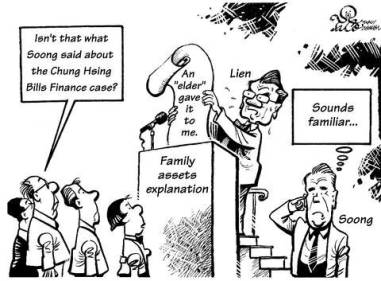
The Democratic Progressive Party (DPP) and Chinese Nationalist Party (KMT) yesterday continued trading claims over KMT Chairman Lien Chan's assets.
While the KMT held a press conference to rebut the DPP's claim that Lien had owned real estate with a total area of 20,000 ping in 1989, the DPP launched a new attack involving Lien's assets with an ad campaign meant to cast doubt on Lien's integrity.
At a news conference held at the KMT-People First Party (PFP) alliance's national headquarters in Taipei, KMT Secretary-General Lin Fong-cheng displayed a taxation document from 1989 to disprove the DPP's claims.
Lin said the tax records show that Lien owned real estate with an area of only 228 ping in that year.
The DPP on Thursday published 200,000 copies of an updated booklet detailing its claims about the manner in which Lien and his father had amassed their family fortune. According to the booklet, Lien had failed to mention the 200,000 ping of real estate controlled by enterprises related to his family when he disclosed the value of his assets last week.
"In accordance with [first lady] Wu Shu-chen's suggestion, whoever makes false claims or can't provide evidence to substantiate their claims should announce their withdrawal from the [upcoming presidential] race," Lin said.
Lin was referring to Wu's statement last week that if Lien could prove his claims that President Chen Shui-bian has accepted kickbacks or bribes, she would ask her husband to withdraw his re-election bid for the upcoming election. Likewise, Wu said, Lien should withdraw from the presidential election if he can't prove his accusation.
At yesterday's news conference, pan-blue alliance spokesman Alex Tsai was critical of Wu's dealing in stocks.
"Never before have we had a first lady like Wu who is so active in the stock market," Tsai said, raising the question of whether she had used the same stock management team that is overseeing the government's National Stabilization Fund.
Tsai urged Wu to publicize the names of those who help to manage her stocks to prove that she is not using the stabilization fund's managers.
Meanwhile, the DPP yesterday continued its attack on Lien with a newspaper ad questioning the KMT chairman's honesty regarding the value of his assets.
The half-page ad, which appeared on the front page of several major Chinese-language newspapers in Taiwan, referred to a magazine's report that Lien owned real estate in the US, but that he has not declared this to the Control Yuan for the past 10 years. It accuses Lien of "intentionally concealing his properties in the US."
The KMT said that the magazine was referring to an apartment in Boston which Lien's mother had bought for his daughter, Lien Hui-hsin, and registered in the name of Lien Fang Yu, the KMT chairman's wife. According to the KMT, Lien Fang-yu did not know that the apartment had been registered in her name.
The DPP's ad said that personal statements were needed for the registration of property and that the owner's signature was required every year when filing a tax declaration. According to the ad "it is impossible for Lien Hui-hsin to have forgotten to inform her mother about the apartment" and for Lien Fang-yu to not know that the apartment had been registered in her name.
-----------------------------------------
On Jan. 10, 2004 ……
-----------------------------------------
On Jan. 10, 2004 ……
Don't blame the US
Peter J. Herz, Taichung
As an American, I take exception to James Wang's take on recent history ("An old China hand knew the story," Jan. 3, page 8). It seems that he is angrily asking the US to fight yet another war, this time with China.
I write this as one who believes that the world should have recognized an international border off Xiamen and Fuzhou long ago; that Taiwan, whether it calls itself Taiwan, the Republic of China or anything else, is a real nation; and that US President George W. Bush should have told Chinese Premier Wen Jiabao that Britain's former American empire is now a divided country, the two parts of which get along quite well, with embassies in each other's capitals, and which share the world's longest unguarded border.
The chief difference between Wang and myself is that he takes Beijing's protestations of anti-hegemonic innocence at face value, whereas I take Beijing at its word when it says it wants war.
Wang needs to note that on the issue of Taiwan's sovereignty, all the cards are in the hands of a Beijing government that has made it clear it is willing to make the last chapter of the Chinese civil war a nuclear one, and that it badly wants war to prove itself a superpower and redeem its nationalist pledges.
While I may criticize aspects of Bush's foreign policy, this time around I recognize that, no matter the depth of sympathy Bush may have for Taiwanese democratization, he fears a war in which a lot of bombs are likely to hit Taiwan, and in which most of the casualties would be Taiwanese.
I especially take offense at Wang's line that "the US failed to give the people in Taiwan an opportunity to decide their own future after World War II." I'm sorry, but Taiwan was never the US' Hong Kong, and Taiwan's democracy was thus never for America to give. Wang's statements presuppose the Chinese Communist lie that Taiwan was under US occupation between 1950 and 1979, the widespread leftist superstition that the CIA is omnicompetent, or both.
As a former official of the US Department of State, I can state that if the CIA had a tenth of the power the common leftist superstition imagines that it has, China and Taiwan today would either be two multiparty democracies with seats in the UN and demilitarized entry points at Xiamen and Kinmen, or else a single multiparty democracy.
Taiwan, of all countries, ought to understand that there are very real limits to US power. When given half a chance, the US' first international instinct is to head for home and relax rather than build an empire.
The reason Taiwan is in diplomatic limbo, despite the best efforts of presidents Chiang Ching-kuo, Lee Teng-hui and Chen Shui-bian to create a separate international character, is that the combined forces of progressive opinion -- including many in the Taiwan independence movement -- defeated Taiwan's only powerful Cold War ally.
That's right. The US lost the Cold War. At least, that's how it looked to all of us back in 1978. We Americans were whipped in Vietnam and determined never again to involve ourselves in similar adventures.
The world's best minds were certain that Maoism was a viable economic and political option for Third World countries, and rational, humane Euroleftist intellectuals who knew everything were certain that Beijing would have Taiwan after the passing of the Chiangs.
That was why former US president Jimmy Carter cut Taiwan off.
It seems that Chen does not take seriously Beijing's threat to make war. This is clear from his foot-dragging on national defense and his taking for granted an already over-stretched US military coming to Taiwan's rescue. Or perhaps he has not outgrown the delusion held by Taiwan independence activists of three decades ago that the Chinese communists had to be humane since they fought against Chiang Kai-shek.
Yes, I agree that Taiwan is a real country which the rest of the world needs to recognize. But before asking Americans to give that which isn't theirs to give, Taiwan's green camp needs to do the following.
First, press Beijing, and not the US,
to make good on its anti-hegemonic and anti-colonial rhetoric.
Second, recognize that a functioning democracy can't itch for social or ethnic civil war. The green camp must find ways to present a "united front" with the blue camp, which doesn't seem to be in any hurry to live under the communists, either.
Third, make common cause with
democracy forces in China.
Fourth, make it clear that if Beijing
pushes for a military settlement, it will pay a heavy price whether or not the
US gets involved.
Finally, point out that if Taiwan
faces the choice of surrender or suffering, Beijing faces the choice of having
a reliable neighbor or a disgruntled territory.
-----------------------------------------