20040111
=======
Reported on Jan. 11, 2004 ……
China opens up on SARS crisis
DIFFERENT MESSAGE: Last year China kept news about SARS secret, but this time around the country's leaders are making frequent swift and informative statements
AP , BEIJING
Last year, when what would become SARS first appeared, you couldn't pry information loose from China's secretive government. Now, as the virus edges back into the spotlight, the country's leadership has a different message: Operators are standing by.
A Health Ministry hotline that opened this week is one extraordinary indication of a usually unresponsive government's starkly different public approach as it marshals forces for Round Two of the fight against SARS.
This time, the government has worked hard to appear swift and decisive -- and make frequent statements that sound open and informative.
The response reflects an evolution in the way China, long accustomed to burying bad news, is dealing with the press and the public -- a change quite probably driven by the blistering overseas reaction to the way it handled things last time.
"During the first SARS outbreak last year, the lesson was quite grave. During that struggle, we improved our system and structures," Kong Quan, a spokesman for China's Foreign Ministry, said Thursday.
Few things are more important to the Chinese government than maintaining a good reputation abroad. Anything less threatens foreign investment, tourism dollars and the country's deep hunger for international respect.
For weeks last year, leaders simply denied the problem, accusing the international media of alarmism and suppressing reports in the state-controlled press. One official bristled at questions about what would be christened SARS, saying: "You can see that atypical pneumonia is not a very serious disease."
Only in late April, after one American newspaper called for a quarantine on China and rumors about the disease were reaching a crescendo, did China fire its health minister and promise a new openness and aggressiveness. But the damage was done.
Some officials now acknowledge privately that the government's first response to SARS last year was wanting -- an unusual admission for members of a leadership that rarely admits missteps. And those speaking publicly say it too, although less directly.
"The government's reaction to SARS this time is much better than the last time. It has made real progress in its crisis management," said Wu Aiming, a professor of public administration at People's University in Beijing.
In the latest anti-SARS effort, authorities in the southern province of Guangdong threatened fines of up to US$12,000 for merchants who try to hide civet cats ahead of yesterday's deadline to slaughter thousands of the animals. Many believe civets are responsible for the virus' jump to humans, although that remains unproven.
The World Health Organization suggested further tests and requested more information about the outbreak's second suspected case, a 20-year-old waitress in Guangdong.
The government's new openness isn't limited to SARS, although it may have been the impetus. The new leadership under President Hu Jintao has promised at various junctures to conduct its business more openly and protect public safety more aggressively.
The government has been unusually swift in investigating a lethal gas explosion last month and assigning blame. New regulations unveiled this month promise monthly news conferences by national and local security bureaus "to promote transparency of police affairs."
And earlier this week, the State Council, China's Cabinet, announced plans to increase the number of government spokesmen and "ease news flow."
"We hope to better address the needs of the domestic and foreign media," Zhao Qizheng, the minister in charge of the State Council Information Office, was quoted as saying by the state-controlled newspaper China Daily. "The global demand for Chinese information has increased greatly."
The new attitude toward the press has not extended everywhere, however. Earlier this week, an editor in southern China whose newspaper broke the news of China's first new SARS case was detained and questioned by prosecutors, a human rights center reported.
Cheng Yizhong, editor in chief of the Southern Metropolitan Daily, was taken from his office on Tuesday in the southern city of Guangzhou by three members of the municipal prosecutor's office, the Hong Kong-based Information Center for Human Rights and Democracy said. It said he was released eight hours later.
For the most part, though, officials seem less defensive as the new battle against SARS begins.
"Last year, we were at our wit's end. We didn't understand or recognize this illness. We didn't have a lot of knowledge about it, especially when it first emerged," said Tang Xiaoping, president of Guangzhou's No. 8 People's Hospital.
-----------------------------------------
On Jan. 11, 2004 ……
WHO searches restaurants for SARS
REUTERS , BEIJING
Doctors of the World Health Organization (WHO) yesterday searched a restaurant in southern China that employed a waitress suspected of having SARS, to find out if she could have caught the virus from civet cats dished up there.
The WHO said it was taking the case of the 20-year-old woman seriously but had yet to see any sign an epidemic of SARS was about to sweep out of southern China as it did last year.
"This place did have civet cat," WHO spokesman Roy Wadia said by telephone from the restaurant in the southern city of Guangzhou.
China confirmed on Monday its first SARS case since the world outbreak was pronounced over in July. The patient, a 32-year-old television producer from the south, recovered and left hospital on Thursday.
Chinese authorities said a gene sample from the man resembled that of a coronavirus found in civets, a local delicacy.
SARS first appeared in southern China and infected about 8,000 people around the world last year, killing about 800. About two-thirds of the cases and about 300 deaths were in China.
Many experts believe the flu-like disease jumped from animals to humans in southern China, and the weasel-like civet has emerged as the prime suspect.
Top Chinese respiratory expert Zhong Nanshan told reporters on Friday he believed the waitress's illness was related to the animal, now banned and being rounded up in a mass cull.
The WHO team searched the seafood and exotic game restaurant in an old quarter of Guangzhou where the waitress worked, looking for clues.
"There's big pictures on the wall downstairs of all the food they served, and I heard someone say that three of those pictures showed civet cat," Wadia said.
The WHO has recommended that authorities send samples from the woman, who has been in stable condition without fever for more than a week, to laboratories in Beijing and WHO facilities abroad for more tests.
"Working from the incomplete data we have, this seems to us that there is sufficient evidence to indicate that further laboratory tests should be performed and that this case should be taken seriously," the WHO said in a statement.
State media said a Guangdong provincial panel would make the final diagnosis of the woman and it would not take as long as the man's diagnosis, which dragged on for more than a week after he was declared a suspect.
It remained to be seen whether the government would comply with WHO requests for tests elsewhere.
"As far as I know, we have not sent any samples outside for tests," a provincial health official said.
Health authorities have warned for months of the reappearance of SARS this winter but on Friday, the WHO discounted the possibility of a major outbreak.
"For now, we do not see a significant public health threat from SARS," the WHO statement said.
Yesterday also marked the deadline Guangdong set last week in its crusade to wipe out the civet cat and several other species. They are being rounded up and drowned in chemical disinfectant by the hundreds, their remains incinerated and buried.
From yesterday, violators of the trading ban on the animal were subject to fines of up to 100,000 yuan (US$12,080).
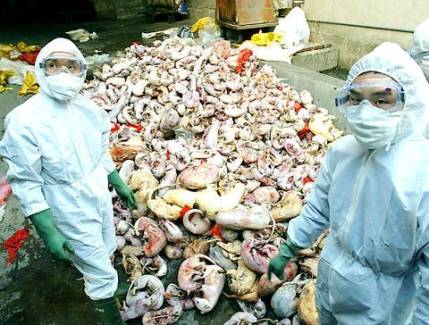
Chinese quarantine inspectors in full protective gear yesterday confiscate frozen civet cats during a raid at a warehouse in Guangzhou.
-----------------------------------------
On Jan. 11, 2004 ……
Resolute Chen sticks to his guns
"It is understood that some members from the pan-green camp are using the term "pragmatism" to stop further reform and rooting out democracy, so they can preserve their own interests. Chen feels pained by the situation, but he can only try to set a good example and hope more party members will follow him on the way of reform."
MAN OF THE MOMENT: Never one to wither in the face of adversity and opposition, President Chen Shiu-bian is determined to follow through on his democratic ideals
By Tenson Kao, , NEW TAIWAN MAGAZINE
Why was President Chen Shui-bian the man in the spotlight this past year? The reason is not because he is the President, standing at the helm of the controls over the nation's political and economic resources. It's also not because of his battle to secure a second term in the presidential office under the flag of pro-Taiwan ideals.
It is because he has conquered a myriad of difficulties in the name of establishing a new Constitution, determined to draw out a blueprint for a new nation. Come 2008, Chen, the "Son of Taiwan," will become the founding father of a new nation with the implementation of a new Constitution that receives its mandate via a referendum.
The results of the 2000 Presidential election reversed the roles of the nation's political parties, putting the long-time opposition party into office. Chen was not only the president, but was also a creator and writer of Taiwanese history.
In Chen's book, The Premier Voyage of the Century, Chen called Lee Teng-hui's 12-year democratic reconstruction that began in 1988 Taiwan's first wave of democracy. Chen's election to office in 2000 is then the second wave of democracy.
Chen pointed out that during the first democratic wave, the debate revolved around those for and against revolution, pro-Taiwan localization and mainstream political thought. However, in the second democratic wave, the societal struggle was between those for and against democracy.
Concrete value
The party switch in the presidential office demonstrated the concrete value of democracy. Political switchover is a normal occurrence in democratic societies, but during the 2000 presidential elections, in which Chen recorded a landslide victory and which was a developmental leap for Taiwan's democracy, it met with protest and attacks from the pan-blue camp.
The result was a loss of political and economic stability that led to societal chaos. What had been an occasion worthy of celebration was manipulated into a tragedy.
The number of seats the Democratic Progressive Party (DPP) won during the 2001 Legislative elections significantly increased to 87 seats from the previous 70. In addition, the Taiwan Solidarity Union's (TSU) 13 seats brought the total pan-green legislators to 100. However, the People First Party (PFP), together with the Chinese Nationalist Party (KMT), controlled over half of the legislative seats.
Having the ruling party in the legislative minority and the opposition party in the legislative majority resulted in resistance to all initiatives put forth by the Chen administration.
Why is it that the KMT can be counted on to oppose Chen's policies? Most people say its because the pan-blue camp was especially unwilling to admit defeat, given that James Soong and Lien Chan had together won 70 percent of the vote.
If the two had not split the vote, Chen would not have taken the presidential office with just 40 percent of the vote. The prize went to the third contender, leaving not only Lien and Soong unable to tolerate the outcome, but also their supporters.
In the 2001 Legislative elections, the pan-green camp's DPP and TSU won roughly 100 seats with about 45 percent of voters opting pan-green. High-ranking officials in the pan-blue camp asserted that Lee Teng Hui's departure from the KMT only removed about 5 percent of the vote.
Also, in the 2002 Taipei Mayoral elections, KMT political superstar Ma Ying-jeou captured over 60 percent of the vote. In contrast, the green camp's Lee Ying-yuan, who had had both Chen and Lee Teng-hui behind him, took only 35 percent of the vote, to the pleasure of the pan-blue camp.
This brought together Lien and Soong as running mates for the upcoming elections on Valentine's Day, marking a pivotal turning point.
As president, Chen faced numerous challenges: unprecedented dangers in the economic and political sectors; strong political resistance from opponents; supporters who had yet to be mobilized to action; the political, economic, agricultural problems that came with entry into the World Trade Organization (WTO); and irrational attacks from the opposition party.
In light of these circumstances, Chen's scars do not come as a surprise to anyone.
Su Tseng-chang was elected Taipei County Commissioner with more than half the vote in 2001, despite strong competition from KMT candidate Wang Chien-hsuan.
Support
In addition, with support from both Chen and Lee Teng-hui, Frank Hsieh was also able to capture the Kaohsiung Mayoral election in 2002 despite pan-blue pressure from KMT contender Huang Jun-ying.
While Hsieh and Su's determination and success bode well for Chen's bid for a second term as President, news reports from pro-unification media touting high support ratings for the Lien-Soong pairing have caused green-camp senior officials to break out in a cold sweat, even causing some to lose confidence in Chen.
The referendum and constitution
The Constitution and referendum are key issues to Chen's election strategy. Election polls indicated an upward trend in Chen's support ratings after Chen announced his intentions for a new Constitution on Sep. 28 and after his October stopover in the US, during which Chen had met with several senior US officials. At the same time, Lien and Soong saw a decline in their support ratings.
All the polls agreed that support for Chen had increased even amongst Taiwan's middle range voters who did not side with either political camp.
What few people know is that before Chen officially put the topics of a referendum and a new Constitution on the table, he had asked senior DPP members and his administration officials for their opinion on the two issues.
Despite the fact that the referendum and new Constitution had long been DPP ideals and that several party members had sacrificed a great deal in pursuit of them, many responded that the two controversial issues were not necessarily beneficial to Chen's election campaign.
At the time, Chen took the opinion of his advisors to heart, but said no more on the issue.
When Chen formally announced his intention to bring about a referendum and new Constitution, there was resistance within the DPP. Chen later revealed to a friend that the DPP's spirit of idealism had room for improvement. He said that if he had first informed the DPP that he would be officially announcing the referendum and new constitution issues, then the fetus would have died in the womb.
It is understood that some members from the pan-green camp are using the term "pragmatism" to stop further reform and rooting out democracy, so they can preserve their own interests. Chen feels pained by the situation, but he can only try to set a good example and hope more party members will follow him on the way of reform.
"Suffering is nutrition" -- this has been Chen's consistent philosophy in life. Chen has walked a long and winding road in life and reached the nation's top office, and what is the difference between one term and two terms of presidency from the perspective of honoring his forefathers?
For Chen, the purpose of seeking a second term is to carry through his ideals, create Taiwan's core values and be able to endure scrutiny by generations to follow. Those in the know said that maybe everything was meant to be.
Back in the presidential election in 2002, Chen's campaign team opposed the idea of Soong-bashing at one point. They thought that from a strategic point of view, bashing Soong would be helping Lien in a way and Lien might consequently win the election.
Chen, however, listened to some other friends and decided to lash out at Soong despite disagreement from his campaign team.
But not long after, everyone attacked Soong with Chen and in the end Chen surprised many political analysts and unexpectedly won the election.
For the presidential election this year, Chen is pushing the referendum and new Constitution issues out of his strong sense of mission, disregarding strong opposition. From the electoral point of view, Chen is facing an unprecedented, difficult battle. It is very difficult to predict who will win the election, and the battle is full of unknown and unpredictable variables.
Right now Chen is the only one in the DPP who is putting more emphasis on the referendum, the new Constitution and normalizing Taiwan as a country than on the election, while many DPP members still have not caught up with these issues.
This results in the DPP's thin discourses on these issues and not many are enthusiastic in persuading their electorates to support the ideologies that concern Taiwan's future development. The public energies are not directed toward these issues and Chen still cannot get a clear lead in his supporting rate, compared with the Lien-Soong ticket.
The new issues of a referendum and a new Constitution have been stigmatized after manipulation by the pan-blue camp. In fact, the referendum and new Constitution are the essence of Chen's "second-wave democratic reform" -- the referendum is the means, and the new Constitution is the goal.
Anti-reform
But because the pan-blue camp's anti-reform influence dominates the legislature, and they would oppose everything propounded by Chen, there is indeed political difficulties for Chen in further promoting democratic reform.
Therefore, Chen needs to direct the public's will to break the existing political impasse and he has to take the road to referendum. A new Constitution is the inevitable way for Taiwan to transform from a virtual country based on China to a real country based on Taiwan.
The blueprint set out in the new Constitution can also solve the sensitive issues generated by independence. Right now the popular saying is that "Taiwan is already a sovereign and independent country, called Republic of China," but from an international point of view, Taiwan is still not a normal, complete or great country.
But there would be no need to declare independence and create political opposition with the birth of a new Constitution. With the operation of the new Constitution, many sensitive issues can be solved by democratic mechanisms.
The pan-blue camp's version of a referendum is indeed a "bird-cage version of a referendum law," but it gives Chen a way out and Chen did not miss the opportunity to pursue a defensive referendum.
International concern
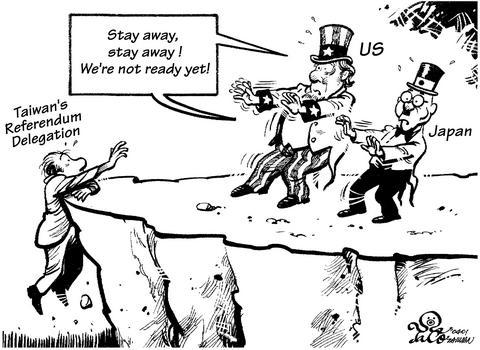
But besides the pan-blue camp's strong opposition, the idea of a defensive referendum has also attracted international concern from China, the US and Japan. Pressure has been increased and Chen's campaign has also been negatively influenced by China's spy allegations and the tumult in the Taiwan-US relations.
Political analysts pointed out that when former president Lee proposed his two-country discourse, it also raised controversies internationally. But after Taiwan weathered the storm, Taiwan's sovereignty also made a major breakthrough.
Now Chen also is pressured by his ideals and whether he can get public consensus remains the key to his election campaign and Taiwan's normalization.
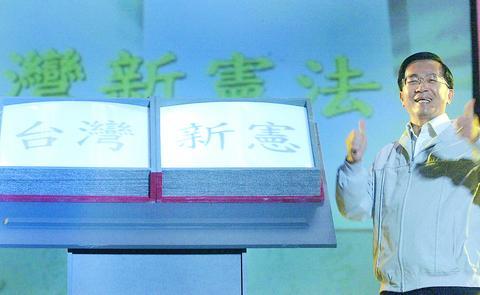
President Chen Shui-bian stands next to a symbolic copy of "A New Taiwan Constitution" during an event in Kaohsiung in October. The event was aimed at promoting public referendums and the creation of a new Constitution for Taiwan.
-----------------------------------------
On Jan. 11, 2004 ……
On freedom of HK press, not all of the news is bad
By Lee Chin-chuan
On the eve of the 1997 handover of Hong Kong, I published an article entitled Twelve questions about Hong Kong's press freedoms. It has now been more than six years since the handover. Looking back on those questions and considering the current situation, I can't help answering eight of the questions myself.
1. The people of Hong Kong were very concerned about freedom of the press before the handover. Hong Kong's economy has declined, making media operations difficult. This is a result of the 1997 Asian financial crisis, as well as the flawed policies of Tung Chee-hwa -- the chief executive of the Hong Kong Special Administrative Region (HKSAR). Vulgar media outlets have monopolized the market in an atmosphere of vicious competition. Sensational news stories about sex, violence and drugs have become mainstream as the media's taste goes downhill.
2. Both ownership changes and the media's tendency towards self-censorship are worrisome. But the media are often able to confront political interference with "market rationality" (the public's right to know). Considering that the HKSAR government is biased, that the Legislative and District Councils do not follow public opinion and that the democratic consultation mechanism is ineffective, people could rely only on the media to help them fight the legislation process of Article 23 of the Basic Law and to uncover the SARS outbreak. Media can sometimes be noisy and unpleasant, but without them, Hong Kong might sink deeper.
3. Beijing has cooled down since the handover and seldom publicly criticizes Hong Kong's media. Still, the HKSAR government has supported left-wing newspapers and pro-China forces and has oppressed local radio and democratic forces. Hence, public opinion has gradually softened toward Beijing while it has become more critical of Tung.
4. The Chinese central government
wanted the HKSAR government to enact the Article 23 legislation (the
"subversion" law) by itself. Surprisingly, Tung and Secretary for
Security Regina Ip colluded with
the pro-Beijing Democratic Alliance for the Betterment of Hong Kong, wishing to
take credit for the legislation. These people forcibly and mistakenly tried to
push the article through. About 500,000 people took to the streets to protest
the legislation.
5. I predicted in 1994 that Hong Kong's press freedoms would decline but that transparency would remain high. Today, owners of the major media conglomerates have massive business interests in China. The opinions of their media outlets often waver in the face of conflicts of interest. Discussion of either Taiwanese independence and the Falun Gong sect is taboo.
6. The Hong Kong media are no longer as crazy as they were before the handover. Whether the handover of Hong Kong was good or bad, the whole matter settled down after a while. In any case, the overall situation after the return has not been as bad as people had imagined it would be.
7. Some newspaper editorialists hesitate to speak openly but in general the content is diverse and open. What Hong Kong longs for is democratic politics and a prosperous economy, not stereotyped nationalism. The trend of publishing patriotic editorials has faded since the handover.
8. The quality of Hong Kong's journalists is not high but their professional spirit is outstanding. Without their effort, more SARS patients in Hong Kong and China might have died as their governments covered up the truth.
Lee Chin-chuan is chairman of the Department of English and
Communication at City University of Hong Kong.
-----------------------------------------
On Jan. 11, 2004 ……
CEPA and CEOF are poison pills
By the Liberty Times editorial
An economic agreement among China, Hong Kong and Macau known as the Closer Economic Partnership Arrangement (CEPA) came into force on Jan. 1.
Members of the business community in both Hong Kong and Macau, along with Taiwanese businessmen, mostly believe that the preferential treatment offered by Beijing under the arrangement will bring a lot of opportunities. In Taiwan, some have begun to talk about how Taiwan ought to join in the integration of the "Greater Chinese region" to maintain economic growth and avoid the risks of marginalization.
Some have even proposed the "innovative" concept of a "Closer Economic Operational Framework" (CEOF), believing that CEOF would avoid the problems associated with the politically sensitive CEPA.
In other words, according to these people, substituting of "operational framework" for "arrangement" would allow the regulation of cross-strait economic and trade exchanges while circumventing potential sovereignty disputes.
Will Taiwan lose business opportunities and become marginalized if it does not agree to CEPA with China?
We should seek the answer through an in-depth analysis of the contents of the arrangement and its potential effects.
CEPA encompasses three main issues -- trade in goods, trade in services and convenience in investments.
In terms of trade in goods, China on Jan. 1 stopped charging tariffs on the import of 273 categories of goods originating in Hong Kong.
In terms of trade in services, also effective Jan. 1, China opened up the service industries in China to Hong Kong, including the banking, stock, insurance, accounting, medical and management consultation sectors.
As for investments, administrative procedures will be simplified.
Focusing on CEPA's impact on trade in goods, manufacturing costs in Hong Kong are very high. Hong Kong manufacturing companies have mostly relocated to China already. Even with no tariffs, manufacturing costs in Hong Kong remain so high that prices of Hong Kong goods will still not be competitive in the Chinese market. In other words, preferential treatment under CEPA does not benefit the Hong Kong manufacturing industry very much.
The same would be true in Taiwan.
The most important aspect of CEPA may be giving the special administrative regions a competitive edge over foreign businesses in the area of trade in services. Under CEPA, the minimum capital requirement for Hong Kong banks seeking entry into China has been reduced to US$6 billion (NT$202 billion), which is much lower than the US$20 billion required of foreign banks. To qualify for offering banking services in yuan, a bank from one of the special administrative regions must have set up branch bank(s) in China at least two years beforehand, as compared to the three-year requirement for foreign banks.
Many banks in Taiwan have more than US$20 billion. If they seek authorization to offer banking services in yuan through Hong Kong, they save only about one year. This is not to mention that China has already made a commitment to the World Trade Organization (WTO) to completely open up its financial services sector by 2006, only two years from now. So the convenience offered to Hong Kong's small and mid-size financial institutions under CEPA does not hold any irresistible attraction for Taiwan.
Under the circumstances, it is obviously an exaggeration to say that "if we do not take after Hong Kong, we will lose business opportunities, and if we do not establish CEPA with China, Taiwan will be marginalized."
Then why has CEPA created such a fuss in Taiwan? The most important reason is that Beijing is calling on Taiwan to sign a CEPA pact. Beijing plans to use this as a magnet to suck in Taiwan's capital. Over the past 13 years China has sucked away more than US$160 billion in manufacturing capital, which has laid the foundation for China's status as the manufacturing capital of the world.
Beijing's next target is Taiwan's financial capital. China believes that Taiwan's finance industry, which is dominated by big conglomerates, is now the most vulnerable to being sucked dry. It can see the big financial conglomerates' greed and their ambition to expand. Beijing seeks to pressure the Taiwanese government through the financial and banking sectors so that Taiwan begins to seem like a part of China.
Even though Taiwan remains adamant about sticking to the principles of equality and sovereignty in its dealings with China, Beijing continues to hope that CEPA with Hong Kong can successfully lure Taiwan's financial capital to China, so as to facilitate the accomplishment of its policy goal.
These are Beijing's intentions, and
the pro-unification media and scholars have joined the CEPA chorus. "If
Taiwan does not take part in or does not actively seek to take part in the
business opportunities offered by CEPA, Taiwan will be marginalized" --
this is a sort of slogan they use to persuade the people of Taiwan that CEPA is
a good idea. CEPA and CEOF are part of the same trap, set by Beijing for the
purpose of engulfing Taiwan. "Reviving the Hong Kong economy" is only
a secondary part of the regime's strategy.
Can CEPA truly revive the Hong Kong economy? As described above, CEPA won't do much for manufacturing in Hong Kong. As for the financial services sector, since most large Hong Kong banks have already entered the Chinese market, if Taiwan's finance industry does not jump on the bandwagon, it isn't likely that CEPA will do much for Hong Kong's service sector. In other words, Taiwan is the key to whether CEPA can serve the purpose of saving Hong Kong's economy.
As long as Taiwan's scholars, government and members of the business and finance industries do not dance to China's tune, and Taiwan's finance industry does not head en masse to Hong Kong, CEPA can at most give Hong Kong one to two years of good times. Thereafter, the entire service sector of Hong Kong will head West or North, gradually losing its ties to Hong Kong and repeating the exodus of the manufacturing industry 20 years ago.
The vacuuming out of the service sector and the re-enactment of the tragedy of a larger economy engulfing a smaller one will only force the residents of Hong Kong to encounter another wave of painful marginalization.
In recent years, China has suffered no defeats in foreign policy. China has won the right to host not only the 2008 Olympic Games but also the 2010 World Exhibition.
Moreover, it has made moves to take over leadership of APEC. On Dec. 9 last year, Chinese Premier Wen Jiabao and his entourage were received with fanfare at the White House, where Wen urged US President George W. Bush to issue comments that reflected unfavorably on Taiwan's referendum for peace.
A rapidly expanding economy is the reason that China has been able to get away with murder in the area of diplomacy. Yet the momentum for the rapid growth of the Chinese economy is Taiwanese businessmen. Taiwan sacrificed its own growth, enduring the pain of high unemployment, to help China. Now China wants even more -- Taiwan's financial capital.
CEPA brings no business opportunities, but rather the serious questions of whether Taiwan wants self-determination and sovereignty. In June 1989, after Chinese tanks ran over the dead bodies of innocent students, and as the countries of the world imposed economic sanctions on China, Taiwanese businessmen offered a hand in the form of capital and technology. Fourteen years later, China is targeting Taiwan with 496 missiles.
Now China is asking for our financial capital. Do we want to continue being generous and repeat the financial and economic policies of the pan-blue regime in the 1990s?
CEPA is not the business opportunity spoken of by a certain lawmaker.
CEPA is no wonder drug. Instead, it is a deadly poison. CEOF is a sugar-coated CEPA and is no less lethal. It would dry up financial capital, cause industry to wither and increase unemployment.
Is that what we want?
-----------------------------------------
On Jan. 11, 2004 ……
-----------------------------------------