20040113
=======
Reported on Jan. 13, 2004 ……
Lawmakers take allies to task
"The US government cares about
nothing but its own national interest. It couldn't care less about us." --- Tang
Huo-shen, a DPP legislator
FICKLE FRIENDS: Several DPP legislators say the nation's allies are overly concerned about their own self-interest and pay only lip service to democratic reform in Taiwan
By Ko Shu-ling, STAFF REPORTER
Democratic Progressive Party (DPP) lawmakers yesterday delivered a tirade against Japan and the US, calling on the public to get behind the "defensive referendum" proposed by President Chen Shui-bian for the sake of the country.
"While the US government doesn't have the guts to stand up to China, we Taiwanese people must stick together and do it for ourselves," DPP Legislator Tang Huo-shen said. "We want to tell the US, Japan and the rest of the world that we want the defensive referendum and we want it for the sake of self-defense, nothing else."
Tang, speaking at a press conference yesterday morning, also upbraided the US for its unilateralism.
"A volley of opposition recently expressed by US officials, including US President George W. Bush and US Secretary of State Colin Powell, has highlighted one thing: that is, the US government cares about nothing but its own national interest. It couldn't care less about us," Tang said.
Since the US has already benefited from Taiwan politically, commercially and militarily, Tang said, Taiwan's national interest means little to the US.
"Why bother to care so much about the opinions of such a selfish friend?" Tang said.
Likening the battle over the referendum to the War of Independence, another DPP lawmaker, Su Chih-fen, questioned the US government's commitment to democracy.
"I'm very curious to know why the American people can be their own lord and master but we can't," Su said.
While the nation was thrilled about the passage of the Referendum Law (公民投票法), Su said, the US raised high the flag of freedom and democracy on the one hand, while prohibiting Taiwan from mounting a peace referendum on the other.
"Is this the democratic value they claim to take pride in and embrace?" Su asked.
DPP Legislator Kuo Jung-chung criticized the opposition bloc for "blindly dancing to the tunes of Japan and the US."
"They thought the defensive referendum was bound to fail because it lacks the support of such superpowers as Japan and the US. What they overlook here, however, is the power of the people," Kuo said.
"We want to tell the world this time around that we refuse to be a watch dog obsequiously wagging its tail before its master," Kuo said.
-----------------------------------------
On Jan. 13, 2004 ……
Delegation takes message overseas
AGENCIES , PARIS
It is only natural for democratic countries to have referendums and it is wrong to say that the holding of a referendum will trigger cross-strait war, the head of a Taiwan delegation to Europe said on Sunday.
Byron Weng, a national policy adviser to the president, made the remarks at a meeting in Paris, the first stop of the delegation's European tour aimed at explaining President Chen Shui-bian's referendum plan in the wake of widespread criticism from various major powers around the globe.
According to Weng, the holding of a defensive referendum will galvanize Taiwanese and make them concerned about the fate of the nation.
There is nothing wrong with Taiwan holding a referendum, but because Beijing has interpreted the plan as a move toward Taiwan independence and, according to Weng, have influenced the views of the US, which is currently preoccupied with Iraq and North Korea, the US has expressed misgivings about the planned referendum.
"The government's decision to push through the referendum on March 20 will not be changed because of the views of foreign governments," Weng said.
Chuang Suo-han, delegation member and vice minister of the Overseas Chinese Affairs Commission, also addressed concerns on the theme, timing and possible effects of the referendum.
He said the referendum will be held on March 20 to coincide with the presidential election because the turnout rate for the presidential election will be high and it is better to have more people participating in public policy debate.
The other reason is to save money, Chuang said, adding that if the referendum is held separately from the presidential election, the cost would reach NT$500 million (US$14.7 million).
Huang Wei-feng, a delegation member and academic, said that on one hand, the referendum will galvanize the people and, on the other, will declare to the international community that the Taiwan people want a peaceful environment.
On the agenda of the referendum, the delegation members said only that they will bring back the views from all sides for the reference of the government.
Nearly 100 overseas Chinese and students attended the meeting.
The delegation had already met with two French parliamentarians and was scheduled to meet with news media yesterday.
The delegation's next stop will be Strasbourg, where it will visit the European Parliament before continuing on to Berlin today.
Meanwhile, officials expressed hope yesterday a government delegation can visit Washington later this month to seek US support for a Chen's proposed referendum.
Chiou Chwei-liang, national policy adviser to the president, said the US is worried about hosting the delegation while the referendum's final wording has not been finalized.
He acknowledged that the referendum issue has "strained the relationship," but did not believe the problem was very serious.
-----------------------------------------
On Jan. 13, 2004 ……
Chen says referendum about stability
By Lin Chieh-yu, STAFF REPORTER
President Chen Shui-bian assured the international community yesterday that he will be cautious and steady in carrying out the March 20 referendum, which he described as a democratic achievement to stabilize the Asia-Pacific region and bring a lasting peace.
Chen expressed goodwill toward China, saying he is confident leaders on both sides of the Taiwan Strait can put aside their differences after the presidential election, to be held on the same date as the referendum.
"I would like to make my statement again that, as the head of state, I will absolutely deliberately deal with those issues of public concern, including Taiwan's first ever referendum, cross-strait development and the Taiwan-US relationship," Chen said.
"I must reaffirm that the government appreciates support from international allies and friends of Taiwan's democracy," he said.
"Peace and democracy are the common language between Taiwan and the international community, and the efforts Taiwanese people have made in seeking peace and democracy are not just for us but also for future generations, as they will bring permanent stability in the entire Asia-Pacific region," he said.
During the keynote speech at a lunar year-end gathering with the media yesterday, the president said his "defensive referendum" will ultimately be accepted by the international community.
Chen said he is willing to listen to the opposition parties' criticisms and will consider their suggestions.
He also appealed to opposition leaders to handle the presidential campaign rationally and to stop threatening the public.
"Every presidential election is an opportunity for Taiwan to improve upon its democratic achievements," he said.
"What we need is a fair race," Chen said. "It is not necessary to frighten Taiwanese people all the time in every election."
On cross-strait tensions, Chen said he was confident that he has proposed a clear framework of the cross-strait relationship.
"We are ready for positive interaction after the March 20 [presidential election], especially after the May 20 inauguration."
Chen hopes that leaders of both sides can show trust, which will become the basis of future interaction.
"Welcoming the traditional Lunar New Year, I hope there will be no more nostalgia or worries, but only reconciliation, cooperation and peace," Chen said.
-----------------------------------------
On Jan. 13, 2004 ……
Participants in Kaohsiung Incident band together
1979 CRACKDOWN: The vice president was on hand yesterday to launch the Kaohsiung Incident Comrades Association and said participants in the event still have work to do
By Chang Yun-ping, STAFF REPORTER
Victims of and participants in the 1979 Kaohsiung Incident yesterday formed the Kaohsiung Incident Comrades Association to strive for long-lasting peace and security.
Vice President Annette Lu, who was jailed for her role in the human rights rally which led to a crackdown by the Chinese Nationalist Party (KMT), yesterday led the formation of the association.
Lu said the "defensive referendum" to be held on March 20 is to ensure Taiwan's peace and security.
The Kaohsiung Incident occurred on Dec. 10, 1979, as the KMT government imprisoned participants in an anti-government parade organized by Formosa magazine. The crackdown is also known as the Formosa Incident.
Speaking at the headquarters of the Democratic Progressive Party (DPP), Lu said those who were involved in the incident helped achieve democratization and the realization of human rights in the last century; but for the new age, participants have repositioned their roles to continue protecting the peace and security of Taiwan.
"Although the mission of the Kaohsiung Incident to help bring about press freedom and other democratic initiatives has been completed, Taiwan still faces an incessant political and military threat from China. There are still 496 Chinese missiles pointed at Taiwan and the number is likely to grow to 650 by 2005," she said.
Lu said intelligence indicated these missiles are aimed at the country's major political and military institutions.
"While the world now is engaged in the anti-terrorism campaign, China's 496 missiles aimed at Taiwan have become evidence of China's possession of weapons of mass destruction and that China is actually the country developing state terrorism," she said.
"Therefore, the defensive referendum which President Chen Shui-bian has proposed is to remind the people of Taiwan as well as the world the urgency of this military threat from China," Lu said.
She said more than 10 governing bodies, including the European Parliament and the US House of Representative, have passed resolutions demanding that China dismantle the missiles and that the people of Taiwan should enjoy the right of peace as guaranteed by the UN.
Lu said that the government will initiate a series of activities to campaign for peace and to appeal for international support for the referendum. The government will also dispatch a corps of "Peace Ambassadors" to the UN to promote the campaign.
DPP Secretary-General Chang Chun-hsiung, a lawyer for the victims of the Kaohsiung Incident, read a declaration of the establishment of the association yesterday, saying, "Victims, defense lawyers and the families of the victims have devoted their lives to Taiwan's democracy in the past.
"Today, as we are here to form the association, we want to start the mission of `saving Taiwan with peace' to protect our homeland," it said.
DPP Legislator Chang Chun-hung, who was also imprisoned for involvement in the Kaohsiung Incident, urged victims of the crackdown to reinvigorate the spirit of 1979, saying people must brave challenges and difficulties to insist on holding the referendum and fighting for peace and democracy.
"The spirit of Taiwan people helped to end the KMT's decades-long authoritarian rule. It could also terminate the dictatorship of the Chinese Communist Party," Chang said.
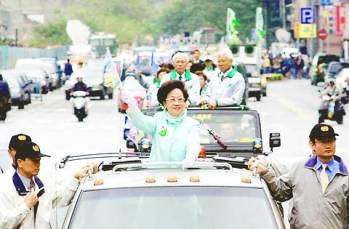
Vice President Annette Lu waves a flag during a parade in Taipei yesterday marking the establishment of the Kaohsiung Incident Comrades Association.
-----------------------------------------
On Jan. 13, 2004 ……
-----------------------------------------
On Jan. 13, 2004 ……
Aborigines want to fight stereotypes on own TV station
By Cody Yiu, STAFF REPORTER
Aborigines want their own television station to revise the twisted image of Aborigines portrayed on Taiwanese television, Aboriginal representatives said yesterday.
"I hope the Cabinet's Council of Indigenous Peoples and the Legislative Yuan can set up a task force that would include civil groups to examine the possibility of setting up a television channel and training Aboriginal broadcasting personnel," said Voyu, chairman of the Association for Taiwan Indigenous Peoples Policy.
Taiwan Media Watch recently conducted a review of television programs about Aboriginals that were broadcast in 2002.
"Many television programs have misinterpreted Aboriginal practices and twisted the image of Aboriginals. For instance, the program hosts often refer to Aboriginals as `they,' as if we are some foreign creatures from another world," said Mayaw Biho, the head of Amis Tribe Film Festival Committee.
Mayaw pointed out certain common biases and misunderstanding regarding Aboriginals which are often seen on television.
"One major mistake is that Aboriginal holy rituals have often been portrayed as sports events. Another common scene is when Aboriginals are given a chance to talk before a camera, they are usually only asked to echo what the program host has already said and are not able to voice other opinions. We Aboriginals are not tape recorders, we know more than repeating," Mayaw said.
Wei Ti, assistant professor of mass communications at Tamkang University and a member of Taiwan Media Watch, described the characteristics of Aboriginal television channels in other countries, which could be used as a framework for an Aboriginal television channel in Taiwan.
"APTN in Canada and TVNZ in New Zealand, which are public television channels dedicated to their respective native populations, receive stable financial resources from government. Furthermore, Aboriginals make up the majority of employees at these channels.
"These channels can be viewed across the nation and aim to promote native languages and cultures, as well as to improve the understanding and interaction among different ethnic groups," Wei said.
Last year, the Council of Indigenous Peoples last year set aside NT$3 billion for the establishment of an Aboriginal television channel.
However, the budget proposal did not clear the Legislative Yuan.
"The budget for a Hakka television channel, which is the same at NT$3 billion, cleared the Legislature Yuan smoothly and the channel has been in operation since last July. So why is the budget proposal for an Aboriginal television station still in difficulties at the Legislature Yuan?" asked Ado Calaw, a member of ATIPP.
Legislators expressed concerns that a large number of Aborigines would not be able to receive the channel because they live in the mountains where reception is poor, but Ado considers the rejection of the proposal as a more complex issue.
"I feel that legislators might not believe in the ability of Aboriginals in managing a television network on our own and do not trust us with NT$3 billion. Besides, there may be a matter of politics involved as well," Ado said.
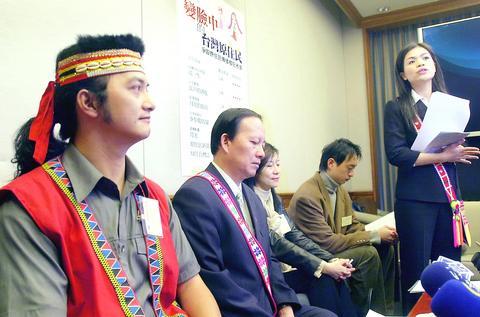
Members of the Association for Taiwan Indigenous Peoples Policy and Taiwan Media Watch hold a joint press conference yesterday to promote a TV station for Taiwan's Aboriginal peoples.
-----------------------------------------
On Jan. 13, 2004 ……
Status quo has gone out of balance
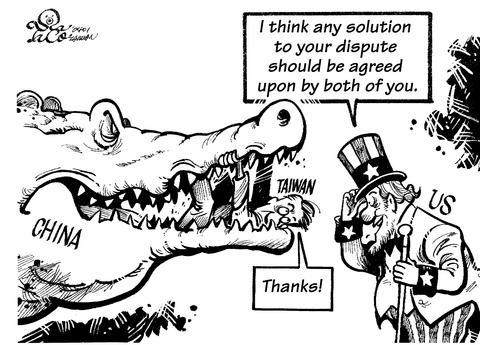
President Chen Shui-bian's plan to hold a referendum -- Taiwan's first ever -- at the same time as the presidential election on March 20 has drawn a great deal of international attention. Viewing it as a scourge, China has gone all out to block the referendum. US President George W. Bush and Japan have displayed a "no, no" attitude toward any referendum that may change the status quo. Some opposition parties in Taiwan are also using international pressure to attack Chen.
In fact, those exerting internal and external pressure are like a pack of wolves howling at the moon because they cannot touch it.
The moon is the status quo.
"Changing the status quo" is the phrase that those exerting pressure care most about. But what is the status quo?
The US has made the maintenance of the status quo its top priority and opposed any unilateral attempt to change the status quo. The US demands that Taiwan avoid provoking China or making any move toward independence; it also demands that China not use military force against Taiwan.
If we look at this policy as a set of scales, we can see that the scales have never been level to begin with.
There is also the problem that balance is dynamic -- it never stays put for very long.
US policy is based on the three Sino-US communiques and the Taiwan Relations Act. But the scales have tipped gradually in China's favor in the long evolution of the communiques, highlighting the US' tendency toward imbalance in its cross-strait policy.
China has risen as a power in international politics. Using its political, diplomatic and economic power, China has become a leading force in Asia. For Taiwan, China's threat is very deep, as are its attempts to isolate Taiwan diplomatically.
On the military front, China has continued to build its military power and has aimed almost 500 ballistic missiles at Taiwan.
In economics, China has continued to suck away Taiwanese capital and vitality, causing Taiwan's economy to shrink.
The cross-strait center line has been squeezing in on Taiwan, on the political, military and economic fronts. Ignoring this shift and demanding the maintenance of the status quo is as impractical as marking the place on your ship's hull where your sword dropped into the sea, in the hope of retrieving the sword.
The US hopes the two sides will move toward dialogue, but Beijing has set the "one China" condition for any dialogue -- basically demanding Taiwan's surrender before sitting down at the negotiation table. This is not fair. The US demands that Chen keep his "five noes" promise but pays no heed to the premise of his promise -- that China must not threaten Taiwan militarily.
Now China is not only making such threats, but also views any referendum or rewriting of Taiwan's Constitution as provocative. Even a Taiwanese complaint about Chinese missiles has become provocative. This is even more unfair.
China has every reason to maintain a
status quo that contains so many things that are absurd and unfair to Taiwan.
Under this status quo, China can increase its missile deployments against
Taiwan, block Taiwan's entry into international organizations and force other
countries to accept Beijing's unilateral definition of provocation.
Taiwan's March 20 referendum is not going to change the status quo. It is merely a loud objection against what is unfair in the status quo so that people both at home and abroad may pay heed.
-----------------------------------------