20040115
=======
President Chen go go go on Jan. 15, 2004 ……
President appears before prosecutors
"He did not want any special privileges. The president insisted that he wanted to respond to the summons as an ordinary citizen." --- James Huang, Presidential Office spokesman
HUALIEN INQUISITION: Chen Shui-bian
reported to a summons as an ordinary citizen, refusing special treatment that
included a comfy chair
By Jimmy Chuang, STAFF REPORTER , IN HUALIEN
President Chen Shui-bian reported to Hualien prosecutors yesterday to answer questions about a corruption case, becoming the first head of state in the country to provide such testimony.
Prosecutor Lee Tsu-chun had summoned Chen in his investigation into alleged vote-buying by the Democratic Progressive Party's (DPP) candidate in last summer's Hualien County commissioner by-election, You Ying-lung.
In addition to the president, Lee summoned nine other people, including DPP Secretary-General Chang Chun-hsiung.
You is the only defendant in the case. The others were summoned as witnesses. They all reported to the prosecutors' office on time, with the exception of DPP Culture and Information Department Director-General Cheng Yun-peng, who asked to be excused.
More than 100 reporters and some 200 supporters gathered in front of the prosecutors' office at around 8am. The president arrived at the prosecutors' office at around 9:30am. Chen left his van about 200m from the office and decided to walk the rest of the way.
In addition to the van, there were two sedans with the president's security guards. Upon Chen's request, none of the guards accompanied him to the prosecutors' office.
The crowd included overseas Taiwanese.
Masa Fan, a Hualien native who is now an insurance broker in Toronto, came to Hualien with his wife to show their support for Chen.
"Taiwan is like a mother to us. Chen Shui-bian is the son of Taiwan so we definitely have to support him," he said.
The closed-door interrogation began immediately after the president was identified by the clerks.
Presidential Office spokesman James Huang said Chen refused any special arrangements for the appearance, including a comfortable chair provided by the prosecutors' office.
"He did not want any special privileges," Huang said. "The president insisted that he wanted to respond to the summons as an ordinary citizen. He said that he would bow to the prosecutor before the interrogation, as does everyone else."
Chen was protected only by Huang and two court guards when entering the prosecutors' office. Huang said there was room for improvement with regard to security.
"This is the first time for the president to do this. None of us is experienced in this," Huang said. "We definitely can figure out a better way to do this next time."
Chen didn't comment when he left the prosecutors' office a little after noon.
After Chen left, Lee questioned other witnesses until around 5pm.
DPP officials yesterday complained about the summons.
"The summons is ridiculous," You said. "Candidates' campaign policy has nothing to do with bribery. Prosecutors do not have the right to interfere with campaign policy."
The case began when You said during a campaign activity on July 27 that he would give a monthly NT$5,000 service allowance to the county's Aboriginal chiefs to help them with community affairs if he won the by-election.
An anonymous voter, however, reported to the prosecutors' office claiming that You's promise constituted bribery.
In his first interrogation over the case on Aug. 13, Lee summoned DPP Deputy Secretary-General Lee Chin-yung, You and DPP Department of Information and Culture Deputy Director Chen Wen-tsan.
DPP Policy Research and Coordinating Committee Deputy Director Liang Wen-chieh, after appearing before Lee, said the prosecutor had assumed that vote-buying had taken place before talking to them.
Liang said the case is classified as one in which prosecutors are still looking for evidence and do not yet regard it as a crime.
"However, through the way Lee Tsu-chun was asking questions, it seemed to me that he believed it was a vote-buying case and was looking for criminals, not evidence," Liang said.
Prosecutors' office spokesman Chen Sung-chi said he appreciated Chen Shui-bian's cooperation and that Lee Tsu-chun has decided not to list more defendants in the case at this time. Chen Sung-chi added the case is still classified as one in which more evidence must be gathered.
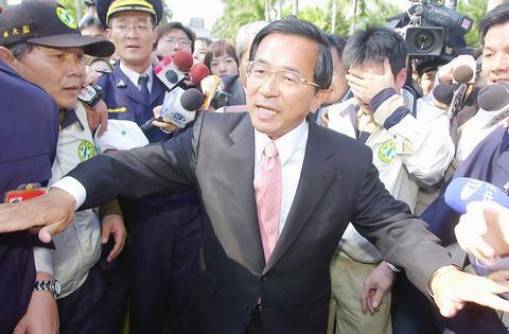
President Chen Shui-bian asks reporters to make way as he leaves the Hualien District Prosecutors' Office after giving testimony yesterday.
-----------------------------------------
On Jan. 15, 2004 ……
US lawmaker slams Bush policy
"The very suggestion that an exercise of democracy is a greater provocation than that posed by 496 missiles emanating from the People's Republic of China is an absurd policy that violates the core principles of the US." --- Robert Wexler, US congressman
STANDING UP FOR TAIWAN: The US congressman was one of a number of foreign lawmakers attending a conference here to support the `defensive referendum'
By Chang Yun-ping, STAFF REPORTER
US Congressman Robert Wexler, also the co-chair of the Congress-ional Taiwan Caucus, yesterday voiced strong support for the "defensive referendum" planned by the Taiwanese government and urged the world to help Taiwan join the World Health Organization (WHO).
Wexler, a member of the US House of Representatives, said in a keynote speech at the 1st Annual Convention of the International Parliamentary Forum for Asia-Pacific Security held in Taipei yesterday that as Beijing continues its belligerent build-up of missiles across the Taiwan Strait, it is critical for the US to renew its commitment to Taiwan's security and defense.
Wexler said the increased cooperation between the US and China in the war against terror and in negotiations with North Korea should not come at the expense of US relations with Taiwan.
He said the George W. Bush administration's recent kowtowing to Beijing in opposing a defensive referendum in Taiwan had compromised its moral authority to lead, while the US remains mute over the military excesses of China's authoritarian regime.
"In the past month, many have questioned Washington's recent failure to acknowledge the military threat from Beijing while vocally opposing a defensive referendum in Taiwan," Wexler said. "This policy stands in stark contradiction to the Bush administration's stated policy of advancing democracy throughout the world.
"The very suggestion that an exercise of democracy is a greater provocation than that posed by 496 missiles emanating from the People's Republic of China is an absurd policy that violates the core principles of the US," Wexler told a luncheon gathering of more than 150 parliamentary members from 50 countries.
"America must now reaffirm the importance of our bilateral ties with Taiwan and applaud its strong system of governance that promotes freedom and protects the rule of law. Rather than pay homage to the rigidity of the Chinese system, we should highlight Taiwan's democratic evolution because it serves as a highly successful model for political liberalization throughout the world," he said.
Wexler also voiced keen support for Taiwan's bid to join international organizations, particularly the WHO.
"It is unconscionable that 23 million Taiwanese people have been excluded from receiving the benefits of membership status in the WHO ... impairing its crisis response teams and creating a wall of separation between Taiwan and the global health care community," he said.
"Healthcare is an issue that transcends borders and politics and is addressed most effectively through international cooperation and collaborative support. This is why we must renew our conviction to assist Taiwan in its effort to obtain observer status at the World Health Assembly this May," Wexler said.
Vice President Annette Lu yesterday addressed the opening ceremony of the convention, saying the threat of communist, authoritarian China to democratic, peace-loving Taiwan was a matter of "the bullet versus the ballot."
She described China as a ferocious lion and Taiwan as a "kitty cat" to demonstrate the relationship between China and Taiwan.
"Imagine what results will come if the kitty cat is forced into the arms of the lion? The consequence of that must be bloody. Only when the lion is caged and dealt with [according to] the rules of the zoo can other small animals such as doves, rabbits and kitties live peacefully together," Lu said.
Lu also said Beijing's suppression of Taiwan's democracy and intention to annex Taiwan were aimed at the ultimate goal of building a "Chinese kingdom," turning itself from a continental hegemony to a sea power through its control over the Taiwan Strait.
She said China's 496 missiles aimed at Taiwan could reach Taiwan proper within seven minutes and could carry nuclear warheads.
Given that every day more than 400 foreign cargo ships pass through the Taiwan Strait and more than 350 planes fly through Taiwan's airspace, China's threat to international stability and economic prosperity is obvious, Lu said.
Other visiting members of parliament from around the world yesterday also expressed support for Taiwan's plans to hold a defensive referendum.
Thomas Cox, a British MP and chief of the UK's delegation, said yesterday: "It is not Taiwan, or any of the policies it follows, that threaten the PRC. The policies of the PRC threaten this country [Taiwan]. The referendum will give the Taiwanese people the democratic choice to vote as they wish. That is democracy. And we should all fully support that."
Norwegian MP Trond Helleland urged his European colleagues to support a democratic Taiwan in the face of China's threats.
"Small nations believing in democracy should stand up and say no to dictatorship. European nations should recognize Taiwan. What comes first? Democracy should come before dictatorship," Helleland said.
The two-day convention, which started on Tuesday night and ended yesterday, was sponsored by the Legislative Yuan, the Taiwan-USA Inter-Parliamentary Amity Association, the Washington-based Formosan Association for Public Affairs and the Taipei-based Formosa Foundation.
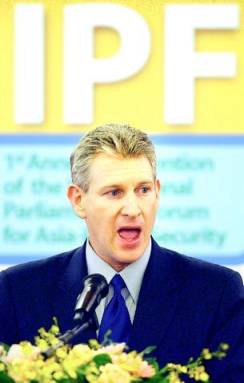
US Representative Robert Wexler gives a keynote speech at the two-day International Parliamentary Forum for Asia-Pacific Security conference at Taipei's Grand Hotel yesterday.
-----------------------------------------
On Jan. 15, 2004 ……
The US' principles
By Laurence Tseng, Los Angeles, California
The ideals that are the very structure of the United States, the basic principles on which the country was built and continues to function, were revolutionary when first formed.
They were the result of discussions between philosophers and enlightened thinkers who believed, as stated in the Declaration of Independence, that every man has a right to life, liberty and the pursuit of justice.
It is rash to believe that abstract ideals can withstand realistic forces that might disrupt it. Who can argue against economic power, military power or political power, especially when one side is overwhelmingly stronger?
But for the founding fathers of the United States, it was precisely this idea of freedom that motivated them to declare independence and establish a democratic nation against the British empire.
Times have changed drastically since then, but the idea has not. It is not the problem of whether China or Taiwan should be independent, but which of these nations strives to follow the same ideals of democracy.
The possibility of unification is not improbable, but it is impossible to expect a democratic Taiwan to surrender its freedom. Taiwan may be forced to do so, and it is the responsibility of other democratic nations, especially the United States, to prevent this from happening.
The question before the United States is whether it can do justice to the people that built the nation, in the face of global politics and pressure, and resolve to remember and uphold the principles that the United States stands for.
-----------------------------------------
On Jan. 15, 2004 ……
Taiwan's future locked in its past
`Many people often like to talk of politics as something deep and unfathomable. In fact, politics is a matter of those in power striving for power, and of the general public striving for happiness. Even though power was the main concern during the authoritarian era, the government didn't dare neglect the public's happiness.'
By Frank Wu
A few years ago, as the last century drew to a close, the world's foremost historians and trend specialists all looked at the possible directions human society could take in the 21st century. Although there were minor discrepancies between the different views, they all hoped for the arrival of a more peaceful, harmonious and happier society.
Pragmatically speaking, if this is an ideal that can be fulfilled, then we, the men and women of Taiwan, have the right to show our concern for the world at large if we ourselves already are moving towards that ideal here in Taiwan. If we don't, then Taiwan will fall behind the rest of the world.
First, anyone who has read a bit more extensively on the history of Taiwan, the 400 years of Taiwanese history have been filled with constant ethnic conflict. Regardless of the period, indigenous peoples have been in a weak position, oppressed. The Min and the Hakka people have sometimes also had problems seeing eye to eye, and even the Zhangzhou and Quanzhou people, all from the Minnan area, have been divided. The Japanese colonial rulers also discriminated clearly between people, and later on the same thing happened to Taiwanese and mainlanders. Although these ethnic stories have meant that benefits have been improperly distributed, looking deeper into the matter, we find that these conflicts have been negative for ruler as well as the ruled. There are 23 million people squeezed onto an island with little flatland -- with too much pushing and shoving, how could harmony and happiness develop?
The Japanese left a little over 50 years ago, and mainlanders and locals have already gotten along for more than half a century. It is sad that by the time the mainlander-Taiwanese problem gradually became considered an irrational issue as a result of work or cross-marriages, "unificationist" and "independence advocate" instead gradually became the new ethnic labels, disturbing people and arresting social advancement.
Talking of unificationists and independence advocates, both factions were fearsome in their righteousness. Still, we only have to consider the fact that whether they are unificationists or independence advocates, they all make this island their home. Many independence advocates have sizeable businesses in China, and many of the rest crisscross China on their travels. Every one of the unificationists feed off of Taiwan, use the Taiwanese currency, and after traveling to China, they all return to their homes in Taipei, Kaohsiung or Taichung. It is obvious that we need time to resolve the issues handed down to us by history, while current livelihood and business issues still must be handled according to the present situation. What's more, we cannot ignore the international situation.
I have never hidden my political position over the past few decades, so let me pose a question: If Taiwan does not belong to the Taiwanese, then to whom does it belong? What I am trying to do here is to emphasize the issue of freedom of expression in a democratic society. If it is only a matter of differing opinions, then there really is no need to take the position that I am completely right and you are totally wrong. If media workers and politicians exacerbate things, they are guilty of intellectual immorality. This kind of immorality moves in a direction opposite to peace, harmony and happiness.
Second, every kind of business has its values. The reason I especially highlight politics and the media is that these two have equally high profiles in society, and that they have a greater influence over the direction society will take.
All in all, if we assess Taiwan's media workers and politicians, their performance has been poor. In today's Taiwan, there are few unprejudiced media and few media workers who understand the fundamental principles of the fourth estate. Unknowingly, the majority of media are tearing society apart, cheered on by their supporters.
Even more criticism can be aimed at politicians than at media workers. Very few of them understand what "respecting the opponent" means, not to mention showing shame in the face of criticism or having a guilty conscience. Not many of them would readily admit to making a mistake or abstain from making excuses even if they were suddenly alerted to the fact that they had committed one.
History is a constant cycle of successes and failures. Every political party will hold to certain ideals, and every party will make a few foolish statements. They will all have their personalities worthy of respect, and they will also include some uglier characters. In mature societies, few people will be superstitiously faithful to a party or given to idolatry. I am, however, very sad to see many politicians in today's Taiwan still adopting the inferior methods of a past era in their attempts at political manipulation, and many irresolute leaders actually follow these suggestions, thus, deliberately or unwittingly, misleading the public.
Third, if we take an even higher vantage point to look back at everyday life in Taiwan, the chaos pointed out in the previous two parts in fact merely fills us with disgust. Although it might also cause development to come to a halt, society can actually continue to function in the midst of this hubbub. The most worrying thing in Taiwan is the issue of future economic development and national finances.
It is the good economic performance over the recent past that has caused the public to be satisfied with little Taiwan and the international community to look at it with respect.
Under the pressure of rising production costs over the past few decades, many companies have directed their investments toward China. Taiwan has been severely bled, there is massive unemployment and foreign trade has seen great changes. While all this has been going on, a new international economic order has gradually taken shape, and Taiwan is now becoming isolated. If this development continues, the Taiwanese economy will rot away, like a once lush tree. At the same time, the burden on the treasury will increase due to shrinking tax income, which will result in a towering national debt. The trunk of the tree will become hollow. If this situation is perpetuated, it wouldn't be so strange if one day the tree toppled over.
People observing the political situation in advanced countries for a longer period find that in situations similar to Taiwan's current situation, including the upcoming presidential election, the debate between candidates from all sides, as well as public concern, will all be aimed at the questions of how to plan economic development and social welfare strategies, and how to stabilize national finances. Strangely, however, politics in Taiwan do not work this way, and I have to say this comes as a surprise.
Fourth, many people often like to talk of politics as something deep and unfathomable. In fact, politics is a matter of those in power striving for power, and of the general public striving for happiness. Even though power was the main concern during the authoritarian era, the government didn't dare neglect the public's happiness. In the democratic era, there are restrictions on power, and the happiness of the general public has instead become a solid foundation of that power.
Although the universe is vast and things come and go, we can still use such a simple formula to view the future of Taiwan, and see that there is hope. If we all could look into our hearts and make some brave changes, Taiwan should still be capable of a quick turn-around, making an effort and returning to the correct road, the one leading forward.
Frank Wu is chairman of the Public Television Service Foundation.
-----------------------------------------
On Jan. 15, 2004 ……
KMT insincere on ethnic harmony
On Tuesday, a brawl broke out between a group of Hakka protesters and some ethnic-Hakka opposition legislators at the Legislative Yuan over the pan-blue camp's plan to freeze 80 percent of the budget for the Cabinet-level Council for Hakka Affairs. An explanation from two ethnic-Hakka legislators -- Chun Jung-chi and Chung Shao-ho -- saying the opposition had withdrawn the motion to freeze the budget, did little to allay the anger of the Hakka protesters. According to media reports, the two received a few punches and kicks from the protesters.
Everyone knows the machinations of the Chinese Nationalist Party (KMT)-People First Party (PFP) alliance. Hakka voters have long been staunch supporters of the pan-blue camp. Now, worried about an apparent shift in their support, the KMT-PFP alliance tried to freeze the Hakka council's budget in an attempt to cut off the council's resources so that the ruling Democratic Progressive Party (DPP) would have no Hakka card to play in the election campaign.
Their action reminds us of one of the pan-blue camp's biggest campaign slogans: ethnic reconciliation. Speaking in Taoyuan, one of the Hakka strongholds, KMT Chairman Lien Chan on Saturday accused the DPP of discriminating against Hakka people. His remarks were a stark contrast to the opposition camp's attempt to freeze the council's budget. The KMT-PFP camp apparently thinks Taiwanese voters are dumb.
Only disadvantaged groups and victims of discrimination are qualified to talk about "ethnic reconciliation." It is laughable that the KMT, after exercising White Terror and authoritarian rule for decades, is now suddenly espousing ethnic reconciliation in the election campaign.
The KMT has been very good at creating taboos and using them as their protective umbrella. In the past authoritarian era, under the "everyone is Chinese" assimilation policy, people were distinguished by their "provincial ancestry" from cradle to grave, but they were not allowed to discuss ethnic issues. Today, the authoritarian system is gone, but the KMT continues to mobilize the local media, most of which is controlled by mainlanders, to create another ethnic taboo. Whoever dares to challenge this taboo is a sinner.
Ethnic issues involve vested interests, the power to interpret history, the power to guide culture and the power to allocate resources over the past half century, as well as Taiwan's ultimate problem -- a review of national identity. A political party which committed crimes in the past is now calling for "ethnic reconciliation" and wants everyone to love each other and forget about past grievances. This political party is still very good at propaganda and political manipulation.
Recently, we saw the establishment of an "Ethnic Equality Action Alliance" led by internationally renowned film director Hou Hsiao-hsien. At a press conference to launch the group, National Taiwan University professor Hsia Chu-joe quoted the words of Lee Hsing-chang, a dumpling franchise operator, accusing pro-DPP voters in southern Taiwan of boycotting his shop and causing his income to fall by 15 percent because he had opposed the DPP government's education reforms. Hsia used those remarks as proof that the DPP was engaging in ethnic mobilization.
Hsia and Lee's accusations are low and shameless. Most people in southern Taiwan do not know Lee, who is not that famous. Their accusations only proved that some people with a strong ethnic consciousness are trying to hide it and accusing others of harboring ethnic consciousness. This has got to be what is most hypocritical and most laughable about the opposition alliance and this ethnic equality alliance.
-----------------------------------------
On Jan. 15, 2004 ……
-----------------------------------------