20040116
=======
We concerned referendum on Jan. 16, 2004 ……
Chen says referendum in March his No. 1 concern
DEMOCRATIZATION: The president said that he was prepared to lose the election in his quest to promote democracy in the country, calling the goal a matter of faith
By Lin Chieh-yu, STAFF REPORTER
President Chen Shui-bian yesterday insisted that the nation's first referendum must go ahead as planned and that he was prepared to pay the heavy price of losing the presidential election in order to accomplish this historic mission for the people of Taiwan.
"My most important two missions for March 20 are to win the presidential election and to hold the referendum, and if I had to choose between the two, I would choose the referendum," Chen said at a party to publicize the release of his latest book.
"If I am not able to achieve these two missions simultaneously, the referendum is absolutely my priority because it is my promise to the people, to the nation," he said.
"My most important concern about the presidential election is not whether I can win a second term, but what I can achieve to give to the nation and to history," Chen said, adding that holding the referendum and establishing a new constitution are now not only ideas of his, but also matters of faith to him.
The new book, titled Believe in Taiwan -- President A-bian's Report to the People, was released yesterday. Chen and first lady Wu Shu-chen attended the party for its release together and answered questions from the media.
In the second chapter of Chen's new book, headed "International Diplomacy," he discusses issues concerning his plan for a "defensive referendum," which he has pledged to hold on March 20, the day of the presidential election. He also elaborates on his appeal for a new constitution to be ratified in 2006.
Talking about current tensions between Taiwan and the US over Chen's insistence on holding the referendum, Chen said that communication between the two countries was based on "whether Taiwan has violated the `five noes,'" but he stressed that a pre-condition was that "China must renounce the use of military force against Taiwan."
"The international community can not ask Taiwan to abide unilaterally by the `five noes' and just ignore China's intention to use military force against Taiwan and the actions it takes to enable it to do so," Chen said.
Chen says in the book that he can understand the US government's concerns about maintaining its national, political and even, he said, "election campaign" interests. As a democratic country just like the US, Chen said, Taiwan must appreciate those concerns.
"We will consider the concerns of the US, Japan and the European Union when deciding on the content and wording of the referendum," Chen says in the book. "But we will neither give up our own national interests nor allow the international community to take the threats of China's missiles targeting Taiwan for granted."
He said in the book that even though Taiwan has a firm friendship with the US, it still needs to develop "normal space" to survive in the international community and allow all of its people to live in freedom and dignity.
"So, if my bid to win re-election is affected by the push for a referendum and a new constitution -- even if it leads to my losing the election -- I will accept it willingly," he says.
Focusing on this strong statement, the media asked the president to elaborate, and Chen reaffirmed that he wished to shoulder full responsibility for continuing to democratize the nation, which he reasserted has nothing to do with declaring independence and certainly would not violate the "five noes."
"On the road to democracy in Taiwan there remain only two things to be accomplished; one is the referendum and the other is a new constitution," Chen said.
"I hope to accomplish at least one of those two missions in my first term," he said.
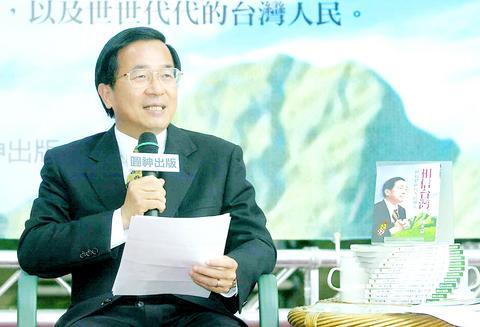
President Chen Shui-bian promotes his new book, Believe in Taiwan -- President A-Bian's Report to the People, during a press conference in Taipei yesterday.
-----------------------------------------
On Jan. 16, 2004 ……
Myers warns China over missile threat
BLUNT COMMITMENT: The US chairman of the Joint Chiefs of Staff told reporters in China that his country was committed to helping Taiwan in case of an attack
AGENCIES , BEIJING AND NEW YORK
The US' top military officer yesterday said that China had built up a "very large" missile arsenal opposite Taiwan and cautioned that Washington was committed to helping the nation defend itself.
"The US is committed to helping Taiwan maintain its ability to resist the use of force or coercion to solve this problem," Chairman of the Joint Chiefs of Staff General Richard Myers told journalists as he wrapped up a two-day visit to China, during which he met the country's top military brass.
"And it is not just a one-sided issue," he said when questioned by Chinese journalists on US arms sales to Taipei.
"In fact, if you look at the build-up on the Chinese mainland side of the [Taiwan] Strait in terms of surface-to-surface missiles, you would see a very large build-up. And China continues to build up its capability opposite Taiwan.
"Our responsibility under the Taiwan Relations Act is to assist Taiwan in its ability to defend itself. Again, so there will be a peaceful resolution to the problem and no temptation to use force," he said.
President Chen Shui-bian plans to hold the nation's first referendum in tandem with the presidential poll on March 20.
Chen hopes the referendum will send Beijing a clear message that the nation is unhappy about the hundreds of ballistic missiles deployed against it.
Last month, US President George W. Bush publicly rebuked Chen's plan and Myers repeated the stance yesterday, but also warned China the US would not stand by if it used force.
"President Bush could not have been clearer when he was speaking to Premier Wen [Jiabao] that the US will resist any attempts to use coercion to solve the problem between China and Taiwan," Myers said.
"Again, I think all three parties in this case understand that very thoroughly," he said.
Meanwhile, State Department deputy spokesman Adam Ereli said on Wednesday that one of the reasons ties between the US and Taiwan were so close was that democracy continued to flourish in Taiwan.
Addressing foreign correspondents at the New York Foreign Press Center, Ereli said the US-Taiwan relationship was marked by a couple of constants, including US "appreciation for and support of Taiwan's democracy and democratic development."
He added that Bush "has been very clear and uncompromising on the issue of Taiwan's security and our commitment to that."
Ereli said the US believes that "the way to solve cross-strait tensions in the Taiwan Strait is through a cross-strait dialogue rather than statements here and statements there."
Stressing that the US government was taking very seriously the commitments made by Chen in his inaugural speech, Ereli said the US opposed any attempt by either Taiwan or China to unilaterally change the status quo.
"In that regard, we would be opposed to any [referendum] that would change Taiwan's status and move toward independence," he added.
-----------------------------------------
On Jan. 16, 2004 ……
Will Taiwan be forsaken just like Korea was?
By Kwon Tai-hyung
From Afghanistan to Iraq, US President George W. Bush is bent on spreading freedom and democracy and says so every chance he gets. But when it comes to Taiwan, he is ambiguous. This became apparent recently when Chinese Premier Wen Jiabao visited the White House.
"We oppose any unilateral decision by either China or Taiwan to change the status quo," Bush said. His comment was prompted by recent moves by President Chen Shui-bian, who has called for a referendum in March calling for China to withdraw all missiles aimed at Taiwan and renounce the use of force against the island. Beijing views the referendum as a move toward independence.
The Taiwan issue has resurfaced amid another high-stake issue -- North Korean nuclear weapons. The US needs China to press Pyongyang to dismantle its nuclear-weapons program in exchange for security guarantees and economic aid. For that, Bush welcomed Wen with a 19-gun salute and declared, "We are partners in diplomacy working to meet the dangers of the 21st century."
To many, Bush's comments appeared to tilt US policy slightly toward Beijing and were a retreat from his words on "freedom and democracy." Some conservatives went so far as to call them a "mistake" or "appeasement of a dictatorship."
Others asked, "Can it be really Bush's position that Taiwan is not permitted to hold any democratic referendums at all?"
The precarious position of Taiwan, reminiscent of Korea at the dawn of the 20th century, makes one wonder if the Americans would eventually abandon Taiwan as they had abandoned Korea a century ago.
When Japan emerged triumphant from the Russo-Japanese War, US president Theodore Roosevelt and the Americans applauded the small doughty nation who dared to fight the Russian giant. In their approbation, the Americans forgot their treaty of protection, wherein they had promised to help Korea to freedom. In the 1882 Korean-American Treaty, Washington promised that if any country dealt with Korea unjustly or oppressively, it would bring about an amicable arrangement.
After Japan invaded Korea and forced the Korean king to sign the Protectorate Treaty at gunpoint, the Korean government made no less than six appeals to the Roosevelt administration for help between 1904 and 1905. But the president openly declared, "Korea is absolutely Japan's." He could not comprehend the strategic importance of Korea, as did US president Harry Truman 45 years later. The US, the first Western treaty power to open a legation in Seoul, was the first to abandon Korea.
The consequence was the unrestrained Japanese expansionism in Asia that culminated in the sneak attack on Pearl Harbor. After World War II, the US yielded the northern half of Korea to Russia. This led to the division of Korea and the Korean War.
Had the US kept its promise in the 1882 Korean-American Treaty and helped Koreans secure their country as a free independent nation, instead of yielding it to Japan, the Pearl Harbor fiasco, World War II in the Pacific and the Korean War could have been avoided. And, more importantly, the US would not be facing the North Korean nuclear problem today.
If history were any lesson, any step toward abandoning Taiwan would be a tragic mistake on the part of the US. Obtaining China's help to defuse the North Korean crisis is important, but what is more important in the long term is that the US adheres to its promises in the Taiwan Relations Act. The US will then be remembered not only as a superpower in the 21st century, but also remembered for its democracy and support of freedom.
Kwon Tai-hyung is a professor emeritus of physics at the University of
Montevallo.
-----------------------------------------
On Jan. 16, 2004 ……
-----------------------------------------
On Jan. 16, 2004 ……
Kerry must be clear
Geoff Merrill, Taipei
It is somewhat depressing to read US Senator John Kerry's opinions regarding Taiwan's proposed referendum ("Bush failed Taiwan: Lieberman," Jan. 8, page 1). A Massachusetts resident and former Kerry intern myself, I have met the senator on more than one occasion and was impressed by his articulation and deep understanding of domestic and foreign issues. However, since having read this article, I have begun to reconsider my support for him in the upcoming Massachusetts Democratic primary.
I congratulate Senator Joe Lieberman on his support for Taiwan, stating that the US must stand and unite on common principles of democracy and freedom, despite China's overwhelming presence, and approve the right of the Taiwanese to hold national polls on issues regarding their national security. After all, would you feel safe if there were 500 ballistic missiles aimed at you? That is exactly what Taiwan is protesting and the defensive referendum is in no way an attempt by President Chen Shui-bian or any member of any political party in Taiwan to alter the status quo or stray from Chen's inaugural pledge to abstain from formal independence unless there were an attempted Chinese invasion.
Is Kerry really condoning the failure of a "one China" policy that has become so evident in Hong Kong? Does he actually think that Taiwan can continue the push towards the democracy he praised under a one-party system that he says the US must continue to adhere to?
This position by Kerry knocked the wind out of me. I found it difficult to believe that an experienced and decorated war veteran like himself under-estimates the real threat escala-ting in the Taiwan Strait and cannot recognize the importance of Taiwan that his mentor, the late US president John F. Kennedy, understood. Yes, times change and people change, but the threat posed by China's regime has not.
Though Kerry is bright and well-educated, and I have a great deal of respect for the majority of his priorities, it is far more refreshing to see Howard Dean and Senator John Edwards have expressed on behalf of the country in which I have been residing for the past two years, and their declaration that a defensive referendum is what Taiwan wants and needs, and that they will respect whatever outcome is reached in this March 20 milestone.
Kerry is right to acknowledge that Taiwan is a true democracy and that the country must never slip back into martial law or be subject to invasion. But for him to add that the "one China" policy is right and that the US would consider any declaration of independence unacceptable just adds further ambiguity to an already imperfect China-Taiwan-US imbalance.
Kerry should clarify his position to his constituents because, at the moment, it appears as though he will stand by Taiwan, but, given his contradictory statements, who can really be sure? This would be the best way to win back admirers, such as myself.
-----------------------------------------
On Jan. 16, 2004 ……
Spotlight China's tyranny
Lee Long-hwa, United States
The US, through State Department spokesman Richard Boucher, voiced support for more democracy in Hong Kong after Chief Executive Tung Chee-hwa failed to address the issue in his recent speech on the territory's future. Now Beijing has told the US to back off and stop interfering in China's internal affairs. It is the typical statement of an infantile, weak and cowardly regime, the bully that can't stand to be told to its face how awful it is.
The regime that fears words must be insecure, and must have something to fear. China's fear of democracy, or even talking about democracy, is merely the reflection of the weakness in its system of government.
The US, all democratic nations and all people who believe in democracy should continue to talk loudly about the tyranny in China, about the ruthless government, about the executions, the repression, the human rights violations, the suppression of religions, the eugenics policy in Tibet, the imperialistic aggression towards and disregard of human rights in Taiwan, the suppression of freedom of speech, freedom of belief, freedom of the press and the long, long list of other freedoms that China lacks.
Bringing outside influences and information to China will lead to its ultimate reformation. While we loathe it, we must embrace it. While we criticize it, we must enlighten it. While we shun it, we must befriend it. Kudos to Boucher for telling it like it is. Now let's hear something about the thriving democracy in Taiwan, and how the rest of the world must prevent China from putting its dictatorial paws on this shining example of free enterprise and freedom.
-----------------------------------------