20040118
=======
Status quo on Jan. 18, 2004 ……
Maintaining status quo is the point
By the Liberty Times editorial
The right to hold referendums is a fundamental political and civil right that has been pursued by this country for a long time. It is also a right that is available in other democratic countries.
However, since this country began to push for this right, it has encountered obstruction and misunderstanding from many people, both in our country and outside it.
Some of these people have acted in their own self-interest and others have acted out of misconceptions about the right to hold referendums.
If we can clear up the misunderstandings that people have, people who have opposed our right to hold referendums out of their own self-interest will be exposed.
Recently, Chinese Nationalist Party (KMT) Chairman Lien Chan has said that the presidential election is the best way to reveal the popular will.
Lien said that all other proposals can be depicted as "self-created problems." If this is Lien and his party's view of the civil rights underlying the referendum, we are truly disappointed.
If the pan-blue parties hold views such as this, then they should not have spearheaded the passage of the rubber-stamp Referendum Law, through which they tried to deceive people that the pan-blue camp supported the right to hold referendums.
Legislative representatives are elected by the people to make policy decisions on their behalf. While this governmental system may be efficient, it has at least two flaws.
One, at election time, people cannot votes on specific issues. They can only make decisions based on the collective differences among candidates and parties. Therefore, the views of those who are elected are not always reflective of the views of the majority of the voters.
Two, representatives can change their behavior or views after they are elected. Therefore, their conduct at times might not reflect the people's will.
These flaws have caused people with foresight to propose measures such as referendums to address the weaknesses inherent in representative democracy.
As the chairman of the KMT, and the holder of a doctorate in political science, Lien has no excuse for not understanding logic so simple.
Another important function of referendums is to demonstrate popular will. People should not forget that an important factor bringing about the movement in favor of referendum rights has been China's blows against this country during the SARS crisis last year.
The goal of the upcoming referendum is to express through peaceful means our wish not to be isolated or become second-class citizens of the world. We hope to join the World Health Organization (WHO) and to live free of threats.
Some foreign friends believe that we should not try to change the cross-strait status quo, and some even believe that the referendum by itself is a provocation. Others believe the it is the unilateral obligation of Taiwan to maintain the status quo in the Taiwan Strait. We have always been grateful for the support of our foreign friends, and have never ceased to work hard to maintain the status quo. President Chen Shui-bian's statement on the "five noes" is a commitment to maintaining the status quo.
However, China has not reciprocated with goodwill in terms of maintaining the status quo. The continued increase in the number of missiles it is aiming at Taiwan is an obvious provocation.
We want to conduct a referendum to make the world understand that Taiwan is the one that wishes to maintain the status quo and that China is the one trying to disrupt the cross-strait status quo.
It is truly unfair that even a peaceful expression of our wish not to be further threatened is being deemed a provocation.
In the past 30 years, we have withdrawn from the UN and many other international organizations. In 1997, at the height of the Asian financial crisis, we tried to help other countries but were kept from doing so by Chinese opposition.
Last year, as SARS swept through the region, we desperately needed the assistance of the WHO but were unable to receive it as a result of Chinese opposition.
Some Chinese officials even taunted us by saying "who cares about you?"
We can't help others and others can't help us.
Now China is targeting Taiwan with close to 500 missiles, yet our wish to express our desire for peace is considered a threat to the status quo. What is left of democracy and freedom in Taiwan?
Actually, our interests and views align with those of the US. The US does not want to see peace disrupted in the Taiwan Strait and has warned China never to make trouble in the Taiwan Strait.
The US has not simply chosen to chastise Taiwan. Instead, it has demanded the same things of both sides. This is something that should not be missed by the people.
China is plotting to engulf Taiwan. The number of missiles and submarines targeting Taiwan has been increasing. This is real provocation, and a real change in the status quo.
Through a referendum, the people are simply trying to express their opposition to the threat of unilateral change by China.
Yet they face so much misunderstanding and pressure. This is truly pathetic.
However, even more sad is the fact that more than a few of our foreign friends have apparently been misled by the words of the pro-China faction within Taiwan. The pro-China faction continues to twist the referendum's purpose -- opposing Chinese missiles -- to generate the impression that the referendum is a change in the status quo. They also invite China to join the chorus by making threats.
If Taiwan's foreign friends do not see through these tactics, which are typical of China and it allies -- opposing the freedom of the people to express their will and asking them to endure the increasing missile threat, which would strip them of their freedom to live free of fear -- how can there be any hope that peace and liberty can be maintained in the world?
-----------------------------------------
On Jan. 18, 2004 ……
-----------------------------------------
On Jan. 18, 2004 ……
Chen's referendum is about peace
On Friday, President Chen Shui-bian announced the two topics of the referendum for peace on March 20.
The first question asks voters -- if China does not withdraw the missiles aimed at Taiwan and does not renounce the use of force -- whether they would support the government in buying more anti-missile weapons to strengthen Taiwan's defense capabilities. The second question asks if voters agree that the government and China should begin negotiations to push for the establishment of a cross-strait framework for peace and stability.
As everyone can plainly see, these topics are not in the least bit provocative. All the talk about how a referendum would bring catastrophe is groundless.
In the past three years, China's increase in missile deployments targeting Taiwan has demonstrated an intention to unilaterally change the status quo in an undemocratic and violent manner.
Chen emphasized in his remarks on Friday that he is willing to do his best to maintain peace and security, and that the campaign for a referendum on March 20 is an effort to prevent China from using force and unilaterally changing the status quo.
Chen's remarks are supported by the referendum topics he announced. The purpose of choosing these topics is to reveal China's ambitions to change the status quo, as well as to make the world and people here understand that Taiwan's efforts to strengthen its defense capabilities are purely in response to Chinese threats.
Especially noteworthy is the fact that the "anti-missile weapons" are defensive in nature -- so there is no intention on the part of Taiwan to engage in an arms race with China. Despite Chinese threats, Taiwan continues to maintain goodwill. There is no intention to provoke China or make trouble.
The second topic answers the question left open by the first. With offensive counterattacks ruled out as an option in the face of Chinese threats, what are the peaceful means through which cross-strait issues can be resolved?
Chen is trying to answer this question by forging a popular consensus in support of peaceful cross-strait negotiations.
The referendum on March 20 is in no way intended to change the status quo. Instead, the goal is to safeguard the status quo through the most peaceful means. All the concerns that the US, Japan and Europe have had about a referendum changing the status quo were the result of deception by China. Taiwan's intention to uphold the status quo is consistent with the intentions of Taiwan's allies. From this standpoint, the international community now has even more reason to support Taiwanese people's right to exercise their fundamental civil rights through a referendum.
However, a word of caution is in order. While the majority of people here will support replacing antagonism with negotiations in dealing with China, it is critical that such negotiations be conducted on the basis of reciprocal respect for sovereignty, and under close monitoring by the international community. Without that, there would seem to be little reason to trust China.
The referendum topics are consistent with popular will in Taiwan. Surely, both questions will be answered in the affirmative on March 20 by the voters.
Under the circumstances, both the pan-green and pan-blue camps should offer their utmost support to forge a united front in safeguarding peace.
With China targeting Taiwan with close to 500 missiles -- not to mention countless other offensive weapons -- and also conducting a relentless unification campaign through economic pressure, we do not understand why anyone continues to say that China poses no immediate threat to Taiwan's peace and security.
-----------------------------------------
On Jan. 18, 2004 ……
Our desire for comfort today risks danger later
`Most voters in Taiwan are content to maintain the status quo, which seems peaceful and attractive to the current generation.'
By Tien C. Cheng
Swing voters present a frustrating challenge to politicians.
A focus of attention in the current presidential election is what the swing voters, who make up 3 to 5 percent of voters, will do in response to President Chen Shui Bian's push for a referendum in his re-election campaign.
Polls have consistently shown that the majority of voters prefer to maintain the status quo. Pro-China politicians and the news media claim that any referendum will irritate China and push it to invade Taiwan.
When voters are asked if they want China to take over Taiwan, the answer is always a strong "no."
But how far can the status quo go? Taiwan is being isolated more and more as time passes, while China on the other hand is gaining strength economically and militarily.
Don't the voters know that?
After a lot of soul-searching, I want to tell a story.
The story is based on what is required to produce delicious apples for consumers. To purchase apples is very easy; an abundance of apples is good for the consumer and everybody enjoys them.
However, there is a great deal of work involved in getting the apples to the consumer.
If you are the one actually planting the apple trees, you will find the labor to be very tiring, for it takes years to produce fruit-bearing trees.
This process also requires people to pick the apples and people to make them attractive so the consumer will find them eye-catching enough to buy. Not to mention the role of those involved in transporting the apples.
Finally, the consumer is the one who admires the beautiful fruit and is willing to pay for the apples and the good health they bring.
The point is that everybody plays a role -- but I happen to prefer the role of the grower, who knows what life really means.
Most voters in Taiwan are content to maintain the status quo, which seems peaceful and attractive to the current generation, which only wants to enjoy the apples.
But if we maintain the status quo, the future of Taiwan will become more uncertain. Taiwan will not only be isolated and marginalized; it will become a part of China.
Going down this path, China will not even have to use force to conquer Taiwan.
To those voters who want Taiwan to be prosperous and stand tall in the global village, I challenge you to climb the trees pick the apples.
Tell your undecided friends to wake up and not to sit on the sidelines.
It is up to you, who would suffer the most if Taiwan became part of China, to take immediate action.
Decide your own destiny in this contentious presidential campaign.
Let Taiwan be Taiwan and China be China. We are two separate countries that should respect one another's existence.
Tien C. Cheng is a member of the Overseas Chinese Affairs Commission.
-----------------------------------------
On Jan. 18, 2004 ……
Chen apologizes for white terror era
By Cody Yiu, STAFF REPORTER
President Chen Shui-bian yesterday presented victims of unjust verdicts during the martial law era with a certificate to signify a formal apology from the government.
"I am here today to represent the government of Taiwan in offering a formal apology to victims of the white terror era," Chen said at the award ceremony.
Chen said that out of the 7,200 cases in which an unjust verdict was passed, 6,700 were being processed and will be compensated accordingly.
According to Chen, the ceremony was held to pay respect to the people who fought for democracy in Taiwan and ensured a bright and peaceful society for future generations.
Vice President Annette Lu, who also attended the ceremony, said that she had more than one reason to be there.
"I am here today as the vice president of the country, the director of the Presidential Office's human-rights committee and as a victim of an unjust verdict during the white terror era," Lu said.
Lu said that it was a wonder that she and Chen, who were both involved in the Kaohsiung Incident and its fallout, had risen to the nation's top office.
"On Feb. 28, 1980, in the martial court, President Chen was the youngest defense attorney for the Kaohsiung Incident case while I was the youngest defendant. Who could have thought that we both would become the elected leaders of Taiwan 20 years later?" Lu said.
The Kaohsiung Incident occurred on Dec. 10, 1979, as the KMT government imprisoned participants in an anti-government parade organized by Formosa magazine. The crackdown is also known as the Formosa Incident.
According to Lu, the Compensation Foundation for Improper Verdict on Sedition and Communist Espionage Cases during the Martial Law Period has set aside NT$22 billion to compensate victims.
"Without the past sacrifices of these individuals today, the society based on human rights that we have today would not have been possible. Historical mistakes can be forgiven, yet not be forgotten," Lu said.
Po Yang, a victims representative and human-rights activist, said that the award ceremony had added significance.
"It was the first time ever that the head of state has publicly offered an apology to the victims of the white-terror era. Furthermore, it is the first time the victims have had the chance to be compensated for their suffering," Po said.
Po added that both sides of the Taiwan Strait had been shrouded in white and red terror.
The Association for Human Rights told reporters yesterday victims of unjust verdicts needed legal assistance to fully reverse their verdicts.
According to the association, under the National Security Law Article 9, none of the 30,000 white terror cases could be reversed.
"It states that political cases cannot be appealed, which is against the principles of a country which depend on verdicts that are just and fair," said Hsieh Tsung-min, national policy adviser to the president.
Hsieh also said that even after political prisoners had been released, their criminal records could still be found on their identification cards and household documents.
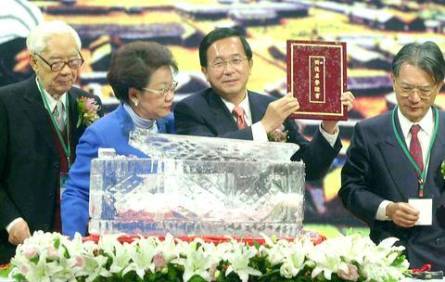
President Chen Shui-bian takes a certificate restoring the reputation of victims suffering unjust verdicts during the martial law era out of an ice-box yesterday, symbolizing that victims can now come in from the cold.
-----------------------------------------
On Jan. 18, 2004 ……
Chen says his aim is to have peace
DETERMINED: President Chen Shiu-bian yesterday said at the opening of his campaign headquarters that he is set on holding a referendum to ensure cross-strait peace
By Chang Yun-ping, STAFF REPORTER
President Chen Shui-bian yesterday reaffirmed his determination to hold a referendum for peace alongside the March 20 presidential election as a way to maintain the status quo across the Taiwan Strait and pursue regional peace and stability.
One day after his announcement of the exact wording of the proposed referendum, Chen yesterday reiterated the reasons behind holding the referendum and sought broad international support to back the democratic progress of Taiwan, which he said has become one of the world's "precious assets."
Democracy
"In the process of furthering democracy and persevering in reform, Taiwan also wants to actively contribute to the international community and to assume the responsibilities and obligations as a member of the global village," Chen said during the launch of his national campaign headquarters in Taipei.
"Taiwan has never been a burden for the international community and the Taiwanese people's pursuit of democracy, freedom, human rights and peace has inspired those nations and their people wishing to build a democracy and become a precious asset of global democratization," he said.
Chen again explained the reasons behind holding the referendum, saying it is aimed at strengthening Taiwan's democratic achievements and maintaining regional peace and stability.
"Over the past three and a half years, I have fully honored my `five noes' pledge. However, China, during the same period, has been continuously increasing the deployment of missiles targeted at Taiwan and has been intensifying its military preparations for an attack on Taiwan.
Regional peace
"China's purpose is patently obvious, that is, they aim to change the status quo across the Taiwan Strait through undemocratic and unpeaceful means, rather than working with us to maintain stability in the region. Nonetheless, for the sake of regional peace and stability, I am still willing to make every effort to safeguard peace across the Taiwan Strait. I remain resolute in this endeavor to the very end," Chen said.
The president said the "March presidential election signifies not only whether Taiwan can achieve greater democracy and prosperity, but will also be a historic event when the first referendum in Taiwan is held. This is a concrete action by the Taiwanese people to announce to the world their desire for peace and happiness as well as a decision not to be threatened by force."
In addition to reaffirming that the proposed referendum will go ahead, Chen said Taiwan has changed remarkably in the past three years under his Democratic Progressive Party (DPP) administration, in contrast to the five-decade rule by the Chinese Nationalist Party (KMT).
Chen said the differences are: First, the DPP believes that Taiwan and China are "one country on each side of the Taiwan Strait," while the KMT upholds its "one China" rhetoric.
Chen said the various interpretations of the KMT's "one China" beliefs have all failed to distinguish themselves from the "one China" framework set up by China, which will marginalize Taiwan and reduce it to a local government under China.
Difference
The second difference, Chen said, is that the DPP administration upholds people's interests as its priority, while the KMT selfishly only has the party's own interests as its priority.
Thirdly, the DPP government endeavors to eliminate the "black gold politics" manifested in rampant political corruption and election bribery of the former KMT regime, while the KMT continues this corrupt type of politics, Chen said.
The fourth difference between the DPP and the KMT is that the DPP perseveres in reforms, while the KMT opposes any reform initiatives, he said.
Thousands of supporters yesterday gathered at the opening of Chen's national campaign headquarters on Minsheng East Road, Section 3 in Taipei -- the same location as Chen's presidential campaign office four years ago.
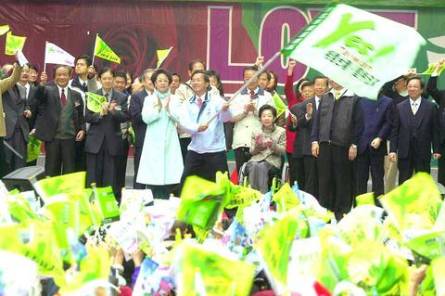
President Chen Shui-bian, center, waves a campaign flag in front of his supporters as Vice President Annette Lu, left, claps her hands at the opening ceremony of their national campaign headquarters yesterday.
-----------------------------------------
On Jan. 18, 2004 ……
US cautiously welcomes Chen's referendum changes
REUTERS , WASHINGTON
The US on Friday cautiously welcomed the changes Taiwan made to the terms of a referendum that has outraged China and which US President George W. Bush feared would upset the delicate status quo with China.
Conciliatory statements about the referendum from Secretary of State Colin Powell and White House spokesman Scott McClellan came after President Chen Shui-bian set ballot issues that were less aggressive than expected.
The US had warned Taiwan that its plans for a March 20 referendum could be seen as a unilateral attempt to change the status quo and move the nation toward independence, which China has threatened to go to war over.
On Thursday Chen unveiled what analysts said was a toned-down version of what they had feared would raise tensions across the Taiwan Strait.
He said his "peace" ballot alongside the election was aimed at preventing China from attacking Taiwan and changing the political status quo.
It will ask voters two questions -- whether Taiwan should acquire more advanced anti-missile weapons if China refuses to withdraw missiles pointed at the nation, and whether Taiwan should negotiate with China to establish a peaceful and stable framework for interaction.
White House spokesman Scott McClellan said the US did not see the referendum as something that would change its status with China.
"I would keep in mind that, as a matter of principle, we are not opposed to referendums, but nor will we endorse any specific referendum," he said.
"We understand, however, that there would be no relationship between the outcome of the proposed referendum and Taiwan's commitment to the status quo," McClellan said.
Powell told Hong Kong-based Phoenix TV that Chen has shown some flexibility.
"I think President Chen has shown a little flexibility in the way those two questions have been worded," he said, referring to the new terms of the referendum.
He repeated that the US "would not be supportive of any effort on the part of either of the parties to undertake a unilateral resolution of the difficulties between them."
"And so we will study the statement very, very carefully, and it seems to suggest a bit of flexibility from his earlier positions," he said.
The two sides split at the end of the Chinese civil war in 1949. Washington switched diplomatic recognition to Beijing from Taipei in 1979 but is the nation's main arms supplier and trade partner.
-----------------------------------------