20040119
=======
The empty “one China” framework on Jan. 19, 2004 ……
Referendum can balance cross-strait relationship
By Liu Kuan-teh
In his latest book, titled Believe in Taiwan -- President A-bian's Report to the People, President Chen Shui-bian reviews in detail the cross-strait dynamics over the past three years and provides his perspectives on the future of China-Taiwan relations.
Describing China's rise as a power in Asia as the realization of the Chinese "Monroe Doctrine," Chen says China has become a hegemonic power in Asia, generating mixed feelings among Asian nations.
The notion of the Chinese "Monroe Doctrine" has resulted in an unbalanced cross-strait relationship in at least four ways:
First, no Chinese leader dares to take the initiative to adjust Beijing's Taiwan policy for fear of being victimized in an internal power struggle. Since Deng Xiaoping unveiled the formula of "one country, two systems" in the early 1980s, it has become a political icon for the new generation of Chinese leaders to abide by.
Nevertheless, the gradual opening of Taiwan's democracy, coupled with a growing national identity in Taiwan, has widened the gap between the two sides of the Taiwan Strait.
The fact is, the "one country, two systems" formula is opposed by over 70 percent of Taiwanese people and does not enjoy international approval either. Conservatism, rigidity and the fear of facing reality have shaped Beijing's inflexible policy toward Taiwan.
Second, the Chinese leadership has never had the courage to recognize the consolidation and deepening of Taiwan's democracy. While Chinese leaders have repeatedly stated that their "hopes lie with the Taiwanese compatriots," the people have countered their expectations with a grand transformation of economic liberalization and political democratization -- all within a span of less than 20 years.
At a time when China has only just entered the embryonic stage of democracy characterized by local elections, people in Taiwan already enjoy the more progressive "popular sovereignty" of national referendums.
Far outpaced by Taiwan's rapid democratic progress, China has no option but to suppress Taiwan's efforts to enhance its democracy.
Third, China always lacks the courage to face the fact that there is one country on each side of the Taiwan Strait.
In addition to threatening Taiwan's international place and rooting out the nation's diplomatic allies, Beijing has on many occasions used its influence to try to prevent Taiwan's accession to the WTO and its attempts to join the World Health Organization.
Such moves not only have pushed the people of Taiwan further away from but also failed to draw Taiwan into the narrow confines of the empty "one China" framework.
The fourth element contributing to an unbalanced cross-strait relationship is the military imbalance across the Taiwan Strait. The situation causes great concern among the Asia-Pacific countries and the US.
These inherent factors that lead to an asymmetrical cross-strait relationship deserves global attention.
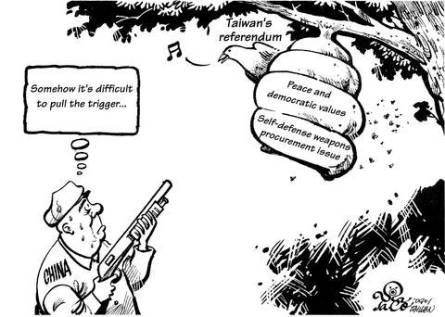
To help balancing current cross-strait relations, a "peaceful referendum" can be regarded as the first step to demonstrate 23 million Taiwanese people's steadfast intention to call for a peaceful transformation of its relationship with China.
With a new mandate on such a peaceful resolution on cross-strait disputes, whoever wins the March 20 presidential election in Taiwan will have full legitimacy to deal with Beijing for the sake of protecting Taiwan's interests. Pragmatic policies can be implemented based on parity and mutual benefit.
This is the essence of maintaining the status quo.
Liu Kuan-teh is a Taipei-based political commentator.
-----------------------------------------
On Jan. 19, 2004 ……
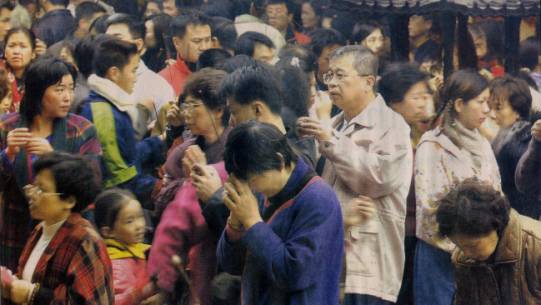
People swarm to temples to pray for good luck and health in the coming
new year.
-----------------------------------------
On Jan. 19, 2004 ……
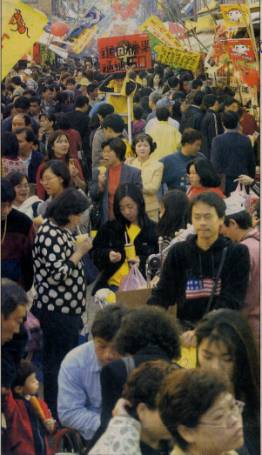
As the Chinese Lunar New Year is only three days away, busy shoppers swarm to Tihua Street for the 2004 Promenade and Bazaar for the New Year Festival.
-----------------------------------------
Two open letters to US Congress
By Li Thian-hok
On Dec. 30 last year, China's ambassador to the US, Yang Jiechi, wrote a letter to the members of the US House of Representatives.
The opening paragraph of the letter is as follows:
"I have learnt with deep concern that some Congressional members are currently drafting a resolution to support the Taiwan authorities' attempt to hold a `referendum' and write a `new constitution.' This is a highly political issue which deserves close attention."
Yang went on to argue that the proposed referendum is "a cover for [President Chen Shui-bian's] pursuit of Taiwan independence." Yang made many misleading statements in the letter.
Chen, on the other hand, insists that the defensive referendum is intended to make the people of Taiwan more aware of China's military threat and to help preserve the status quo.? He wants to conduct the referendum on March 20, in conjunction with the presidential election, in spite of the objections of the administration of US President George W. Bush.
China has threatened to use force if Taiwan holds a referendum. In July last year, Chen Yunlin, director of China's Taiwan Affairs Office, and Zhou Mingwei, Chen Yunlin's deputy, were reported to have told Richard Armitage, US deputy secretary of state, that any referendum in Taiwan was unacceptable as it would lead to an eventual vote on independence.
On Dec. 17, Li Weiyi, a spokesman for the Taiwan Affairs Office, accused Chen Shui-bian of risking war with his plans for a symbolic referendum on China's missile deployments. "We must make all needed preparations to resolutely smash these splittist schemes for Taiwanese independence," Li said. Later in the month Chinese Premier Wen Jiabao chimed in: "China would pay any price to safeguard the unity of the motherland."
So there exists the potential for Chinese military action against Taiwan in March or around May 20, the day the winner of the election will be inaugurated. Yet it is virtually impossible for Chen Shui-bian to accede to the Bush administration's wishes.
Over the past few years, there has been a groundswell of nationalism in Taiwan in response to China's intransigence.
There were two demonstrations last year in support of a referendum law and a new constitution to improve the efficiency of government. The demonstrators numbered 150,000 in Taipei and 200,000 in Kaohsiung. No political party that ignores such an outpouring of popular will can stay in power.
That is why the pan-blue alliance of the Chinese Nationalist Party (KMT) and the People First Party reversed its long-held positions and pushed for the passage of its version of the Referendum Law. The pan-blue alliance is committed to an early annexation of Taiwan by China.
The US' interest is maintaining the status quo, which gives Taiwan de facto independent status.
If the Bush administration succeeds in compelling Chen Shui-bian to abandon the peace referendum, his disappointed supporters could well abstain from voting to protest his betrayal of democratic values. Chen Shui-bian's defeat would likely result in Taiwan's capitulation to China within a couple of years. This would effectively terminate the US' role as guarantor of peace and stability, drastically alter the geopolitical landscape of East Asia and usher in instability and turmoil in the region.
What can be done to resolve the impasse? The first step is to do away with the misconceptions and falsehoods that surround the dispute about Taiwan's proposed referendum.
Below is an open letter to members of the US House of Representatives that rebuts Yang's letter and offers a proper way to forestall a conflict in the Taiwan Strait.
"Dear Representative: As your constituent, I am concerned about the seeming disagreement between President George W. Bush and President Chen Shui-bian regarding the `peace referendum' which Chen proposes to conduct on March 20, 2004, in conjunction with the presidential election in Taiwan.
"The US' Taiwan Relations Act (Public Law 96-8) states: `The preservation and enhancement of the human rights of all the people on Taiwan are hereby affirmed as objectives of the United States'? (Section 2(c)).
"To achieve the objectives described in the act, the Bush administration is mandated by Congress to `maintain the capacity of the United States to resist any resort to force or other forms of coercion that would jeopardize the security, or the social or economic system, of the people on Taiwan'? (Section 2(a)(6)).
"On Dec. 30, Ambassador Jiechi Yang of China sent you a letter outlining China's objections to the `peace referendum.' I would like to point out some factual errors in that letter.
"The US does not recognize China's claim of sovereignty over Taiwan. We merely acknowledge the Chinese position, without agreeing to it.
"The US' `one China' policy differs from China's `one China' principle in other respects. The US insists on peaceful resolution of Taiwan's future status and that any settlement must have the assent of the people of Taiwan. China insists that it has a right to resort to force and coercion and that the future status of Taiwan is to be decided exclusively by the Chinese government.
"Yang asserts that China's basic policy is `peaceful reunification.' China ceded Taiwan to Japan in 1895. Since then Taiwan has been ruled by a central Chinese government for only four years -- 1945 to 1949. The current government in Beijing has never ruled Taiwan.
"The word `reunification' is a misnomer; `annexation' is more apt. The word `peaceful' is inappropriate, too, since China has for years been developing the military capability to launch a multi-pronged attack against Taiwan and to deny US forces the opportunity to render assistance in time. Beyond the several hundred missiles targeted at Taiwan, the People's Liberation Army has acquired modern weaponry and conducted massive military exercises -- these are hardly evidence of peaceful intentions.
"Chen Shui-bian's `peace referendum' will ask China to renounce the use of force and to withdraw the missiles deployed against Taiwan. It is a defensive referendum which does not involve independence or annexation. China's concern that any referendum mechanism can later be utilized to decide Taiwan's sovereignty is disingenuous.
"Taiwan's Referendum Law, which was passed on Nov. 27 last year, was drafted by the pan-blue alliance, which favors Taiwan's eventual annexation by China. The law is designed to prevent a referendum on the independence or annexation issue.
"From the US' standpoint, a referendum is desirable. How else could the people of Taiwan express their assent to a proposed settlement of Taiwan's status?
"In order to preserve Taiwan's hard-won freedom and to keep the peace in the Taiwan Strait, we request that you support the resolution soon to be introduced in the House of Representatives to urge the Bush administration to (1) affirm our commitment to defend Taiwan's democracy in accordance with the Taiwan Relations Act; (2) refrain from interfering in Taiwan's domestic politics and withdraw its objections to Chen Shui-bian's "peace referendum," which cannot be deemed "provocative" by any stretch of the imagination; and (3) reinforce US naval and air presence in the Western Pacific promptly so as to deter any military adventure by China.
"While much of the US ground force is tied up in Iraq and the US military is stretched thin, we can deploy sufficient naval and air power in the Western Pacific to deter Chinese military aggression against democratic Taiwan.
"At issue are not just the freedom of the 23 million citizens of Taiwan and peace in the Taiwan Strait, but also whether China will become a peaceful member of the global community or instead turn into an expansionist power intent on becoming the hegemony of Asia and beyond.
"Standing firmly with our democratic friends is in our national interest.
"As the wise former US Representative Gerald Solomon said: `Taiwan's security is ultimately America's security as well.'
"I look forward to hearing your view on this important subject."
Li Thian-hok is a freelance commentator in Pennsylvania.
-----------------------------------------
On Jan. 19, 2004 ……
-----------------------------------------
On Jan. 19, 2004 ……
US has obligation to Taiwan
Alou Bo, Hsinchu
David Evseeff (Letters, Jan. 8, page 8) says that President Chen Shui-bian is ignorant and arrogant in proposing the "defensive referendum."
In his opinion, it is US soldiers' lives that will be at stake if Taiwan has to be defended against an attack by China.
But with or without Chen's proposal, nearly 500 ballistic missiles in China are pointing toward Taiwan.
The lives of 23 million Taiwanese are under constant threat. Should we keep quiet about this threat just because it is part of the "status quo?"
Won't these missiles be launched once an attack has been initiated?
Or are Taiwan's civilian lives not as precious as those of US soldiers?
It would not be a pure favor to the Taiwanese people if the US were to help defend the country against a Chinese attack.
The US will defend Taiwan only to protect its own interests, without regard to its obligations to this country.
Who was a long-time supporter of Chiang Kai-shek's dictatorship?
It was this dictatorship under which the Taiwanese people suffered for more than four decades. It was also this dictatorship that has led Taiwan into facing a rather difficult situation on today's international stage.
The US, which claims to be the leader of the democratic world, cannot simply withdraw from its long involvement and leave Taiwan to fend for itself against a possible Chinese attack.
-----------------------------------------
On Jan. 19, 2004 ……
Taiwan already independent
Daniel McCarthy, Salt Lake City, Utah
I read that China has imposed anti-dumping tariffs on cold-rolled steel imports from Taiwan ("China to impose steel tariffs," Jan 14, page 11).
If China imposes tariffs on imports from Taiwan, then it is certainly behaving as though Taiwan were a separate country.
In fact since Taiwan and China have
separate borders, governments, legislatures, laws, presidents, militaries,
passports and currencies, no objective observer could conclude anything but
that China and Taiwan are separate countries.
Taiwan need not "move toward independence" (China's words) since it is already there.
-----------------------------------------
On Jan. 19, 2004 ……
Lobbyists pressure US Congress
PAST PROMISES: Influential organizations close to Congress will seek a resolution to reaffirm pledges made by the Reagan administration on Taiwan's sovereignty
By Chang Yun-ping, STAFF REPORTER
Taiwan supporters in the US Congress said a new resolution in the upcoming session will aim to draw a clear line between Taiwan's and China's sovereignty.
Wu Ming-chi, chairman of the Washington-based Formosan Association for Public Affairs (FAPA), one of the most active Taiwanese organizations engaged in congressional lobbying, said that the new resolution would not only endorse the Taiwanese government's holding of an election-day referendum, but also seek to reaffirm the part of the Six Assurances introduced by the Ronald Reagan administration, which recognizes Taiwan's separate status from China.
"The fifth and sixth points of the Six Assurances deal with Taiwan's sovereignty issue. Although the US has been adhering to the `one China' policy regarding cross-strait relations, it nevertheless recognizes that at no time since the [People's Republic of China] PRC was established in 1949 has Taiwan's sovereignty belonged to the PRC," Wu told the Taipei Times at an international parliamentary exchange meeting which brought more than 150 legislators from 50 countries to Taipei last week.
The Six Assurances were introduced in the early 1980s to allay concerns over Taiwan's security brought by the previous 1982 Joint Communique signed between Beijing and Washington to reduce gradually the amount of arms sales sold to Taiwan. The fifth and sixth points of the Six Assurances are: The US has not altered its position regarding sovereignty over Taiwan and the US will not exert pressure on the Republic of China to enter into negotiations with the PRC.
Wu said, "This is a very important distinction between the PRC's `one China' principle and US' `one China' policy, but oftentimes people confuse the two policies and mistakenly think the two are the same.
"The US' one China policy advocates a peaceful resolution on the cross-strait issues and that any decisions leading to the change of the status quo must acquire the assent of the Taiwanese people. In addition, the US doesn't recognize that Taiwan's sovereignty belongs to China," Wu said.
Wu continued, "The PRC's one China principle treats the so-called `Taiwan question' as the internal affairs of China. Although China also agrees to a `peaceful resolution' to the end of the cross-strait issue, it nevertheless means the imposition of the `one country, two systems' formula to coerce Taiwan to accept this sole means for what it calls a `peaceful resolution' to the China-Taiwan problem. Since the Six Assurances recognize that Taiwan's sovereignty does not belong to the PRC, it is clear that the sovereignty of Taiwan belongs to the Taiwanese people."
Based on this concept, Wu said the resolution would add a point at the end to specify that Taiwan's future should be determined by the people of Taiwan only, excluding the people of the PRC.
Prospects for such a bill, however, have unnerved China, prompting its US ambassador last month to send a letter to all members of Congress urging them to reject the planned legislation. In his letter, dated Dec. 30, Chinese Ambassador Yang Jiechi urged the members of Congress to "prevent the above-mentioned draft resolution from passage in the US Congress."
He said the bill "runs counter to the relevant commitment of the United States government" in its one China policy, and its commitments in the three US-China communiques.
"Facts have shown," Yang wrote, "that [President] Chen Shui-bian is a trouble-maker. He cares about nothing but his own political agenda, ie `Taiwanese independence' and his own re-election."
No previous Chinese ambassador is known to have made such a direct lobbying effort to Congress to reject a legislative initiative involving Taiwan.
-----------------------------------------
On Jan. 19, 2004 ……
WHO hunts for bird flu victims
BAFFLED EXPERTS: Although Vietnam's southern parts were hardest hit by avian flu, all human fatalities occurred in the north, forcing scientists to search for an explanation
REUTERS, HANOI
Experts from the World Health Organization (WHO) and Food and Agriculture Organization were hunting yesterday for cases of humans infected by bird flu in southern Vietnam after four deaths in the north.
Officials of the UN agencies were meeting health and agriculture officials in Ho Chi Minh City, Vietnam's biggest city which is in the south of the country, in their search for victims, said WHO spokesman Robert Dietz.
"They're speaking with officials and trying to find out what is happening," Dietz said.
Eight northern and seven southern provinces have reported outbreaks of avian flu type H5N1 but the south has been hardest hit. Two southern provinces have seen the cull or deaths of 1 million chickens.
But all the confirmed human flu cases have been in the north, baffling the experts.
The deaths have raised fears of a new deadly epidemic sweeping out of the region that saw an outbreak of SARS spread around the world last year and kill about 800 people.
The four confirmed bird flu deaths, three children and one woman, occurred in three provinces near Hanoi. The woman was the mother of one of the children. Vietnam has a total of 12 suspected avian flu deaths.
The WHO said it had found no evidence of human-to-human transmission of the H5N1 virus. Some of the victims had come into contact with sick poultry, a WHO official said.
But in what could be the first cases of bird flu in humans in the south, a hospital in Kien Giang province said yesterday a man showing symptoms similar to those seen in bird flu victims had died.
A woman with similar symptoms was in critical condition.
"Clearly we know there's avian influenza in the south, probably on a bigger scale than in the north, so we are concerned that there could be other [human] cases over there," said Peter Horby, the WHO's Hanoi-based epidemiologist.
"That's one of the reasons we are bringing epidemiologists who can go to the south who can try to detect any cases that might be there," he said in an interview late on Saturday.
Five children remain hospitalized in Hanoi as suspected avian flu cases, but only one was very sick, Horby said. Seven adults suspected of having bird flu were being treated at Hanoi's Bach Mai hospital.
South Korea, Japan and Taiwan have also reported outbreaks of bird flu but Vietnam has been the hardest hit.
The type of avian flu virus that caused the four confirmed deaths in Vietnam is similar to a variant that struck Hong Kong in 1997, killing six people.
The virus emerged in Vietnam just ahead of the country's biggest celebration, Tet or the Lunar New Year which kicks off on Wednesday.
New Year dinners usually feature chicken but Ho Chi Minh City and two nearby provinces have banned the sale of the birds.
Eating cooked chicken and eggs was safe, Horby said.
Vietnam has ordered that farms and villages reporting bird flu destroy all poultry in their vicinity, but has not sought the mass destruction of fowl in provinces with cases.
Prime Minister Thaksin Shinawatra of Thailand, one of the world's biggest chicken producers, said on Saturday the WHO had confirmed there was no bird flu in his country.
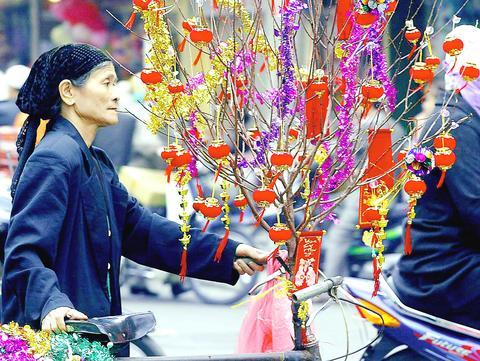
A vendor yesterday hawks small decorative red lanterns for Lunar New Year along a street in Hanoi. Vietnam ushers in the Year of the Monkey this week, but people might be forgiven for thinking it is the chicken that will rule the roost over the next 12 months. Bird flu outbreaks in nearly half of Vietnam's 64 provinces and cities have thrown a dampener on celebrations.
-----------------------------------------