20040120
=======
Reported on Jan. 20, 2004 ……
What our president should be in a crisis
By Chen Yi-shen
Our presidents used to be elected by the National Assembly based on an earlier version of the Constitution of the Republic of China.
At that time, people didn't need to worry about assessing the qualifications of national leaders if they weren't in the assembly.
And that body was a rubber stamp anyway.
This was because rulers during authoritarian times did not entrust people other than themselves or their sons with the presidency.
Now the people of Taiwan are going to exercise their right to elect a president for the third time.
We should cherish this wonderful opportunity and the responsibility of being masters of the country.
We should also think carefully about the qualities that our national leader should have.
We can draw some answers to this question from what former president Lee Teng-hui has said over the past two years in reference to a leader's qualities.
He said that a leader should be firm in his convictions, be willing to sacrifice personal interests for the public good, be fearless in the face of a challenge, be rich in charisma, be high in prestige and be capable of getting things done.
He has also used these criteria to variously criticize the Chinese Nationalist Party (KMT) for put-ting its own interests above those of the country and Taipei Mayor Ma Ying-jeou for his administration's incompetence in flood prevention.
I do not think it is possible for us to set criteria for a perfect leader if we do not consider the nation's political reality and needs.
In other words, people need to have a basic idea about social justice and the direction the country is heading in before deciding which pair of candidates is more suitable for the highest office.
Choosing a leader is about choosing one's direction and values.
It is not about choosing an all-powerful deity to worship to solve all of one's problems.
Taiwan has been ruled by different foreign powers, and events of the past 50 years have not been clearly investigated due to the White Terror and martial law.
The confusion over who this period's victims and oppressors were is detrimental to forming a common identity.
But the democratization and localization that started here in the 1990s are irreversible. Only the one who can continue along this path would be a suitable president.
In recent years, Taiwan has suffered from the crisis of being a country but not acting like one.
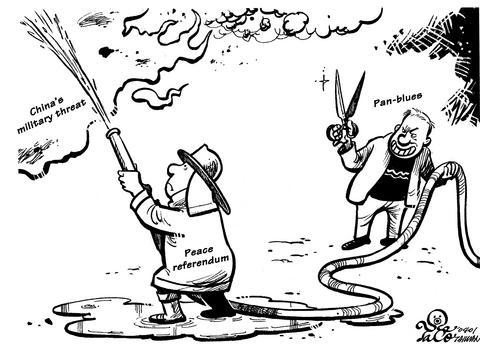
This has deepened with the endless incentives and threats offered by China as well as the collaboration with China of local political parties and media outlets.
Beijing has distorted President Chen
Shui-bian's anti-missile referendum in an attempt to convince some that it is a
referendum on Taiwan's independence.
Its attempts to make Taiwan cancel
the referendum process, together with pressure from the US and Japan, indicate
a crisis still looms before us.
If a president is not willing or able to resist such unreasonable, ridiculous pressure, then he does not have the requisite will power to serve the country.
We need a president who can continue democratic reforms and localization.
He needs to be sufficiently strong-willed to resist such pressure and ensure the nation's best interests are protected and dignity preserved.
Chen Yi-shen is an associate research fellow at the Institute of Modern
History at the Academia Sinica.
-----------------------------------------
On Jan. 20, 2004 ……
-----------------------------------------
On Jan. 20, 2004 ……
What really is China's bottom line?
By Paul Lin
China has always claimed that it will start a war if Taiwan crosses its bottom line on the cross-strait issue. We must therefore ask what "crossing the bottom line" means. The question of whether holding a referendum would be considered crossing that line has become the focus of everyone's attention.
Condemnations of Taiwanese independence by Chinese government officials are a dime a dozen, but no one can explain what "Taiwanese independence" really means. If we tried to establish a definition based on official documents, we would have to use China's white paper on the "one China" principle and the Taiwan issue published in 2000.
This document specifies China's bottom line on the Taiwanese independence issue in this way: "However, if a grave turn of events occurs leading to the separation of Taiwan from China in any name, or if Taiwan is invaded and occupied by foreign countries, or if the Taiwan [sic] authorities refuse, sine die, the peaceful settlement of cross-strait reunification through negotiations, then the Chinese government will only be forced to adopt all drastic measures possible, including the use of force, to safeguard China's sovereignty and territorial integrity and fulfill the great cause of reunification."
John Tkacik, a research fellow at the US-based Heritage Foundation, who participated in a symposium discussing the effects of Taiwan's referendum on the triangular US-Japan-Taiwan relationship, also talked about where China draws its line. He said that Taiwan may have already crossed it by electing Chen Shui-bian as president in 2000.
Prior to that, former president Lee Teng-hui also crossed the line with his special state-to-state model.
Tkacik's two examples can indeed be seen as examples of overstepping the boundaries set by the aforementioned "separation of Taiwan from China." We can even trace earlier transgressions. In 1995, when Lee visited Cornell University, he mentioned the Republic of China several times in a speech. This was seen as an attempt at establishing two Chinas, and was followed by a first wave of propaganda attacks and military threats.
Next, the first direct presidential election in 1996 further confirmed that Taiwan was a democratic country where sovereignty rests with the people, and this incited a second wave of propaganda attacks and military threats from China. But the reality is that there is one country on each side of the Taiwan Strait. It's just that China won't allow Taiwan a voice in the international arena.
But China did not start a war due to these incidents, even after issuing a warning that electing the pro-independence Chen to the presidency would "mean war." The implication is that this is not where China draws its bottom line, or that the bottom line can be redrawn depending on policy requirements. And not even China can define the meaning of the expression "sine die" used in "if the Taiwan authorities refuse, sine die, the peaceful settlement of cross-Straits reunification through negotiations."
Chinese academic Zhu Xianlong recently published an article discussing where the bottom line is drawn on the Taiwan independence issue. Crossing the line involves becoming an independent country, writing a new constitution, changing the national title, flag, anthem and territory, holding corresponding referendums, or holding referendums on participation in government-level international organizations. It also includes Taiwanese military provocations, Taiwanese development of weapons of mass destruction, Taiwanese internal unrest and foreign invasion of Taiwan.
The meaning of all this just keeps getting more confused. What would happen if, for example, Taiwan were to change only the national anthem and flag, but not the nation's title? How should internal unrest be defined? Apart from clarifying China's lack of a clear bottom line, the gray area also leaves Taiwan with considerable room to maneuver.
The referendum issue was also mentioned in the white paper, which stated that "We firmly oppose changing Taiwan's status as a part of China by referendum." However, the March 20 referendum is only being held to oppose the missiles China is aiming at Taiwan. And, if anything, China's missile threat simply proves that Taiwan is not part of China.
Beijing's English-language newspaper,
the China Daily, has recently reported that Wang Zaixi, deputy director of the
Taiwan Affairs Office under China's State Council, wants Chen to stop playing
with fire. He also said that the next three months will decide whether peace
and stability will continue in the Taiwan Strait. Some people in the Chinese
army have issued similar threats. If these threats aren't simply a matter of
misjudging Taiwan's position, then they might be deliberate attempts at
creating more tension in the Taiwan Strait, thus aiding the campaign of the
Chinese Nationalist Party (KMT) and the People First Party (PFP).
It might also be intended to mislead the US. Unfortunately, the US also believes that something very serious has occurred in Taiwan, and that is the reason why US President George W. Bush spoke out.
If Taiwan really wants to declare independence under another name, now is not the right time.
Taiwan's politicians aren't that stupid -- the US is busy with the war on terror and does not have the power to deal with the East.
Besides, the US needs China's help -- or at least its continued neutrality. The two nations are also in the middle of an economic honeymoon.
But unless this propitious period in the Sino-US relationship can be sustained over the long term, and unless China's economy continues to develop and remain socially stable, the people of Taiwan, long oppressed and bullied by China, will not miss the opportunity to cross China's bottom line once something major happens there. The initiative therefore in fact lies with China itself.
The problems experienced by China as a result of the current development of Taiwan's democracy movement should actually be an opportunity for the US to use Taiwan to apply pressure on China, instead of an opportunity for China to blackmail the US.
Paul Lin is a commentator based in New York.
-----------------------------------------
On Jan. 20, 2004 ……
No judicial integrity
Tina Chang, New York
I read your report ("Hualien prosecutor has poor record, lawmaker charges," Jan. 9, page 1) regarding President Chen Shui-bian's summons to testify in a vote-buying case in Hualien.
I was surprised by Justice Minister Chen Ding-nan's response to the issue. He stated that summoning prosecutor Lee Tsu-chun's qualifications were questionable because Lee had received a "B" performance assessment for 14 consecutive years.
I think the minister has double standards.
I have recorded many statements he has made,
publicly and privately, about the legal case involving my husband, [former Tainan Mayor] George Chang.
The minister totally ignored our appeals to him that the overwhelming amount of pretrial publicity was orchestrated by the prosecutor, Chen Chih-ming, who himself had failed on two occasions to pass examinations to be a prosecutor.
He eventually passed and was appointed through the recommendations of his superiors. Apparently, his superiors didn't want any disqualification to affect the investigation and indictment of my husband and other people in the Tainan City government.
The minister was quite a different person then, not the one arrogantly speaking today in support of a certain individual merely because of a prosecutor's summons.
I do not believe judicial practice in Taiwan has any integrity. It is all personal and political. It is all for the sake of power.
-----------------------------------------
On Jan. 20, 2004 ……
Hong Kong is ample warning
Hong Kong plays a subtle role in Taiwan-China relations. It is a guinea pig for China's "one country, two systems" formula. Beijing used it to unify Macau, and is now attempting to annex Taiwan using the special administrative region as a model. Once a would-be democratic window for China, Hong Kong now offers Taiwan a vivid example of failure and regression. China's wishful thinking of catching Taiwan with Hong Kong's bait will only push Taiwan further away.
Chinese legal expert Xiao Weiyun, who participated in the drafting of Hong Kong's Basic Law, said at a seminar in Hong Kong on Friday that Hong Kong residents might have to wait 30 years to elect their own chief executive and legislative councilors.
Xiao also reiterated the central government's commitment to direct channels of influence over Hong Kong. Since Xiao frequently reflects the opinions of Beijing, his comment this time will no doubt infuriate the people of Hong Kong, who on July 1 last year took part in a massive, 500,000-strong demonstration to demand democracy.
Taiwan held its first free presidential election in 1996 and will hold its first referendum this year. According to Xiao's estimates, Hong Kong lags behind Taiwan in democratic development by at least 40 years and the difference between Taiwan and China is over half a century. So how can the two sides be reconciled and the democratic gulf be bridged with the simplistic slogan "one country, two systems"?
Taiwan's pan-blue camp still cannot bring itself to understand that democracy is an irreversible development. But withdrawal from democracy can only be regarded as a major setback, which neither Taiwan nor the international community would be able to put up with. The pan-blues more or less accept the "one China" policy to please China, ignoring utterly the Taiwanese people's desire for democracy.
In his televised address on Sunday, President Chen Shui-bian mentioned a note he received from China after the 2000 presidential election. Chen even included in his subsequent inauguration address part of a message from Beijing. He has therefore been making a genuine effort to deal with cross-strait issues since the day of his inauguration.
But the pan-blues have hampered these efforts in every conceivable way. This meant that a bipartisan task force on cross-strait affairs led by Academia Sinica President Lee Yuan-tseh achieved nothing.
The pan-blue camp now, however, accuses Chen of having dispatched secret envoys to China to obtain this message. Their election interests clearly outweigh the national interests, and, as a matter of fact, this irrational and baseless accusation only does harm to their election prospects.
If the pan-blues win office, and are prepared to accept a repeat of Hong Kong's "one country, two systems" debacle, then there would be no need for any more presidential elections. China would instead appoint someone to be the head of a Taiwan Special Administrative Region, a process in which the Taiwanese people would not be allowed to take part.
Chinese Nationalist Party (KMT) Chairman Lien Chan should ask himself this simple question: Once elected, do I want to be downgraded from being a president to being a chief executive?
And even if his answer is yes, the people of Taiwan will still say no.
-----------------------------------------
On Jan. 20, 2004 ……
Presidential Office denies use of any secret envoys
MYSTERY MISSIVE: President Chen Shui-bian's display of a note sent to him before his inauguration has raised questions about the use of couriers to and from China
By Lin Chieh-yu, STAFF REPORTER
The Presidential Office yesterday denied that there have been any secret envoys between President Chen Shui-bian's administration and China, stressing that Chen is willing to listen to messages from the other side of the Taiwan Strait even though Beijing has repeatedly ignored his goodwill efforts.
"President Chen showed a note (a message from a top Chinese official) during a live TV interview on Sunday to let the people of Taiwan know that he was sincere about being willing to react to Beijing leaders," said Presidential Office spokesman James Huang.
"However, Beijing has repeatedly ignored President Chen's goodwill and would rather choose to increase [its] military threats against Taiwan," Huang said.
In the interview on Formosa TV, Chen reaffirmed that his administration had tried to improve cross-strait relations ever since he was elected.
He took out a note from a pocket and said that it was a message from an influential Chinese political figure which had been passed onto him by a very important Taiwanese.
Chen then read the note aloud. It said the writer hoped Chen would promise in his inauguration speech to deal with the "one China" issue.
Chen did make such a commitment in his speech, saying, "We believe that the leaders on both sides possess enough wisdom and creativity to jointly deal with the question of a future `one China.'"
Opposition politicians attacked Chen yesterday, accusing him of betraying the country.
They called upon the Democratic Progressive Party (DPP) to say who the writer of the note was and whether there have been secret envoys to Beijing during Chen's term in office.
The Presidential Office said message and the issue of secret envoys were totally different.
"The message was delivered before President Chen was inaugurated on May 20, 2000. Since taking office, President Chen has never authorized any person to negotiate with representatives from the other side in Taiwan, China or any other third place," Huang said.
"We understand that there have been some business leaders, academics and even some elected representatives shuttling between two sides of the Strait during past three years and therefore some messages have been delivered through their interactions. But such persons, who tried to give us messages [upon their return] were not representing [themselves] as the government's secret envoys," he said.
"The president just wanted to tell the public that he had received a message from Beijing and that he had showed sincerity and effort in reacting to that message," Huang said.
Vice President Annette Lu told reporters yesterday that she had not known about the note before Chen displayed it during the TV interview. She said she could not comment on the issue.
Lu, however, urged the media and the public to focus on China's actions over the next few weeks rather than on old notes.
She said the people should also be aware of outside pressure from China, which is going all-out to affect the presidential election.
"For example, China may add a new article to its Constitution to define Taiwan's referendum as an illegal movement," Lu said.
-----------------------------------------
On Jan. 20, 2004 ……
Chen pressed to reveal origins of China message
NOTE: Pan-blue alliance leaders said Chen should explain how the contents of the missive ended up in his 2000 inaugural address
By Huang Tai-lin, STAFF REPORTER
Opposition Chinese Nationalist Party (KMT)-People First Party (PFP) alliance leaders yesterday urged President Chen Shui-bian to explain the origins of his so-called "message from China."
During an interview on Formosa TV Sunday night, Chen displayed a note which he said was a message from the Chinese authorities before his inauguration in May 2000.
Without identifying from whom the message came, Chen said, according to the note, Beijing hoped that he would state in his inaugural speech that the two sides of the Strait would deal with the future "one China" issue under the principle of mutual respect.
"Chen should clearly explain to the Taiwanese public about the note, such as who passed the note to him and the whole process of its existence," KMT Chairman Lien Chan said yesterday.
Stating that he was "shocked" upon hearing Chen's remarks, Lien questioned whether Chen had downgraded Taiwan's dignity.
"I don't know whether the Republic of China can still be considered an independent sovereignty if a message in a note can be added to his inaugural speech and become an important direction of the nation's policy," Lien said.
"And I don't know whether Chen has dispatched any secret envoy or is involved in doing anything that might in one way or another disturb the Taiwanese public's rights," he said.
Lien compared Chen to Hong Kong Chief Executive Tung Chee-hwa.
"To do such a thing that undermines Taiwan's dignity, what's the difference between him and the chief executive of Hong Kong," Lien said.
At a press conference with local and foreign press yesterday, Lien restated his disapproval of Chen's referendum questions, branding them a "tool for his own personal campaign electioneering."
Chen on Friday night unveiled the two questions that will be put to voters in the nation's first-ever referendum on March 20 alongside the presidential election.
The two questions will ask the people whether they would support enhancing the nation's defensive capabilities should China refuse to withdraw the missiles it has targeted at Taiwan and to openly renounce the use of force against Taiwan; as well as negotiating with China on cross-strait peace and stability.
"Chen's call for the referendum does not at all adhere to the qualification nor the spirit of Article 17," Lien said, referring to the article in the Referendum Law which stipulates that a defensive referendum can be initiated by the president under the condition that the country faces an external threat that could interfere with national sovereignty.
Lien's running mate, PFP Chairman James Soong, said the referendum was without legal basis, unnecessary and untimely.
Chiding Chen for not observing the law, Soong said that more people, including the international community, are now asking "What's next?" if Chen succeeds in his re-election bid.
The pan-blue alliance also took the opportunity at yesterday's press conference to announce that it would dispatch a seasoned diplomat, Jason Yuan, to Washington as the "formal communicative channel" with the US government.
"In the past, the alliance's messages had often been misunderstood and distorted," Lien said.
"Yuan will act on behalf of the alliance to clearly express to the US government, Congress, academia and the press the views of the alliance and that of Taiwan's mainstream," he said.
Yuan, former director of the Taipei Economic and Cultural Office in Los Angeles and previously representative to Canada and Panama, is slated to take off for his role in the US shortly after the Lunar New Year holiday.
-----------------------------------------
On Jan. 20, 2004 ……
DPP says China's reaction to referendum is old hat
By Chang Yun-ping and Ko Shu-ling, STAFF REPORTERS
The Democratic Progressive Party (DPP) yesterday said Beijing's comments on the content of Taiwan's election-day referendum did not show any changes to its stance and merely reflected its stated policy.
Vice President Annette Lu yesterday said Chinese State Councilor Tang Jiaxuan's response to the wording of the referendum questions reflected only its guilty conscience toward the anticipated result of the referendum -- that the people of Taiwan will say no to China's rule.
"Although China has said it places hope upon the people of Taiwan [to realize peaceful unification], it nevertheless opposes Taiwanese people's exercising a referendum because it knows already that the people of Taiwan will reject being ruled by China," Lu said yesterday during a press briefing with reporters.
At the ninth anniversary of the announcement of the former Chinese president Jiang Zemin's "Eight Points," Tang said Taiwan's referendum is a "provocation" in cross-strait relations.
In addition to reiterating the "one China" principle, Tang repeated Beijing's stated policies that China will continue to push for "peaceful reunification" with Tai-wan, promote the "one country, two systems" formula and remain steadfast on Jiang's "Eight Points" guidelines.
Cabinet Spokesman Lin Chia-lung said yesterday that Tang's stance was "irrational" and "unacceptable."
"If such a gentle way of expressing our opinion is deemed provocative, then any effort we make to deepen our democracy can be misconstrued as a provocation," Lin said.
Lin also dismissed the "one China" policy, which Tang said was the precondition for cross-strait negotiations.
"If we accede to follow the rules it sets down, it will only lead to the nation's defeat at the negotiation table," Lin said.
"If China wants us to recognize
the `one China' policy as the premise of cross-strait negotiations, isn't it fair
for us to ask them to renounce the use of force against us, put aside political
differences and deepen its democracy?
"I don't think any elected president can accept the proposal to use our sovereignty, land and people to exchange for transient and ersatz peace and security across the Taiwan Strait," he said.
If the public and politicians do not correct the illusion, Lin said, the nation is bound to fall into the snare of Beijing's negotiating plot.
"If they really care about the voice of our people, they should've let us hold the nation's first national referendum instead of vilifying and blocking it," he said.
Lin also called on the public to learn a lesson from the mistake Hong Kong made.
"We shouldn't make the same mistake Hong Kong made. It believed that it would prosper under the `one country, two systems' formula, but it didn't," he said. "Once we go down that road, our democratic development and national security will be gone forever."
Lu said yesterday China had inverted the cause and effect in opposing Taiwan's referendum.
"It is not that Taiwan's holding of a referendum leads to China's missile deployments against Taiwan. Rather, it is China that initiates all kinds of threats and hostility toward Taiwan in the first place," Lu said.
She reiterated that President Chen Shui-bian's "five noes" pledge comes with a precondition, which is China must not use force against Taiwan.
"But China has violated this rule in the first place," Lu said.
Moreover, Lu said the validity of Chen's "five noes" pledge, which was made on May 20, 2000, in Chen's inauguration speech, will stay in effect only until May 19 this year. Any new rules defining cross-strait relations after May 19 this year will depend on how the new president gauges the situation.
Lu also expressed optimism about international support for the referendum.
"I have observed that many countries, including [China], believe that President Chen is capable of holding the referendum alongside the election and the underlying meaning of this belief signifies the confidence of the world in Chen's re-election. And therefore, what the international community now cares about is what President Chen will say in his May 20 inauguration speech," Lu said.
Chairman of the DPP's China Affairs Department Chen Chung yesterday said China's response to Taiwan's holding a referendum demonstrated that Beijing was reluctant to further strain cross-strait ties.
-----------------------------------------