20040121
=======
Reported on Jan. 21, 2004 ……
Democracy an asset to both sides of Strait: Chen
APPEAL TO CHINA: The president said China had nothing to fear from the referendum planned for the same day in March as the presidential election
By Chang Yun-ping, STAFF REPORTER
In his year-end talk to the people of Taiwan, President Chen Shui-bian yesterday appealed to Beijing to embrace Taiwan's democracy and that the results of the election-day referendum will be the basis for both sides to enhance future dialogue.
"Taiwan's democracy will become the common asset of people across the Strait and by no means is it a burden to the people of both sides," Chen said at the last meeting of the Democratic Progressive Party's (DPP) Central Standing Committee.
"The consensus reached by the Taiwanese people through this democratic means will be the basis for the two sides to initiate future dialogue and communications," he said.
Chen yesterday urged the people of Taiwan to continue striving for the deepening of democracy, which has become a successful model to the rest of the world.
He said he appreciated international support for the referendum, which will be held on the day of the presidential election, March 20, and commended the referendum as a remarkable milestone in Taiwan's democratic development.
Chen said the two referendum questions prove "the determination of the Taiwanese government to protect the peaceful status quo across the Strait to prevent China from using force to unilaterally change the status quo. In addition, the people of Taiwan want to construct a peaceful interaction framework with China to resolve the long-standing political stalemate across the Strait," Chen said.
He said Taiwan's democracy was not a gift; it was a hard-won achievement resulting from the determination of Taiwanese people.
After detailing Taiwan's major democratic achievements over the past two decades, Chen said: "In 2004, the people of Taiwan are going to hold a historic referendum. I believe that ... history will record March 20, 2004, as a day when the people of Taiwan cast their ballots to choose not only their new president but also to decide the nation's policy and future," Chen said.
-----------------------------------------
On Jan. 21, 2004 ……
Japanese soldiers debut in Iraq
DEPLOYMENT: The newly arrived units weren't combat troops, but that did not make their presence any less conspicuous, nor less a target for attack by terrorists
AP, SAMAWAH, IRAQ
Japanese soldiers, embarking into a conflict zone for the first time in a half-century, inspected the site of their future base in southern Iraq yesterday amid reports of a possible terrorist plot against them.
A group of about 10 Japanese troops drove up in four cars -- followed by hordes of reporters, TV cameramen and photographers -- to a muddy field outside this southern town where the camp will be built.
They spent 20 minutes looking around before returning to the Dutch garrison at Camp Smitty where the 30-member Japanese contingent is based temporarily. The Japanese contingent will be 1,000 strong by the time it is fully deployed in March.
The noncombat group, comprising engineering and water purification units, will help purify local water supplies, rebuild schools and provide medical care in Samawah and surrounding areas.
Samawah lies about 230km south of Baghdad.
The troops arrived in southern Iraq late Monday overland from Kuwait.
Japanese defense chief Shigeru Ishiba yesterday told reporters in Tokyo that the government was investigating reports of a possible terrorist plot against the troops, based on unspecified information. He did not elaborate.
"We don't have the details, but such information should be investigated over there," Ishiba was quoted as saying by a Defense Agency spokesman.
"It is the advance team's mission to assess the local security situation," he said.
The Japanese army mission is the
biggest for Japan's military overseas since the end of World War II and the
first to be deployed in a war zone.
The dispatch has triggered widespread opposition in Japan with polls indicating a majority of the public believes the mission is too dangerous, or opposes it because it might violate the country's postwar pacifist Constitution.
Earlier yesterday, Japanese Chief Cabinet Secretary Yasuo Fukuda said the government was resolute in going through with its dispatch.
"We have responsibilities as a member of the international community. Without fulfilling those responsibilities, our country cannot exist," he said.
On arrival in Samawah on Monday, the commander of the advance party, Colonel Masahisa Sato, said his objective was to "collect information about the security relating to our activities" and to coordinate with humanitarian organizations active in the Samawah area.
Another officer, who identified himself only as Lieutenant Colonel Toshi, said: "Not last Samurai, first Samurai in Iraq ... Never kill any Iraqi people. I come here to shake hands."
Tokyo spent a lot of money supporting the 1991 Gulf War, but sent no troops, Afterward, Japan was criticized at home and abroad for relying on "checkbook diplomacy."
Residents of Samawah have mounted a grand welcome for the Japanese in the hope that they would bring jobs and put an end to the constant power outages and sanitation problems since the US-led coalition toppled the regime of Saddam Hussein last April.
"The Japanese make the best of everything," said Mohammed Ali Hussein, showing off a beat-up Sony Walkman.
"We are hoping they bring jobs, give us work and teach us ... I hear there will be construction projects," he said.
Welcoming banners in Arabic and Japanese have been strung up in markets. Merchants have stocked up on goods they hope the Japanese will want, sometimes making cultural miscalculations.
One shop owner was displaying cheese and cracker packs.
"I am told the Japanese like it," said Ahmed Abdul Hamid, 25, unaware cheese is unpopular in Japan.
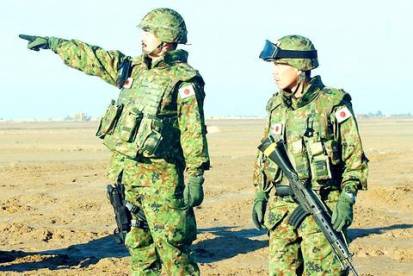
Japanese Army advance party commander Colonel Masahisa Sato, left, points to the horizon yesterday as he inspects his military base in Samawah in southern Iraq.
-----------------------------------------
On Jan. 21, 2004 ……
DPP urged to develop fresh campaign issues
MAINTAINING MOMENTUM: Analysts say that now the referendum questions have been made public, the DPP needs to move on to issues of people's livelihoods
By Lin Chieh-yu, STAFF REPORTER
The Democratic Progressive Party (DPP) must develop new campaign issues after the Lunar New Year to maintain momentum instead of just sticking to President Chen Shui-bian's referendum plan, political analysts said.
"Though the DPP and President Chen continue to dominate the campaign as well as the media agenda, the question is whether such an advantageous position in the media can effectively attract those undecided voters," said Chang Jung-feng, former deputy secretary general of the National Security Council (NSC).
"The president's defensive referendum plan may impress his supporters but is obviously not enough to become the top priority for people who have yet to make a final decision" on who to vote for, Chang said.
Chang, who now serves as vice president of the Chung-hua Institution for Economic Research, said that since the president announced the wording of the two referendum questions, the DPP should now move on from debates over the referendum.
"Taiwan's first ever referendum is very important to hard-core voters, but as for middle-class voters, they may be concerned about the economy more than politics," he said.
Chang said both the Chinese Nationalist Party (KMT)-People First Party (PFP) alliance and the DPP had pledged to end negative campaigning and to focus on what visions they have for the country, "but the policy card has, up to now, not been a crucial element of the campaign."
DPP senior official and Legislator Hung Chi-chang agreed that since Chen has announced the referendum questions, international uncertainty about the issue was no longer a problem.
"The DPP campaign headquarters is planning to raise new campaign issues after the Lunar New Year," Hung said.
He said the DPP should start to switch its campaign topics from political policies to people's livelihoods to win the support of non-aligned voters.
The DPP government has accomplished much during the past three years that the former KMT administrations failed to carry out, he said. Therefore the party should begin discussing policies and comparing KMT candidate Lien Chan's personality with Chen's, he said.
Senior political columnist Hu Wen-huei said Chen's popularity slipped after the US president openly criticized "Taiwan's leader," though it has recovered lately.
He said that the announcement of the referendum questions had taken the pressure off the pan-green camp.
"Once those pressures from external factors are gone and the campaign activities return to domestic issues -- and Chen's opponents have to adjust their tactics in dealing with the referendum issue -- it will be time for Chen to enjoy the results and get ready for the next battle," Hu said.
-----------------------------------------
On Jan. 21, 2004 ……

Stocking up
Shoppers buy popular candy and other snacks at Taipei's traditional Nanmen Market ahead of the Lunar New Year.
-----------------------------------------