20040127
=======
Reported on Jan. 27, 2004 ……
Local chiefs rail against referendum
"All the 14 [pan-blue] heads of cities and counties agreed that Chen's proposed referendum has serious flaws in its legality." --- Tseng Yung-chuan, KMT convener
RALLYING OPPOSITION: Local government heads from the pan-blue camp urged the president to reconsider the `illegal and unnecessary' referendum
By Huang Tai-lin, STAFF REPORTER
Questioning the legality and necessity of President Chen Shui-bian's planned referendum, pan-blue mayors and county commissioners yesterday urged Chen to submit the referendum questions to the Referendum Review Committee.
The committee -- formed by the head of the Central Election Committee and representatives from all political parties according to their representation in the legislature -- is responsible for deciding whether a referendum proposed by the people is suitable.
"All the 14 [pan-blue] heads of cities and counties agreed that Chen's proposed referendum has serious flaws in its legality and necessity," Chinese Nationalist Party (KMT) policy convener Tseng Yung-chuan said at a press conference yesterday.
"Therefore they see the need to have the proposed referendum content reviewed by the Referendum Review Committee strictly for its legality," he said.
The news conference was held following a meeting attended by all pan-blue mayors and county commissioners, except Taoyuan County Commissioner Chu Li-lun, who was overseas.
On Jan. 16, Chen unveiled the two questions that will be put to voters in a referendum on March 20, the same day as the presidential election.
The questions will ask the people of Taiwan whether they would support enhancing the nation's defense capabilities should China refuse to withdraw the missiles it has targeting Taiwan and whether the government should negotiate with China on cross-strait peace and stability.
The opposition KMT-People First party (PFP) alliance's initial response to Chen's announcement was to brand it "illegal" and to urge pan-blue local chiefs to boycott the referendum.
But there was no talk of a boycott yesterday, and the pan-blue alliance instead turned the subject over to the Executive Yuan.
Tseng urged Premier Yu Shyi-kun "not to blindly accommodate [Chen's] proposed referendum content without regard for law and [Yu] should instead present a clear, detailed explanation on the legality and necessity of Chen's proposed referendum."
"While the president [is calling the referendum] for the sake of personal campaign electioneering, the premier should be a role model to civil servants nationwide and hold fast to the basic principle of implementing rules according to the law," Tseng said.
"To sum up the consensus of the pan-blue local chiefs, they are opposed to illegal referendums and condemned the attempt to use the referendum as a tool to manipulate the presidential election."
Before the meeting, KMT Chairman Lien Chan -- citing the Referendum Law, which stipulates that a defensive referendum can be initiated by the president if the country faces an external threat to national sovereignty -- slammed Chen for "abusing such rights for a personal campaign gain."
-----------------------------------------
On Jan. 27, 2004 ……
Legislature mulls loyalty checks
"It's definitely intended to
cause a return to the days of `White Terror' although Taiwan is no longer an
authoritarian regime." --- Sun Kauo-hwa, a KMT legislator
NATIONAL SECURITY: Members of the blue camp feel threatened by a bill that would test civil servants for loyalty, saying it would signal a return to the `White Terror' era
By Ko Shu-ling, STAFF REPORTER
Civil servants working in sensitive fields such as national security would be subject to regular loyalty and morality checks, according to a draft law before the legislature.
The measure would apply to new government employees and those transferred to new positions in fields related to national defense, foreign affairs, technology, intelligence gathering and China affairs.
Seventy to 80 percent of these posts are at the National Security Bureau, the Ministry of Justice's Investigation Bureau and the National Police Administration. It is estimated that 4,000 to 5,000 positions would be subject to the checks.
According to a Cabinet official who asked not to be named, civil servants subject to the requirements would be checked in 10 major areas every four years.
"The Investigation Bureau under the Ministry of Justice would investigate whether they have developed a drug, alcohol or mental problem over the past five years, whether they have had close contact with those convicted of treason, maintain dual citizenship, or whether they or their immediate family has stayed in China, Hong Kong or Macau for over a year since November 1987," the official said.
They would also be checked for whether they or their immediate family members have served in political parties, the military, government agencies or any politically oriented institution or group in a foreign country.
Violators would be subject to being transferred to a non-sensitive position, rejection of recruitment or dismissal.
Chinese Nationalist Party (KMT) Legislator Sun Kauo-hwa criticized the plan as a means of "systematically dividing and persecuting minority groups such as mainlanders."
"It's definitely intended to cause a return to the days of `White Terror' although Taiwan is no longer an authoritarian regime," he said.
People First Party (PFP) Legislator Huang Yi-chiao said there is no need for the new law, adding such matters should be handled in accordance with existing criminal legislation and the Constitution.
"We thought it would be a better idea to amend the Civil Servants Employment Law to nullify the provision requiring loyalty checks for all government employees," he said.
Taiwan Solidarity Union (TSU) Legislator Chien Lin Huei-jyun said the pan-blue alliance should be blamed for the loose security checks conducted on civil servants.
"We came up with a host of draft bills in May 2002 with a view to tightening the protection of military intelligence and other national secrets, but the KMT and the PFP had boycotted screening of these bills and stonewalled the transfer of the national loyalty bill to the legislature's Judiciary Committee for deliberation 17 times," she said.
Without the enactment of this bill, Chien Lin said, government agencies cannot conduct stringent loyalty checks on would-be civil servants.
In light of serious leaks of classified information over the past few years, the Cabinet's Central Personnel Administration presented in January 2002 a draft measure that would allow the Ministry of Justice's Investigation Bureau to conduct loyalty checks on government workers in sensitive positions.
The draft triggered a public outcry and warnings about a return to the "White Terror" era. "White Terror" refers to the decades of martial law under KMT rule.
-----------------------------------------
On Jan. 27, 2004 ……
US needs to match the Chinese in diplomacy
By Earl Carr
This month marks the 25th anniversary of the establishment of diplomatic relations between the People's Republic of China and the US. Because of America's global presence, China's relationship with it is, as President Hu Jintao put it, the "central thread in China's foreign policy strategy."
The US plays an integral role in China's foreign policy. However, China has and will continue to assert its independence through other diplomatic channels. China's effective diplomatic strategy has allowed it to consolidate its influence in Asia. The US must therefore implement a new public diplomacy strategy aimed at preserving core geo-strategic and national interests in Asia.
Chinese Premier Wen Jiabao's visit to the US last month was consistent with China's foreign policy objectives: strengthening relations with the US is paramount, furthering relations with the developing world is of lesser importance.
In a highly interdependent global economy, Beijing needs the US just as the US needs China.
Wen's meeting with US President George Bush was the third meeting between Chinese and US leaders last year. At Wen's arrival ceremony, Bush was in rare form, smiling and leading Wen near crowds braving freezing temperatures.
This was in stark contrast to the Bush administration threatening to slap trade sanctions on Chinese textiles, TV and iron-fitting products in November. The sudden change in relations demonstrates the importance both countries place on maintaining political and economic stability.
The Chinese Communist Party has staked its legitimacy on attracting higher levels of foreign direct investment and increasing overall economic growth. To do this, Beijing must continue to improve its relations both with the US and other key economic powers.
Robust economic growth, combined with effective diplomacy, has immeasurably improved China's international image. Because of this, China's diplomatic engagement has important implications for the US.
As a growing economic and military power, China is perfectly positioned in Asia. It now acts as a vital mediator between the US and North Korea. In addition, China's relations with South Korea are better than they are with the US. ASEAN now looks at China as an important economic and political lifeline.
But China's diplomacy also has important implications for US interests in the region, such as Taiwan. China has prevented Taiwan from entering the UN and from obtaining observer status in the World Health Organization. Even more surprisingly, because of strong pressure from Beijing, Bush went so far as to tell President Chen Shui-bian not to hold a referendum.
The US must recognize that while China is dependent on the US for its export markets and foreign direct investment, Beijing has and will continue to assert its independence through diplomatic channels.
Beijing has become very effective in using this "soft power" to consolidate its influence in Asia.
The US needs to embark on an aggressive public diplomacy strategy, de-emphasizing the "war on terror," and increasing state-level contact between the US and traditional Asian allies. It must also devote more resources to international student exchanges to improve trust and understanding at the grass-roots level.
Failure to improve America's image in Asia will lead to a weaker presence there and a smaller overall influence in the region.
Earl Carr is a research associate in East Asian studies at the Council
on Foreign Relations in Washington.
-----------------------------------------
On Jan. 27, 2004 ……
Pan-blue boycott threat misguided
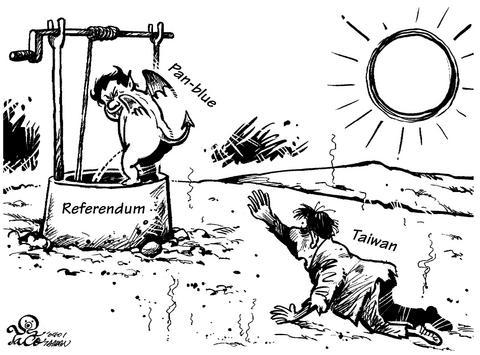
The road to the nation's first ever referendum has been bumpy. International anxiety over President Chen Shui-bian's referendum plan subsided after the referendum questions were announced. Now, however, a boycott planned by the pan-blue camp has cast another shadow over the upcoming ballot.
The referendum issue is legally controversial, but it is ultimately a political struggle. The pan-blue camp plans to oppose the ruling party by three means -- asking for an interpretation of the Constitution from the Council of Grand Justices, mobilizing the cities and counties run by pan-blue leaders to resist taking part in the referendum and encouraging voters to reject the referendum ballots. An interpretation of the Constitution is certainly a proper way to resolve the dispute over a defensive referendum. But by the time an interpretation is issued, the election will have long been a fait accompli.
Cities and counties run by pan-blue leaders may be able to paralyze the referendum proceedings by refusing to cooperate. But it will be illegal for the cities and counties to resist a legal order issued by the president in accordance with Article 17 of the Referendum Law and the Executive Yuan could punish any mayors and county commissioners who baulk at cooperating. Such resistance will result in negative perceptions of the pan-blue camp. Pan-blue-run cities and counties may have to pay a high price for the boycott.
The pan-blue camp's most likely approach would be to separate the presidential election from the referendum administratively and call on the public to refuse to vote in the referendum. This may reduce both the turnout rate and the political association between the referendum and the election, thereby minimizing the points Chen could gain from the referendum and minimizing the pan-blue camp's loss.
Whether Chen's handling of the referendum issue meets the criteria set in Article 17 of the law -- when the nation comes under external threats and is in danger of a sovereignty change -- is up to his political judgment. The voters will decide how to answer that question; the political parties should not overstep their responsibility and answer it for them.
The KMT continues to exercise an authoritarian decision-making model. It still wants to have a small group of people make decisions for the majority. This is a democratically regressive approach. The referendum plan is a rather daring and risky political decision, but it is also a smart strategy compatible with a state leader's handling of the nation's international predicament and China's threats.
If a head of state does not have the ability and determination to resolve a predicament facing the country, the people certainly will not entrust him or her with governance. Chen first attracted international attention by raising the referendum issue and then gained international acceptance by presenting the carefully worded referendum questions. He has demonstrate his ability to run the country.
Taiwan is not a normal country. It has limited national international status and its people have no dignity in the international community. These are key factors affecting the nation's ability to join the international community. Both presidential candidates should see the big picture of Taiwan's plight and propose solutions. This will be a key factor determining voter behavior and cannot be ignored.
Taiwan is still facing China's military threats. It must maintain a status of independence and self-determination in the changing international situation. Only then can Taipei negotiate peacefully and engage in exchanges with Beijing on an equal basis. The question of which presidential candidate can stand firm on national sovereignty issues, trust the people and defend Taiwan's interests is a question that voters cannot ignore.
-----------------------------------------
On Jan. 27, 2004 ……
-----------------------------------------
On Jan. 27, 2004 ……
Ethnic issues must be confronted
`In response to Lien's words, a White Terror victim said he was persecuted in the past but was unable to ask for redress under the military dictatorship. Now, in the democratic era, he must remain silent in order not to `tear ethnic groups apart.''
By Bob Kuo
As usually happens in elections here, a group of "unselfish intellectuals" has come forward to make a political statement. Worried that politicians will pit ethnic groups against one another, these intellectuals have formed the Coalition for Equal Opportunity, calling on the nation to "oppose the manipulation and tearing apart of and discrimination against [ethnic groups]."
I admire the intellectuals' spirit, but disagree with their negative ideology. After all, ethnic issues have been repeatedly stir-red up in our elections but our democracy continues to progress. Nor did any bloody incidents occur during the peaceful transition of power from the KMT to the DPP, which was one of the miracles of modern democratic politics.
But behind this miracle lies endless helplessness, sadness and hatred. That is why the ethnic issue always is an election issue. On the surface, opposition to the manipulation and tearing apart of and discrimination against ethnic groups may appear to be solemn and moral, but how can mere opposition achieve the goal of resolving ethnic confrontation?
Perhaps the intellectuals do not understand that in the eyes of those who have been oppressed in the past, their position is another kind of oppression.
Not long ago, Chinese Nationalist Party (KMT) Chairman Lien Chan said in a speech entitled "I Have A Dream" that "In the past, some people may have experienced unequal ethnic treatment in this land, but Taiwan still has to move towards reconciliation. We cannot have an ethnic group oppress other ethnic groups just because that ethnic group itself was oppressed by another ethnic group during the previous generation."
In response to Lien's words, a White Terror victim said he was persecuted in the past but was unable to ask for redress under the military dictatorship. Now, in the democratic era, he must remain silent in order not to "tear ethnic groups apart." He said the past was painful but that the present is even more so because people do not even have the most basic freedom of expression.
How can there be true ethnic integration in a society lacking freedom of expression?
It is not very difficult to imagine the kind of person who would oppose the tearing apart of ethnic groups. A political party or a politician who in the past has persecuted others might offer a cursory apology and ask victims not to publicize their experiences for the sake of ethnic integration. The Coalition for Equal Opportunity has voiced its opposition out of goodwill but unfortunately they have fallen into the trap of hypocrisy.
Opposition is therefore not what is needed to resolve ethnic conflict. What we need is to honestly and bravely face ethnic conflict. In order to accomplish genuine and long-lasting ethnic integration, we must draw upon all useful opinions and study how this country can withstand tension without being torn apart.
For example, the group of intellectuals should tell us all how a victim of the White Terror, during an election campaign, should go about revealing his or her misfortunes without being said to be pitting ethnic groups against each other. How can others understand this persecution, lend a helping hand and embrace the victims? How should voters go about interpreting malicious rumors instead of being confused by them? How should they implement their civic rights and overcome the media that specialize in pitting ethnic groups against each other?
The intellectuals should not delay answering these questions until after the election because no matter who is elected, politicians will forget the victims and rush to compromise with the media. The media will abandon the intellectuals and continue to encourage division.
Democratic politics is not perfect, nor is credibility, which is only examined at election time. The important issue of ethnic integration has been ignited. We should not let it die out due to hypocrisy. Opposition is inferior to promotion -- the intellectuals should give ethnic integration a different kind of opportunity.
Bob Kuo is a professor in the department of information management at
National Sun Yat-sen University.
-----------------------------------------
On Jan. 27, 2004 ……
China's assembly-line journalism
By Lee Chin-chuan
During visits to various schools and colleges in China, I am frequently asked: "Journalism and communications are a combined discipline in other countries. Why are they separate in China today?" The answer is simple: different traditions and cultural backgrounds.
Journalism and communications are products of the US education system. Between them, there exists a general conflict between theory and practice. But there is no substantive difference in their philosophical foundations. Both have as their objectives the enrichment of US capitalism and its free, democratic system.
During World War I and World War II, sociologists from the University of Chicago inherited the legacy of the early 19th century "progressive movement." Taking John Dewey's pragmatism as their guideline, they explored the media's pedagogical role in social transition (urbanization, industrialization and large-scale immigration from Europe). They promoted gentle, gradual social reforms.
At the end of World War II, with US power at its height, communications studies reigned supreme at Columbia University. Focusing on the processes and functions of the media, the discipline tended to become conservative and narrow. In the late 1970s, it was challenged by western European Marxism.
Peking University was the cradle of China's journalism education, where people such as Cai Yuanpei raised their banners high. Taking the US as their mentor, they burned with the spirit of liberalism and viewed journalism as part of China's modernization. After 1949, the legitimacy of journalism theory changed along with the political power. Following Lenin's doctrine, a priori privileges were given to "the party's mouthpiece" so that it could, by subterfuge, represent the voice of the proletariat .
Apart from this, no other voice was allowed. After the agony of the Cultural Revolution, China opened up out of curiosity, longing to learn from Western scholarship. But no sooner were communications studies introduced from the US and Britain than the "ideological czars" [people such as Hu Qiaomu and Deng Liqun] -- who had always harbored hatred in their hearts -- criticized the "capitalist class" stigma of communications studies, saying that it blurred the direction of class struggle.
China's education system is controlled by the central government. When the education ministry reviews and approves "doctorate points," it makes a clear distinction between journalism and communications studies.
So, there are two points to make. One, in journalism theory, the authorities resolve academic debate by political means in order to safeguard the fundamental doctrine of the "party's mouthpiece." There's no knowing how many people have been purged. Every word the party says is the truth and therefore no debate is allowed. Apart from offering tenuous arguments, the authorities have no other recourse than suppression.
In apparent seriousness, theorists debated for several decades over the "mouthpiece theory" and "information theory" of journalism -- with new scholars replacing those who have fallen, fighting life-and-death struggles and attacking each other's weak spots. The history of journalism became a little more lively, especially in the collection of historical data. However, the historical view followed the direction set by the party and offered few new ideas.
Two, in the area of communications studies, such as "the early stage of socialist market economy," Western scholarship has been introduced with a one-sided view at best. It is a matter of poor imitation.
Scholarship in journalism and communications theory has been unable to keep up with changes in real-life practice. But China has begun to produce doctorates in journalism and communications studies. Chinese people care more about face than substance; they stress "doing it big, doing it strong" in everything.
To put it bluntly, the big eat the small. Media units are forcibly merged to become conglomerates, but in fact, this is nothing more than syndicated monopolization. A merger of entirely unrelated schools results in a hodge-podge crowd. But you can't make an aircraft carrier by tying sampans together.
All this is driven by the will of officials and executive orders, not by free will. China may find it difficult to become the world's No. 1 in other areas, but it has good prospects in the production of doctoral students.
Undertaking doctoral studies requires academic curiosity, enthusiasm and discipline. Only then can one cultivate taste and excel. Only a mentor-intern system can inculcate influence by way of experience. Doctorates should not be created in a mass-production process like an assembly line in a Ford auto plant.
A certain school in Beijing has scored victory by numbers, recruiting a breathtaking 150 doctoral students per year. One professor took in 30 doctoral students in one swoop. Even if that person has three heads and six arms, meeting each student for one hour a week leaves that person no time to do anything else.
Above professors there are "doctoral supervisors." Doctoral supervisors who have no doctorates scramble to take up doctoral studies. This is called "doctoral supervisors gunning for doctorates." This has got to be a Guinness world record with Chinese characteristics.
Lee Chin-chuan is head of the English and communications department at
the City University of Hong Kong.
-----------------------------------------