20040128
=======
Reported on Jan. 28, 2004 ……
Pan-blue members show their true colors
`We can do nothing about opposition from Beijing, nor do we need to. But we can rebuke the pan-blues for their belief that holding a referendum violates the Constitution.'
By Chin Heng-wei
President Chen Shui-bian's early announcement of the referendum questions is certainly a strategic move. Most importantly, he wants to put the US at ease. The two referendum questions have not deviated from US policy, so the US will have no reason to oppose them. Thus, the diplomatic pressure that Taiwan has faced over holding a referendum is relieved.
Although the two referendum questions are neither new nor impressive, the point is that the people of Taiwan can finally vote in a referendum, which is a vital demonstration of the nation's sovereignty. That is why China, the Chinese Nationalist Party (KMT) and the People First Party (PFP) oppose it.
The KMT and PFP always complain that their motives are being misunderstood, but why do they always side with communist China on the issue of the nation's status and sovereignty?
Take the Referendum Law for example -- Beijing publicly denounced it as a move to claim independence. The KMT and PFP also criticized it as a violation of the Constitution and tried to resist it in counties ruled by them. We can say that Beijing is an overt villain and the pan-blues are hypocrites. And they work together to prevent Taiwan from holding a referendum.
We can do nothing about opposition from Beijing, nor do we need to. But we can rebuke the pan-blues for their belief that holding a referendum violates the Constitution.
First, the Referendum Law was passed by the legislature after three readings. Commonly referred to as a "defensive" or "peace" referendum," Article 17 entitles the president to initiate a referendum on national security issues, so the referendum can be defensive or offensive in nature. Chen and the Democratic Progressive Party (DPP) employ the term "peace referendum" to make the mechanism more powerful and flexible in its use.
Second, Article 17 entitles the president to initiate a referendum "whenever the country is faced by an external threat that could interfere with national sovereignty." So as long as there is a "possibility" of such a threat, the president is entitled to hold a referendum. According to the law, the president has to make the decision on whether a referendum should be held, but this decision has to be approved by the Executive Yuan. So the final decision does not rest on the president's subjective judgment alone -- a check mechanism is still in place. Although, practically speaking, the Executive Yuan's approval is only a procedure, it is not fair to say that law endows the president with dictatorial powers.
According to Article 17, there is no violation of the Constitution in Chen's initiation of a referendum. The KMT and PFP oppose the referendum simply to please China. That's why they make up the excuse about violation of the Constitution. But all they are doing is showing the public who they really are.
Chin Heng-wei is editor in chief of Contemporary Monthly magazine.
-----------------------------------------
On Jan. 28, 2004 ……
Et tu, Chirac?
COZYING UP: The French president said Taiwan's March 20 referendum would be a `grave error' as he sought to boost ties with Beijing during a visit by his Chinese counterpart
AP, PARIS
France's president, in a strong show of support for the visiting leader of China, warned Taiwan that it will be committing a "grave error" that could destabilize the region by holding a referendum in March.
At a state dinner Monday to honor Chinese President Hu Jintao, French President Jacques Chirac added his weight to China's opposition to President Chen Shui-bian's plan to ask voters whether Taiwan should beef up anti-missile defenses if Beijing refuses to withdraw the hundreds of missiles it has pointed at Taiwan.
"Breaking the status quo with a unilateral destabilizing initiative, whatever it is, including a referendum, would favor division over unity," Chirac said. "It would be a grave error. It would carry a heavy responsibility."
Speaking later, Hu thanked Chirac for his "clear position of principle ... against the moves by the Taiwanese authorities that tend toward the independence of Taiwan through a referendum."
"We firmly oppose the independence of Taiwan and will not let anyone separate Taiwan from the rest of China in one way or another," Hu said.
But Chirac also pressed for human rights improvements in China, urging Hu to lead his country of 1.3 billion people "resolutely down the track of democracy and of liberties," to match its impressive economic transformation.
"Respect for human rights is a necessary condition for the development of modern societies and economies," Chirac said. "I know it is one of your priorities."
According the Chinese leader a rare honor, Chirac went himself to Paris' Orly airport to meet Hu and his wife, Liu Yongqing. The two men inspected a military guard as a band played China's anthem, March of the Volunteers, followed by France's Marseillaise.
Hu said closer ties between the two permanent members of the UN Security Council, who both opposed the US-led war in Iraq, would help promote "peace, stability and prosperity in the world."
Hu and Chirac discussed Iraq, Iran, the Middle East and Afghanistan, but not human rights, at a meeting Monday afternoon, Chirac spokeswoman Catherine Colonna said.
Chirac told Hu that France backs Chinese efforts to peacefully defuse tensions on the Korean peninsula stemming from North Korea's nuclear weapons program.
The state visit was Hu's first to Western Europe since he ascended to the presidency last March.
But human rights, a key concern in the country that spawned the declaration of the rights of man in 1789, overshadowed the official agenda. In protest at Chinese abuses, some lawmakers said they would boycott Hu's address to the French parliament yesterday.
"Nothing obliges us to listen to
him who leads the world's biggest dictatorship," Lionnel Luca, a lawmaker
from Chirac's UMP party, said on France-Info radio.
"China is not the smiling face
it seems," he said.
Rather than hear Hu, Luca will join protesters against China's policies in Tibet at a demonstration scheduled to coincide with the speech, said Luca's parliamentary aide, Marie Huteau.
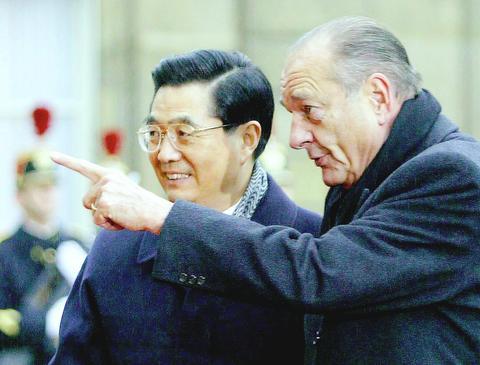
French President Jacques Chirac, right, points while talking to Chinese President Hu Jintao during welcoming ceremonies in Paris on Monday.
-----------------------------------------
On Jan. 28, 2004 ……
Cabinet, MOFA say they regret Chirac's remarks
By Melody Chen, STAFF REPORTER
Cabinet Spokesman Lin Chia-lung yesterday expressed regret over French President Jacques Chirac's opposition to Taiwan's referendum agenda and reiterated that Taiwan will not flinch under China's suppression nor change its resolve to hold its first national referendum.
"We feel sorry about President Chirac's remarks and call on the international community to respect our democratic development," Lin said. "I'd like to remind the French government not to forget about the efforts made by former French president Charles de Gaulle to push for direct democracy some 40 years ago. The campaign was criticized as a mutiny back then but was later proved to be a direct decision."
Lin also lambasted China, who he said has shamelessly used monetary incentives to influence other countries' opinions, continuously attempted to interfere with this nation's domestic affairs, sway the upcoming presidential poll and suppress the nation's diplomatic space.
"The crux of the problem lies in China and its opposition to the proposed `peace referendum' only proves that it's not only necessary but also urgent to hold the referendum," Lin said.
"It may claim victory on the diplomatic front but its opposition to the `peace referendum' only shows its anti-democracy attitude," Lin said.
The Ministry of Foreign Affairs also expressed "deep regrets" over Chirac's remarks concerning the referendum and protested China's pressuring other countries.
Calling France "the oldest democracy in the world," ministry spokesman Richard Shih urged the international community to understand the spirit of Taiwan's referendum, due to be held on March 20 alongside the presidential election
The ministry appealed to international society not to bow to China's pressure to make "anti-democracy and anti-peace statements," Shih said.
Shih, noting France itself has held nine referendums on domestic and foreign issues since the establishment of the Fifth Republic in 1958, said France should have understood that referendum is a means to deepen democracy.
The French revolution and the Declaration of the Rights of Man and the Citizen in 1789 were crucial steps in the development of Western democracy, he said.
"France's democratic tradition has long been revered by other countries ? France, viewing democracy as its fundamental belief and value, should understand that democracy has never been a factor to destabilize peace," Shih said.
Before Hu's visit to Paris, the ministry realized Chirac was prepared to voice public opposition to Taiwan's referendum and it tried to dissuade the French government from doing so, according to Shih.
He said Chiou Jong-nan, Taiwan's top representative in Paris, had been in intensive communications with the French government before Hu's visit.
The ministry is still assessing the impact of Chirac's statement, Shih said, adding that China's attempt to gather "international pressure to influence Taiwan's presidential election" hurt the feelings of the Taiwanese people.
Shih appealed to the international community to demand China show its sincerity about improving relations with Taiwan and maintain regional peace by dismantling its missiles and renouncing the use of force against Taiwan.
Meanwhile, Lo Fu-chen, representative of the Taipei Economic and Cultural Office in Japan, said Japan's Ministry of Foreign Affairs has harmed Taiwan in its handling of the referendum issue.
According to Lo, the Japanese ministry issued two different explanations of Taiwan's referendum plan to its parliament and Japanese reporters based in Taipei.
The Japanese foreign ministry then issued a third version explaining its stance on the referendum while communicating with the Presidential Office over the issue, Lo said.
In presenting the version to the Japanese Diet, the ministry stated it had told Beijing that it hoped the "Taiwan problem" can be solved through peaceful means and that it opposes the use of force against Taiwan, Lo said.
However, in explaining its stance on the referendum to the Presidential Office, the ministry deliberately omitted its opposition to China's use of force against Taiwan.
Lo described the omission as an "incorrect and dishonest" act.
Shih said Lo had revealed the Japanese ministry's improper handling of the referendum issue in order to urge the Japanese government to adopt a neutral attitude toward the issue.
"Lo did not mean to criticize the Japanese government," Shih said.
-----------------------------------------
On Jan. 28, 2004 ……
EU upholds arms embargo on China
REUTERS, BRUSSELS
A French bid to lift the EU's arms embargo on China by April 1 was rebuffed by the bloc's foreign ministers on Monday due to concerns about the country's human rights record.
The ministers agreed only to reconsider the ban -- imposed after the 1989 crackdown on pro-democracy demonstrators in Beijing's Tiananmen Square -- at a future meeting.
The EU enjoyed a trade surplus with China at the beginning of the 1980s, but it now has a large and widening deficit which stood at around 47 billion euros (US$59.15 billion) in 2002.
Ending the arms embargo could open up lucrative trade opportunities with the world's fastest-growing major economy.
France's push, which coincided with a visit to Paris by Chinese President Hu Jintao, drew an angry response from the head of the Liberal Democrats group in the European Parliament.
"Do European governments want to risk having blood on their hands by allowing European weapons to be used against civilians in any future crackdown?" Graham Watson said in a statement.
"A desire to curry favor with the Chinese president during his state visit to France is no excuse for rethinking a long-standing European policy rooted in principle," he said.
France argues that the ban is
"anachronistic" given the improved relations between Beijing and the
EU and sits oddly with weapons embargoes imposed by the bloc on only three
other nations -- Myanmar, Sudan and Zimbabwe.
"China is now a special partner ... playing a key and responsible role in the international system," French Foreign Minister Dominique de Villepin told reporters before going into talks on the sensitive issue with his EU counterparts.
"We should encourage it in this direction to contribute to international stability and security, especially in Asia," he said.
But he won no support in the meeting for France's aim to lift the embargo at an EU summit at the end of March.
-----------------------------------------
On Jan. 28, 2004 ……
Military not worried about lifting of arms embargo
"It is apparent that the EU wants to use China as a check against the US. China is willing to play this role for the sake of acquiring high-tech hardware from European countries like France and Germany." --- Anonymous defense official
WEAPONS: Defense officials said improved relations between China and the EU are probably a response to the US' growing power and do not necessarily threaten Taiwan
By Brian Hsu, STAFF REPORTER
Faced with the prospect that the EU might lift its arms embargo against China, Taiwanese defense officials said yesterday that this was just a possibility, and that if the EU did lift the restrictions, the impact on Taiwan might not be as great as some people feared.
In response to a question by the Taipei Times, Ministry of National Defense spokesman Major General Huang Suei-sheng said the development poses no reason for concern, since the ministry has been preparing for such an event.
Acknowledging that China's military power would be greatly improved if the EU did lift its arms embargo, Huang said: "We will continue to strengthen our defense capabilities at our own pace despite what happens."
A senior defense official who spoke on condition of anonymity said improved relations between China and the EU should not necessarily be interpreted as a threat to Taiwan, since it is more likely a response to the growing power of the US.
"It is apparent that the EU wants to use China as a check against the US. China is willing to play this role for the sake of acquiring high-tech hardware from European countries like France and Germany. But for the moment there is no sign that France or Germany would consider selling weaponry that might affect the balance of power in the Taiwan Strait," the official said.
"We are not really worried about the development between the EU and China, but we will keep an eye on it," he said.
Keven Cheng, editor-in-chief of Defense International magazine, said there is only a slim possibility of France or Germany selling any big-ticket weapons system such as fighter planes or submarines to China.
"France and Germany are more likely to sell minor weapons systems like radar, air-to-air missiles, sonar equipment or torpedoes to China. They would face great pressure from the US if they wanted to sell anything bigger to Beijing," Cheng said.
"From a strategic point of view, the growing alliance between the EU and China is obviously a result of the US' expansion of its influence and power in recent years," he said.
It might be too early to worry about the EU lifting its arms embargo, since France and Germany, the two countries that are actively pushing for the move, have yet to enable a modification of a resolution reached by the EC in 1992 governing arms exports by EU members.
One of the aims of the 1992 EU Code of Conduct for Arms Export is to preserve "regional peace, security and stability." It has a clear-cut principle on arms exports by EU members: "Member states will not issue any export license if there is a clear risk that the intended recipient would use the proposed export aggressively against another country or to assert by force a territorial claim."
-----------------------------------------
On Jan. 28, 2004 ……
Will the US Congress save Taiwan?
By Robert Sutter
The government's insistence on pursuing a referendum amid initiatives on broad constitutional and other changes affecting Taiwan's relationship with China has not only soured cross-strait relations, its effect on US policy toward Taiwan has been profound, arguably resulting in the most serious crisis in mutual trust in US-Taiwan relations since gangsters secretly supported by Taiwan's officials gunned down prominent Taiwanese dissident Henry Liu in his California driveway 20 years ago.
Taiwan's supporters in Washington are mobilizing to appeal to the US Congress, which begins a new session this month and will get down to legislative business in early March. They will be seeking strong signs of congressional support in order to pressure and offset the US administration's stance against Taiwan's efforts to disrupt the cross-strait status quo. They have been successful in the past in getting Congress to pass resolutions at odds with administration policy, notably in the wake of then US-president Bill Clinton's accommodation of China in supporting the "three noes" in 1998. While supportive of Taiwan, Congress is likely to be more reserved this time for several reasons.
One, because of the US Constitution, Congress has a hard time initiating foreign policy. Usually the best it can do is to try to brake administration actions. To be effective in this regard generally requires broad bipartisan efforts such as those seen in amending the Taiwan Relations Act (TRA) in 1979.
The George W. Bush administration has done a pretty good job in keeping Republican and conservative Democrat members in Congress together, even in the face of big disasters like Iraq. One can assume the administration can handle any congressional dissent on Taiwan more easily.
Two, during situations of national security crisis, the Congress is reluctant to go against the president on national security issues. Congress went along with then- president Richard Nixon's downgrading of Taiwan after 1972 in part because the opening to China was seen as a way out of the Vietnam crisis.
There was no similar crisis seen uniformly by Congress when then-president Jimmy Carter normalized relations in late 1978, adding to reasons why members of Congress were prone at that time to second-guess the president and amend the TRA. There was no sense of national-security crisis at all when Congress pushed Clinton to grant a US visa to Taiwan's then-president Lee Teng-hui in 1995. After Sept. 11, and given the protracted war in Iraq and big dangers in North Korea, there is a clear sense of national-security crisis in the US. At this time, members of Congress remain reluctant to second-guess the president on national-security issues in ways that would put US troops in greater danger.
Three, the issues for Congress at the time of the TRA involved the survival of Taiwan. There was a real sense that if Congress didn't act that Taiwan's future was in serious jeopardy. When Congress pushed on Lee's visa and later against the three noes, the issues were less serious from a US national interest point of view.
Few on Capitol Hill thought Taiwan was in jeopardy but many felt a need for partisan, particularistic and other more narrow reasons to take a stand against the administration. Moreover, supporting Taiwan was in many respects a "free ride." The Clinton administration was unlikely to punish a member for voting for Taiwan, the PRC was as likely as not to invite the member of Congress to a VIP trip and the US media would likely play positively a member's pro-Taiwan position.
This year, members are dealing with the first US president in many decades who gives top priority to punishing his enemies; important segments of the US media have come out against the Taiwan referendum and China now has a proven record of resorting to military action over Taiwan.
Four, a big change from the past is that a member of Congress cannot be sure what Taiwan's administration will do. During the 1970s and 1980s, the credibility of Taiwan's government was good in Congress. Members of Congress could assume that what they were hearing from Taiwan's representative offices was what Taipei wanted. More importantly, Taiwan's leaders worked hard to show how Taipei's interests were in line with US interests, and that Taiwan had no intention of causing the US unneeded difficulty.
The situation became more complicated with the rise of Taiwan-American interest groups and Taiwanese political parties lobbying in Washington, but there still seemed to be a clear chain of command on the Taiwanese side.
President Chen Shui-bian's maneuvers on the referendum and related issues have seen Taiwanese officials repeatedly scramble to explain his new positions. This has meant a big loss of credibility in Washington.
Five, Lee in his later years also surprised his government's officials in Washington and Taipei from time to time, but he was seen on Capitol Hill as in part provoked by Clinton administration pres-sure. Chen, however, is seen, even by some of Taiwan's strongest supporters, as engaging in dangerous maneuvers with potentially negative consequences for the US for the sake of political expediency -- his election.
Over the next several weeks, members of Congress will be listening attentively to the arguments about Taiwan's democracy and rights made by Taiwan's advocates and lobbyists in Washington. But those arguments will be offset by the recognition that Chen is seeking re-election by taking advantage of his US "friend."
Robert Sutter works at the School of Foreign Service at Georgetown University. Sutter was the senior official dealing with Taiwan issues at the Congressional Research Service between 1977 and 1999.
-----------------------------------------
On Jan. 28, 2004 ……
Acquiesence to 'one China' is back
By Huang Tien-lin
During the 1960s and the 1970s, China strongly promoted "one China," demanding that each country setting up diplomatic relations with China respect "one China" -- all in order for China to get its hands on Taiwan. This was the famous policy of political besiegement: as long as the world recognized only one China, Taiwan was already in the bag, and Beijing could take its time to finish implementing its plans.
This policy was actually quite a risky one. The chances of success were not that great because Taiwan was obviously not under the effective control of China. There were also many disputes over the historical origins of the "one China" claim. With the passage of time, the rationality of the Chinese claim that Taiwan was a Chinese province could only become weaker.
But Beijing's "one China" policy has still been successful. Why? Because Taiwan itself acquiesced to the policy. With such acquiescence, how could the "one China" policy not be successful? Some foreign friends and important politicians wanting to help Taiwan could only pull away, shaking their heads.
As a result, everyone advocating Taiwanese sovereignty and "one country on each side of the Taiwan Strait" received the death penalty or were forced into exile by the Chinese Nationalist Party (KMT). The Shanghai Communique appeared on Feb. 27, 1972. The future of Taiwan was thus forfeited by the KMT's bowing to China.
If the KMT government had been rooted in Taiwan, shown concern for the local people and given up the thought of a "Greater China," Taiwan would have been able to immediately expose the hypocrisy of the "one China" policy and prevent it from spreading internationally. Taiwan would also have been certain to receive assistance from many international friends and would have gained early accession to the UN. Naturally, no Shanghai Communique would have appeared.
The communique's "one China" doctrine as expressed in the words "... all Chinese on either side of the Taiwan Strait maintain there is but one China ..." is the result of the acquiescence to Chinese policy by the KMT government and the media controlled by it.
Unfortunately, history seems to be repeating itself. The leaders of the KMT and the pan-blue camp are incapable of learning from history. While the Democratic Progressive Party (DPP) government is trying to break the siege, pan-blue forces are once again acquiescing to China.
When China says that holding a referendum would be tantamount to provocation, the pan-blue camp and the China-friendly media echo that claim. When China says it will resort to force if provoked, the pan-blue candidates and media loudly agree, doing their best to frighten the people on China's behalf.
When the government wanted to send a delegation to explain the referendum to friendly countries, the China-friendly media rushed to report the matter and create tension between Taiwan and the US.
Can we blame this on the late US president Richard Nixon's communique? At the time, he only used language common to Taipei and Beijing -- "one China." Following the same reasoning, we cannot blame officials in the administration of US President George W. Bush for their doubts. When China says that Taiwan is guilty of provocation, the opposition parties say Taiwan is guilty of provocation, while the pan-blue camp's presidential and vice presidential candidates shout even more loudly that the government must stop its provocation.
Under the circumstances, what can the US, under pressure from China, be expected to do?
If the people of Taiwan are disappointed over US statements regarding a referendum, they shouldn't blame the US, but rather the anti-Taiwanese groups that are feeding the Americans misinformation through media and their own statements.
Thirty years ago, a group from the pan-blue camp followed Beijing's "one China" doctrine, which led to the Shanghai Communique. Today, the same pan-blue organization is once again dancing to China's tune, this time saying "referendum means provocation."
The referendum is the only way remaining for the nation to free itself from the shackles and fetters of Beijing's "one China" policy. If Taiwan bends to China's pressure, we will never be able to hold a referendum. "Referendum means provocation" will become the international consensus. China will use this to stifle Taiwan and then use economic means to swallow us.
Then, any talk of some "Republic of China" or being "sovereign and independent" will be nothing but mad ravings. Regardless of how wealthy you are, Taiwan will only be a fat sacrificial pig waiting to be slaughtered by Beijing.
Help yourself and others will help you. Let us tell the world, loudly, that missiles are the real provocation, and holding a referendum to protest these missiles is a peaceful undertaking; that it is China that wants to change the status quo and that holding a referendum is a protest against China's changing the status quo.
Let's tell China no and let's say no to pan-blue defeatism. This is the only way that this country will have a future and the people will enjoy wealth and dignity.
Huang Tien-lin is a national policy advisor to the president.
-----------------------------------------
On Jan. 28, 2004 ……
-----------------------------------------