20040129
=======
Reported on Jan. 29, 2004 ……
Ma does battle at Cabinet meeting
VERBAL SKIRMISH: The Taipei mayor got an angry reaction after telling the Cabinet the defensive vote should be put to the Referendum Review Committee
By Ko Shu-ling, STAFF REPORTER
Yesterday's weekly Cabinet meeting became a verbal battlefield for Taipei Mayor Ma Ying-jeou and Kaohsiung Mayor Frank Hsieh over the planned referendum.
Claiming to speak on behalf of the public and local government chiefs, Ma questioned the legality and necessity of the referendum proposed by President Chen Shui-bian and argued that the two questions proposed for the referendum should be put to the Referendum Review Committee.
He also proposed that the referendum be separated from the presidential election at the polls.
Hsieh, however, questioned Ma's representation of the people and other elected local leaders and said Ma misconstrued the Referendum Law.
Hsieh branded Ma's criticism of the planned referendum an insult.
Seeking to relieve the tension among his colleagues, Premier Yu Shyi-kun called on government employees and agencies to fulfill their duties and help the Cabinet hold the first national referendum.
Cabinet Spokesman Lin Chia-lung quoted Yu as saying after the closed-door meeting that, "We thought some people's twisted view of the referendum and their mixing it up with martial law ... did little positive for the nation's democratic development."
As the Referendum Law clearly mandates that the president has the right to initiate a referendum to safeguard the sovereignty and security of the nation if he deems the nation is in danger, Yu said, it is without a doubt legal for Chen to hold the referendum.
According to Lin, the war of words between Ma and Hsieh and other Cabinet officials started when Ma called on Yu to send Chen's referendum proposal to the Referendum Review Committee, which would then examine its legality, necessity, urgency and appropriateness.
Ma argued that the referendum is not necessary because the nation is not in a state of emergency.
"The nation has been under military threat from China for half a century but has never been in a state of emergency. If Chen can call a `peace referendum' to safeguard national security, do future presidents have to do so every year?" he asked.
Ma also proposed separating the presidential election and the referendum because they are two different kinds of polls bound by two separate pieces of legislation and yielding two different results.
Cabinet officials, including Hsieh, Minister of Justice Chen Ding-nan and Mainland Affairs Council Chairwoman Tsai Ing-wen, however, said it is legal for Chen Shui-bian to call the referendum and that the proposal does not require the consent of the Referendum Review Committee.
Chen Ding-nan said it was wrong for Ma to mention the peace referendum and state of emergency in the same breath because the referendum is meant to pre-empt a possible emergency situation, while a state of emergency is declared to deal with an emergency situation.
He said it is inappropriate for the Referendum Review Committee, a subordinate unit of the Cabinet, to review the referendum proposal, adding that the Referendum Law does not require the committee to do so.
Hsieh, meanwhile, criticized Ma's likening of the referendum to an act of theft and his branding of civil servants cooperating to hold the referendum as Chen's accomplices.
"It's clearly an insult and stigmatization of the head of state and civil servants," he said.
-----------------------------------------
On Jan. 29, 2004 ……
Top officials retaliate for Chirac snub
DIPLOMATIC ROW: Two members of the Cabinet have cancelled trips to France, a day after the French president said the March 20 referendum would be `irresponsible'
By Chiu Yu-Tzu, STAFF REPORTER
Two Cabinet members yesterday cancelled scheduled trips to France to show Taiwan's anger over French President Jacques Chirac's denunciation of the "defensive" referendum.
National Science Council (NSC) Chairman Wei Che-ho, on a trip to Europe, removed France from his itinerary and will stay only in Germany the following week to promote scientific collaboration between the two nations.
Council for Cultural Affairs Chairwoman Tchen Yu-chiou also canceled a trip to France scheduled for yesterday to Feb 8.
Tchen was originally set to confer awards on Taiwanese students studying in France.
Counselor to the chairwoman Chung Cha-pin yesterday confirmed that the nine-day visit to France had been postponed, but declined to confirm that Chirac's statements were responsible for the cancellation.
NSC officials said that, in light of the political turbulence caused by Chirac's comments, it was not an appropriate time for high-ranking officials to visit France.
Three science and technology divisions under the council -- one each in Belgium, Bonn and Paris -- work on scientific collaboration with European countries. High-ranking officials of the council usually visit more than one of the divisions on trips to Europe.
According to NSC deputy chairman Shieh Ching-Jyh, Wei cancelled the visit to France because of Chirac's talk.
"Scientific collaboration between Taiwan and France will continue, but whether more effort will be put into new projects remains uncertain at this moment," Shieh said.
"Terminating projects wouldn't change Chirac's stance, so we will consider long-term bilateral collaboration," Shieh said.
The NSC will continue to help academics build close relationships with their counterparts in France, Shieh said.
Taking the France-Taiwan Science Award -- given to outstanding scientists from both sides -- as an example, Shieh said that similar sponsorships would not be terminated.
In past decades, fields involving scientific collaboration have included biotechnology, agriculture, geology, nuclear engineering and electronic engineering.
Shieh said the ROCSAT-2 project, the nation's second satellite jointly built by Taiwan and France, would continue as planned and would not be affected by politics. The satellite is scheduled to be launched late next month in California.
The ROCSAT-2 project, which cost NT$4.7 billion, is one of several projects in which France can participate. France also hopes to persuade Taiwan to buy its Airbus products, Shieh said.
The satellite was built jointly by Taiwan's National Space Program Office and France-based satellite manufacturer Astrium, Europe's No. 1 space company.
The pan-European Astrium, established in 2000, is the result of a merger of Germany-based DASA, France-based Matra-Marconi Space and other European companies. Astrium is a joint venture of the European Aeronautic Defense and Space Company, which owns 80 percent of Airbus.
According to Taipei Times' sources, scientific cooperation between Taiwan and France on ROCSAT2 in 1999 hurt the relationship between France and China, leading to a delay in Beijing's purchasing of Airbus products.
Since the early 1990s, there has been friction over French involvement in Taiwan's major national projects.
Failures included bids involving the Fourth Nuclear Power Plant, Taipei Rapid Transit System, Taiwan High Speed Rail Project and the Lafayette frigate scandal.
The Mirage-2000 deal with the Ministry of National Defense was one of a few successful cases.
-----------------------------------------
On Jan. 29, 2004 ……
Chirac's remarks shamed France: Lu
DEMOCRATIC AFFRONT: The vice president told a campaign rally that the French leader had been enticed by the prospect of business opportunities in China
By Chang Yun-ping, STAFF REPORTER , WITH CNA
Vice President Annette Lu yesterday said that French Presi-dent Jacques Chirac's remarks disapproving of Taiwan's planned referendum have brought shame to France.
"It's a shameful and regrettable
matter" that Chirac expressed opposition to the referendum plan and in
favor of Beijing simply out of monetary considerations, Lu said.
"Beijing has enticed Chirac to issue unfavorable remarks on Taiwan's referendum plan by offering lucrative business opportunities that may arise from the 2008 Beijing Olympics and by promising to purchase French weapons," Lu said at a campaign rally in Taoyuan County.
Lu made the statement two days after Chirac warned Taiwan at a state dinner in honor of visiting Chinese President Hu Jintao that it would be committing a "grave error" that could destabilize the region by holding a referendum in March.
Noting that Chirac's opposition to the referendum initiative goes against the France's founding spirit of upholding freedom and democracy, Lu said all the people of Taiwan should stand up and condemn Chirac.
She also urged all countries to respect and support Taiwan's democratic development.
Lu said Taiwan would not flinch under China's pressure nor be swayed from its determination to hold its first-ever referendum -- against Beijing's missile threat -- to coincide with the March 20 presidential election.
President Chen Shui-bian said during a televised interview on Tuesday night that Chirac's linking Taiwan's referendum with a move toward independence which would ultimately lead to war reflected the French leader's ignorance about democracy and undermined the integrity of a democratic France.
"It is understandable that Chirac made such remarks because France has business ties with China," Chen said.
"However if Chirac, like China, treated the universal values of a referendum as something dreadful and compared it to a move toward Taiwan's independence and war, then he is rather ignorant about democracy," Chen said.
The president said that "Taiwan is Taiwan and it is not a place where France has a say in deciding our business."
"It might not cost anything for him [Chirac] to say so, but it does huge damage to France. It's really a pity," Chen said.
The director of the Democratic Progressive Party's (DPP) international affairs department, Hsiao Bi-khim, yesterday said the French leader's remarks have seriously interfered with Taiwan's internal democratic procedures and were a result of China's attempt to use other countries to suppress Taiwan through the promise of weapons purchases.
"Until China denounces the use of force against Taiwan, any countries that sell weapons to China should be [held] responsible for destabilizing peace and regional stability," Hsiao said.
Noting that France had experienced a
revolution and even gave the US the Statue of Liberty, a symbol China's young
Tiananmen demonstrators used in 1989, Hsiao said France should promote this
democratic tradition if it deems itself a democratic nation.
"If France believes itself a democratic nation, it should not just sell weapons to China, but should export freedom, democracy and another statute of liberty to China," Hsiao said.
In related news yesterday, DPP Legislator Chen Chi-mai noted that the French proposal that the EU lift its weapons sales embargo against China was outvoted 14 to one in the recent meeting of EU's foreign ministers.
The lawmaker called upon France to export democracy, not weapons.
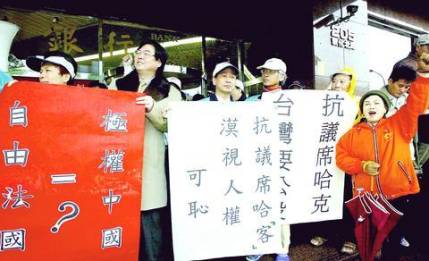
Pro-independence activists display placards outside the French Institute in Taipei yesterday to protest French President Jacques Chirac's remarks condemning Taiwan's plans to hold a referendum during the March presidential election.
-----------------------------------------
On Jan. 29, 2004 ……
Small group protests French stance
By Melody Chen, STAFF REPORTER
The Taiwan Independence Party protested at the French Institute Taipei (FIT) yesterday against French President Jacques Chirac's condemnation of Taiwan's referendum plan.
On Monday night, during a state dinner in Paris in honor of visiting Chinese President Hu Jintao, Chirac said the referendum plan was "a grave error."
The Taiwan Independence Party and a number of social groups recruited about 50 people to join yesterday's protest, to voice their anger at Chirac and demand an apology from him.
Chirac's behavior oppresses Taiwan's democracy and embraces an arbitrary regime like China, said Hsu Ching-song, the party's deputy secretary-general, who wrote a protest letter to the FIT.
"Democracy is an universal value. Chirac has no right to interfere in Taiwan's internal affairs," Hsu said.
The demonstration began at 10am and lasted about an hour.
The protesters carried banners condemning Chirac's statement, shouted slogans and dropped eggs.
The institute sent an official to collect the party's protest letter.
"The official told us he would report our opinions to his superiors. We are not satisfied with their response, but at least we have expressed what most Taiwanese people think about Chirac's remarks," Hsu said.
FIT officials declined to comment on yesterday's protest or on other questions related to the French president's comments.
Despite Chirac's open opposition to Taiwan's referendum, communication channels between the two countries "still exist," a source at the Taipei Representative Office in France said yesterday.
French reporters approached the office for comments after Chirac made the statement against the referendum, but the office remained quiet over the issue, according to the source.
The office is trying to further understand the implications of Chirac's remarks, the source said.
Meanwhile, the Ministry of Foreign Affairs issued a statement in response to Chirac's comments late Tuesday night, expressing "its strong displeasure with the French government."
"The referendum will be the most significant milestone in Taiwan's process of democratization, in which the governments of other countries have no right to intervene," the ministry said in the statement.
The ministry emphasized that the referendum is not intended to alter the status in the Taiwan Strait, nor is it for the pursuit of independence.
The Chinese government, "by its diehard militant nature, has pressured the French government, urging it to ignore the universal value of democracy and to publicly oppose Taiwan's holding a referendum," the ministry said.
The ministry reiterated its call to China to respect the basic human rights of the 23 million people of Taiwan as well as their space in the international community.
-----------------------------------------
On Jan. 29, 2004 ……
China's defense advances due to some friendly help
"China's rapid progress in
shipbuilding is due to a lot to help from other countries." --- Chen
Hsiao-ming, a former engineer with China Shipbuilding Corp
By Brian Hsu, STAFF REPORTER
Due to help from many other countries, China's military power has leapfrogged in recent years without showing any sign of slowing down, military analysts and sources said yesterday.
The Chinese military has made great progress, especially in the building of fighting ships, they said, thanks to Russia and an Asian country. It has also developed several new fighter planes, with Israel being one of the contributors to that effort.
Chang Li-teh, a senior editor with Defense Technology Monthly magazine, said China's shipbuilding speed is quite amazing over the past few years.
"Within a few years, China has already built several new fighting ships. Two more are under construction in Shanghai. They are comparable to the US' AEGIS destroyers," Chang said.
"The Chinese AEGIS-type ships boast phased-array radar as well as long-range air defense missiles and anti-surface missiles. They are expected to become operational in a few years. By that time, they will be a big threat to Taiwan," he said.
China obtained the phased-array radar technology from Russia and advanced shipbuilding technology from an Asian country, a defense source said.
"That Asian country is friendly to Taiwan as well. But it has its own strategic concerns while transferring shipbuilding technology to China," the source said.
Chen Hsiao-ming, a former engineer with state-run China Shipbuilding Corp, said it is a pity that while China is making rapid progress in shipbuilding, Taiwan has ceased to advance.
The Chenkung-class frigates were the last ships that Taiwan built on its own and that was 10 years ago. They were based on the US' Perry-class ships.
Chen, who was involved in the building of the Chenkung-class ships, predicts China's AEGIS-like ships will be go into service next year and that the balance of power in the Taiwan Strait might be lost by then.
"China's rapid progress in shipbuilding is due to a lot to help from other countries. Russia and some European countries are the helping hands," Chen said.
The navy is scheduled to take delivery of the first of four Kidd-class destroyers bought from the US next year, but the Kidds are outdated ships.
The Chinese military has also impressed the international community with its development of several new fighter jets, the most noteworthy of which is the Jian-10. The Jian-10 boasts semi-stealth capabilities and advanced design comparable to several Western fighters such as Israel's Lavi, which never went into production in that country.
An air force general, who spoke on condition of anonymity, said the military is closely watching the development of Jian-10.
"The Jian-10 does have semi-stealth capabilities partly because of its design and partly because of its composite material. It will be a great threat to us sooner or later," the general said.
-----------------------------------------
On Jan. 29, 2004 ……
Ma's democratic credentials queried
TRUE COLORS: According to analysts and political pundits, the Taipei mayor has opposed the nation's democratic reforms in the past and is still opposing them now
By Huang Tai-lin, STAFF REPORTER
Taipei Mayor Ma Ying-jeou's vocal opposition to President Chen Shui-bian's proposed referendum is a reflection of his conservative political stance, political observers say.
"Looking back over the past few years, it's clear that the pan-blue camp's middle-generation elite -- such as Ma Ying-jeou and [Tai-chung Mayor] Jason Hu -- tends to be more conservative when it comes to sensitive issues such as ethnicity, independence and unification, referendums and the like," said Chiu Hai-yuan, a professor of sociology at National Taiwan University.
Questioning the legality of Chen's planned March referendum, Ma on Tuesday described Chen as a "red-handed criminal in action."
Ma's rhetoric immediately drew a sharp response from Cabinet spokesman Lin Chia-lung, who said Ma's statement had "insanely insulted" the head of the nation.
"Ma's reactionary stance has been consistent," Lin said. "A referendum serves as the best mirror for politicians in Taiwan, exposing any anti-democratic attitudes they harbor."
Taking their offensive a step further, members of the Democratic Progressive Party (DPP) yesterday fired a volley of criticism at Ma, with DPP Legislator Julien Kuo branding Ma "a serial anti-democracy criminal."
"Looking back at Taiwan's road to democracy, Ma had always jumped out to block the moves and made such statements, as in the cases of opposing legislative reforms and direct presidential elections," Taipei County Commissioner Su Tseng-chang said at a news conference at the DPP's headquarters yesterday in his capacity as the party's national campaign manager.
Su was referring to the reform of the Legislative Yuan in 1991 and the first direct election of the president and vice president in 1996.
Until then, presidents of the Republic of China (ROC) were chosen by the National Assembly, which was first elected in China in 1947 to carry out the duties of choosing the president and amending the Constitution.
Re-established in Taiwan when then-president Chiang Kai-shek's Chinese Nationalist Party (KMT) retreated to Taiwan in 1949, representatives elected in 1947 and 1948, all mainlanders, held onto their seats "indefinitely" because it was impossible to hold subsequent elections for representatives in those constituencies in China.
It wasn't until June 1990 that the Council of Grand Justices mandated the retirement of National Assembly members, which became effective in December 1991.
Like the National Assembly,
representatives elected in the Legislative Yuan in 1947 and 1948 held these
seats "indefinitely" until the grand justices 1991 ruling.
The second National Assembly was elected in 1991. A majority of members were elected directly, while some were chosen from party slates in proportion to the popular vote.
The National Assembly amended the
Constitution in 1994, which paved the way for the direct election of the
president and vice president in March 1996.
In 1994, the Legislative Yuan also
passed legislation to authorize direct elections for the positions of Taiwan
provincial governor and mayors of Taipei and Kaohsiung municipalities.
As Taiwan underwent these democratic transitions, Ma, a KMT stalwart, came out to oppose the changes in order to safeguard the interests of his party.
At the time Ma said the president should be elected by the reformed National Assembly, rather than by direct election.
He also opposed amending Article 100 of the Criminal Code, which allowed for people suspected of plotting to overthrow the KMT regime to be charged with sedition.
In 1991, Lee Chen-yuan, an internationally recognized expert on snake venom research and a passionate advocate of Taiwan independence, led the Action 100 Alliance, whose aim was the abolition of the provision in the Criminal Code.
Lee's call received vigorous support from both Taiwanese intellectuals and the public, prompting the legislature to abolish the article.
The abolition of Article 100 granted the people of Taiwan freedom of thought and speech as well as freedom of association.
"These events did demonstrate Ma's position as anti-democratic and anti-reform," said Ku Chung-hwa, an executive member of the Taipei Society and a sociology professor at National Chengchi University.
However, Chiu believes that Ma should not be labeled as "anti-democratic" or "anti-reform" simply because of his stance during these events.
"It is rather unfair to label Ma with these names simply by judging him from one perspective of what he did during those events," Chiu said.
"He was simply reflecting his party's political stance and defending the interests of the higher echelons of his party," Chiu said.
Chiu also defended Ma's actions on the night of the 2000 presidential election, in which the KMT's presidential candidate, Lien Chan, lost to the DPP's Chen, ending the KMT's 50 years of rule.
Some criticized Ma as being anti-democratic when he addressed an angry crowd of KMT supporters that had gathered outside the residence of then-president and KMT chairman Lee Teng-hui. In his speech, Ma urged Lee to step down.
"I don't think it was so much that Ma was anti-democratic but rather that he, then serving as Taipei mayor as well as a member of the KMT's Central Standing Committee, was confused about what he should do in terms of what was appropriate for his roles," Chiu said.
While agreeing that Ma's recent comments about Chen were inappropriate, Chiu said that the Taipei mayor's harsh rhetoric might also be the product of the intense campaign atmosphere ahead of the presidential election.
"With the election campaign's intensity growing, both camps' moves and rhetoric are inclined to move toward the extreme ends of the spectrum, which will make the DPP appear more progressive and the KMT more conservative," Chiu said.
Meanwhile, Ku cautioned Ma to be more careful with his rhetoric in order to avoid being labeled "anti-democratic and anti-reform."
He gave the example of the mayor making an "inappropriate" analogy between referendums and the Cultural Revolution in China when the issue first surfaced last September.
"The fact that Ma is largely regarded as the pan-blue camp's heavyweight means that he needs to be more careful with his public rhetoric," Ku said.
-----------------------------------------
On Jan. 29, 2004 ……
China stepping up Internet crackdown, rights group says
ONLINE CENSORSHIP: Amnesty International said China detained 54 people for expressing opinions on the Internet, a sharp increase from the 33 people cited in its report released in 2002
AP, BEIJING
Amnesty International called yesterday for the release of 54 people jailed in China for expressing opinions on the Internet, citing a "dramatic rise" in the number detained for anything from political speech to spreading news about SARS.
In a report released yesterday, the London-based group said the 54 cases it had documented represented a significant increase from the 33 people listed in its November 2002 report.
Amnesty said the 54 cases were likely just "a fraction" of the actual number of people detained for opinions expressed online.
"China is said to have in place the most extensive censorship of the Internet of any country in the world," Amnesty said.
The organization said the prisoners included people who signed online petitions for government reform, published non-official news about SARS, communicated with dissident groups overseas, or called for a review of Beijing's bloody 1989 crackdown on demonstrators in Tiananmen Square. Detainees also include followers of the banned spiritual group Falun Gong, it said.
China's Foreign Ministry said it had no immediate comment on the report early yesterday. In the past, it has denounced Amnesty's claims as biased and baseless.
Amnesty said the number of people detained for sharing information about SARS was especially hard to determine.
The Chinese government was criticized for keeping last year's SARS outbreak under wraps in its initial weeks, and many in China resorted to sharing rumors about the disease by e-mail, online bulletin boards and mobile-phone text messages.
While China eventually allowed more reporting on SARS, Amnesty renewed its call for Beijing to ensure the media can report freely on the disease in the event of another large outbreak.
As Internet use surges in China, so does the government's efforts to control it, Amnesty said. China outlaws any challenges to Communist Party rule, and even people who supply vaguely defined "state secrets" to groups overseas can face the death penalty.
The government tries to control all online communication in China by blocking access to sites that discuss sensitive issues. Online information providers are held responsible for postings on their sites.
Amnesty said the 54 detainees -- all of them "prisoners of conscience" -- received sentences of between two years and 12 years.
-----------------------------------------
On Jan. 29, 2004 ……
Besmirching the tricolor
Politicians change their stances with the same ease as they flip the pages of a book. This is as true today as it was in the past. Only a few months ago, French President Jacques Chirac raised the moral banner high as he took the lead in criticizing a US-led war in Iraq. Chirac never forgot to mention "principles" and to pose as a savior of small nations the world over. Now he wears a different face as Chinese President Hu Jintao visits his country. He has forgotten about principles entirely as he criticizes -- with vitriol matching that of the Zhongnanhai leaders -- President Chen Shui-bian's plan to hold a referendum alongside the presidential election.
The Chirac administration has also proposed the EU lift its arms embargo against China. Fortunately, however, the proposal was rejected by many other EU nations. People familiar with Franco-Taiwan relations were not surprised by Chirac's actions, since he has always been a good friend of China. Franco-Taiwan relations have not improved since he came to power. For three years in a row, France spoke against a proposal aimed at allowing Taiwan to participate in the UN. It has also repeatedly opposed Taiwan's participation in the World Health Organization. The purpose of such actions can only be to echo China's stance on Taiwan.
Chirac's remarks on the March 20 referendum verge on cruelty and are tantamount to supporting a belligerent China pointing its missiles at small Taiwan. He also wants to sell weapons to China so that the thugs in the Zhongnanhai may use them to deal with dissent. Chirac's China policy is a textbook case of a politician's naked hypocrisy.
No wonder Chen pointed out candidly during a TV interview on Tuesday night that Chirac's remarks reveal his ignorance of democracy, and that such remarks harm France, not him.
Indeed, Chirac's remarks have lowered the status of France, a country steeped in the traditions of freedom, democracy and human rights, to the same level as China's.
France is too far away from Asia, both geographically and culturally. Taiwan is a small country that can hardly satisfy France's needs in terms of business interests. Naturally, it will be difficult to expect France to sympathize with and be friendly to Taiwan. However, people do expect France, as a democratic nation, to have some sympathy for Taiwan's democratization process -- at least to refrain from openly opposing it. Apparently, even this small expectation has come to naught.
This reminds one of a scene just before the World Health Assembly in Geneva last year -- a French-speaking official from the Ministry of Foreign Affairs gleefully explaining to reporters that, despite speaking against Taiwan's participation in the WHO, France was not really opposing Taiwan's participation but was simply of the opinion that the two sides of the Taiwan Strait should gain a consensus on the issue before anything could happen.
The sight of a Taiwanese diplomat defending a France that had snubbed his own country goes a long way toward explaining the unrealistic expectations Taiwan has placed on the Chirac administration.
We can only hope that the people of a country that embraces the values of freedom, democracy and human rights will continue to stand firm on their principles. The future prospects for Franco-Taiwan relations depend as much on France's determination to defend these values as on Taiwan's admiration for these deep and vast French traditions.
-----------------------------------------
On Jan. 29, 2004 ……
EU misguided
Lee Long-hwa, United States
Desperate people do desperate things. A child feels he or she is ignored, and does something awful, hoping for attention. Wanting to prove he is bigger or better, or grown up, he does something inadvisable just because he can. The EU, desperate to be a force in the world and desperate for attention, is considering lifting the 15-year-old embargo on arms sales to China. Could anything be more overtly petulant? Or stupid?
The EU of course acknowledges the US is steadfastly opposed to arms sales to China, but of course, being the petulant child, smugly states that it will consider such objections only. No one will tell the EU what to do. But hopefully the EU will screw its head on straight before it makes a decision.
The embargo arose out of the 1989 Tiananmen Square massacre and crackdown on democracy protests. Hundreds died then. Thousands have likely died or disappeared since -- so have basic human rights such as freedom of speech, freedom of worship and freedom of the press.
The timing of the suggested change in the embargo is strange. Human rights in China have not improved since 1989; they have worsened. And China's aggression has not improved either. It has moved ahead with eugenics in Tibet, gobbled up Hong Kong and it continues to increase the number of its missiles aimed at Taiwan.
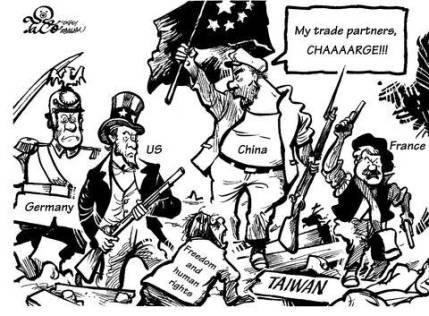
This week, France plays host to Chinese President Hu Jintao. What better way to lay rose petals at the feet of the Chinese emperor, than to bear gifts -- in this instance, bombs, fighter jets and missiles?
The French are behind the changes. France has been cozying up to China for some time. It would love to sell its Mirage jets and other arms products to the world's largest consumer of arms in the world. It is the short-sighted plan of what can only be characterized as a group of discontented "spoilers" -- now largely impotent nations searching for long gone days of glory and influence, trying to whip up market share in China.
In the course of its petulance, however, the EU could endanger the lives of 23 million Taiwanese, 120 million Japanese, all of Tibet, South Korea and who knows how many others in the Asia Pacific region and the world. Arming China has to be one of the worst ideas in the last 100 years. Not to mention selfish and childish. But of course, we knew that. I wonder what the EU will cook up for a constitution.
-----------------------------------------
On Jan. 29, 2004 ……
Don't count on US
Dan Roggenkamp, Pingtung
It seems lately that every time I read opinion pieces there's an American telling the Taiwanese how to act in order to assure the good grace of the US. Most of these letters generally have an implicit message of principle that goes something like, "The US is committed to defending Taiwan, but you have to play by the rules."
A recent letter even had the audacity to suggest that the "defensive referendum" threatened American lives because it was Americans that would be defending Taiwan in the event of an invasion.
Such messages from Americans are not only arrogant and irresponsible, but also worrisome because they promote the naive belief among Taiwanese that the US will defend Taiwan according to some principle such as "The US stands for freedom" or "The US protects democracy."
The US government has no genuine, altruistic concern for Taiwan. It has been using Taiwan as a pawn for half a century, and it continues to do so. Overall, this relationship has benefited Taiwan. But Taiwan is now the small wife in a very turbulent and sexy love affair between the US and China. The US could dump Taiwan in a heartbeat.
This is why the US wants to maintain the status quo. So while both Taiwan and China are trying to get things moving in one way or another, the US is trying to pretend that everything is fine just as it is. But ultimately, the US will align itself with the sweetest pot of honey.
The only reason the US supports Taiwan is for strategic purposes. There are 101 reasons why the US might indeed defend Taiwan militarily, but one thing is for sure: it will never defend Taiwan out of lofty, democratic principle.
US foreign policy is not based on any romantic principle of democracy or honor; it is based on capitalism. Does anyone really believe that the US will forego trillions of dollars in trade with China to defend Taiwan based on principles of democracy and freedom?
Why does it bother me when I read references to the prospect of the US defending Taiwan? Because I really like living here for many reasons, not the least of which is that the people of Taiwan, for the most part, still actually like Americans. I don't want to see that screwed up by dashed hopes of US military support.
Some predict that 2008 will be a turning point in cross-strait relations due to a number of factors including China's unwillingness to take drastic actions before the Olympic Games and because of what will be its justified sense of enhanced international stature as a result of the likely successful completion of the Olympics. I hope Taiwanese still like Americans in 2010.
I hope I don't have friends asking embarrassing questions like, "Hey, when China put a naval blockade on Taiwan and coerced other countries into refusing inbound and outbound flights, and our currency and real estate fell by 80 percent and we were brought to our knees without a single bullet being fired, why didn't the US intervene?"
I hope Taiwanese don't count on the US, and I wish people would stop repeating the mantra of US defensive support for Taiwan. It's a gamble not worth taking.
-----------------------------------------
On Jan. 29, 2004 ……
-----------------------------------------
On Jan. 29, 2004 ……
Taiwan's democracy has need of America
By Cheng Tien-chu
US President George W. Bush has enough headaches in taking care of the US. The war in Iraq is not over. The nuclear disarmament with North Korea is much more complicated. The war against terrorism never seems to end. Therefore, Bush was in a disturbed mood when he announced that he did not want Taiwan to hold a referendum during its March presidential election to address the future of Taiwan. His announcement was an attempt to please Chinese Premier Wen Jiabao when he paid a visit to the White House early last month. The US needs Beijing's help to persuade North Korea to drop the development of nuclear arsenals.
Taiwan is a democratic country. People there are as free as the people in the US. As a matter of fact, Taiwan is ranked the No. 1 free country in Asia.
China is a dictatorship. Beijing's policy is set by only a handful of people who are not chosen by the citizens. It currently has 496 missiles aimed at Taiwan. China will invade Taiwan by force if Taiwan declares independence through a referendum chosen by the Taiwanese people.
The US threatened the war against Cuba when Havana obtained missiles from Russia, which were aimed at the US during the Kennedy era. Eventually Russia dismantled the missiles and ended the crisis.
The Taiwanese in Taiwan want -- through the referendum -- China to dismantle those missiles. This is simply an exercise of democracy and an expression by the people to defend their own country.
Bush does not have to be nervous or uneasy about this situation. I believe on this issue his reaction was unexpected and a complete surprise. Rather, we expect that he will support free people to exercise their own will without intimidation.
Moreover, we expect Bush, peace-loving Americans and all other rational people on Earth will join the effort to denounce China for its terrorist act to have missiles aimed at a neighboring country. After all, the value of democracy, peace and human rights will connect everyone together and the dictatorship will be outlawed.
Cheng Tien-chu is a member of the Overseas Chinese Affairs Commission.
-----------------------------------------