20040130
=======
Chirac on Jan. 30, 2004 ……
Chen repudiates Chirac for 'interfering'
BACKLASH:: The president said it was
incomprehensible that his French counterpart, who has himself initiated a
referendum, would criticize the nation's path to democracy
By Lin Chieh-yu, STAFF REPORTER
President Chen Shui-bian yesterday repudiated French President Jacques Chirac for interfering in Taiwan's domestic affairs following his negative comments about the proposed referendum.
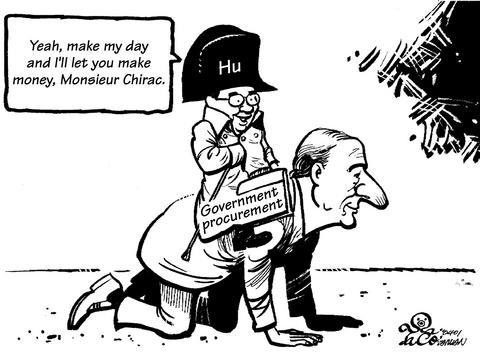
Chirac on Monday described Taiwan's referendum as a "grave error" during a state banquet in honor of Chinese President Hu Jintao's visit to France.
The French president said Taiwan's referendum was a unilateral destabilizing initiative that would disturb the status quo. "It would be a grave error. It would carry a heavy responsibility," Chirac said at the banquet.
Taiwan immediately lodged a complaint with the French government about Chirac's remarks.
"The referendum mechanism has been used in France since 1791 as a part of the nation's democracy. Nine referendums were held during the Fifth Republic period, and four under president Charles de Gaulle," Chen said at a reception at the Presidential Office for Fernando Sanchez-Arias, world president of the Junior Chamber International, an international federation for young leaders and entrepreneurs.
"Even President Chirac himself has carried out a national referendum in 2000 to decide whether to adjust the length of the presidential term," Chen said.
"It was incomprehensible to me that the head of state of such a nation, with a 213-year history of practicing referendums, could dare to interfere in another nation's domestic affairs," he said.
Chen told Sanchez-Arias that the referendum was a necessary step on Taiwan's path toward a democratic system, which will be the most important mechanism to ensure Taiwan's security and the welfare of the country's future generations.
Chen said that Taiwan's economy has taken a turn for the better, and that various infrastructure construction projects have been initiated, which means that the worst is over and the best times are yet to come.
The reform process could not be stopped halfway, and no one could deprive Taiwan of its democracy, the president said.
"Taiwan's way to democracy is a way we cannot abandon. We have to insist on the correct way and keep walking. It's a road of no return, and a milestone for Taiwan's deep-rooting of democracy," Chen said.
"Taiwanese people have a right to a referendum. Only by believing that no one can govern or betray us can Taiwan avoid becoming a local government of another country, changing the status quo unilaterally, and sending our children to the battlefield," Chen said.
He also denied Taipei Mayor Ma Ying-jeou's criticism that the referendum was illegal by referring to Ma's conservative stand at crucial moments in the past, especially his history of opposing the public's right to directly elect the president.
"When I was still a legislator, I debated the direct election issue with Ma, who was then the minister of justice. It was later proved that we stood on the correct side of history, and this is still the mainstream public opinion," Chen said.
The president has toned down the wording of the questions in the referendum, which is slated to be held along with the March 20 presidential election. Instead of being asked whether they want China to remove the 496 ballistic missiles targeted at Taiwan, voters will be asked whether they approve of Taiwan's defensive capabilities being upgraded against a possible Chinese military threat. Citizens will also be asked to vote on whether to negotiate for peaceful coexistence with China.
-----------------------------------------
On Jan. 30, 2004 ……
France only against unilateral action, ministry says
By Melody Chen, STAFF REPORTER
France does not oppose Taiwan's first national referendum on March 20 but disagrees with any votes that might change the status quo in the Taiwan Strait, the Ministry of Foreign Affairs (MOFA) quoted its French counterpart as saying yesterday.
Chiou Jong-nan, Taiwan's de facto ambassador to Paris, met with officials of the French foreign ministry, including Director of Asia-Pacific Directorate Thierry Dana, on Tuesday to seek clarification on President Jacques Chirac's condemnation of Taiwan's referendum plans.
At a state banquet honoring visiting Chinese President Hu Jintao on Monday night, Chirac made scathing remarks about Taiwan's referendum, calling the vote "a grave error."
According to the explanation given by the French foreign ministry, Chirac was not referring specifically to the March defensive referendum proposed by President Chen Shui-bian, which is slated to be held on the same day as the presidential election.
The French ministry told Chiou that Chirac was referring to any referendum that would have sufficient impact to change the status quo in the Taiwan Strait, said MOFA spokesman Richard Shih.
"That is why both Chirac and France's foreign ministry have never, in their open statements about Taiwan's referendum, specified that they oppose the March vote," Shih said.
Admitting that they favor the "one-China" principle, officials in the French Ministry of Foreign Affairs encouraged China and Taiwan to conduct open dialogues.
"What France opposes is unilateral actions that may destroy peace in the Taiwan Strait. France opposes any referendum on Taiwan's independence," the French ministry said.
French diplomats told Chiou that they understood the referendum was a sensitive issue and that they have seriously studied Chen's statements about Taiwan's referendum agenda. They said that a Taiwanese delegation had delivered a presentation on the referendum plan during a visit to France earlier this month, and that their government has taken this presentation into account.
Meanwhile, National Security Council Chairman Wei Che-ho and Council for Cultural Affairs Chairwoman Tchen Yu-chiou have canceled planned trips to France as a result of Chirac's remarks.
Shih said there was currently no plan to halt exchanges between Taiwan and France.
-----------------------------------------
On Jan. 30, 2004 ……
Angry Cabinet suspends exchanges with France
By Ko Shu-ling, STAFF REPORTER
The Cabinet is temporarily suspending high-ranking exchanges with France to protest French President Jacques Chirac's comments on Taiwan's planned referendum, Premier Yu Shyi-kun announced yesterday.
"We feel extremely sorry about Chirac's bowing to China and caving in to commercial interests. His talk not only is detrimental to our democratic development but also violates the true spirit of freedom and democracy," Yu said.
Under the premise of reciprocity, Yu said, the government will make adjustments to the relationship between the two countries in accordance with the French government's sincerity in resolving the matter.
Yu made the remarks yesterday morning after attending the monthly meeting of the Cabinet's Veterans Affairs Commission.
According to Yu, the Cabinet learned details of Chirac's talks on Saturday, two days before Chirac publicly denounced the referendum proposed by President Chen Shui-bian.
"We decided to adopt a counterattack measure and asked two Cabinet officials to cancel their scheduled trips to France," Yu said.
The two officials are National Science Council Chairman Wei Che-ho and of Council for Cultural Affairs Chairwoman Tchen Yu-chiou.
Wei, who is on a trip to Europe, will remove France from his itinerary and stay only in Germany to promote scientific collaboration between the two countries. Tchen has cancelled a trip to France scheduled from Wednesday to Feb 8.
While the suspension of exchanges applies to high-ranking officials only, cultural and economic exchanges are unaffected, Cabinet Spokesman Lin Chia-lung told reporters yesterday.
Lin said that Taiwan, as an independent sovereign state, is obliged to unequivocally express its stance.
"We should express our stance in a firm and appropriate manner but never overreact," he said. "As Chirac's comments are merely political language made in response to the request of visiting Chinese President Hu Jintao, we're still evaluating the impact it has on the French government's Taiwan policy."
Lin, however, warned the French government that indulging China was quixotic.
"It might acquire some short-term gain from China but end up being manipulated by it," Lin said. "What EU nations and other countries should do while dealing with China is to collaborate with each other under a strong leadership instead of fighting the battle alone."
-----------------------------------------
On Jan. 30, 2004 ……
Ma's hoof-in-mouth problem
Taipei Mayor Ma Ying-jeou has stirred up a storm with his comment that holding the national referendum on March 20th is a "criminal action." That characterization by itself is, of course, grammatically questionable, since the word "criminal" as used refers to a person rather than an act. The only way it makes sense is if it is deemed as referring to the actor or the person carrying out the act in question. In this case, since the said national referendum is a major policy of President Chen Shui-bian, the only logical explanation is that Ma was referring to his own superior and the president of the country.
More surprising was that Ma made such a disrespectful and crude comment during a routine weekly Cabinet meeting -- which he attends in his capacity as Taipei mayor -- and where a group of reporters summoned by Ma were waiting for him to give a mini-press conference condemning the supposed illegality of the referendum. Ma is as entitled to freedom of speech as any other citizen -- but one would think that the mayoral role would impose certain restrictions on how freely he could speak his mind in public. Ma is certainly a remarkable role model for civil servants and government officials when it comes to insubordination against government policies or actions they oppose.
Such new-found courage could have certainly been used a decade or two earlier. Just think -- Ma and others, such as People First Party Chairman James Soong, who had made it to the top of the bureaucratic heap by staying mute to or actively assisted in the Chinese Nationalist Party's (KMT) government' s autocracy -- could have spoken out against egregious illegal government actions with the same might.
On second thought, it is probably more accurate to say that Ma was speaking not as mayor but as the head of the campaign headquarters for KMT Chairman Lien Chan and Soong. With less than two months until the presidential election, Ma is speaking more frequently in that role. What other plausible explanation could there be for why he chose to speak out in such a way at such a time -- except to try to keep Chen from earning any brownie points with the voters. Ma knows that his comment won't stop the referendum, since both Chen and the DPP appear resolved to stand by their decision to hold it.
If Ma and the pan-blue camp have a bone to pick over the legality of the March referendum, they should seek a ruling by the Council of Grand Justices, which many believe may decline to make such a ruling, since the underlying issue -- whether the country is facing sufficient external threats that may jeopardize its sovereignty -- is more a political question to be determined within the executive purview of the president.
Interestingly enough, after Chen refuted French President Jacques Chirac's open denunciation of Taiwan's referendum plan, Lien and Soong rushed to defend Chirac, condemning the referendum as illegal and Chen for thinking that he alone understands democracy. At least Chirac parroted China's line in the presence of visiting Chinese President Hu Jintao -- either to kiss up to China or under Chinese pressure. What explanation could Lien and Soong have for joining in the chorus?
-----------------------------------------
On Jan. 30, 2004 ……
Lien and Soong: Chinese irritants
By Chiou Chwei-liang
An independent country, especially a democratic one, has the right to hold referendums to decide major national policies. This is not only a right but a duty -- a "universal value" recognized by the people of the world, especially those of the world's democratic nations.
Therefore, it is the most basic democratic right of the Taiwanese people to hold a "defensive referendum." No other countries, including China, Japan or the US, have a greater say on the matter. But China is using every possible means to shrink Taiwan's international space, pressuring Japan, the US and other European countries by claiming that President Chen Shui-bian is promoting Taiwan's independence and changing the status quo in the Taiwan Strait. As a result, Japan, the US and most recently France have expressed their concern to Taiwan, and have even opposed Taiwan holding a referendum in March.
These developments are in fact part of the normal operation of international politics. Each country's attitude has complex dimensions and can be interpreted differently. This is not something worthy of panic. From Taiwan's perspective, Chen has his views on how to rule the nation, as well as to what degree Taiwan should resist pressure from China, Japan and the US. All of this is open to public scrutiny.
But in view of China's behavior, if a nation were a normal and independent sovereign state, its people would unite to resist China's hegemonic bent and protest against the interference of Japan, the US and other countries in its domestic affairs.
Unfortunately, Taiwan is an abnormal country. Chen and Chinese Nationalist Party (KMT) Chairman Lien Chan do not resemble the heads of the ruling and opposition camps that are supposed to vie for control of an independent sovereign state. Rather, they resemble politicians who are in different, even rival states, resulting in a bizarre, rarely seen phenomenon in international affairs.
Remember the absurd moment when Lien compared Chen to Osama bin Laden, the guru of international terrorism? Chen is holding a defensive referendum, and claims that the presidential election is in fact "a sacred battle between the Taiwanese people and the Chinese Communist Party." This statement was absolutely legitimate. But Lien seems to believe that Chen's "sacred battle" statement was in the same vein as bin Laden's terrorism agenda, and said that the president could go right ahead if he wanted to die, and that he wasn't interested in going to war alongside the president.
Chen is holding a preventive referendum to demand China cease threatening Taiwan with its ballistic missiles. China is in fact the real al-Qaeda, and Chinese President Hu Jintao is the real bin Laden. But Lien has reversed these roles, calling the president bin Laden and the nation a terrorist troublemaker. Where's Lien's sense of right and wrong? Has he completely forsaken any sense of justice?
These remarks were not only stunning in their shamelessness but also frightening to many Taiwanese people. With an opposition presidential candidate blathering on in this capitulationist vein, does Taiwan really need China for an enemy?
People First Party (PFP) Chair-man James Soong has also been a champion of capitulationism. He is both unwilling and unable to maintain Taiwan's sovereignty, and is singing the nation's demise. He recently mimicked and even exaggerated the concerns of Japan, the US and other countries. Not only did he lobby the blue camp to prevent the launch of referendums on the Fourth Nuclear Power Plant and other issues at the Legislative Yuan, and called on Chen to give up his defensive referendum, he also claimed that "no nation in the world can afford to irritate China." His remarks were stunning and frightening. I can't help but wonder whether Soong is running for the vice presidency of China.
Irritate China? Taiwan's efforts to maintain its sovereignty over the past 50 years have irritated China. The US' "three communiques" based on its "one-China" policy and the Taiwan Relations Act have irritated China. Washington letting Chen and Vice President Annette Lu stop over in the US -- where they received enthusiastic welcomes -- irritated China.
The European Parliament passed a resolution recently demanding Beijing not wage war across the Strait and withdraw its missiles; this irritated China. India's development of nuclear weapons has irritated China. Former Japanese prime minister Yoshiro Mori visited Taiwan last month and irritated China. It must be a sign of the apocalypse if all these democratic countries dare irritate China.
In a word, both Lien and Soong have divested themselves of any dignity. They dare not support the international status of the nation. Will Taiwan remain a democratic and independent sovereignty in the future if this pair is elected? I really don't think so.
Hopefully, the Taiwanese people can see through this on March 20. They must use their ballots to recognize and maintain the sovereignty of Taiwan.
Chiou Chwei-liang is a visiting professor at the Graduate Institute of Southeast
Asian Studies, Tamkang University.
-----------------------------------------
On Jan. 30, 2004 ……
-----------------------------------------