20040201
=======
Reported on Feb. 1, 2004 ……
Public will reject pro-China tactics
`If the pan-blue camp has any doubts about the legality of the referendum, it should resolve them through legal channels. Instead it is encouraging local government heads to boycott the referendum before turning to the judicial process.'
By the Liberty Times editorial
French President Jacques Chirac stated during a state banquet in honor of Chinese President Hu Jintao last Monday that holding a national referendum along with Taiwan's presidential election is a "grave error" that will disrupt regional stability.
On the other hand, President Chen Shui-bian indicated during his New Year's remarks on Jan. 27 that the referendum will constitute another major accomplishment in Taiwan's democratic evolution.
In the past, Taiwan won the recognition of the world with its economic miracle and now it will win the respect of the world with its democratic achievements, Chen said. He went on to say that he believed Taiwan could write a new chapter in history.
The referendum is a focus of attention not only in Taiwan, China, the Asia-Pacific region and the US. Against the backdrop of security threats posed by China and as a result of media manipulation, the issue has even attracted the attention of European countries. In the future, with the approach of the presidential election, it could become the center of global attention.
Among all the countries that have expressed views, the US is the most influential and significant. General Richard Meyers, chairman of the US joint chiefs of staff, visited Beijing last month. During his meeting with former Chinese president Jiang Zemin, Meyers explicitly indicated the US government's opposition to a unilateral change of the status quo by either side of the Taiwan Strait.
He also told a press conference that on the Taiwan issue the US and China understand each other's stance.
If Taiwan is attacked, the US will assist Taiwan in its self-defense. Meyers said that as China continues to make massive missile deployments, according to the Taiwan Relations Act, the US is obligated to assist Taiwan in its self-defense.
Meyers is a top US military commander. His comments in Beijing were open and unequivocal. It was also an international declaration that constituted a pleasant development at a time when the US-Taiwan relationship was characterized by the pan-blue camp and by some local media as being at the "lowest point" over the so-called referendum "controversy." Meyers' comments were an accurate piece of "preventive national defense" on the part of the US.
In other words, Meyers has clearly informed China that the US has not changed its policy of supporting Taiwan's self-defense pursuant to the Taiwan Relations Act as a result of its disapproval of holding the referendum.
In addition, during Meyers' visit to Beijing, Chen announced the topics for the referendum. US Secretary of State of Colin Powell responded that the US neither opposed Taiwan's national referendum nor endorsed it, stating that Chen has shown flexibility on the issue. At the same time, Powell reiterated that both Chen and the Chinese leaders are "good friends" of the US, and that both the US-Sino and the US-Taiwan relationships are in good order.
Obviously, China's intention to exploit the US to pressure Taiwan has not been accepted by the US government. This proves that the US-China-Taiwan relationship is back in equilibrium.
Powell's comments have relieved the pressure and suspicion of the US over the national referendum.
As the head of the alliance of democratic countries of the world, the US government cannot and should not have double standards for democratic values. All its concerns about the referendum arose from China's deliberate twisting of the referendum as "incremental Taiwan independence."
China on the other hand also uses the threat of force as a bargaining chip to engage in extortion of the US and Asia-Pacific countries, and now even European countries such as France. It also uses international comments to sing in unison with the pan-blue camp, calling the referendum "dangerous," building up an impression of looming danger and threats in the Taiwan Strait.
This was the reason for the concerns of the US and numerous Asia-Pacific countries. Fortunately, after Chen announced that the national referendum will be held based on the "five noes" principles, the controversy cooled.
From the standpoint of its global strategy, the US is very concerned about the referendum because Taiwan's geographical location ties it to the Asia-Pacific region's stability and development. Peace in the region in turn is closely tied to the political and economic interests of the US in the region.
Each year, the volume of US trade with the region takes up 70 percent of the country's foreign trade. About 97 percent of the energy needed by Japan, which has signed a security treaty with the US, relies on imports, and more than 20 Japanese oil tankers travel through the Taiwan Strait each day. Therefore, neither the US nor Japan could deny that the seas surrounding Taiwan are key for their economies, trade and energy. The strategic importance of the Taiwan Strait is evident. It goes without saying that the US and Japan are very concerned about the referendum.
In view of the US government's declared stance of neither endorsing nor opposing the referendum, we know that the referendum is not what the pan-blue camp has declared it to be -- a provocation of China, nor a cause of war.
Actually, referendums are a key democratic index and facilitator of democracy for democratic countries.
Unless democracy is defeated or threatened, unless a country is subjected to totalitarianism or authoritarianism, referendums are a norm for democratic countries and a pillar that strengthens democracy.
It is truly regrettable that at a time when Chen had only made a policy declaration with respect to the topics of the referendum and before any formal proposal had been made, the pan-blue county commissioners and mayors had already gotten ready to boycott the referendum, openly encouraging people not to cast votes in the referendum. We feel very disappointed by such conduct on the part of pan-blue local government heads.
After all, the Referendum Law was formally enacted by lawmakers across party lines, including pan-blue lawmakers.
If the pan-blue camp has any doubts about the legality of the referendum, it should resolve them through legal channels. Instead it is encouraging local government heads to boycott the referendum before turning to the judicial process.
This indicates the pan-blue camp's "support" for the law was nothing but an act.
This not only goes backward on democracy but also help China stifle democracy. China will be the one benefiting.
The pan-blue camp blindly follows China in many respects. It does not protest the Chinese military and missile deployments. Yet it refuses to support a referendum for peace that does not even deal with the independence and unification issue.
If we let them have their way, no future policy that displeases China can ever be implemented. When that happens, how does that make Taiwan different from Hong Kong and Macau?
Therefore, we want to call on the pan-blue camp not to obstruct the referendum out of party interests and hurt democracy in the process.
If it does, it will be despised by the people.
-----------------------------------------
On Feb. 1, 2004 ……
China-based businessmen favor blue camp
ELECTION: Many executives have lost patience with the DPP because they feel it has failed to launch policies that they urgently needed, business leaders said
By Melody Chen, STAFF REPORTER, IN TAINAN
The majority of Taiwanese businesspeople based in China seem to have decided to cast their ballots in favor of the pan-blue camp in the March presidential election, despite the government's latest initiatives to change their minds.
Premier Yu Shyi-kun visited a Lunar New Year gathering of around 130 heads of business associations for China-based Taiwanese in Tainan yesterday. President Chen Shui-bian had announced four government initiatives designed to benefit businesspeople at the same gathering on Friday night.
Senior officials from various government agencies also participated in the businessmen's three-day gathering, hosted by the Straits Exchange Foundation (SEF).
In Chen's neck-and-neck campaign race against his blue-camp rivals, if Chinese Nationalist Party (KMT) Chairman Lien Chan and People First Party Chairman James Soong, were to get a bigger chunk of the business vote, it would be a crucial step in winning the election.
The number of China-based businessmen planning to return to Taiwan to vote in the election is expected to be limited by the number of available air tickets. Some of the business leaders said that only a few of them could afford to take leave to cast their ballots.
In the 2000 presidential election, only about 2,000 businessmen returned to Taiwan to cast their votes, officials said.
Many of the businessmen's families and relatives live in Taiwan, and the businessmen's opinions could influence the way their families vote.
The businessmen, their families and relatives could easily represent more than one million votes in this year's election, according to the SEF's estimation.
Hector Yeh, president of the Association of Shanghai-Taiwan Businessmen Invested Enterprises, said in the 2000 presidential election the Democratic Progressive Party (DPP) did not pay much attention to China-based Taiwanese businessmen.
"At that time, so few of us came home to vote that the DPP did not care much about us. But we must go home to vote this time," Yeh said.
Shanghai is the Chinese city with the most enterprises run by Taiwanese businesspeople.
Yeh said that many Taiwanese businessmen in Shanghai have been suffering over the past four years because the government, "obsessed with a certain ideology," has failed to launch policies that they urgently needed.
The DPP government has not shown much support for China-based Taiwanese businesspeople because of the hostility of some factions within the party, Yeh said.
"These factions have always been against us. We feel it would be easier for the pan-blue camp to carry out policies that can really benefit us. That's why most of us support the blue camp," Yeh said.
The number of businessmen going home for this year's election will certainly be more that of four years ago, because they "don't want to suffer for another four years," Yeh said.
"We want peace and stability. `More economy, less politics' is our suggestion to the government for handling cross-strait relations," Yeh said.
Tony Cheng, chairman of the Taiwan Merchants Association in Shenzhen, said many businessmen could no longer place their trust in the DPP government, although it has promised to launch four initiatives to benefit them.
"The government should have carried out the initiatives four years ago," Cheng said.
The pan-blue camp and the DPP have both proposed cross-strait policies, but Cheng said what the businessmen care about most is whether the parties are trustworthy and sincere.
"The DPP government's sincerity has been heavily questioned over the past four years," Cheng said.
-----------------------------------------
On Feb. 1, 2004 ……
Lien pledges to demilitarize Kinmen if he is elected
By Huang Tai-lin, STAFF REPORTER
Opposition Chinese Nationalist Party (KMT) Chairman Lien Chan yesterday pledged to demilitarize Taiwan's outlying islands of the Kinmen group if he wins the upcoming presidential election.
In a speech delivered at the opening of the KMT-People First Party (PFP) alliance's campaign office in Kinmen, Lien, the alliance's presidential candidate, said he wished to turn Kinmen into a model for cross-strait peace.
"Once I am elected president, I will make pushing for the demilitarization of the Kinmen region and [China's coastal city of] Xiamen a priority, so that they can become a trial area for cross-strait peace," said Lien.
The Kinmen group is at its nearest only 1.5km from Xiamen.
Lien's proposal was similar to plans already drawn up by the Ministry of National Defense, which announced last October plans to demilitarize six islands in the Kinmen group and open them for tourism, after placing them under the administration of the coast guard and the Kinmen police.
The ministry, however, did not make public the timetable for demilitarization of the six islands. It also stressed that it would not withdraw all of the troops from the region until China retracts its threat to use force against Taiwan.
"In order to promote cross-strait peace, leaders of both sides of the Strait should use sincerity and wisdom, stop engaging in guessing-games and take substantial action to work together and resolve both sides' differences," Lien said.
At the launch of the Kinmen campaign office, which he presided over with his running mate, PFP Chairman James Soong, Lien vowed to expand the "small three links" and relax regulations governing the links if he wins the presidency.
With that said, Lien criticized President Chen Shui-bian as a "copycat."
"Proposals spoken by Chen are issues that I've already been promoting," said Lien. "In the past four years, Chen has not done much, and is now doing all the talking because election day is approaching."
Lien was referring to Chen's announcement regarding China-based Taiwanese businesspeople Friday night.
Chen, in a speech given Friday at an annual Lunar New Year gathering with approximately 130 officials from China-based Taiwanese business associations, spelled out four expanded benefits, which included the opening of "small three links" services to the families of China-based Taiwanese businesspeople, expanding the coverage of the national health insurance program to China-based Taiwanese and education subsidies for the children of Taiwanese businesspeople in China.
-----------------------------------------
On Feb. 1, 2004 ……
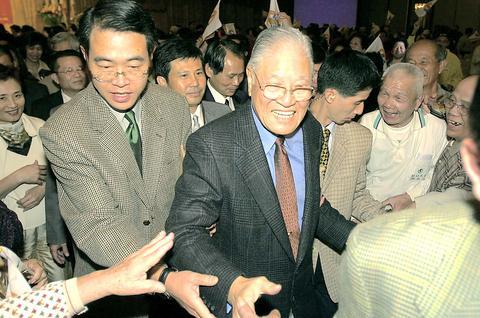
TSU tackles kaohsiung
Former president Lee Teng-hui is greeted by supporters at an inauguration ceremony to celebrate the establishment of the Taiwan Solidarity Union's Kaohsiung chapter yesterday. Many attendees were shouting: ``Uncle A-hui, I love you.''
-----------------------------------------
On Feb. 1, 2004 ……
EU's China embargo is critical for Strait peace
By Chen Mei-chin
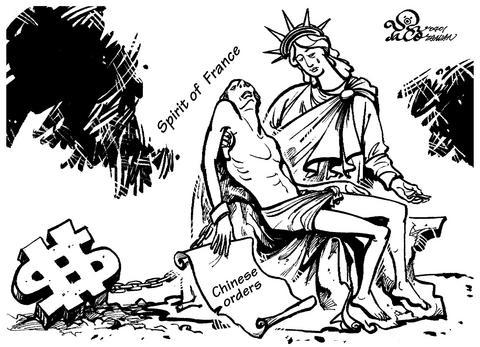
German Chancellor Gerhard Schroeder and French President Jacques Chirac are proposing that Europe lift its arms embargo against China, imposed in 1989 after the crackdown on China's democracy movement at Tienanmen Square.
The two argue that the ban is out of date and does not fit the pattern of improving relations between Western Europe and China.
However, the move seems to be prompted by political expediency and commercial opportunism. It would enable the sale of quiet German submarines and advanced French Mirage fighters to a weapons-hungry China, a country that is one of the major sources of tension in the East Asia region.
Isn't it a fundamental European policy not to sell weapons in hot spots around the world?
That East Asia is a hot spot is beyond doubt: China is aiming some 500 missiles at Taiwan and is increasing its arsenal. The July 2003 US Defense Department Study on the military power of China calls the region a potential powder keg and clearly suggests that China's policy of threatening Taiwan is the root cause of this tension. Quotes from the study include "Preparing for a potential conflict in the Taiwan Strait is the primary driver for China's military modernization," and "China is developing advanced information technology and long-range precision strike capabilities, and looking for ways to target and exploit the perceived weaknesses of technologically superior adversaries."
The phrase "technologically superior adversaries" refers to the US. If Europe sells weapons to China, they will very likely be used against Europe's ally, the US -- not a desirable situation.
But these are three other important reasons that Europe should not proceed with this unsavory idea.
First, China may be progressing economically, but human rights and democracy have not benefited from this progress.
On the contrary, China is still one of the most totalitarian regimes in the world. Human rights organizations still document widespread violations of human rights, torture in prisons and application of the death penalty.
The second reason is the continued occupation of Tibet by China. If Europe wants to go beyond lip service on this issue, it must emphasize that this is a major issue to be resolved before relations can be improved. What has been perpetrated in Tibet by the Chinese is nothing less than a holocaust.
The third reason is Beijing's perpetual threats against a free and democratic Taiwan.
It is ironic that the leaders of a repressive regime are feted in Paris by Chirac while the democratically-elected president of Taiwan, Chen Shui-bian, is prevented from even getting a transit visa.
Isn't there something wrong with this picture?
European governments -- and the US administration for that matter -- still seem oblivious to the fact that Taiwan is a democratic nation that beat tremendous odds in overcoming the authoritarian regime of the Chinese Nationalist Party (KMT).
The KMT was a party to the civil war which ravaged China from the 1920s through the 1940s.
Taiwan, a Japanese colony during that period, was not a party to that civil war. Now the Taiwanese people themselves a free and democratic people being held hostage to the civil war.
It is clear that the "one China" policy, not the ban on arms sales, is out of date. Perhaps Schroeder and Chirac should focus their attention on analyzing what is so terribly wrong with their present policy and work towards normalization of relations with Taiwan.
Mei-chin Chen is the editor of Taiwan Communique and writes from the
Hague, the Netherlands.
-----------------------------------------
On Feb. 1, 2004 ……
Chen urges the nation to stand up against China
MASS MEETING: President Chen Shiu-bian last night addressed a crowd of 30,000 supporters at a massive campaign rally to boost support for his referendum
By Chang Yun-ping, STAFF REPORTER
The Democratic Progressive Party (DPP) last night held the first large-scale campaign rally in an envisaged series of national referendum promotion campaigns in Taoyuan County to boost the momentum and public support for an election-day referendum proposed by President Chen Shui-bian.
Speaking at the rally, Chen urged the people of Taiwan to jointly defend the nation's democracy, peace, status quo and the wish not to be belittled as a Chinese local government.
Chen said that as the national leader, he can't ignore the threat of Chinese missiles aimed at Taiwan and he must raise public awareness of the underlying danger of missiles against Taiwan's security.
Chen said the facts are that the Chinese missiles are aimed at Taiwan, China wants to make Taiwan a second Hong Kong and China would use force against Taiwan to coerce Taiwan into accepting this situation.
"These are things that are happening every day, but some people [in Taiwan] are rather uninformed about these dangers and treat them as natural matters. However, as a national leader, I can't pretend not to see these dangers and we have to voice our discontent towards these unreasonable military threats," Chen said.
Chen said Taiwan is not a normal and complete country because the people of Taiwan have long refrained to acknowledge that Taiwan is a country, even though they can choose their own lawmakers and national leader and even though Taiwan and China have different areas of jurisdiction.
"It is a known fact that Taiwan and China are separate countries on each side of the Taiwan Strait, but some people dare not acknowledge it and think it might bring disaster to Taiwan. That's the reason the international community won't recognize us," Chen said.
Chen said Taiwan has come a long way in the process of democratization through the abolishment of the ban on political parties, the press and the accomplishment of the legislative elections and direct presidential election in the past.
"At this juncture, to further Taiwan's democracy, the holding of such a historic referendum will be necessary to advance democracy and ensure Taiwan's security," Chen said.
Meanwhile, Chen said his administration has braved many difficulties, including the economic recession, black-gold politics rampant in the former Chinese Nationalist Party (KMT) regime and many financial irregularities to enforce many reforms since he took office in 2000.
He urged the people not to allow a corrupt political system led by the pan-blue alliance to stage a comeback.
Vice President Annette Lu, a native of Taoyuan and a former Taoyuan County Commissioner, yesterday said the 2004 presidential election differs from all the previous elections in that it determines whether the people of Taiwan could prove to the world their determination to have peace and stand up to China's military threats.
She urged the people to safeguard the security and prosperity of Taiwan through an election-day referendum to defy China's missiles.
Lu said Taiwan does not have a problem of "exercising splittism" as alleged by China, since Taiwan is already an independent and sovereign country and has been exercising separate jurisdiction from China for more than five decades.
She said the Taiwanese people should waste no time debating on the independence or unification issues; they should rather work together to boost Taiwan's international standing.
The campaign rally in Taoyuan saw many local Hakka clan leaders throwing their support behind Chen, including Wu Yun-tung, cousin of Chinese Nationalist Party (KMT) Vice Chairman Wu Po-hsiung and president of the Taiwan Medical Association.
DPP Legislator Chiu Chui-chen, campaign director in Taoyuan County, yesterday urged a 50 percent voting support for Chen to win the election, as the party is still lagging behind the pan-blue camp in Hakka communities.
The first massive rally held after the Lunar New Year, the event last night drew more than 30,000 people to gather in Chung-li township.
-----------------------------------------
On Feb. 1, 2004 ……
EU, US should cooperate
Vincent Wang Wei-cheng, Virginia
The implicit agenda in France's heavy-lifting for China is to assert that Paris' foreign policy is independent from Washington's, as well as being payback for the perceived slight by the administration of US President George W. Bush on the Iraqi War ("Et tu, Chirac?" Jan. 28, page 1).
The EU would commit a "grave error" by selling arms to China. Such sales violate the EU's own code of conduct on human rights and of not proliferating arms to "areas of conflict." China has 500 missiles aimed at Taiwan, and selling more arms to China will further tip the military balance in its favor.
The US will not welcome the prospect of having American EP-3s intercepted by Chinese pilots flying French Mirages. The US and the EU should work together to defuse this possibility.
-----------------------------------------
On Feb. 1, 2004 ……
-----------------------------------------