20040206
=======
Reported on Feb. 6, 2004 ……
China warns of flu vulnerability
CONTAINMENT: As China said it faced some tough problems fighting the outbreak, experts in Rome said a vaccination campaign for poultry may help control the disease
AP, BANGKOK
China's vast size and its developing disease reporting systems have made it "weak and vulnerable" against bird flu, a top Chinese official said yesterday, while Thailand reported two new suspected human cases of the deadly virus.
Some experts meeting in Rome on Asia's bird flu crisis recommended vaccinating healthy poultry as part of a broader strategy to control the disease, which has claimed 10 human lives in Vietnam and five in Thailand, as well as tens of millions of chickens in the region.
Health officials previously have said safely destroying infected birds is the best way to contain the disease. Mass slaughter and import bans have ravaged Asia's poultry industry -- some 50 million birds, mostly chickens, have been killed.
Vietnam's Prime Minister Phan Van Khai ordered a nationwide ban on sales of all live chickens and poultry products, state media reported yesterday.
Officials said the order was to contain the disease's spread, without elaborating. It was not clear whether authorities feared people might catch the disease by eating infected chicken meat.
The World Health Organization (WHO) has said there are no indications so far that bird flu is spreading to people who eat properly cleaned and cooked poultry products. But countries worldwide, including the US on Wednesday, have slapped import bans on poultry from nations affected with bird flu.
Thailand has sought to restore confidence in its poultry industry with government giveaways of cooked chicken and eggs.
China yesterday urged caution when eating eggs but said there was no cause for serious alarm.
"There is a chance that in affected regions eggs may carry bird flu," said Jia Youling, a poultry expert with the agricultural ministry. "We suggest that when eating eggs, they be very well boiled."
No human cases have been reported in China, but by Wednesday, there were five confirmed outbreaks and 18 suspected ones in chickens, ducks and geese throughout the country, Vice Agriculture Minister Liu Jian said.
In a rare news conference, he vowed stringent measures to stop the virus before it spreads to people. Liu acknowledged that "some parts of our animal disease-prevention system are weak and vulnerable, and the public has limited knowledge about the disease and ways to prevent it."
"The poultry population in China is quite big, and production methods are quite diverse. That has brought us some difficulties in controlling this epidemic," he added.
The two new suspected cases in Thailand were a two-year-old boy from northeastern Khon Kaen province and a 67-year-old man from central Chainat province, Thai officials said. Thailand has 19 suspected cases in all, nine of whom have died.
Bird flu has now been found in 40 of Thailand's 76 provinces and authorities said yesterday that nearly 26 million chickens have been culled, making the mass slaughter all but complete in five of the provinces.
In neighboring Cambodia, the avian virus was found in two dead swans on a small farm near the capital Phnom Penh, the second time the disease has been detected near the city, the Agriculture Ministry said. The disease has not been found to have jumped to humans in Cambodia.
The WHO is working to develop a human vaccine against bird flu, but an animal vaccine against a closely related strain of the disease already exists. Some farmers have used it to protect against other forms of bird flu and experts believe it could give chickens partial protection from the deadly virus now afflicting Asia's farms.
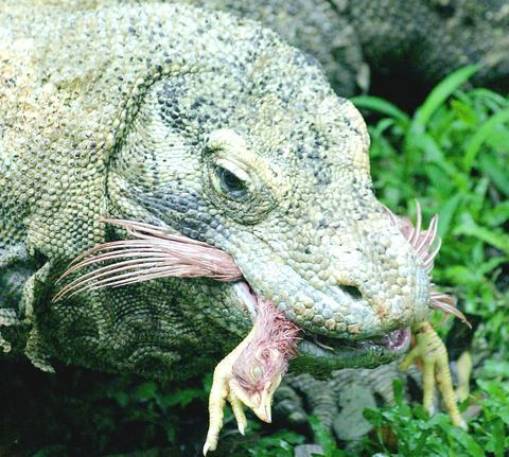
An Indonesian Komodo dragon chews on a chicken at Jakarta Zoo on Wednesday. A strain of bird flu that has already killed a dozen people has spread to Indonesia, the government said Tuesday. Indonesia said it had detected the H5N1 strain in poultry. The strain is the only form of the avian influenza virus known to have killed humans.
-----------------------------------------
On Feb. 6, 2004 ……
Hsieh banks on southern charm
MARCH VOTE: The Kaohsiung mayor said the DPP will have to perform well in the south and fight hard in central Taiwan if it is to win the presidential election
By Chang Yun-ping, STAFF REPORTER , IN KAOHSIUNG
Kaohsiung Mayor Frank Hsieh said yesterday that President Chen Shui-bian would get 54 percent of the vote in southern Taiwan, while the key to his re-election would be the vote in the central region.
"If today were election day, the DPP's Chen-Lu presidential ticket could garner about 53 to 54 percent of the vote in the eight counties and municipalities in southern Taiwan," Hsieh said.
He made the remark Wednesday night in a meeting with the media in Kaohsiung.
He said the Chen-Lu ticket could get 57 percent of the vote in Tainan -- Chen's hometown -- and 53 percent of the vote in other areas in the south.
Southern Taiwan has long been viewed as a DPP stronghold. The party believes it must stage a strong performance in the south if it is to overcome losses in the north.
In the presidential election in 2000, in which the vote was split three ways, Chen saw about 47 percent support in the south.
With Chinese Nationalist Party (KMT) Chairman Lien Chan joining forces with People First Party Chairman James Soong in this year's election, however, Chen faces a two-way race. He will have to boost his support compared with the 2000 poll if he is to win.
Hsieh said support in Chiayi County has been increasing due to the consolidation of local factions, as has support in Kaohsiung City and Pingtung County.
For his own constituency of Kaohsiung City, Hsieh said his goal is 55 percent of the vote for Chen -- a 10 percent increase over Chen's performance in 2000.
As for Kaohsiung County, Hsieh was less optimistic, noting it is the base of KMT heavyweight Wang Jin-pyng, the current legislative speaker.
Hsieh said if the DPP wants to use the high support rate in the south to offset the loss of votes in northern Taiwan, it must perform well in the central jurisdictions of Taichung City, Taichung County, Changhua County and Nantou County.
"The eight southern electoral districts must outperform their six counterparts in northern Taiwan. And if the north and south are tied, it means the DPP can't lose in central Taiwan," Hsieh said.
He said the party has gradually gained support in central Taiwan due to the establishment of the science-based industrial park in Taichung last year. Hsieh added that support from former Taichung mayor Chang Wen-ying, whose relations with the party had soured after Chang lost the party's backing in the 2001 mayoral election, had helped.
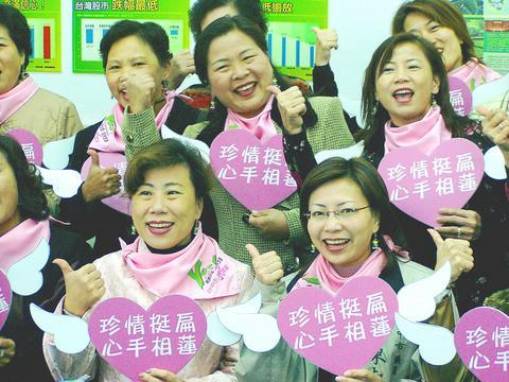
Members of the Democratic Progressive Party's Taichung campaign headquarters gather at a press conference yesterday to announce that a women's group to support President Chen Shui-bian and his running-mate Vice President Annette Lu will be established tomorrow. Kaohsiung Mayor Frank Hsieh said yesterday the DPP will have to perform well in central Taiwan if it is to win the March presidential election.
-----------------------------------------
On Feb. 6, 2004 ……
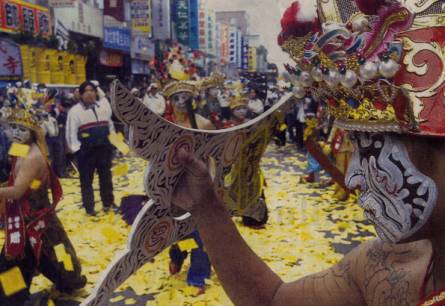
FESTIVAL SPIRIT
Dancers brave pyrotechnics during the Hantan Yeh Festival in Taitung County yesterday. The festival, traditionally associated with expelling evil spirits, was held as part of the Lantern Festival.
-----------------------------------------
On Feb. 6, 2004 ……
Referendum shows up French gall
By Paul Lin
When Chinese President Hu Jintao was
done with his Lunar New Year show, "Visiting The Poor To See How They Are
Doing," he dashed off on a foreign tour with France being the most
important stop. The reason France is so important is that it is one of the most
important members of the EU. Since France also often takes the lead in opposing
the US, it has become a natural strategic partner of China's.
Hu brought with him two major demands on his visit to France. First, he wanted France to oppose a referendum, and, second, he wanted France to use its influence in the EU to lift the ban on arms sales to China. On Jan. 26, the same day Hu arrived in France, a meeting between EU foreign ministers in the General Affairs and External Relations Council turned down France's suggestion that the EU embargo on the sale of arms to China be lifted prior to April 1, with some countries saying they needed further proof showing that China's human-rights record has been improved.
Some countries also warned that a lifting of the embargo should not be rushed at a time when the relationship between Beijing and Taiwan was tense due to the March 20 referendum. They did agree, however, to reconsider a lifting of the ban at their spring session, and invited the Permanent Representative Committee and the Political and Security Committee to look into the matter.
When it comes to the issue of the referendum, the French president, Jacques Chirac, couldn't wait to express his support for China's position, and did so on the night of Hu's arrival. At a news conference on Jan. 27, he also attacked Taiwan, using the words "grave mistake" and "provocative" (to describe Taiwan's plans to hold a referendum).
A joint Sino-French declaration also stated France's opposition to "any unilateral initiative whatsoever, including a referendum which aims to change the status quo by increasing tensions in the strait and leading to Taiwan's independence." Compared to the attitude of US President George W. Bush, who issued a simultaneous warning that China must not change the status quo (in the Taiwan Strait), it is obvious that Chirac is firmly on China's side.
French media criticized Chirac, saying that he was granting any and all of Hu's requests. But apart from meeting these two major demands, there are at least two or three other problematic issues.
First is the arrests by French police
of many Falun Gong members protesting their suppression by China. Without
discrimination, police arrested anyone wearing yellow clothes or a yellow
scarf. The same thing happened when former Chinese president Jiang Zemin
visited Europe -- seeing anything yellow was frightening and made host
countries nervous.
Second, the French government gladly
accepted that the ethnic Chinese French citizen and winner of the Nobel Prize
for Literature, Gao Xingjian, and his works will be completely excluded from
the "Year of China" organized in France to celebrate 40 years of
Sino-French diplomatic recognition, despite the fact that Gao's book, Soul
Mountain, was written in Chinese.
Third, Hu was allowed to give a speech in the French parliament, a temple of the people. As a result, more than half of lawmakers were absent in protest.
Hu actually said that without democracy, there would be no socialism and socialism would not be modernized. It turned out that China had implemented democracy before France did so, and of course before Taiwan did so.
He also said that when France and Taiwan still were implementing capitalism, China had already realized socialism. Does the fact that this kind of nonsense can be heard in the French parliament add to France's glory, or does it mean that France is in decline?
These actions by Chirac are, in fact, not unexpected. France is indeed the homeland of the declaration of human rights. After the Tiananmen massacre, it was very moving to see former French president Francois Mitterand's government open its arms to accept and support the Chinese democracy movement.
Not long after, however, Chirac came to power and in 1996 he received then-Chinese premier Li Peng, "the butcher of Tiananmen," making France the first major Western nation to receive Li.
When Jiang visited France in 1999, Chirac invited him to his home in central France, where his wife danced with the dictator. The aim of sucking up to China in this manner was the hope to receive Chinese orders, and orders for Airbus aircraft in particular.
How much more of the French people's spirit will Chirac have to sacrifice? France indeed has its measure of nationalism, in particular when arguing with the US. But where is this nationalism when France is being so unassuming towards the Chinese dictatorship?
There is nothing of the spirit of Charles de Gaulle, but, instead, we see the shadow of Henri Philippe Petain (head of the collaborationist French Vichy regime during World War II). No wonder there has been a strong public reaction.
The people of Taiwan, however, shouldn't be too concerned with France. They should see that China is behind all this.
Unfortunately, some blue-camp politicians and media people gloat over this disaster and aim their attacks not at China, but at Taiwan itself.
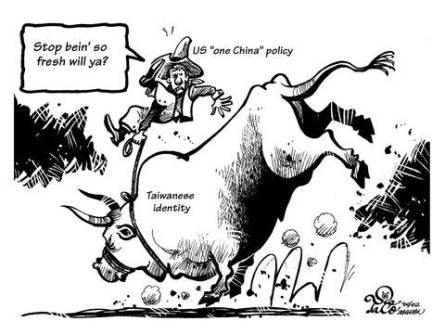
This is what their "Taiwan First" means -- just like China, they give priority to beating up on Taiwan. This is not a matter of ethnicity, it is a matter of national identification.
After looking at the issue from this perspective, can it still be said that holding a referendum is unnecessary?
Paul Lin is a commentator based in New York.
-----------------------------------------
On Feb. 6, 2004 ……
-----------------------------------------