20040207
=======
Spy’s problems on Feb. 7, 2004 ……
Military refuses comment on latest `spy' round-up
"Why did the pro-unification
United Daily News get the scoop? Why was the report released in the lead-up to
the March 20 presidential election?" --- Chang Bai-ta, a military
researcher with the Democratic Progressive Party
By Brian Hsu, STAFF REPORTER
The Ministry of National Defense refused to comment yesterday on reports that China had broken up another Taiwanese spy ring.
The spy story hit the headlines of a local newspaper yesterday.
The alleged ringleader was identified as 40-year-old Colonel Li Yun-fu of the Military Intelligence Bureau.
A photo of him in casual wear was run in the story. It was quite unusual that the photo of an alleged intelligence agent operating in China was printed in a newspaper.
The paper identified another two persons -- Li's nephew Kao Kuo-ning and Wu Che-ming -- as members of the ring.
The trio were said by the newspaper to have been rounded up recently by Chinese authorities. They were alleged to have collected information on the deployment of ballistic missiles targeted at Taiwan and the status of fighting ships with the East China Sea fleet.
The paper called the exposure of the spy ring the largest of its kind since 1998 when a major general and senior colonel in the People's Liberation Army were discovered to be spying for Taiwan.
The report claimed Li had contributed a lot of the information that President Chen Shui-bian recently made public regarding the number and deployment sites of short-range ballistic missiles in Fujian and Jiangxi provinces aimed at Taiwan.
Minister of National Defense Tang Yao-ming, appearing at a public occasion, would neither confirm nor deny the story.
National Security Council Secretary-General Kang Ning-hsiang made some comments to reporters suggesting that he knew about the case. But Kang added, "I have yet to get more information."
Chang Bai-ta, a military researcher with the Democratic Progressive Party (DPP), said he had questions about the timing of the spy story.
"Why did the pro-unification United Daily News get the scoop? Why was the report released in the lead-up to the March 20 presidential election? It would certainly have a negative effect on the DPP," Chang said.
Chang was not the only DPP official to have such doubts, given the number of alleged spy cases in the news recently.
Before the Lunar New Year holiday, reports in Hong Kong that more than 20 Taiwanese businessmen had been arrested in China for espionage triggered a feeding frenzy in local media.
China aired a live television broadcast of interviews with several of the so-called spies, who blame President Chen Shui-bian and Taiwan's government for not trying to save them.
Such broadcasts violated what Tang said was the principle of "not openly discussing a spy case" between countries.
-----------------------------------------
On Feb. 7, 2004 ……
Democracy, elections and security
By Nat Bellocchi
The US and Taiwan are both having presidential elections this year. China, which lays claim to Taiwan, not only opposes democracy for its people, but is now trying to diminish Taiwan's democracy, posing a real challenge to the US-Taiwan relationship. Resolving the problems inherent in the mix of democracy, security and elections could well be setting a precedent not only for the cross-strait issue, but for problems in other newly democratized countries as well.
As in every democratic country, especially in a presidential election, the parties use every advantage they legally can to win. The opposing parties accuse the ruling party of pursuing policies that they claim disregard the national interest.
Take the present incumbents running for re-election in the US and Taiwan, for example. In the US, once the campaigns begin in earnest, there will be many accusations about the president's conduct of the war with Iraq. One accusation that may be of interest to Taiwan is his insistence on a June deadline for turning over sovereignty to the Iraqi people. It will doubtless be said that he is turning over responsibility too early just to avoid American casualties before the election. Doing this supposedly puts the democratization of that country at risk -- an important national objective.
In Taiwan there were accusations that President Chen Shui-bian was supposedly insisting on a referendum solely to accommodate his election advantage, and in the process was in fact endangering the country's security. I was dismayed that many experts in the US, however, were also challenging Chen's integrity in a way that parroted his domestic opposition and China's claims. Like candidates running for the US presidency, wanting to get credit for having brought something good to the country for the first time is rather normal. In any event, that accusation is and should be a part of the domestic debate that is an element of any open election campaign.
The initial charges made by the experts seem to have subsided, at least in the US. It is notable that the US government has been more circumspect in these concerns. One hopes that the issue of a referendum has become more manageable (if not more clear) in the relationship between the US and Taiwan. However, the referendum issue has been replaced by another concern -- doubts about where the leadership in Taiwan is taking the country. The middle of a presidential election campaign is not the best atmosphere for any candidate to lay out what would be a highly sensitive (and controversial) plan for either political party. Rhetorical commitments, as opposed to formal ones, are most likely to be the result.
There are some experts in the US that say any trend toward efforts by Taiwan to strengthen the people's opposition to unification would be undesirable because of the resulting instability. There seems to be no equivalent concern about the manifold efforts already being made by China to discourage independence (also causing instability). The US government has rightly been persistent in reminding both China and Taiwan that it opposes moves by either side to change the status quo. One would expect that this would be the case in this instance as well.
The best recourse in dealing with the difficult, sensitive and important tripartite relationship, and the equally difficult issues that have to be addressed on a continuous basis, is an effective means of communicating with each other. This is particularly important for the US-Taiwan relationship, as communications between the two countries do not follow the normal pattern of diplomacy. It is a jerry-built system that encourages multiple channels, reduces high-level exchanges and in no way keeps up with the changes taking place in both countries. Both sides have surprisingly similar problems.
A country's foreign ministry traditionally helps to develop and then implement approved policies on international relations. Communications with foreign governments are usually channeled through the ministry. Taiwan may not have the titles, but its "embassy" in Washington is more professional than almost any embassy, including some of those that represent very large and powerful countries. It has a far greater capability to communicate with all elements of the host government than most embassies. The same is true of the American side, though there is the inefficient necessity to work in a semi-governmental capacity.
There are other means of communicating, but the leadership in both countries do not use their foreign ministry to full advantage. The leadership of both sides are prone to wanting that special attention (ie, their own) be given to more sensitive foreign relationships, especially those that have domestic political implications. But leaders are busy people. Just keeping up with the current crisis, whatever that might be, means that less attention can be given to other important relationships.
The answer is to trust and use the resources already in place and trained for its mission. That's not easy in the constant pressure for attention, the differences between senior members of an administration and the ego that comes with leadership. Yet the result is often misunderstanding, or belated attention when a crisis already exists. The need to address more complex security issues while maintaining the human rights of individuals under a democratic system will be a continuing challenge. And the need for ever better communications is not just unique to Taiwan-US relations, but also to many other newly democratic countries -- South Korea and Morocco, for example.
This is a very difficult cure. A leader wants to set his own priorities. But there could be nothing more important for them than to understand the potential consequences of a mistake in such a place as the cross-strait issue. Frequent communications between the leadership in Taiwan, China and the US would help remind them that a mistake could mean at least one of them might be faced with expulsion for having "lost Taiwan." That ought to be quite an incentive to keep communications open.
Nat Bellocchi is the former chairman of the American Institute in Taiwan and is now a special adviser to the Liberty Times Group. The views expressed in this article are his own.
-----------------------------------------
On Feb. 7, 2004 ……
Law will have no mercy in Tuntex case, minister says
By Debby Wu, STAFF REPORTER
If any laws were broken in the course of the Tuntex Group political donations, the justice system will punish the guilty individuals, regardless of their status or what party they belong to, Minister of Justice Chen Ding-nan) said yesterday in response to questions during a legislative session.
Independent Legislator Chu Hsin-yu said in the Legislature that several Democratic Progressive Party (DPP) politicians, including people with good reputations, are involved in the case.
Chen replied that some legislators have already visited State Public Prosecutor-General Lu Jen-fa and presented him with Tuntex Group chairman Chen Yu-hao's open letter to the media. Chen Ding-nan said that Lu considers the open letter to be evidence and has asked the Taipei District Court to investigate the case.
"If there are people who have broken laws, they will be punished, regardless of their partisan loyalties, identity or social status," Chen Ding-nan said.
Meanwhile, deputy secretary-general to the president Chen Che-nan and his son, DPP Legislator Chen Chi-mai, yesterday again denied a claim by the pan-blue camp that Chen Che-nan owned two condominiums in Kaohsiung valued at NT$60 million.
The pan-blue camp made the claim on Wednesday. Chen Che-nan responded to the allegation on the same day, saying that the condominiums had been purchased by his children and Chen Chi-mai's wife.
Chen Che-nan said that the property was worth just more than NT$20 million, and that the family had borrowed over NT$10 million from a bank. He stressed that the purchase was completely legal.
Yesterday morning the pan-blue camp again questioned the legality of the purchase by pointing out that the one condominium was registered in the name of Chen Che-nan's wife. Chen Chi-mai later responded by saying he and his sister had paid for the property, but registered it in their mother's name.
"What's wrong with children buying a house for their parents so that the family can reside together?" Chen Chi-mai asked.
Meanwhile, Chen Che-nan visited the Presidential Office yesterday afternoon for the first time since the Tuntex Group political donation case had been unveiled. He delivered a public statement on the condominium purchase, echoing his son's explanations.
-----------------------------------------
On Feb. 7, 2004 ……
Donation skullduggery denied
""I met Chen Yu-hao three
times in 2002 ... We did not discuss donations at any of the meetings, and I
have neither transferred donations for Chen Yu-hao to the president nor
accepted his money." --- Chen Che-nan, Deputy secretary-general to
the president
ACCUSATIONS: The president's deputy secretary-general said that, despite his close relationship with the former Tuntex chairman, he never accepted donations from him
By Lin Chieh-yu, STAFF REPORTER
Deputy secretary-general to the president Chen Che-nan yesterday finally broke the silence about his relationship with former Tuntex Group chairman Chen Yu-hao, who created quite a stir with his revelation that President Chen Shui-bian's administration had accepted donations from his company.
"I met Chen Yu-hao three times in 2002. The first time was at a restaurant, where a friend introduced us," Chen Che-nan said at a news conference at the Presidential Office.
"The other two meetings were at the Presidential Office, where Chen Yu-hao explained that he did not transfer capital to invest in China while leaving huge debts in Taiwan. We did not discuss donations at any of the meetings, and I have neither transferred donations for Chen Yu-hao to the president nor accepted his money," Chen Che-nan said.
He said that Chen Yu-hao's assertions had a political motive.
Over the past five days opposition parties have held several press conferences accusing Chen Che-nan of involvement in financial scandals. In response to their claims, Chen Che-nan authorized Presidential Office spokesman James Huang to answer any questions.
On Thursday some Democratic Progressive Party (DPP) legislators asked Chen Che-nan to face the media in person to clearly explain whether he had made any deal with Chen Yu-hao.
At yesterday's press conference, Chen Che-nan denied all the claims against him, including allegations that he had met Chen Yu-hao at the China Development Group's private club and that he had accepted money from Chen Yu-hao at his residence.
"I am stating frankly and honestly that we do have a close relationship, but that I never took his money," Chen Che-nan said.
Meanwhile, Vice President Annette Lu urged members of all political parties to put into practice of their promise of legislating the donation process, rather than just waging a war of words.
"The problem is not political donations as such, but how to regulate the donation process, and placing all politicians under the scrutinizing mechanism," Lu said in a TV interview last night.
"The opposition parties, including the Chinese Nationalist Party (KMT) and the People First Party (PFP), attack others for taking money, but at the same time do their best to obstruct the DPP's plans for passing the Political Donation Law," Lu said.
"How could those two parties dare to point fingers at us?" Lu said.
Commenting on a report in a Chinese-language newspaper on Wednesday that she had also received donations worth NT$55 million from Chen Yu-hao's group, Lu criticized the media's performance and asked the media to restrain itself.
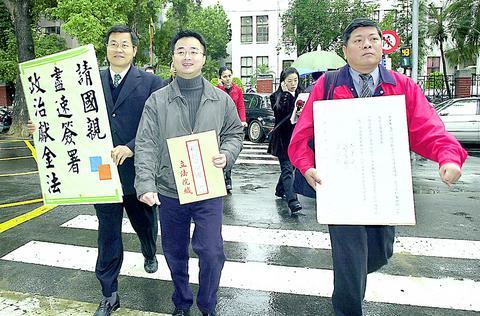
Democratic Progressive Party legislators Chao Yung-ching, right, Lo Wen-chia, center, and Tu Wen-ching, left, visited opposition party legislative caucuses yesterday with signature lists asking for the passage of a bill governing political donations.
-----------------------------------------
On Feb. 7, 2004 ……
Building a framework for peace
Amid international suspicion over the motive and timing of the March 20 referendum, President Chen Shui-bian elaborated on the rationale for the referendum earlier this week. He also unveiled what he called a "framework for cross-strait peace and stability" in the hope of convincing both the world community and people here that the referendum is not aimed at changing the cross-strait status quo.
For those who have questioned why Chen needs to pursue a defensive referendum regardless of the danger it might create, the portrayal of the president as an unpredictable and reckless politician is false. The idea is based on the assumption that the cross-strait relationship in the last four decades has rested upon ambiguities that have allowed both the PRC and Taiwan to interpret the same concept to their own individual satisfaction. Therefore, any unilateral attempt to break such an ambiguous definition of the cross-strait status quo would be considered rocking the boat.
Most people tend to overlook the fact that Taiwan's democracy is an irreversible trend and any attempts to appease Beijing should not be conducted at the cost of the nation's democratic consolidation. Taiwan has always been a valuable asset to the international community with its democracy, economic progress and intensive participation in the world affairs. Without touching upon the sensitive issues of independence or unification, Chen's suggested referendum aims to secure cross-strait peace by asking Beijing to reduce its military deployment and to restart negotiations on peace. Such an effort to institutionalize cross-strait dialogue should be supported by the world community.
Hence, the main international implication of the framework for cross-strait peace lies in its predictability, manageability and responsibility. To rebut the accusation that his referendum move and plan for a new constitution in 2006 may pave the way for a de jure independence, Chen has pledged that constitutional reform will be based on no change to Taiwan's status quo. Moreover, a framework for cross-strait interaction will enable both sides to engage in peaceful contacts in a more predictable and manageable way.
For example, Chen suggested the establishment of demilitarized zones including the removal of combat personnel, equipment and deployed missiles and the creation of a buffer zone to prevent military conflicts. Those are constructive measures aimed at reducing miscalculations and misperceptions that might lead to military conflicts. Aren't these what the international community was anticipating? The proposal indeed displayed Chen's responsibility to handle cross-strait relations.
Most importantly, Taiwan will show self-restraint under such a framework. Since its aim is to peacefully deal with China without changing the status quo of Taiwan, the international community can monitor the process of cross-strait negotiation without worrying about any unexpected changes.
Referendums are a democratic tool. While some argue Taiwan is using referendums like a hammer to pound people, Chen's framework proposal demonstrates his determination to incorporate the referendum as a hammer to build a house -- a house where people from both sides of the Taiwan Strait can peacefully live next to each other and enjoy democratic progress and economic prosperity.
Whether or not Beijing will react to Taiwan's peace gesture in a positive way is unknown. Given how close the presidential race is, it would be natural for the Chinese leaders to ignore Chen's proposal. Beijing, however, will have to face the results of the referendum. If a majority of voters support the framework, both sides will have to shoulder the responsibility of international expectation for cross-strait peace.
-----------------------------------------
On Feb. 7, 2004 ……
-----------------------------------------