20040208
=======
How to talk of peace on Feb. 8, 2004 ……
Do not be fooled by talk of peace
`We must also remind all citizens and the ruling and opposition camps to not hold on to unrealistic illusions about cross-strait peace or to over-optimistically believe that peace is at hand.'
By the Liberty Times editorial
On Tuesday, President Chen Shui-bian gave a substantive explanation of the contents of his executive order formally calling a referendum.
In particular, regarding the second referendum topic about pushing for the signing of a treaty on cross-strait peace and stability, so as to seek cross-strait consensus and further the welfare of the people, Chen provided a detailed explanation. This rates as the most unambiguous policy declaration on the prospects for the cross-strait relationship by the government in recent years.
Chen expressed a hope of inviting
China to appoint government representatives for discussions about cross-strait
negotiations after the presidential election in March this year, and then to
formally engage in negotiations based on "one principle and four major
issues."
The "one principle" refers to the principle of peace. The "four major issues" include the following: both sides appointing delegates to communicate directly, authorized by the leaders of the two countries; the two sides appointing permanent delegates to the other side; the two sides establishing representative offices on the other side; and the setting up of a demilitarized zone.
According to Chen, seeking to establish a cross-strait stability and peace framework aligns with the needs of the two sides and will enable both countries to work for the welfare of the people of the two sides.
It cannot be denied that in the current complicated and sensitive cross-strait relationship, Chen's proposal for a "framework for peace and stability " to resolve longstanding political disputes may be able to facilitate the interests of the people of the two sides. Chen's proposal for a referendum for peace is intended to create a popular consensus for national identification and Taiwan sovereignty.
The cross-strait framework for peace and stability is intended to ease the tensions in the Strait after the referendum for peace gains the support of the people. This not only reveals the sincerity of the government about maintaining cross-strait peace, but further highlights Chen's policy on the future of the cross-strait relationship as well as a responsible attitude on the part of Chen.
We think that the peace principle proposed by Chen should be acceptable to both the ruling and opposition camps, as well as the international community. Moreover, the peace principle can be seen as the basis of the four issues accompanying it, as well as a fundamental condition for cross-strait interactions. If the peace principle cannot be upheld, there is no point in talking about anything else.
In other words, if Taiwan unilaterally expects to resolve the standoff with a framework for peace and stability, while China's strategic goals are to engulf Taiwan, oppose its democratic referendum or force it to accept "one country, two systems," then nothing can be accomplished even if the two sides resume negotiations. This is something that people ought to realize as we push for a framework for peace and stability.
The Chinese government continues to insist on the "one China" principle, refuses to acknowledge the fact that neither side of the Strait is part of the other side and continues to be trapped by ideas left over from the days of the civil war with the Chinese Nationalist Party (KMT).
Therefore, despite repeated negotiations with the Straits Exchange Foundation, China has never ceased to treat peace as bait and has relied primarily on military coercion so as to pressure Taiwan into relinquishing sovereignty and accepting "one country, two systems."
Ranging from its unification propaganda campaign targeting Taiwanese businesspeople, to dragging its feet on negotiating over administrative issues based on technicalities, to deliberate lack of enthusiasm in cooperating on the return to China of illegal Chinese immigrants from Taiwan to the diplomatic assaults on and siege of Taiwan -- these are all means for China to accomplish the goal of engulfing Taiwan one way or the other.
While on the surface China talks about peaceful unification, it has never bothered to conceal its refusal to renounce the use of force. It openly deploys 496 missiles that target Taiwan, placing the people here under threat. Recently, it has tried to interfere with the presidential election and referendum by dealing with so-called "Taiwanese spies."
It has spared no effort in trying to threaten and buy over Taiwanese businessmen. Under the circumstances, it is hard for anyone to believe that China could actually feel sincere about negotiating for peace.
On the other hand, we must also understand that in view of the fundamental nature of the communist regime in China, it can never tolerate the existence of a democratic and free independent country within arm's reach.
The most obvious example is the recent discussion in Hong Kong about whether to popularly elect the chief executive of the special administrative region in 2007. Tsang Hinchi, a standing committee member of the National People's Congress, declared that the Beijing government would not allow Hong Kong to conduct a popular election because the Chinese Communist Party could not tolerate "anti-China and anti-communist" factions coming into power in Hong Kong.
According to Tsang, "in all of China only one communist party can rule, and Hong Kong is part of China ... an anti-China political party with power together with foreign factions could turn Hong Kong into an anti-China base, and therefore the central government will never allow such people to form a ruling party."
According to China's logic regarding democracy in Hong Kong, if Taiwan implements "one country, two systems" as well, not only can no presidential election be held but the opposition camp can never come into power. The entire democratic system would collapse. There would be no popular election of the "chief executive" either.
It is beyond dispute that after Hong Kong's handover to China in 1997 the level of democracy there backtracked.
On July 1 last year, as many as 500,000 people took to the streets in protest and another 100,000 did the same on New Year's Day this year. What they demanded was nothing other than democracy and freedom.
In view of the experience of the people of Hong Kong, how can Taiwan throw itself into a Chinese trap and hold any illusions about "peace" with China?
We do not oppose what Chen said about having the two sides formally appoint authorized delegates to engage in negotiations and to establish a long-term framework for cross-strait interactions. However, we believe that from negotiations on peaceful topics to the future signing of a peace treaty, we must insist that the People's Republic of China and the Republic of China are different countries, neither side belonging to the other and that each side must respect the equality of the other.
Negotiations and the signing of a treaty must proceed on the condition that the welfare of the Taiwanese people and the security of the country will be safeguarded. While we support the government's plan to push for a framework for cross-strait peace, we must also remind all citizens and the ruling and opposition camps to not hold on to unrealistic illusions about cross-strait peace or to over-optimistically believe that peace is at hand.
Some people always turn a blind eye to China's obstruction of this country's democratic development, and in fact dance to the Chinese tune in opposing referendums and democracy.
Such internal divisions will turn Taiwan into a laughingstock of democracy and China will be the one laughing in the end.
-----------------------------------------
On Feb. 8, 2004 ……
US unease caused by its duty to defend
CHINESE THREAT: Senior US officials said that the US had to engage Taiwan 'fairly aggressively' over its cross-strait strategy, while affirming US help in case of conflict
By Charles Snyder, STAFF REPORTER IN WASHINGTON
US concerns that the referendum called by President Chen Shui-bian might upset the status quo in the Taiwan Strait were a result of its legal obligation to help fend off any Chinese attack, two top US officials told a congressional panel on Friday.
At the same time, the officials
slammed China's deployment of some 500 ballistic missiles targeting Taiwan as a
clear attempt by Beijing at intimidation, and called the action a serious
threat to cross-strait stability.
Deputy Assistant Secretary of State Randall Schriver and Deputy Assistant Secretary of Defense Richard Lawless were speaking during a hearing of the US-China Economic and Security Review Commission on military modernization and the cross-strait military balance.
Both cited a provision in the Taiwan Relations Act of 1979 that requires the US to "maintain the capacity ... to resist any resort to force or other forms of coercion" by China against Taiwan.
US President George W. Bush warned Chinese Premier Wen Jiabao privately during their White House meeting in December that "if there is a crisis in the Taiwan Strait, it's very likely we'll be involved," Schriver told the commission.
So, while the act was not a "formal defense treaty," Schriver said, "questions about our involvement and questions about our obligations I think lead us in the direction that we do have to be very mindful of how we're prepared" in case of a flare-up between the two sides.
The provision in the act, Lawless added, had made it "incumbent upon us to encourage the Taiwanese to do what they need to do to dissuade China to the maximum extent possible from taking risks that they otherwise would not take" to settle cross-strait conflict by "non-peaceful means or coercive means."
The US' "charge is to engage the Taiwanese fairly aggressively" in this regard, he said.
Yet, "If deterrence fails, Taiwan, supported by the US and its allies, must be prepared to swiftly defeat [China's] use of force," he said.
He urged Taiwan to develop a "national will" and bring about "improved national consensus" over the need to develop military capabilities to deal with any use of force.
It was the legal obligation contained in the act that led Washington to be so firm in pushing Taiwan to come up with the money to buy the weapons systems which Bush agreed to sell in April 2001, the two said.
Arguing that the US has a "direct equity" in the Taiwan Strait, Schriver said: "If there are steps [the Taiwanese] don't take, there are scenarios under which [we] are presented with filling that gap."
Consequently, "it's important that we help shape the debate in Taiwan," Schriver said.
Lawless said that China's missile buildup was just one part of the growing military threat that China posed as a result of its military modernization in recent years.
This modernization, Lawless said, "casts a cloud over Beijing's declared preference for resolving differences" peacefully.
"The modernization is focused on exploiting vulnerabilities in Taiwan's national- and operational-level command and control systems, its integrated air-defense system and reliance on sea lines for communications," he said.
As China rapidly modernizes its military, "Taiwan's relative military strength will deteriorate, unless it makes significant investments into its defense," Lawless warned.
The situation was exacerbated by Taiwan's international isolation in the area of security cooperation with other countries, he added.
The challenges were not at all insurmountable, he said.
The US-Taiwan defense relationship sought to reverse the negative trends, "possibly obviating the need for massive US intervention in a crisis," he said.
Schriver also reiterated US opposition to recent suggestions that the EU lift its embargo on sales of arms to China.
"We have been in contact with every member of the EU on this issue, stating clearly our position, and at the senior-most level ... [Colin Powell and others below him] have engaged [our] European counterparts at almost every opportunity," Schriver said.
Lawless said that if Europe sold China arms, Beijing's ability to use those arms would be far more advanced then when the EU embargo was imposed in the wake of the 1989 Tiananmen Square massacre.
"China's ability to acquire, integrate and thereby multiply its force posture has really increased dramatically," he said.
"What the EU may have to offer now may make a lot more sense in the context of where China needs to go than it ever has in the past," he said.
-----------------------------------------
On Feb. 8, 2004 ……
Lu wants live TV debate
VERY EAGER: Vice President Annette Lu says she is willing to have a televised debate with her pan-blue counterpart, James Soong, before the March election
By Lin Chieh-yu, STAFF REPORTER
Vice President Annette Lu yesterday expressed her willingness to have a TV debate with her pan-blue counterpart, vice presidential candidate James Soong.
The ruling Democratic Progressive Party's (DPP) campaign headquarters will negotiate with the pan-blue camp today about the arrangements for holding TV debates between both camps' presidential candidates, President Chen Shui-bian and the Chinese Nationalist Party's (KMT) chairman Lien Chan.
Lu yesterday urged the DPP headquarters to help her arrange a vice-presidential candidate TV debate.
"While the public is accusing both camps of running a negative campaign and urges all candidates to set a good example while campaigning, I must stress that I am the only one who continues to promote policies concerning the nation's future," Lu said yesterday during the launch of her new book, The Great Future of Taiwan.
"It seems that everyone just forgets about me and my efforts to establish a clean, esteemed and honorable campaign has been completely ignored by the media, which just want to grab sensational and dirty issues."
"So, I am expecting that the media now will facilitate the opportunity to allow I and Mr. Soong to expound our ideas and visions," she said.
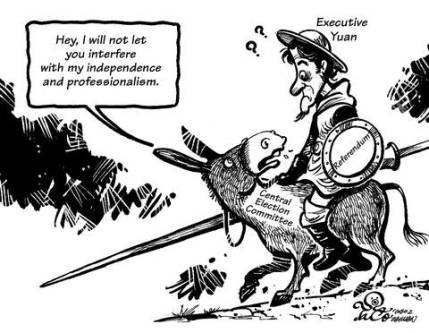
Lu said that the Central Election Committee only arranged a TV speech for the two vice-presidential candidates on Feb. 28, which is the day she and all DPP members will join the Taiwan Solidarity Union's (TSU) "1 million hand-in-hand" effort.
"I hope that the committee will be understanding and postpone the TV speech to the next day," she said.
During yesterday's conference, Lu again advocated creating a Democratic Pacific Union and enhancing the development of an "ocean culture" by uniting the countries of the Asia-Pacific region.
She said that Taiwan's "soft power," which integrates Taiwan's outstanding achievements in technology, democracy, human rights and especially maintaining peace despite China's long-term military threats, are the best weapons to use against the Beijing authority's "Great China Empire" intentions.
Asking to comment on whether the international community's concern about President Chen's referendum plan will benefit the DPP's campaign or not, Lu said that the trend of internationalization of the "Taiwan issue" or the "cross-strait issue" will help maintain Taiwan's security.
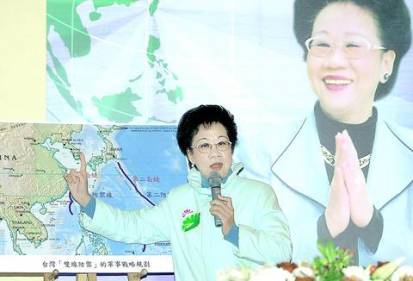
Vice President Annette Lu yesterday delivers a talk at an event introducing her new book, The Great Future of Taiwan.
-----------------------------------------
On Feb. 8, 2004 ……
We Taiwanese are not naive
Lin Yung-Ching, Hsinchu
It was saddening to read Keith Fritzsch's letter (Letters, Feb. 3, page 8) in which he says: "When are the people of Taiwan going to learn that most of the world does not care about what is right or what the truth is ... America will not help you because your market is not as big as China's. Nor do you have something we need and can not get somewhere else."
It's as if we are thought to be irresponsible because we are pursuing a minimal freedom of expression that every other democratic nation takes for granted.
Let me tell you clearly, Keith Fritzsch, we Taiwanese are not as naive as you imagine. We know that no American soldier will ever shed his blood for Taiwan if the US' own interests don't coincide with ours.
Ask yourself why former US president Harry Truman sent the Seventh Fleet into the Taiwan Strait just after the Korean war broke out. It's because of the US' support for Taiwan's fledgling democracy trying to fend off China's aggression -- we do know this, and we appreciate the US' friendly promotion of justice and liberty, which we believe is what makes humans human.
But Fritzsch's hard-line opinion reminds me of the imperialist mindset to which the founding fathers of the US were so strongly opposed.
Frankly speaking, if Taiwan falls into China's grasp, the US will also lose its own frontier defense strategy for the western Pacific region -- we all know this, don't we? Besides, don't underestimate the economic weight Taiwan carries in the world. Maybe you can get anything Taiwan has to offer from somewhere else, but probably at a higher price.
Taiwanese are not living on a cloud. The government has tried to boost military defense in several ways, even by paying unreasonable prices for the outdated F16 fighters.
So if you really are concerned about this region's stability, Mr Fritzsch, why don't you condemn French President Jacques Chirac's proposed lifting of the arms embargo against China, and condemn China's terroristic deployment of 496 missiles aimed at Taiwan?
But if you're the kind of person who judges everything based solely on its market value and on shortsighted interests, we certainly can't expect you to be a friend soon.
-----------------------------------------
On Feb. 8, 2004 ……
-----------------------------------------