20040210
=======
A stick for China on Feb. 10, 2004 ……
US is preparing a stick for China
By John Tkacik, Jr.
If diplomacy really is "the art of saying `nice doggie' while looking for a stick," then "diplomacy" is what the US' top diplomats have been practicing on China for the past two weeks.
When he was in Beijing two weeks ago, US Deputy Secretary of State Richard Armitage was complimenting China on how nice it was.
When asked who was to blame for tensions in the Taiwan Strait, Armitage demurred, saying "You would be putting me on the side of saying that the tensions are only raised by China, and I'm not going to be in that position."
Armitage added that "The question of Taiwan has been handled sensitively and sensibly" by both Beijing and Washington over the past 25 years -- a judgment that is most definitely in the "nice doggie" category.
Armitage's statements also evinced some suspicion about the upcoming referendum which protests China's missiles and calls for government-to-government dialogue with Beijing. Prodded by his Chinese hosts, who are dead-set against any "referendum" (even to establish a Taiwan National Dog-Catching Day), Armitage offered the novel theoretical observation that "referenda are generally reserved for items or issues that are either very divisive, or very difficult," and, because the wording of Taiwan's referendum "seems to be neither divisive nor difficult," he thought there might be some "questions about the motives of those who want to put it forward."
Another "nice doggie" moment.
But it seems the administration of US President George W. Bush is also looking for a stick -- a big stick. On Feb. 6, Armitage's protege, US Deputy Assistant Secretary of State Randall Schriver, and his Pentagon counterpart, US Deputy Assistant Secretary of Defense Richard Lawless, testified together at a congressionally-mandated hearing.
One administration official advised me to pay close attention to what both men said because "they were coordinated."
I did pay close attention, and I am certain that the Chinese embassy paid close attention and is perturbed -- because the two men's comments reflect a new coherence in the Pentagon and the State Department's China policies, which had thus far been invisible to the unaided eye.
Lawless and Schriver's testimony would explain why China's official emissary on the "Taiwan Problem," Chen Yunlin, left Washington in a huff on Thursday. He received nothing more than a polite hearing during his rounds in the US capital last week. He demanded that the US "do more" to rein in Taiwan, but encountered only polite smiles -- if that.
Testifying about the Defense Department's perspective on the Taiwan issue, Lawless not only explained that US law, specifically the Taiwan Relations Act of 1979 , requires the US to give full defense support to Taiwan, but pointed out that this is simply "good policy." He explained that the Bush administration sees "the protection of freedom and democracy as a national security objective of the United States."
Moreover, he asserted that "Taiwan's development into a true multi-party democracy over the past decade has strengthened America's commitment to its defense."
"The preservation of Taiwan's democracy depends," he said, on "providing Taipei the support it needs to deter [Chinese] coercion."
And for the first time in public, Lawless revealed that US military cooperation with Taiwan has gone well beyond simply providing "defense articles and services" and now includes "supporting Taiwan in developing an integrated national security strategy; joint doctrine; and integrated capabilities for training, employing and sustaining joint forces."
Moreover, he added, this has been going on since 1997, though Pentagon officials admit that the pace of the US' direct involvement in Taiwan's war planning stepped up significantly in April 2001, shortly after the infamous "Hainan Incident" in which a US reconnaissance craft was forced to land in Hainan and its crew was held hostage for nearly two weeks.
Lawless also asserted, in another first by a Bush administration official, that "[China's] ambitious military modernization casts a cloud over Beijing's declared preference for resolving differences with Taiwan through peaceful means."
This, one administration official told me, was an indirect response to comments a senior Chinese general made in New York on Jan. 15 reiterating that China would use force "if the Taiwan authorities reject sine die a peaceful solution of the cross-strait reunification issue through negotiations."
It also heralds a change in US Secretary of State Colin Powell's thus-far agnostic stance that "whether China chooses peace or coercion to resolve its differences with Taiwan will tell us a great deal about the kind of role China seeks with its neighbors and seeks with us." Both State and Defense are now beginning to draw their inferences from China's military buildup.
In another tantalizing comment, Lawless disclosed that "although several other states quietly collaborate with Taipei on security matters, the United States stands alone in its political courage, strategic imperative and sense of moral responsibility in assisting the security of Taiwan's democracy."
But some of those countries may also be interested in supporting Taiwan even more. Lawless advised Taiwan to "enhance interoperability ... with the United States and other potential security partners."
Indeed, the US has already achieved a strong tactical interoperability with Taiwan's defense command over the past year. And defense journals regularly report on the cooperation in intelligence collection between Taipei and Washington, which has been stepped up in recent years.
The US has its own views on the substance of the referendum. "We think [China's] missile threat is extremely serious, and we've been engaged with our Taiwan interlocutors on the nature of the threat and what needs to be done to address it." Schriver called for "leadership" in Taiwan to "convince the public that it's necessary to expend the resources to meet the challenge."
He admitted that he didn't know "whether a referendum necessarily helps or hurts" but, as if to contradict his earlier suspicions, he acknowledged that Taiwan's leaders must make decisions about resources which are "always difficult in periods of economic challenge."
Schriver acknowledged that the first question of the Taiwan referendum is indeed "very divisive" and "very difficult." Certainly he would welcome the "leadership" of Taiwan's president in "focusing the people on the necessity for a sufficient defense budget."
Despite Washington's suspicions about the motives for Taiwan's referendum, Schriver praised referendums as valuable "tools of democracy."
Yet he was surprisingly explicit, given the recent controversy within the US government about the March 20 referendum: "It's also important to note that irrespective of a referendum, we have opinions about these two questions."
Should Taiwan focus a "public consensus" on devoting more resources to face the missile threat?
"We think that's an absolute `Yes,'" Schriver said.
Should Taiwan engage in government-to-government talks with China without preconditions?
Schriver said, "Absolutely."
Those conversant in the arcana of the US' Taiwan policy will note that Schriver listed most of former US president Ronald Reagan's `Six Assurances' to Taiwan: "our one China's policy" alongside the "three communiques," the "Taiwan Relations Act," the US' insistence that differences between Taiwan and China "be resolved peacefully" and "our non-support for Taiwan independence."
The cognoscenti will readily remember that Reagan's assurances explicitly eschew recognition of China's claims to sovereignty over Taiwan despite "our non-support" for the nation's independence.
Some argue that growing discomfort on Capitol Hill and among the administration's staunch supporters in the conservative movement has caused the White House to tack to the wind, but am assured this is not so.
All along, the administration's strategy has been to keep at bay China's increasing hysteria about the progress of democracy in Taiwan with reassuring words that the US does not support "Taiwan independence," while at the same time working closely, and heretofore quietly, with Taiwan to strengthen its defenses against unwanted unification with China.
So, faced with growling Pekinese, the Bush administration says "Nice doggies, we're concerned about Taiwan's referendum too, yes we are!"
And now, for the first time, we see the administration visibly assembling an arsenal of sticks.
John Tkacik, Jr. is a research fellow at the Asian Studies Center of
the Heritage Foundation in Washington.
-----------------------------------------
On Feb. 10, 2004 ……
Polls indicate few want cross-strait status quo changed
By Melody Chen, STAFF REPORTER
Around 80 percent of Taiwanese people wish to maintain the status quo in the Taiwan Strait, while less than 10 percent support declaring Taiwan's independence or unification with China, a government poll showed yesterday.
The Mainland Affairs Council released the poll results at a press conference. The poll, conducted last year, indicated the percentage of people supporting the status quo was basically unchanged.
The poll was one of the 80 surveys, four by the government and 76 by private agencies, carried out last year on the public's views on cross-strait affairs, according to council Vice Chairman Johnnasson Liu.
A council committee analyzed the 80 polls to gain an understanding of opinions on cross-strait policies and its handling of relations with China, Liu said.
The committee divided the polls results into 11 topics, such as the people's opinions on Taiwan's national status, the issues put to a referendum, direct links between Taiwan and China, cross-strait negotiations, trade, cultural and social exchanges, and the government's handling of the SARS outbreak.
Private polls on the public's stance toward the independence issue last year also showed most people favored the status quo, with 42 to 66 percent of those surveyed saying they wanted the status quo to last.
Private polls revealed 7 to 23 percent of the public desired unification with China, while 15 to 28 percent said they wanted Taiwan's independence.
"The public's opinions toward Taiwan's national status have become quite diversified," the committee report said.
Asked about their views on national status, 30 percent of interviewees in last year's polls agreed with President Chen Shui-bian's statement of "one country on each side" of the Taiwan Strait.
Another 30 percent of those questioned, however, said they backed the "one China, with each side having its own interpretation" statement.
More than 60 percent of the public said the country should keep its title of "Republic of China" and that there is no need for the country to rectify its name. Only 20 percent wanted a change in the nation's title.
Most of the public thought Taiwan's relations with China had not changed much from the early months of last year, but around 50 percent began to believe cross-strait relations had been worsening by the middle of last year, the polls showed.
Visits by leaders of Taiwan and China to each other's country would help boost cross-strait relations, 78 percent of the interviewees said, while 28 percent to 48 percent of them believed Chen's proposals for a new constitution and referendum would hurt relations.
Nearly 50 percent were unclear about the contents of the Referendum Law (公民投票法) and could not say whether they support or oppose it, but 28 percent were worried the law could harm cross-strait relations.
Meanwhile, 52 percent of those surveyed said Taiwan did not need to take US opinions into account when planning the referendum. Nevertheless, 34 percent thought US views were important in the government's plan to hold the vote.
-----------------------------------------
On Feb. 10, 2004 ……
Lien cronies are fugitives
CRIMINAL FRATERNITY?: The Criminal Investigation Bureau has identified key KMT campaign organizers abroad as criminals who are still wanted in Taiwan
By Lin Chieh-yu, STAFF REPORTER
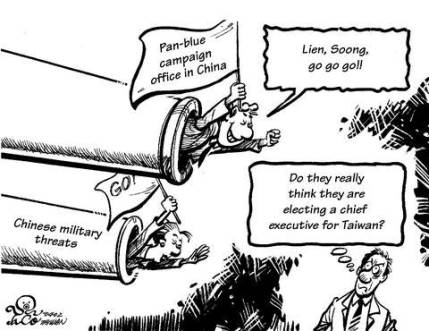
The Democratic Progressive Party (DPP) yesterday said the pan-blue camp is supported not only by Beijing, but also by Taiwanese fugitives in China, who have been assisting the pan-blues in mobilizing Taiwanese businesspeople in China to vote for Chinese Nationalist Party (KMT) presidential candidate Lien Chan.
"Since last year, the pan-blue camp has carried out numerous campaign activities in China, all in violation of Chinese law. However, not only did the Chinese government fail to put a stop to these activities, instead it allowed and even supported their activities," said DPP campaign headquarters spokesman Wu Nai-jen.
For example, Wu said, the Chinese government, has completely ignored a Lien-Soong district campaign headquarters operating under the name of a Taiwanese trade service institute in Shanghai operating since Feb. 7.
Wu said that, according to some Taiwanese businesspeople in China, during the past six months the Lien-Soong camp has sent key figures, including KMT Legislator John Chang, KMT Mainland Affairs department head Chang Rong-kung and KMT policy committee senior member Kao Koong-lian, to launch those campaign events in China.
According to Wu, the Lien-Soong headquarters has held campaign activities, including a fundraising event on Jan. 8 which collected NT$27 million, a reception for businessmen on Jan. 11, sending letters inviting Taiwanese businessmen associations to attend a Lien-Soong campaign activity on Jan. 17, and the opening ceremony for the Lien-Soong Shanghai headquarters on Feb 7.
"All those events violated the Chinese government's regulations, which were published on April 20 last year, but the Chinese government issued no citations and even encouraged Taiwanese business-people to participate," Wu said.
"Therefore, it is reasonable to believe that there is a secret deal between the pan-blue camp and the regime in Beijing," Wu said.
He also said that the DPP is concerned about two aspects of this development. One is whether the secret deal had sacrificed Taiwanese national interested, and the other is that the businesspeople involved in the event may be blackmailed into acting as China's agents provocateur.
"If China decides to reveal its two-faced countenance, Taiwanese businesspeople could be imprisoned at any moment," he said.
Meanwhile, the DPP legislative caucus also claimed that some leaders of the Lien-Soong campaign in China were actually Taiwanese white-collar criminals, among them several who are still fugitives from justice.
"Chang Yang, whose real name is Chang Yi-song, is now serving as the chairman of a Taiwanese business association in Shenyang and he is also in charge of organizing campaign activities for the pan-blues in northern China," said Tsai Huang-liang, DPP legislative caucus leader.
"Yet Chang is a fugitive who has been sentenced for committing fraud, forgery and breaking banking laws in Taiwan," said Tsai.
Tsai displayed a recent photo taken in China showing Chang standing beside Liao Cheng-hao, a former minister of justice and now the deputy head of a Lien-Soong supporters' association.
"We asked the Criminal Investigation Bureau of the National Police Administration to verify Chang's identification. The result is that Chang has been identified as a fugitive criminal, who is still attempting to defraud Taiwanese businesspeople."
But in an interview with local media, Chang said that he had not received a summons, and therefore was not a fugitive. He did not say when he would return to Taiwan, and said that he was the real victim.
Tsai questioned why fugitive criminals including Chang Yang, former Tuntex Group chairman Chen Yu-hao, former Central Broadcasting System president Gloria Chu, and former Legislator Wu Tzer-yuan, are all KMT members and are now campaigning for the pan-blue ticket.
"The public wants to know whether Lien Chan has promised to pardon those fugitives in return for their campaign efforts," Tsai said.
"Why has Lien not asked those KMT members, who are now campaigning for him overseas, to return to Taiwan?"
-----------------------------------------
On Feb. 10, 2004 ……
Campaigning in china carries risks
The situation across the Taiwan Strait is quite unusual in that the two sides are hostile on the military front but economic interaction between them is on the rise.
China has deployed 496 ballistic missiles that are aimed at Taiwan while 25 percent of Taiwan's exports go to China. Relations between the two sides are also quite unique in that they are both domestic and international at the same time. This quaintness leaves one not knowing whether to laugh or cry.
In Taiwan's presidential election campaign, both the pan-blue and pan-green camps have expanded their campaigns to overseas.
The Chinese Nationalist Party (KMT)-People First Party (PFP) alliance has set up a campaign headquarters in Shanghai to canvass for votes from Taiwanese business communities in China. This has drawn criticism from the Democratic Progressive Party (DPP).
Setting up a campaign office in China is like campaigning in North Korea during a South Korean presidential election. Should the campaigners follow the rules set by the North Korean government, or should they follow South Korea's democratic system? Could North Korea discriminate against a South Korean candidate it dislikes? If the number of votes in North Korean territory reached a level that could change the election results, would South Korea have its president chosen by North Korea?
These are merely hypothetical questions, because the two Koreas do not allow free exchanges. However, the scenario suggests a real, difficult issue for Taiwan, involving political freedoms and national security.
The Chinese government does not allow campaign groups on the national level. In China, even establishing a village committee is subject to layers of restrictions. The campaigning activities that the KMT-PFP camp is engaging in violate many Chinese regulations, but Beijing has turned a blind eye to and even secretly encouraged such activities.
China is covertly supporting Lien Chan and James Soong. No wonder Lien and Soong have been described as candidates nominated by the KMT, the PFP and the CPC (Communist Party of China).
The presidential election is a battlefield in China's "united front" strategy. China has been criticizing President Chen Shui-bian and his referendum plan in the international arena, but on the other hand it has allowed the Lien-Soong camp to campaign in its territory. This is an example of the strategy that might be referred to as "teaming up with the secondary enemy to defeat the primary enemy."
Lien and Soong now owe Beijing a huge favor. How do they plan to repay it? If they win the election, will they repay Beijing at the expense of the people?
Businesses that are engaging in political activities in China have violated the laws there. At the moment, their activities are condoned by the CPC -- but if they ever have a falling-out with the CPC, their "crimes" will be used against them.
Taiwanese businesspeople are 100 percent Taiwanese citizens even if they are in China. They enjoy the right to vote as well as many other freedoms, but they are doing business in an area whose government is hostile to Taiwan. Their assets and personal security are all under China's control. In this sense they are China's hostages.
Because the personal and corporate interests of Taiwanese businesspeople in China are in conflict with this country's overall interests, Taiwan should stand firm on the principle articulated by Chen in last Friday's TV interview: overall interests come before any individual's interests.
As for the question of how to handle the political rights of businesspeople, the government should enact legislation to regulate political activities by Taiwanese people in China.
If China is allowed a hand in presidential elections here, the president will be no different from Hong Kong's chief executive.
-----------------------------------------
On Feb. 10, 2004 ……
-----------------------------------------