20040211
=======
Interference on Feb. 11, 2004 ……
Foreign interference is uncalled for
By Chen Hurng-yu
The government's plan to hold a referendum on the day of the presidential election has led to the US, China, Japan and even France, which has nothing to do with the matter, stating their opinions. Some have shown their concern and some their opposition, as if the referendum was their private business.
The responses of the government and the public to these foreigners showing their concern has varied from ignoring it to attaching a lot of importance to it.
For example, we have seen people taking to the streets to protest against Japan and France for interfering in Taiwan's domestic affairs, but not against China. And we have seen the president rebutting statements made by China and France, but we have not seen him oppose the US. This reaction merits further investigation.
International debate over Taiwan used to be much livelier than it is today. As early as the 1950s, the issue of Taiwan's representation at the UN was constantly being debated at international meetings.
Countries supporting China kept suggesting that Taiwan should be stripped of its representative rights, and in 1971 Taiwan was finally locked out of the UN. Following that, demands for terminating the Republic of China's membership were heard in all kinds of international organizations, together with demands to change the name under which Taiwan could remain a member. If there were no name change, the meetings of these organizations were boycotted by China.
Because Beijing tries to exclude Taiwan from the international community and attempts to include it in its own territory, it repeatedly forces the issue of treating Taiwan as part of its
territory when setting up diplomatic relations with other countries and at other international meetings. The rapid internationalization of the Taiwan issue is all the work of China. In this process, each concerned country publicly makes gestures towards Taiwan to meet Chinese demands.
The serious interference in Taiwan's domestic affairs is all but obvious. This ongoing international debate has actually turned the Taiwan issue into a matter of routine. Everyone now remains aloof, ignoring it.
In addition, Taiwan has long seen the US as an ally, relying on it for security and protection. When the US discusses Taiwan, therefore, it is seen as something natural, and there is no reason for opposition.
Furthermore, some politicians tend to meet US demands and invite Washington to interfere in Taiwan's domestic affairs. This is an attitude Taiwan should certainly avoid as it faces the international community.
The US is a superpower, and it is a fact that it recognizes Taiwan's need for protection and security. This is a friendship we should respect.
It is not, however, appropriate for the US to publicly oppose Taiwanese domestic measures. Looking back at the post-war period, US actions in the East Asia region make us understand clearly that the position the US should maintain in the region will suffer severely from repeated US pressure on domestic measures taken by its allies -- eg, South Korea and South Vietnam -- in order to meet China's demands.
It is understandable that the US does not want to sacrifice American lives over the cross-strait issue, but this point of view doesn't have to be built on interference in Taiwan's domestic affairs.
The US has been consistent in its
point of view that the cross-strait issue should be resolved by the two sides
themselves. The George W. Bush administration's opposition to the referendum is
a departure from longstanding US thinking.
Japan's show of concern over Taiwan's
referendum is completely unnecessary. When did Japan ever concern itself over
the Taiwan issue? For a long period after Taiwan and Japan broke off diplomatic
relations, the Japanese media did not report news about Taiwan, and government
officials and university professors refused to visit. Not until 15 years ago
did they begin to change this policy.
Japan has for a long time lived under the shadow of the security threat posed by China. Judging from Japan's opinion concerning the referendum, nothing at all remains of its proposition to become a "normalized country." Japan is still incapable of removing itself from China's coercion, and must continue to be a Chinese pawn. Japan still has a long way to go before it can realize its dream of becoming a regional leader.
France's reaction is the most unexpected. French President Jacques Chirac publicly opposed Taiwan's referendum during a visit by China's President Hu Jintao.
What kind of country is France? It is an old democracy. In 1789, the French people began a great revolution, a protest against tyranny remembered and admired by people around the world. Following China's actions during the Tiananmen massacre in 1989, France also displayed active opposition against tyranny. France is now putting in a good word for China, lobbying European countries to get them to lift the embargo on arms sales to China, and following China's cue in lecturing Taiwan. Believing this is a means to becoming China's window in Europe, France is destroying its own position.
The Referendum Law has been reviewed and passed by the legislature. Holding a referendum pursuant to this law is a domestic matter for Taiwan.
Regardless of whether it follows the spirit of the law or whether it is appropriate, other countries should keep their noses out of the matter, and it is even more inappropriate to invite foreigners to discuss the issue.
It is not appropriate for a media organization to publish long articles about foreigners opposing or supporting the referendum as evidence supporting that media organization's position for or against holding a referendum. We don't see any reports critical of foreigners discussing the Taiwanese referendum, which truly is a strange phenomenon.
There is an old Chinese saying -- "humiliate yourself and you will be humiliated by others." If we do not persist in keeping foreigners from interfering in our domestic affairs, they will interfere, and, thinking themselves successful, foreign governments will then discuss and interfere in Taiwan's domestic affairs at will.
Chen Hurng-yu is a professor of history at National Chengchi
University.
-----------------------------------------
On Feb. 11, 2004 ……
Be aware - know thy enemies
In a free and democratic society where the rule of law prevails, competition between political parties is necessary and normal. However, the premise for such competition should be the interests of the nation and its people. Taiwan's parties should not support the political stances taken by a foreign regime that has publicly vowed to attack their country. Much less should they join hands with such a regime to attack their domestic rivals. Otherwise, a serious problem of national identity confusion will arise, thereby allowing the hostile regime to reap political profits.
What political profits does Beijing hope to reap from Taiwan? Obviously, it wants to change Taiwan's status quo by making it part of the PRC. This is something no one can deny.
What then is Taiwan's status quo? Everyone knows that the democratization of Taiwan's political system began with the lifting of martial law in July 1987. The first ever direct presidential election here was held in 1996, while in 2000 there was the first transition of political power.
In comparison, the Beijing regime has never wanted to practice democracy. It merely wants to thoroughly annihilate a free and democratic Taiwanese social framework where the rule of law prevails -- a society built with the blood and tears of the Taiwanese people -- and replace it with a Communist authoritarian system.
In light of this, it should not be difficult to understand the motive behind the defensive referendum that Taiwan wants to hold. It is meant to call on Beijing to remove the ballistic missiles deployed against Taiwan and not seek to resolve the cross-strait dispute by means of military force. Such a referendum is clearly meant to ensure that Taiwan's status quo won't be changed by the Beijing regime. Creating a new constitution will serve to ensure that Taiwan will continue to deepen its democracy on the basis of the rule of law, and to prevent the emergence of a despotic politician or a military ruler.
However, the Democratic Progressive Party (DPP), which has worked to protect Taiwan's democratic status quo, has been painted -- by Washington as well as pro-Beijing politicians -- as a party bent on changing the status quo. Those who want to overturn the status quo have been extolled as its defenders. Isn't this logic a little too ridiculous?
When it comes to the national identity of Taiwan's four major ethnic groups and political parties, what is most important is to identify with the democratic system that the nation is practising. No external regime should be allowed to change that status quo. Referendums are one of the best ways to reflect the will of the entire citizenry in a democratic country.
Only a constitution compatible with the trends of the time can ensure that the nation's democratic system will not deteriorate. Only the DPP's approach, therefore, will truly safeguard Taiwan's free and democratic status and ensure that it won't be changed by external political forces or military threats.
In addition to deploying missiles and threatening Taiwan, Beijing has also harbored Taiwanese fugitives, especially those suspected of economic crimes. It has also blatantly tried to influence Taiwan's presidential elections. It is Beijing that is trying to change the status quo. The people of Taiwan need to see this fact clearly.
-----------------------------------------
On Feb. 11, 2004 ……
To make a solemn statement
Emmanuel Castro, Montingy le Bretonneux, France
A thing that is often reported in the news and that I can see on the Internet -- as in Arthur Shih's letter (Letter, Feb. 5, page 8) -- is that the referendum is illegal.
I am not a lawyer, but I like to study the way laws are made, and I have a question. What does it mean for the referendum to be illegal? Is it that: 1) it is forbidden to formally ask the opinion of the citizens in a referendum, or 2) the text that the citizens are to vote on cannot be given the force of the law should the citizens give it a "Yes" vote?
I cannot believe that anyone in any democracy-loving country would agree with the first point. Those who fear a question being asked of the people are definitely not democrats.
The second point is more debatable.
Let's suppose that the referendum is not allowed by law. This means that, even if approved by the people, the text of the referendum cannot be used as a law.
The text of the referendum that I have read is just a question about the policy that the government should implement. The force of Taiwan's referendum is not its legality -- it is its solemnity. Whoever wins the presidential election won't be able to ignore the voice of the citizens.
In France, municipalities often organize "illegal" referendums. In such cases, the text that the citizens vote on does not have the force of the law. It can even be declared illegal by the central government, but it gives a signal to the policymakers that something is happening in the city that they cannot ignore.
Such referendums are called rendum consultatif or consultation populaire. An example is the Chamonix referendum in which the people of Chamonix expressed their strong displeasure with seeing international transport trucks polluting the Mont Blanc valley on their way to Italy.
This brings me to comment on a statement by US Deputy Secretary of State Richard Armitage: "As I understand it, referenda are generally reserved for items or issues which are either very divisive or very difficult, and the wording I have seen of the referendum seems to be neither divisive or difficult," he said.
Yes, that is generally the case.
But solemnity is also very important. The last referendum passed in France was to shorten the president's term from seven years to five years. There was little debate about the text; everybody agreed; it was neither difficult nor divisive. It could easily have been approved by the senate and the parliament. But French President Jacques Chirac decided to use the referendum to make each French citizen solemnly involved in the decision-making process. Seventy-one percent of the people voted "Yes."
-----------------------------------------
On Feb. 11, 2004 ……
No such thing as unification
Leon Tseng, New Berlin, Wisconsin
I have read Paul Lin's excellent articles published in the Taipei Times. Lin's points of view are well-taken and certainly I agree with Lin on most of them. However, I have found that Lin uses the wrong word sometimes -- "unification."
Correctly, Lin should use "annexation," not "unification."
Historically, Taiwan has never been part of China, so how can Taiwan be unified with China? "Unification" is the word used by Chinese officials in their propaganda war in order to annex Taiwan. Taiwanese and the people of the rest of the world believe that this is annexation. I suggest that Lin use "annexation" in his future articles.
Also, comparing the situation in Taiwan with that of Hong Kong ("China lacks the right to interfere in democracy," Jan. 31, page 8) is just comparing apples and oranges. They are not related. Hong Kong is part of China, while Taiwan is an independent country. People in Hong Kong are mainly Chinese but people in Taiwan are Taiwanese, not Chinese.
-----------------------------------------
On Feb. 11, 2004 ……
Chen has will to see referendum through
By Lao Pao
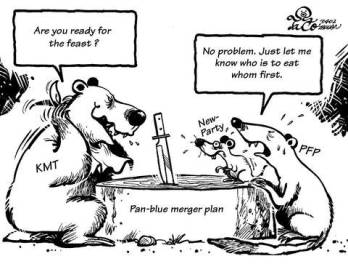
President Chen Shui-bian plans to hold Taiwan's first referendum on the day of the presidential election. This major democratic occurrence has become a thorn in the side to the blue camp and it has joined up with the Chinese Communist Party (CCP) in reviling it. Chinese President Hu Jintao even prompted French President Jacques Chirac to condemn the referendum.
The wave of referendum bashing has
proved one thing: democracy did not fall from the skies. It has been brought to
us by hardworking people with a sense of mission. Over the past decade, Taiwanese
society has been influenced by the unification media's constant nihilism. Fewer
people have a sense of democratic mission, but, luckily, political leaders such
as former president Lee Teng-hui and Chen have not lost their way. They have
spent more time considering the great Taiwanese democracy plan.
During his presidency, Lee engineered the re-election of the whole legislature and direct presidential elections, froze the provincial government and scrapped the National Assembly. He also declared the "special state-to-state" model of cross-strait relations. This was Lee's "democratic line."
In addition to his powerful advocacy of "one country on each side of the Taiwan Strait," Chen last year announced "referendum, legislative reform and the drawing up of a new constitution," or Chen's "democratic line," which has had conservative anti-reform groups jumping with rage.
Not a single item in Lee's and Chen's democratic lines escapes China's vilifications. As the CCP rails, Taiwanese unificationist politicians and media dance to China's tune, gradually creating anti-Lee and anti-Chen sentiment.
For example, ever since the referendum was first mentioned, it has been vilified and satirized by the hypocritical unificationist China Times.
Immediately after the CCP started railing against the referendum, Chinese Nationalist Party (KMT) Chairman Lien Chan, People First Party (PFP) Chairman James Soong and Taipei Mayor Ma Ying-jeou did the same. Chen was even, inexplicably, called a "criminal caught in the act."
Does a referendum bite? Is democracy a frightful beast? Those afraid of letting the people be in charge are the ones possessed by beasts. Ma used to be the biggest opponent of Lee's democratic line. Now he rants and raves over the referendum plan. Although Ma is not willing to give up his anti-democratic ways, he still wants to enjoy the fruits of democracy. Lien or Soong never supported Lee, they only wanted power that Lee could not give. Now they revile Chen's democratic line, which is only appropriate for someone who sees no shame in being the spokesman of those wanting to restore authoritarianism.
When the founder of the China Times was still alive -- and neither the faction advocating popular election of the president nor the faction advocating election by committee would yield -- it was still capable of neutrality. Now that the founder's son has taken over, there are merciless attacks on Chen's democratic efforts at holding a referendum.
How can such a paper have the nerve to call itself a member of the intelligentsia? If the people really are master, can holding a referendum to show their will be such a bad thing? Such media and politicians would fit in better in China than in Taiwan.
Chen faces tough challenges. Only one thing is certain -- he is tough and daring to break through his limitations. I'm sure he will follow through with the referendum. I hope the Democratic Progressive Party will remember its leader's difficult situation and make an effort to protect his democratic line, for the sake of Taiwan.
Lao Pao is a political commentator.
-----------------------------------------
On Feb. 11, 2004 ……
-----------------------------------------