20040213
=======
Powell said on Feb. 13, 2004 ……
Powell approves of referendum
"Taiwan is a democratic place.
If they choose to have a referendum, they can have a referendum." --- Colin Powell,
US secretary of state
FOREIGN POLICY: The US Secretary of State also said that strong diplomatic efforts are being made to dissuade the EU from dropping its ban on arms sales to China
By Charles Snyder, STAFF REPORTER IN WASHINGTON
US Secretary of State Colin Powell appeared to signal a retreat from the Bush administration's tough line on the Taiwan referendum on Wednesday in testimony before a congressional committee hearing on President George W. Bush's fiscal 2005 budget request for the State Department and foreign affairs.
"Taiwan is a democratic place," he told the House International Relations Committee. "If they choose to have a referendum, they can have a referendum."
Powell omitted from his comments recent administration statements that linked the planned referendum with changing the "status quo" in the Taiwan Strait, a connection Bush and his aides have repeatedly made.
Powell did say, however, in answer to a question by Democrat Sherrod Brown, a co-chairman of the Congressional Taiwan Caucus, that the Bush administration "does not want to see these actions lead in any way to a change in the situation." He did not give details.
Citing the administration's "one China" policy based on the three communiques and the Taiwan Relations Act, "which gives us certain obligations with respect to the security of Taiwan," Powell said, "we don't believe any action should be taken in the region that would unilaterally change the situation."
He added that "we don't really see a need for these referenda."
Powell also said the US is making strong diplomatic efforts to dissuade European nations from dropping their Tienanmen-era ban on sales of weapons to China in view of recent efforts by France and other nations to resume the arms sales.
Powell said he raised the issue with the French foreign minister at lunch last Friday, and with Irish Foreign Minister Brian Cowen before his appearance at the committee hearing on Wednesday.
"I have been talking with all of my European Union colleagues," including foreign ministers Jack Straw of Britain and Joschka Fischer of Germany, he said.
He said he told them "this is something they really need to give long and hard thought to, and not do."
While the EU has shelved the issue for the moment, they will return to it, Powell cautioned the committee, and "we will be pressing our European colleagues not to abandon this policy."
Meanwhile, for the fifth year in a row, Brown and the other three Taiwan caucus co-chairmen introduced legislation in the House endorsing observer status for Taiwan in the meeting of the World Health Assembly in Geneva in May.
The bill authorizes Powell to "introduce a resolution on the floor of the World Health Assembly, before the assembled delegates, in support of Taiwan's participation" in the meeting as an observer.
It was the first time that such a bill had authorized the introduction of such a resolution.
Previous years' versions merely urged the secretary to develop a strategy to secure Taiwan's observer status.
As a result, while the US has spoken in favor of Taiwan in recent meetings, such comments were generally made in meetings on the sidelines of the actual assembly, not in it.
"SARS and avian influenza continue to threaten Taiwan," Brown said. "The case has never been stronger for allowing the people of Taiwan access to the World Health Organization," he said, noting that SARS killed scores of people in Taiwan last year.
As in recent years, the current bill also mandates the secretary to develop and implement a plan to secure observe status in the World Health Assembly for Taiwan.
In addition to Brown, the other caucus co-chairs who sponsored the bill are Republican Steve Chabot, Republican Dana Rohrabacher, and Robert Wexler, a Democrat.
-----------------------------------------
On Feb. 13, 2004 ……
DPP officials see the brighter side of US comments
By Lin Chieh-yu, STAFF REPORTER
Reacting to US Secretary of State
Colin Powell's comments this week on the upcoming referendum, the Presidential
Office said yesterday that the US government's policy has not changed and that
Taiwan and the US share a stance on restraining China's intention to expand its
military power.
"The comments by [Powell] need to be interpreted comprehensively, not selectively or partially," Deputy Secretary General to the President Joseph Wu said.
"We think that Secretary Powell's comments did not differ from the content of comments of other US officials lately, that is, the US government's Taiwan Strait policy has not changed. The US administration will not interfere with Taiwan's internal governmental affairs, nor oppose Taiwan's democratization," Wu said.
In testimony Wednesday before the
international relations committee of the US House of Representatives, Powell
said, "Taiwan is a democratic place. If they choose to have a referendum,
they can have a referendum."
But Powell also said that "we
don't really see a need for these referenda."
Wu noted that "Powell's comments in Congress have another emphasis, that is, they show opposition to the EU lifting its embargo on sales of arms to China."
"Regarding this point, Taiwan should express appreciation. Because the common stance of both Taiwan and the US is to preserve peace in the Taiwan Strait and the Asia-Pacific region, the demand that China reduce its military capability is exactly President Chen [Shui-bian's] intention in holding the peace referendum," Wu said.
As to whether Powell's comments and other countries' continuing concerns mean that Chen's referendum plan is under international pressure, Wu said that the referendum has made the "`status quo on both sides of the strait' a focus of international attention. Taiwan should carefully and actively explain this to other countries. This is a natural trend.
"In the past, many countries didn't understand the threat Taiwan was facing nor China's strategy, and now they are willing to express concern to a certain degree," Wu said.
"Taiwanese people should not regard all this as detrimental because the international community is also looking at China's actions," Wu said.
"The international community may be cautious about Taiwan's referendum but they are more concerned about whether China will do something irrational," Wu said.
Meanwhile, Vice President Annette Lu said that Powell's comments were a declaration of a stance that is balanced toward both sides of the strait, and that the longer the situation develops, the more beneficial it will be for Taiwan.
"The peace referendum is like a solemn declaration by a couple at their wedding, which will prevent disruption by a third party," Lu said yesterday at the Presidential Office.
"In the face of China's
two-handed strategy, President Chen also needs to counter it with a `peace and
war' two-handed referendum strategy," she said.
Another Democratic Progressive Party (DPP) leader interpreted Powell's comments optimistically, saying that "the US has already endorsed Taiwan's referendum."
Lee Chun-yee, DPP legislative caucus leader, said that the US government respects Taiwan's democracy and that political parties here should cherish democracy rather than hinder democratization.
"Powell's speech clearly demonstrates that the US has clarified its stance that no country should interfere with other countries' right to hold referendums," Lee said.
"The content of his speech indicates that the US has found an equilibrium between its own interests and Taiwan's development," Lee said.
"While the US understands that it should respect Taiwan's democracy, the [pan-blue] alliance tries in every way to prevent the referendum in Taiwan from being held," Lee said.
"Such actions are wrong and we hope that the [pan-blue] alliance won't hinder the development of Taiwan's democracy," Lee said.
-----------------------------------------
On Feb. 13, 2004 ……
DPP grills `United Daily News' for incorrect stories
By Lin Chieh-yu, STAFF REPORTER
The Democratic Progressive Party (DPP) yesterday accused the United Daily News (UDN) of tarnishing the reputation of President Chen Shui-bian and his administration by publishing what it said were irresponsible and incorrect stories.
Wu Nai-jen, spokesman for the DPP's campaign headquarters, presented a copy of a letter sent to the head of the newspaper at a press conference yesterday.
"The United Daily News published three stories, unverified and unattributed, on Feb. 6, 8 and 11 accusing the DPP government of involvement in a bribery scandal," Wu said. "But the stories do not have any specific evidence."
"These stories not only mislead the public and hurt the president's honor, but also endanger the reputation of the United Daily News," he said.
Wu said the stories are in violation of Article 92 of the Election and Impeachment Law, which regulates spreading rumors in an attempt to affect the outcome of an election.
He called the media's performance during this presidential election campaign the worst in more than 20 years.
Wu said the intention of the United Daily News to sway the election has damaged the credibility of the media, and the DPP hopes the letter will prompt the newspaper to improve.
He cited an editorial in the United Daily News on its 47th anniversary that upheld "anti-communism, democracy, unification and progress" as its principles, but said the newspaper has violated its own principles and ethos.
Wu said the DPP could no longer put up with such irresponsible reports and that it decided to fight back against the paper.
"We will start with a rational appeal, but we haven't decided yet whether to take legal action against the United Daily News."
"Article 92 not only refers to civil issues but also may lead to imprisonment for five years," Wu said. "If the United Daily News fails to make an improvement, we will resort to legal procedures."
Responding to Wu's remarks, the paper issued a statement saying, "The United Daily News deals with stories according to journalistic professionalism and journalistic ethics."
It called on candidates to respect the media's role in society.
Meanwhile, the DPP's campaign headquarters said the pan-blue camp was using campaign tricks that have been condemned in other democratic countries.
"The first kind of blue-camp
negative campaign trick is to make up facts and then implicate an
opponent," Wu said, "like when former legislator Lin Ruey-tou claimed
that Chen Shui-bian had gone to Macau for a wench in 1998.
"The second one is to create a
sensational story for slandering. This includes when People First Party [PFP]
Legislator Chiu Yi suggested that Chen Shui-bian had an affair with a famous
actress in March 2000," he said.
"The third is to viciously impute blame to another, such as when PFP Legislator Diane Lee accused former Department of Health head Twu Shiing-jer of being involved in a sexual harassment case in October 2002. She later apologized for accusing the wrong person," Wu said.
"The last kind is to spread
slanderous rumors with groundless talk, such as PFP Chairman James Soong
claiming that Chen Shui-bian spent US$1 million to have a meeting with a family
member of US President George W. Bush -- an accusation for which Soong never
provided evidence," he said.
Wu said the blue camp's ridiculous
rumors have developed to an evil degree and are even encouraged by the blue
camp's vice presidential candidate, Soong.
"We hope the media do not serve
as those evil tricks' accomplice," he said.
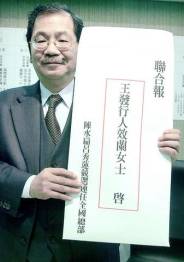
Spokesman of the Democratic Progressive Party's campaign headquarters Wu Nai-jen shows an oversized envelope addressed to Wang Hsiao-lan, publisher of the United Daily News, asking the newspaper to stop publishing irresponsible and incorrect news stories, at a press conference yesterday.
-----------------------------------------
On Feb. 13, 2004 ……
Lu says Chen's re-election crucial to cross-strait stability
CNA , TAIPEI
Vice President Annette Lu yesterday said that President Chen Shui-bian's re-election is critical to stabilizing cross-strait relations and domestic politics.
Lu made the remarks during a tea party with a group of reporters covering the Presidential Office.
If the Chen is re-elected, Lu predicted, the Beijing authorities will come to understand that they have to negotiate with the Democratic Progressive Party (DPP) administration.
"This will be the first step in maintaining cross-strait stability," she said.
Should that be the case, Lu went on, the DPP and its pan-green allies will stand a good chance of winning a majority of seats in the year-end legislative elections.
Claiming that many of the administration's reform programs have been obstructed by the opposition-controlled legislature over the past four years, Lu said gaining a legislative majority will greatly facilitate the implementation of Chen's major policy initiatives.
Lu described the referendum as a historic event in Taiwan's democratic development.
"The referendum is a crucial first step to protect Taiwan's status quo," Lu said, adding that once the referendum results come out, China will no longer be able to turn a blind eye to the Taiwanese people's appeal for its withdrawal of the hundreds of missiles pointed at the nation.
Noting that Chen's referendum initiative has caught world attention and has thus helped make the Taiwan Strait issue an international concern, Lu said Taiwan can use the referendum to demonstrate to the world its desire for peace and commitment to preserving the status quo.
Lu said that the two referendum questions epitomize a two-pronged approach to push Beijing to negotiate with Taiwan for crafting a mechanism for peaceful interaction.
The two questions are:
"The people of the Taiwan demand that the Taiwan Strait issue be resolved through peaceful means. Should mainland China refuse to withdraw the missiles it has targeted at Taiwan and openly renounce the use of force against us, do you agree that the government should acquire more advanced anti-missile weapons to strengthen Taiwan's self-defense capabilities?"
"Do you agree that our government
should engage in negotiation with China on the establishment of a peace and a
stability framework for cross-strait interaction in order to build consensus
and for the welfare of the peoples of both sides."
Lu said that even though the answers to the two questions may be self-evident, the referendum has to be held to manifest the people's sovereignty.
"I think there should be feasible ways to avoid a cross-strait war other than deploying anti-missile systems," she said.
-----------------------------------------
On Feb. 13, 2004 ……
Beijing tries to cloak its favoritism
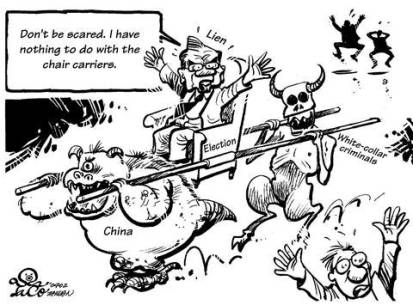
On Wednesday, Zhang Mingqing, the spokesman for the Taiwan Affairs Office of China's State Council told a press conference that the office's attitude toward the stance of Taiwanese businesspeople vis-a-vis the presidential election is "first, no interference, and second, no comment." That same day the Shanghai authorities banned pan-blue supporters from campaigning in the city. Yesterday Chinese Nationalist Party (KMT) Chairman Lien Chan warned Beijing to keep its hands off the March 20 poll. These incidents are aimed at creating the impression that China does not favor a particular candidate or party and that it is not doing anything to influence the election. This, however, is too hard to accept.
Missile exercises during the 1996
campaign; saber-rattling comments by then-premier Zhu Rongji shortly before the
2000 election -- when has Beijing not tried to meddle in Taiwan's presidential
elections? This year is no exception. While Beijing has learned to diversify
and be innovative in its tactics, intimidation remains its core strategy.
This year, enraged by President Chen
Shui-bian's plans for a referendum and a new constitution, Beijing has tried to
sway the election through pressure from other countries. Allies and friends of
Taiwan, including the US, Japan and France, have stepped up to parrot their
opposition to these plans. When that didn't work, Beijing trumpeted the arrest
of Taiwanese "spies." The arrests were more than just an attempt to
muscle Taiwanese living in China, as reflected in the accusations of opposition
law-makers that the alleged "spies" had been exposed because Chen
said there were 496 Chinese missiles targeting Taiwan.
Then there is the fact that Beijing has turned a blind eye to the recent grand opening of a pan-blue campaign headquarters in Shanghai -- which, coincidentally, is right next to the Taiwan Affairs Office building. It is hard to believe that Beijing didn't know what was going on -- after all, Chinese authorities keep a tight leash on all political activities. How could Beijing not have realized that a group of Taiwanese businesspeople -- many of whom are not only wanted fugitives in Taiwan but are well connected with high-ranking Chinese officials -- were establishing a campaign office?
On Wednesday, Democratic Progressive Party (DPP) Legislator Lee Wen-chung said a confidential Beijing document indicated that the Taiwan Affairs Office was preparing to support campaigning for the March 20 election as those taking part in such activities opposed the referendum and Taiwan's independence. The pan-blue's Shanghai office obviously met the criteria.
Even more interesting is the way the Taiwan Affairs Office was so quick to deny any attempt to meddle in the election, and the Shanghai authorities' ban on campaigning after the KMT came under attack in Taiwan for its election-related activities in China. Since when has Beijing ever cared about criticism from Taiwan? The only possible explanation is that it does not want to be seen to be doing anything that might negatively impact Lien's campaign. Under the circumstances, despite the pan-blue's denials, it is obvious that Beijing favors Lien.
-----------------------------------------
On Feb. 13, 2004 ……
-----------------------------------------