20040214
=======
Black gold on Feb. 14, 2004 ……
`Black gold' politics has corrupted democracy
By Liu Kuan-teh
It is generally acknowledged that the key to President Chen Shui-bian's victory in the 2000 presidential election was his pledge to eradicate "black gold" politics.
Ironically, the notion of "black gold" became one of the hottest issues four years later as a fugitive businessman, Chen Yu-hao, who has had a long history of political connections with the Chinese Nationalist Party (KMT), said that Chen had accepted political contributions from him in the last presidential election.
Chen Yu-hao's statements involved political motivations -- note his close connections to KMT Chairman Lien Chan and Lien's running mate, People First Party Chairman James Soong.
Chen Yu-hao has been a heavyweight political donor for Lien and Soong.
Exactly what lies behind his scheme to create a shock wave in the presidential campaign remains unknown -- nevertheless, more attention must be paid to the potential resurgence of "black gold" politics.
The government's efforts to fight against "black gold" have had several consequences.
First, the issue of vote-buying has been tackled, as witnessed in the last elections at both the national and local levels. Second, the number of legislators or local officials who have criminal backgrounds and questionable connections with the KMT has been reduced.
Despite the fact that some notorious criminals have fled the country, their attempts to influence politics have never ceased.
Gloria Chu was secretary to Lien. KMT Legislator Wu Tse-yuan used to work for Soong when Soong was Taiwan provincial governor. Former Kaohsiung City Council speaker Chu An-hsiung and former Changhua County deputy speaker Chang Chao-chuang were close associates of the KMT regime.
Gloria Chu was convicted of transferring money from the government's accounts to her own purse.
Wu was indicted for receiving bribes while in office.
Chu An-hsiung and Chang were charged with buying votes.
These cases, along with that of Chen Yu-hao, illustrate an inherent and destructive aspect of the nation's political structure that deserves greater public attention. Chen Yu-hao and other fugitives are the stereotypical result of Taiwan's unique "black gold" phenomenon -- a type of cronyism involving organized crime, political influence and local and central government officials.
During the KMT's rule, many people with backgrounds in organized crime or with criminal records were recruited into the political arena.
Many of them have successfully "laundered" themselves through elections and accumulated personal influence.
This has not only brought the legislative bodies at both the local and central levels into disrepute, but has also endangered social stability and economic development.
The result of "black gold" politics is a corrupt political environment, a loss of public confidence in judicial independence and the degradation of fairness and competition in the economy.
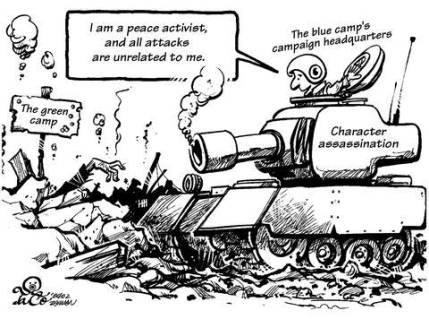
Now those involved in "black gold" politics are trying to influence the presidential election by helping the Lien-Soong ticket to win power.
What they are aiming for is a safe return to Taiwan and freedom from prosecution.
Instead of trying to sabotage Chen Shui-bian's campaign by utilizing Chen Yu-hao, Lien and his camp owe a fair explanation to the voters of how they would deal with people like Chen Yu-hao and whether they could root out "black gold" in the future.
Liu Kuan-teh is a political commentator based in Taipei.
-----------------------------------------
On Feb. 14, 2004 ……
Yu warns on boycott of referendum
POLLING STATIONS: Premier Yu Shyi-kun said those who oppose the Cabinet's plans should consider the legal implications of their actions
By Lin Chieh-yu, STAFF REPORTER
Premier Yu Shyi-kun yesterday issued a stern warning to opposition politicians and local governments to neither defy the Cabinet's referendum plan nor to mobilize voters to boycott the referendum.
"Those who try to violate the central government's policy should understand what results they might have to face, especially the legal repercussions," Yu said in an interpellation session in the Legislative Yuan.
"The decision to have the presidential and referendum ballot boxes in one station was made out of consideration to voters' convenience, and to save money," Yu told lawmakers.
"If we separate polling stations, it would cost the government NT$83 million," he said.
Yu said that in other countries presidential and referendum ballot boxes are usually grouped. He said people should not oppose the issue out of self-interest.
The premier also asked the pan-blue camp not to instigate public opposition to the referendum.
"Those who are preparing to gather in front of the polling stations to discourage voters from taking part in the referendum will be punished," Yu said.
The Central Election Commission (CEC) has agreed to implement the Cabinet's policy that the voting for the referendum and presidential election should be held in the same polling station, but two local governments have decided to adopt different mechanisms to that proposed by the central government.
Maioli County yesterday announced plans to prepare two voting stations, one for the presidential election and the other for the referendum.
"The referendum and the presidential election are two different events, which are regulated by different laws. We must be careful not to make any mistakes, which could cause conflicts and lead to a riot," said Ku Chen-ching, chairman of the Miaoli County Election Commission.
Ku said that security personnel who have been assigned to handle the March 20 voting are opposed to the Cabinet's plan because they are worried about being attacked if the counting of ballots were to be delayed.
"We must seriously recognize the risk of ballots being misplaced and miscounted. The Cabinet never asked our opinion and did not respect our suggestion," Ku said.
Meanwhile, Yunlin County's Election Commission yesterday denied allegations that it had decided to follow Miaoli County's example, saying that the commission would consult with grassroots leaders before making its final decision.
Commenting on Miaoli County's plans to separate the polling stations, CEC Chairman Huang Shih-cheng yesterday urged all local governments to abide by the regulations put forth by the CEC.
However, Speaker of the Legislative Yuan Wang Jing-pyng said that the majority of voters, as well as the Chinese Nationalist Party (KMT)-People First Party (PFP) alliance, support the idea of separating the polling stations.
The Democratic Progressive Party (DPP) urged Miaoli County not to boycott the referendum, saying that separating the polling stations was more likely to cause social and political chaos.
"The pan-blue camp should not encourage local governments to oppose to the central government in order to harvest ill-gotten political gains from the elections," DPP legislative caucus leader Tsai Huang-liang said.
Tsai said the real reason for the opposition alliance's proposed separation of polling stations was that they are worried that the referendum would benefit the DPP.
"The KMT-PFP alliance is trying to reduce the significance of the referendum and sever the relationship between the referendum and the presidential election," Tsai said.
-----------------------------------------
On Feb. 14, 2004 ……
Referendum provokes discussion
`For those of the public fed up with the war between the pan-green and pan-blue camps, the peace referendum will give undecided voters a channel for participating in public policy issues outside of the presidential election.'
By Lai I-chung
President Chen Shui-bian's proposal to hold a referendum on March 20, based on the rights included in Article 17 of the Referendum Law has caused concern domestically and internationally. Among all the explanations and criticisms of Chen's motives, we can find two main points.
The first is that the peace referendum is simply a way to win more votes in the presidential election. But if this is the case, then there will be no following-up on the referendum after the presidential election is over, since there will be no more concern for winning the election, and following up on the referendum would then be superfluous.
The second point is that holding the
peace referendum is only an attempt at manipulating public opinion in order to
expand the government's ability to set the political agenda. But this point is
contrary to the traditional criticism that the political elite is shirking
political responsibility. Both these criticisms are thus logically flawed.
The dust of the international dispute following the decision on the peace referendum questions has settled.
This incident, however, has revealed two issues that should be given attention when considering security in the Taiwan Strait: understanding what maintaining the status quo means and with whom the power to interpret that meaning lies; and the impact of Taiwan's democratization on the US-China-Taiwan relationship.
The US, China and Taiwan are still trying to adapt their different understandings of what the status quo entails to the new reality of Taiwanese democracy. The three parties have used the dispute incited by the peace referendum to communicate their ideas concerning these issues. Although short-term disputes may lead to setbacks, they are in fact beneficial to the long-term stability of relationships. In this sense, the peace referendum should help establish further trust between the three parties.
The current criticism that the peace referendum is illegal, that it creates cross-strait tensions and that it affects mutual trust between the US and Taiwan is in fact mixing up the issue of legitimacy arising out of different understandings of the status quo with the issue of legality arising out of the question of whether there is a legal basis for holding a referendum. This mix-up implies that the critics have no intention of dealing with the habitual neglect of the issue of Taiwan's democracy that has existed in the US-China-Taiwan relationship in the past.
Since the question of whether the referendum is appropriate will and should be answered through public participation, we cannot let politicians renounce it based on their own legal interpretations and electoral considerations.
Even though the meaning of the two referendum questions needs to be clarified, there is ample room for political discussion. The missile defense referendum will in reality involve public debate on security strategies and national defense policies, and the debate over the budget, now stuck in the Ministry of Defense and the legislature, will get a higher profile, and this will help establish public awareness of national defense affairs and psychological defense.
The referendum on negotiations based
on equality will in reality place the people on the front lines of cross-strait
policy and national positioning. Since the final decision rests with the
public, the result of the referendum will set the scope of future cross-strait
negotiations, bring transparency to cross-strait affairs and separate the
ethnicity issue and the national identification issue from each other.
Because the national identification issue will be dealt with through the referendum, it will gradually be separated from campaign politics, which will make room for rational discussion concerning cross-strait affairs and help deal with the ethnicity issue.
The referendum will lead to a systemization of public participation in decision-making, thus forcing the international community to face the demands of the people.
The experience and results of the referendum will set an example for Northeast Asia, where Japan is attempting to amend its constitution through a referendum and South Korea is facing the difficulties of a minority government.
For Southeast Asian nations faced with a regressing democracy, Taiwan's use of the referendum to solve the government's efficiency problems attached to democratic governance will be an important experience to learn from. These factors are all positive for the progress of democracy in Southeast Asia and for promoting Taiwan's international standing.
For those who are fed up with the war between the pan-green and pan-blue camps, the peace referendum will give undecided voters a channel for participating in public policy issues outside of the presidential election.
Some therefore want the presidential candidates to offer some "beef," while others want to block the politically beef-laden peace referendum because they believe it will affect the presidential election. The contradiction inherent in this kind of logic is incomprehensible.
Let us return to the basics of the referendum issue and use this, our first, opportunity to hold a referendum to engage in meaningful social debate.
Lai I-chung is the director of foreign policy studies at the Taiwan
Thinktank.
-----------------------------------------
On Feb. 14, 2004 ……
-----------------------------------------