20040215
=======
Treat China as an enemy on Feb. 15, 2004 ……
Lee advises treating China as an enemy
HOT WORDS: Until China renounces its military threats against Taiwan it should be seen as an enemy nation, the former president told a forum in Taichung yesterday
By Debby Wu, STAFF REPORTER
Taiwan needs a new constitution to reflect its current sovereign status, clarify its political structures and define its relationship with China, former president Lee Teng-hui said yesterday.
Lee was speaking in Taichung at a forum held by the thinktank Taiwan Advocates to promote the drafting of a new constitution.
As well as the new constitution the forum also discussed referendums and the importance of preventing Taiwan from regressing politically by allowing old and discredited political forces to make a comeback.
In his opening speech Lee said that the forum was meant to enlighten people about their own rights as the bosses of the country and about Taiwan's current status, to consolidate the value of Taiwan's sovereignty and the notion of "Taiwan First," to define the roles of Taiwan and China clearly and to define the hostility of China toward Taiwan.
Lee said that Taiwanese should use three core principles in defining their relationship with China: first that Taiwan and the People's Republic of China are two separate countries which do not belong to each other; second, the confirmation of "Taiwan First," ie, thinking from a nationalist perspective centered on the interests of Taiwan; third, counting China as a hostile country until it renounces its military threats against Taiwan.
Much of the discussion of the need for a new constitution centered on the lack of clarity about who should actually govern in Taiwan's semi-presidential system.
"Taiwan is a political system neither led by the president nor by the Cabinet. The president cannot dismiss the legislature when the legislature is running amok and vice versa," Lee Hung-hsi said.
He said it was necessary to draft a new constitution because it was impossible to amend the current one.
"To have the Constitution amended, regulations require that the amendment has to be proposed by at least one fourth of the legislators, at least three-fourths of the legislators have to be present at the session and at least three-fourths of the legislators present at the session must support the amendment. But with the Chinese Nationalist Party (KMT) dominating the legislature, any amendment is destined to fail. So we can only resort to making a new constitution," he said.
Lee Hung-hsi pointed out that the current Constitution was written in 1946 and promulgated in 1947 in China. It reflected the needs of China, and it had nothing to do with Taiwan. Taiwan needed a constitution of its own, he said.
"Someone has even been saying amending the Constitution would cause chaos in the country, but even China has amended its Constitution in the past and we didn't see Chinese people running amok after that," he said.
According to Chen Po-chih, chairman of Taiwan Thinktank, the KMT was trying to preserve the current Constitution to enable it to hold on to power at some level.
"Several years back when I was involved in amending the Constitution, I dined with a politician from a certain party who was also involved in the process. I asked that politician why his party supported a political system with two heads and two legislatures. That politician explained that his party did so because if the party lost the presidency, then it could still control the Cabinet; if the party lost the Legislative Yuan, then it could still continue to control the National Assembly," Chen said.
Ruan Ming, a Chinese visiting professor at Tamkang University, attacked KMT without reservation.
Ruan said that Lien Chan, the KMT's chairman and pan-blue alliance presidential candidate, had said that the march election was an election about war and peace. Lien wanted to cash on people's fear of the threat posed by China to win the election. Meanwhile, China was threatening Taiwan, but using a different method, Ruan said.
"China had ceased to use external threats and turned to manipulating Taiwan's internal struggles instead, turning Taiwanese against Taiwanese. China has come to realize its military threat is useless, and the old political power in Taiwan is useless. Only by combining the two can China achieve what it wants. So what China wants this year to install Lien Chan as Taiwan's president," Ruan said.
"Making a new Constitution, meanwhile, is to allow Taiwan's fate to be controlled by Taiwanese people instead of by those who oppose Taiwan's independence. This is our mission," he said.
"We are not pan-blue nor pan-green. We are pan-Taiwan. We are pure Taiwanese while Lien Chan is pure Chinese," he said.
Ruan's fellow countryman, Chinese dissident writer Cao Chang-ching was also unreserved in disparaging the Lien-Soong ticket and China.
Cao pointed out that the pan-blue camp's stress on "One China" was advantageous to China but hurtful toward Taiwan.
"Lien supports and stresses the notion of `One China,' and says there is only one China, and it is the Republic of China. But he cannot deny there is another country called the PRC. He said he wants to put aside the issue of sovereignty, but that actually means he gives up Taiwan's sovereignty. Where else can you find a presidential candidate who abandons the sovereignty of his country?" Cao said.
"Added to this, the [Chinese] Communist Party supports the Lien-Soong ticket and we cannot support candidates supported by the Communist Party. We should use our ballots in this election to show the whole world that Taiwan is not a part of China, but a part of the whole world, and Taiwan belongs to Taiwanese," Cao said.
Cao also mocked Soong: "US Democratic hopeful Howard Dean is losing his nomination campaign due to his `I have a scream' speech because Americans cannot accept an overemotional person to be their leader. On the same basis, Americans would surely not accept a person like James Soong, who frequently kneels down and begs in front of the public, to be their leader. If Soong gets emotional when he goes to meet Jiang Zemin in Beijing and kneels, it would not be a small matter," he said.
Chin Heng-wei, a political commentator and editor in chief of Contemporary Monthly magazine, said that the current Constitution and the Republic of China have become myths now.
"Former President Lee Teng-hui has said that the Republic of China no longer exists, but still some people are saying that name, together with the Constitution, exists. These two things have become myths, but Roland Barthes writes that `the myth is a semiological system which has the pretension of transcending itself into a factual system,'" Chin said.
"If the Chen-Lu ticket wins again this year, then certain things are destined to happen: first, KMT has to be Taiwanized then, following the KMT's name change, China's theory that the issue of Taiwan is the continuation of a domestic struggle between the Communist Party and the KMT will collapse. China will lose on its claim on Taiwan," Chin said.
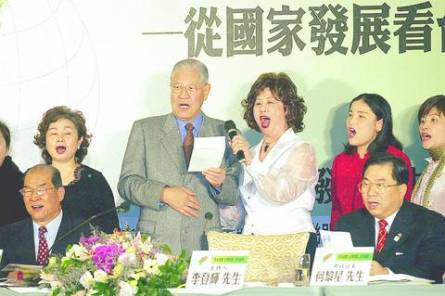
Former president Lee Teng-hui sings in chorus at a seminar held by Taiwan Advocates to promote the drafting of a new constitution in Taichung yesterday.
-----------------------------------------
On Feb. 15, 2004 ……
Referendum is a matter of international law
By Li Ming-juinn
The legal basis for referendums can be divided into the following categories: international law, constitutional law and local autonomy law.
A referendum means citizens making decisions by direct vote.
In a broader sense, therefore, elections are also a kind of referendum. The difference is that elections are held to elect people while what are generally called referendums are held to decide on issues.
Referendum laws are domestic; their status is below that of constitutional laws. Referendum laws are not the legal basis for direct people power. At best, referendum laws are legal regulations for implementation procedures.
First, the legal basis for referendums involving international issues such as a country's sovereignty, independence or the ceding of territory -- such referendums are also called "plebiscites" -- comes from international law. It is a supra-constitutional right. Sometimes a country has not even been established when this right is exercised.
Certainly, in such situations, one does not need to rely on domestic legislation or incorporation of the right to referendums into a constitution. Besides, this is a right that no domestic law can eliminate.
The right to self-determination is a basic supra-legal human right. Its scope includes sovereignty, the freedom to decide on political structures and independence in terms of economic resources and so forth. Referendums are one of the concrete ways to express this right.
After the 18th and 19th centuries, referendums were frequently held in Europe to gauge the residents' wishes regarding the ceding and merger of territories.
After World War II, all the so-called "dependent territories" -- many territories of uncertain jurisdiction, non-self-governing territories, trust territories, protectorates and so on -- decided on their national status by referendums held under the supervision of concerned countries and the UN Trusteeship Council.
The referendums on independence held in the three Baltic nations, Canada's Quebec Province and East Timor, as well as Australia's referendum on setting up a new republic, belong to this type. The timing of such referendums can be determined entirely by governments according to the circumstances.
Second, constitutional-level referendums are called "referendums." They primarily mean the entire citizenry, by way of a vote, decides on constitutional changes, national laws or policy issues. As a rule, such referendums are regulated by constitutional provisions. They are normal systems within constitutional frameworks, and their exercise is national in scope. Switzerland incorporated referendum rights into its constitution in the early days of the 1848 federation. The country has held more than 400 referendums so far.
In Japan, constitutional amendment proposals and the review of supreme court justice candidates must be confirmed by national referendums.
Also, while Taiwan has been discussing the referendum issue, Rwandan citizens were recently holding a referendum on a draft constitution.
In Taiwan, constitutional-level referendums have long been incorporated into constitutional provisions. They have not been practiced for more than 50 years because of executive and legislative negligence. It is not that the citizens have no such right.
In 1993, Japan proposed a referendum law that still has not been passed today, but Japan has held many referendums since the post-war constitution went into effect.
Third, referendums on the local autonomy level (also called "residents' votes") mean that local self-governing organizations and residents, by way of direct democracy, decide on laws and policies specific to that locality. Normally they can be held by way of local self-governance regulations, but they are generally also regulated by constitutional or local autonomy laws in order to verify their legal force. Referendums on local public policies such as setting up incinerators or landfills belong to this type.
Referendum issues involving international law do not need to have domestic constitutional laws and statutes as their legal basis. One can find their basis directly in international law. The legal basis for referendums in international law primarily includes: self-determination, treaties and resolutions by international organizations.
In the relationship between international and domestic law, one does not need to consider whether the referendum on the international law level has any basis in domestic law as long as it is compatible with the principles of international law. This is because the international community has widely adopted the view that international law is superior to domestic law.
Self-determination is the legal basis for national independence, but self-determination is not necessarily exercised by referendums. When a people adopts the referendum method to exercise their right to self-determination, such a referendum is directly related to independence. It is an important procedure in achieving independence.
In this sense, any arrangement or decision concerning a change to the status quo must be decided upon by the entire people. No strong power, government, party, organization or individual can take away or limit such a right. Referendums held on the basis of this right are "plebiscites," which belong on the level of international law.
In comparison, if a referendum is not used as a basis for national independence, but merely to confirm the legality of national status, then such a referendum does not change the subjective status quo even though it in a sense involves sovereignty issues. Instead, it is an act of a political nature.
Therefore, the word "referendum" is used here. The true basis for independence in this case is the self-determination that has long been exercised.
Li Ming-juinn is an assistant research fellow at the Institute of
International Relations, National Chengchi University.
-----------------------------------------
On Feb. 15, 2004 ……
-----------------------------------------
On Feb. 15, 2004 ……
-----------------------------------------