20040216
=======
Lee stressed on Feb. 16, 2004 ……
Lee stresses importance of exercising voting rights
"Let's say `no' to China's threat of invasion and say `yes' to peace with our referendum ballots." --- Lee Teng-hui, former president
By Jewel Huang, STAFF REPORTER , IN KAOHSIUNG
Former president Lee Teng-hui yesterday urged the people of Taiwan to voice their loathing of China's missile threat and their love for peace by exercising their voting rights in the forthcoming referendum, stressing that the referendum is the most effective way to create a new constitution for Taiwan.
Lee made the remarks at a forum held by the think tank Taiwan Advocates in Kaohsiung yesterday. Since the beginning of the month, the organization has held two forums around the nation to preach the importance of the referendum and the need for creating a new constitution for Taiwan. The last forum will be held in Hualien on Saturday.
"A constitution guides a nation's direction of development in the long term," said Lee in his speech. "However, the existing Constitution was not made for Taiwan nor was designed by the people of Taiwan. It is not suitable for Taiwan at all and is full of contradictions," Lee said.
"Only by creating a new constitution can Taiwan be fundamentally transformed into a normal country," Lee said.
Lee urged people to show their resolution to set up a new constitution for Taiwan and denounce China's military menace by voting in the referendum and presidential election.
"Let's say `no' to China's threat of invasion and say `yes' to peace with our referendum ballots," Lee said.
"Also, say good-bye to those conservative and reactionary forces," he said.
With the subject "What is the range of the Republic of China's territory -- a probe into Taiwan's need for a new constitution from the perspective of a nation's orientation," yesterday's forum held at the Kaohsiung Girls High School attracted more than 1,500 Kaohsiung residents. Nine speakers delivered their views on the topic and earned warm applause from the audience. Constitutional expert Lee Hung-hsi and Shih Cheng-feng, a professor in Tamkang University's department of public administration, also talked about the schedule of creating a new constitution for Taiwan.
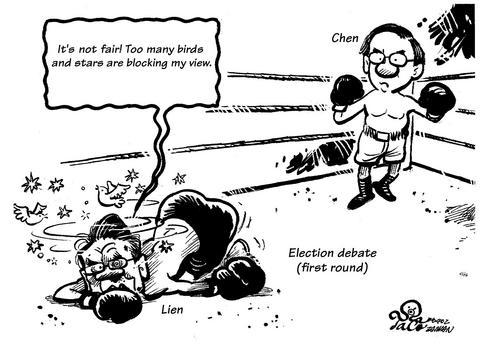
One of the forum speakers, Cao Chang-ching, a political commentator who is a New York-based Chinese dissident, said Chinese Nationalist Party (KMT) Chairman Lien Chan's remarks about Taiwan's national orientation during Saturday's televised presidential-candidate debate were "illogical" and "absurd."
Cao said that Lien defined the so-called "one China" as "the Republic of China" and said "that's where we live and grow up" during the debate.
"What Lien said is totally out of touch with reality," Cao said.
"Lien does not only deceive himself but also the people of Taiwan," he said.
Cao said it is illogical for Lien to suggest postponing the dispute over the country's sovereignty yet increase cultural exchanges between the two sides.
"Strangely enough, if the Republic of China is an independent country like Lien has been claiming, why should Taiwan postpone the dispute over its sovereignty? It is an argument that doesn't work," Cao said.
"Saying postponing the dispute over sovereignty is to actually give up the sovereignty. I don't believe that you will accept this," Cao told the audience.
After watching the TV debate, Cao said he was convinced that Taiwan's future and interests would only be hurt if Lien was elected president.
"Lien failed to propose clear and effective policies for Taiwan and his stand about Taiwan's orientation will only deepen China's illusion that Taiwan is part of its territory. It will put Taiwan in a more dangerous position," Cao said.
He received a standing ovation from the audience.
Stephane Corcuff, a political professor from the University of La Rochelle, who teaches Taiwan politics in France, said that China is unable to accept the fact that the people of Taiwan have shifted their national identity.
"However, it is a change that never stops," he said.
"I think it is important to realize that the biggest problem between China and Taiwan is the problem of national identity," he said.
"I hope that the textbooks used in Taiwan's schools will teach your students more about your own history," said Corcuff, who last month published a book in Chinese about the national identification of mainlanders in Taiwan.
Lee Teng-hui, along with participants and forum speakers, joined hands and rehearsed the "228 Hand-in-Hand Rally" which will be held on Feb. 28. The human chain formed a circle in the shape of Taiwan on the school's playground and participants shouted "believe in Taiwan, stick to reform."
-----------------------------------------
On Feb. 16, 2004 ……
Presidential election, Hong Kong give China a headache
DEMOCRACY AVERSE: Beijing fears a scenario in which Hong Kong produces an equivalent of Chen Shui-bian who would drive the territory toward independence
AFP, Beijing
Taiwan's presidential elections and Hong Kong's democratic stirrings are creating an unsettling problem for China, which is anxious to keep a lid on any moves toward independence, analysts said.
The nightmare scenario as seen from Beijing is for Hong Kong to eventually produce an equivalent to President Chen Shui-bian.
China also fears that democracy in its autonomous enclave Hong Kong will inspire similar aspirations in mainland cities, where economic reforms have created a powerful new elite and growing middle class.
"They really are concerned about the people in Hong Kong electing somebody that could move toward independence," said David Zweig, a political scientist at the Hong Kong University of Science and Technology.
"I don't think it's going to happen. People seem to be realistic here. But that seems to be one of China's fears," he said.
Those fears were made obvious this week, when a Hong Kong task force visited Beijing to seek the government's views on possible universal suffrage in the autonomous enclave by 2007.
After three days of meetings, Beijing made it clear that democracy would have to wait.
Hong Kong's autonomy means
"self-governing under the authorization of the central government,"
the official Xinhua news agency declared, implying the Chinese government would
have the final say on political change.
Statements like this will not go
unnoticed by Taiwan's voters, who are only too aware that the "one
country, two systems" formula adopted when Hong Kong reverted to China in
1997 was originally coined in order to get Taiwan to accept unification.
Even so, Hong Kong's situation is unlikely to have much impact on Taiwan's neck-and-neck presidential race between pro-independence and pro-Beijing parties.
The public knows that China's watchword for Hong Kong is stability, according to Wu Nengyuan, head of Taiwan research at the Fujian Academy of Social Sciences.
"So basically this won't affect Taiwan's attitude toward reunification and the `one country, two systems' policy," he said.
Taiwan's public may also not equate their own situation with that of Hong Kong.
"`One country, two systems' has no appeal to the Taiwan people anyway," said Joseph Cheng, a China watcher at City University of Hong Kong. "If there is no reform in Hong Kong, people in Taiwan won't be surprised."
But even if Taiwan were not such a major problem for the Chinese government, Hong Kong would still be a top agenda item, according to observers.
From Beijing's perspective, a fully democratic Hong Kong could have dangerous implications for the mainland.
If Hong Kong can enjoy democracy, China's increasingly sophisticated urbanites might begin to ask questions about some of China's cities where living standards are rapidly approaching those of their wealthy southern neighbor.
The problem is made all the more complex for the Chinese leadership because of the intense international scrutiny of Hong Kong, severely limiting its scope of action.
China took control of Hong Kong from Britain in 1997, since when the territory's problems have steadily multiplied.
It is still uncertain whether the new leaders who took over the reins in China last year will be any better than their predecessors at handling these issues.
"We can only say they haven't shown the political will yet to push for political reform," Cheng said.
-----------------------------------------
On Feb. 16, 2004 ……
Referendum demanded over Chavez
PETITION: Tens of thousands of protesters, armed with 3.4 million signatures, wanted the National Electoral Council to allow them to vote on the president's future
REUTERS , CARACAS, VENEZUELA
Tens of thousands of opponents of Venezuelan President Hugo Chavez marched through Caracas on Saturday to press election officials to accept their petition for a referendum against the leftist leader.
Waving flags, banners and copies of their petition signatures, protesters streamed along a highway in the capital to demand the National Electoral Council allow them a chance to challenge Chavez at the ballot box this year.
Opposition leaders fear that Chavez sympathizers in the council are trying to scuttle their referendum campaign in the latest political battle over his five-year presidency.
"We have to march to defend our signatures. We don't trust the electoral council and this is our only recourse, to protest," said Guillermo Goitia, a local opposition party representative.
Several thousand National Guard troops backed by armored vehicles along the route kept opposition protesters away from pockets of jeering Chavez sympathizers.
A huge popular market set up by the government blocked the march path to the council headquarters in downtown Caracas.
After two years of conflict over the Chavez government, the opposition now hopes to vote out the former army officer whom they portray as a would-be dictator bent on turning Venezuela into a Cuba-style communist state.
The National Electoral Council has said it will announce on Feb. 29 whether the opposition handed in the 2.4 million valid signatures required to call a presidential referendum.
But setbacks in the verification process and accusations of fraud inside the council have stirred fears of fresh political violence in the world's No. 5 oil exporter, a leading supplier of crude oil and gasoline to the US.
Electoral authorities missed a self-imposed Feb. 13 deadline to announce the results of their checks, sparking opposition anger.
Chavez has battled increasing opposition to his self-styled revolution for the poor after surviving a brief coup in 2002. But he says most Venezuelans back his social reforms aimed at more fairly distributing the nation's huge oil wealth.
The president vowed on Friday he would go to the supreme court to challenge any ruling allowing a referendum. He says the opposition petition is tainted by tens of thousands of forged and false signatures.
"All Venezuela knows that this was a disaster, a fraud. There were dead people and children who signed up," pro-Chavez assembly deputy Nicolas Maduro told reporters.
A referendum could be held around May if the council decides to allow a vote. The opposition says it collected 3.4 million signatures.
One of the council's directors said on Saturday officials were discussing a proposal to clear up a dispute over how to verify signature forms filled in with the same person's handwriting, which the government has challenged.
The Organization of American States and the Atlanta-based Carter Center, which are monitoring the verification, have reported administrative delays due to the complexity of the checks.
Observers have so far not supported claims of massive fraud, but they have warned the council not to become bogged down in technicalities.
"I don't think the international
community has realized that the future of democracy in Latin America depends on
how the Venezuelan case plays out," opposition leader Julio Borges said at
Saturday's rally.
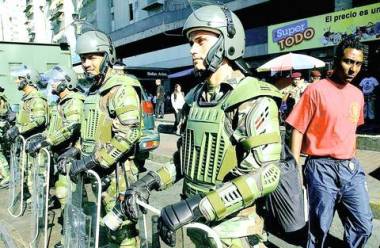
Venezuelan National Security agents guard an avenue in Caracas on Saturday near the point where demonstrators gathered to demand a referendum on President Hugo Chavez.
-----------------------------------------
On Feb. 16, 2004 ……
-----------------------------------------