20040217-2
=========
Activists on Feb. 17, 2004 ……
Activists back referendum with letter
MAKE WORDS, NOT WAR: A group of top academics and political activists led a campaign which netted over 1,000 signatures in support of the referendum
By Lin Chieh-yu, STAFF REPORTER
Over 1,000 activists signed a public letter supporting President Chen Shui-bian's referendum plan, saying that holding Taiwan's first referendum will be a historic achievement not only for the nation but also for Asia, and it should not be obstructed for political reasons.
To gather public support for the referendum, eight prominent activists from different fields launched a signature-collection drive via the Internet last week. They held a press conference yesterday to explain their motive and introduce the results of the drive, which they also publicized with full-page advertisements in two Chinese-language newspapers.
The letter said that the first ever referendum in Taiwan "establishes a historic paradigm," "realizes the core values of democracy," "demonstrates Taiwan's collective will to the world" and "unites the people of the nation."
"Our support for the referendum is not equivalent to our supporting any particular political party or presidential candidate," said women's rights activist Lee Yuan-chen, who was one of the eight organizers of the campaign.
"While the political parties are only considering their campaign interests in regard to the referendum issue, we appeal to the public to focus on the significance of the establishment of Taiwan's first tool of direct democracy," Lee said.
Ku Chung-hwa, executive member of the Taipei Society and a sociology professor at National Chengchi University, said during the press conference that initiating any kind of reform came at a high price and had to conquer strong opposition.
"Once we launch the referendum mechanism, the people of the country can use it to solve deadlocked issues, such as educational reform, constitutional reform, or halving the Legislative Yuan," Ku said.
Ku said that the establishment of the referendum helped to normalize Taiwan's democratic system and therefore, "the content of the first referendum, or the wording of the question, is not the crucial issue."
Academia Sinica sociologist Michael Hsiao, another organizer behind the letter, said that for the time being, over 4,000 people had joined the signature drive, and to seek more support for their idea, they were preparing to take their campaign to campuses and townships.
"The second referendum we expect to implement is to ask people how to accomplish legislative reform, specifically whether or not to halve the number of seats in the Legislative Yuan," Hsiao said, adding that the topic was endorsed by almost everyone in Taiwan, but had been boycotted by politicians.
"Academic Sinica President Lee Yuan-tseh will display his support for the referendum in the near future," Hsiao said.
The other five organizers of the signature drive are Huang Wu-hsiung, Lee Ming-liang, former Department of Health director-general, Allen Houng, professor of the Institute of Neuron Science at National Yang-Ming University, John Chen, president of the Judicial Reform Foundation, and Chang Chung-cheng, president of National Sun Yat-sen University.
The pan-blue camp immediately criticized the signature drive, saying it was organized by pro-green scholars and that the letter did not represent the real voice of academic and professional circles.
"The content of the public letter is absurd, as if it were just an article written by an elementary-school student," said the Chinese Nationalist Party (KMT) spokesman Alex Tsai. "If the referendum brings any problems to the nation, those who signed the letters should shoulder the responsibility."
The Democratic Progressive Party (DPP) defended the letter, saying that its signatories made their decision in accordance with their ideals, rather than their political stance, and they should therefore not suffer having their beliefs being belittled by the KMT.
"The pan-blue alliance owes an apology to those people," said DPP presidential campaign headquarters spokesman Wu Nai-jen.
-----------------------------------------
On Feb. 17, 2004 ……
Human-chain rally gathering steam
OVERWHELMING SUPPORT: The organizers of the 228 Hand-in-Hand Rally said they have already exceeded the number of registered participants they had planned for
By Chang Yun-ping, STAFF REPORTER
The chief organizer of the human-chain rally that is slated to take place on Feb. 28 announced yesterday that the event has so far received overwhelming support nationwide, with the number of scheduled participants exceeding 1 million.
Democratic Progressive Party (DPP) Deputy Secretary General Lee Ying-yuan, chief event planner for the "228 Hand-in-Hand Rally" yesterday said "the event has come a long way in summoning the passion and support of the Taiwanese people to join the rally. The current count of registered participants has exceeded 1 million, and now we are looking forward to seeing this number grow to 2 million."
Giving a report on the progress of the rally, Lee said the quick surge in the number of participants has cheered the morale of the organizers, but has also made transporting the throng of participants an acute problem.
Lee said there are about 9,000 buses available in the country, but even that number would be insufficient to carry all of the participants.
"We hope people can use all kinds of transport, including bicycles, motorcycles, cars or even walking to support the activity," Lee said.
Supporters of the rally, which is being jointly organized by the DPP, Taiwan Solidarity Union and hundreds of private groups advocating Taiwanese independence gathered yesterday in Taipei to appeal for lasting peace, freedom and democracy and to oppose China's aiming of missiles at Taiwan.
Annie Lee, the daughter of former president Lee Teng-hui, yesterday addressed supporters, saying that the core purpose of the event was to enable people to re-examine the meaning of Taiwan's existence and learn to make a choice for themselves.
She said the Chinese Nationalist Party (KMT) in the past five decades has educated people to believe many things that are irrelevant to the well-being of Taiwan, including asking people here to retake China, to build a prosperous China and to liberate the Chinese people living in dire conditions under the rule of the communist party.
"But these demands are irrelevant, vague and unreal to us. To many of us here, the idea of China -- this so-called motherland -- is very vague, and we don't know what it looks like. What is real to us is the land that we stand on and live in. That is what we care about," Lee said.
She said the event aims to invite people to redefine their national identity, to demand China respect Taiwanese people's will and to let the world understand that the people of Taiwan are not the pawns of the Chinese.
Urging more people to attend the rally and to write a new chapter in Taiwan's democracy, Lee reminded supporters to bring three gadgets with them on the day of the rally: cellphones, digital cameras and radios.
The rally will span 500km in length along the north-south provincial highways on the west coast, from Keelung County to Pingtung County. All participants are expected to hold hands at 2:28pm on Feb. 28.
Participants are encouraged to use cellphones to spread text messages about the event, while the digital cameras will be used to keep photographic records which will then be published online to be viewed worldwide. Information regarding the rally will also be broadcast on the radio.
National Policy Adiser Alice King, a veteran overseas Taiwan independence activist from Japan, said yesterday that many Japanese have been supportive of Taiwan embarking on a movement to build their own nation, as they believe support of Taiwan's democracy and independent status from China are crucial to Japan's interests.
"Eighty-five percent of Japanese agree that Taiwan's remaining a democratic and free country and not becoming a part of China are very important to Japan. Japanese are actually more concerned about whether Taiwan could insist on walking its own road and not be swallowed by China. Because if that happens, Chinese naval power can penetrate the Western Pacific, which would endanger Japan's security," King said.
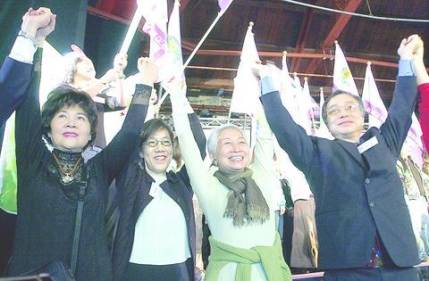
Co-organizers of the Feb. 28 human-chain event join hands and shout slogans during a preparatory rally at Taipei's Red House Theater yesterday.
-----------------------------------------
On Feb. 17, 2004 ……
Dull-witted Lien Chan gives the game away
By Chin Heng-wei
Chinese Nationalist Party (KMT) Chairman Lien Chan's performance in front of the cameras during the televised election debate was as expected -- unbearably miserable.
He was boring, which is fine, but more seriously, he didn't know what he was talking about and he gave evasive answers.
Lien, called "upright and noble" by some, was ill at ease and showed a complete lack of composure during the two-hour debate.
Clicking his tongue, breathing heavily, standing listlessly and with a dull-witted look on his face at times, he couldn't even keep himself from yawning.
Is Lien getting old, or is this who he really is?
This first performance in a debate by Lien, who has never revealed his true colors to voters, disappointed us deeply.
Little wonder, then, that the pan-blue camp was afraid to accept the debate challenge when it was negotiating with the media.
Generally speaking, a party in power hopes to minimize, or best of all, completely avoid electoral debates, while the opposition -- the challengers -- want as many debates as possible.
The strange thing in our current political situation is that the pan-blue opposition does not want to debate.
Instead, it is the Democratic Progressive Party that has been pushing forward, eager for more debates.
In the end, Lien is not a fighter and he crumbles as soon as there is a fight.
Being forced on stage in this way, like a lamb to the slaughter, must be hard on Lien.
If People First Party Chairman James Soong hadn't left the KMT before the 2000 presidential election, Lien would have been elected president and he wouldn't have to endure his current humiliation, making a fool of himself for everyone to see.
Incredible as it may seem, Lien once served as vice president, foreign minister, minister of transportation and communications, Taiwan provincial governor and, concurrently with his position as vice president, premier. His power at the time was second only to that of the president.
There was no obligation back then for fair and open debate. In 2000, Lien adamantly refused to participate in any kind of debate, and now he has come to this.
During the Chiang family dictatorship, Lien was merely a minister. He was arrogant, and no one dared suggest that he go to the Legislative Yuan for interpellation sessions, nor were journalists allowed to interview him.
During former president Lee Teng-hui's years in power, Lien deferred to him and didn't dare gainsay him -- but then again, he never achieved anything.
In other words, the public only knew that Lien was born with a silver spoon in his mouth.
And although there were no obvious meritorious achievements furnishing his past, there was the impression of "a premier for peace and prosperity."
But what does he believe in? Is he a capable man? In what direction do his policy ideas point? What is his political philosophy?
No one knows for sure, and no one understands.
Thanks to the presidential election, Lien has now revealed all for the people to see.
In one-on-one debates there are no shortcuts, no winning through sheer numbers, no hiding stupidity.
For Lien, who probably has had to do nothing on his own except go to the toilet, this is his first tough fight.
And as a result, everyone now knows who he really is.
Chin Heng-wei is editor in chief of Contemporary Monthly magazine.
-----------------------------------------
On Feb. 17, 2004 ……
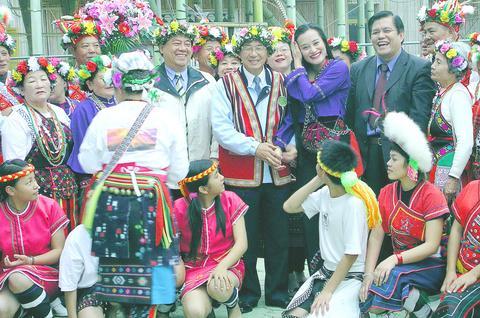
Getting Folksy
President Chen Shui-bian, center, and other officials pose with acclaimed Puyuma folk singer Samingad, third right, and members of the community during a campaign stop in the Puyuma Aboriginal village of Nanwang in Taitung City yesterday.
-----------------------------------------
On Feb. 17, 2004 ……
-----------------------------------------
On Feb. 17, 2004 ……
The EU is Taiwan's friend, for now
By Hao Pei-chih
The EU recently vetoed a proposal to lift the arms-sales embargo against China and signed a proposal calling on China to remove the missiles targeted at Taiwan. However, during the recent visit by Chinese President Hu Jintao, French President Jacques Chirac tried hard to curry favor with China by expressing opposition to Taiwan's referendum.
These entirely different and conflicting phenomena have reminded us that we should pay attention to significant changes in the EU's China policy. Among them, several developments are worthy of our attention.
The EU is attempting to make China one of its global strategic partners. This policy has been directed and formulated by a few core countries such as France, Germany and Italy. Last October, France and China even agreed to develop an all-round strategic partnership. France's attempts to sway the EU's China policy are quite evident.
The partnerships established between the EU and China to rival the US' unilateralism in dealing with global affairs have had several obvious consequences.
For example, some countries in the EU as well as China opposed using military force against Iraq.
Also, when the euro was launched, China promised to convert 40 percent of its foreign exchange reserves into the euro and emphasized the necessity of pluralizing global currencies.
Finally, in the Sino-EU summit meeting held recently, both sides decided to expand economic cooperation and set a target trade volume of 200 billion euros by 2010.
What deserves our special attention is the new triangular relationship taking shape between the EU, China and ASEAN. This is evident in the conference attended by European financial ministers last September when the trio jointly refused to support US attempts to pressure China on the yuan.
However, the EU has yet to map out consistent policies toward China, especially regarding human rights and China's relations with Taiwan. On the contrary, contradictory policies are currently being formulated within the bloc.
Among the EU's internal organizations, the EU Commission tends to forge alliances with China. But the European Parliament chooses to boycott China on grounds of its human rights abuses. Recently it even passed several resolutions friendly to Taiwan.
The policy shift integrating politics with economics has led to a more divided China policy inside the EU. The EU used to adopt a pragmatic policy that separated human rights from trade. But in recent years the European Parliament demanded these two issues be linked, emphasizing that China must improve its human rights record before the EU will consider lifting the ban on arms sales to China.
In the past, the EU insisted that the bottom line was to maintain peace and military balance between Taiwan and China. However, several European countries appear to be using Taiwan-China relations as a political bargaining chip in exchange for economic interests. What France did this time serves as an example.
The French government wants to act as a vanguard in the EU to win over the biggest share of business opportunities China may allocate to Europe.
Even though China will become the center of the EU's East Asia policy, Taiwan need not challenge or fear the EU developing global strategic partnerships with China.
Instead, it should persuade the EU to
play a neutral role and a mediator in cross-strait relations, and push the
union to de-link its global strategic planning from Taiwan-China relations.
Taiwan must persuade the EU that it can protect its economic interests without
giving in to China on cross-strait relations.
Nor should Taiwan overly fear
France's unilateral tilt toward China. But the government must closely observe
as China policy becomes an important diplomatic agenda for the EU. As long as
the EU does not draw up policies that jeopardize the balance of power between
Taiwan and China in the short term, it is not disadvantageous to make the
Taiwan issue a focus on the European stage.
Hao Pei-chih is an assistant professor of public administration and
policy at National Taipei University.
-----------------------------------------
On Feb. 17, 2004 ……
Lien on sovereignty: Be very afraid
The nation's first televised election debate on Saturday represented a major advance for our democracy. The format of the debate was important, but even more important was the fact that it provided information on the candidates' campaign platforms, allowing voters to make an informed choice.
Chinese Nationalist Party (KMT) Chairman Lien Chan's comments on cross-strait sovereignty, however, constitute a threat to national security and are worthy of particular scrutiny.
Lien said: "Our stance is very clear. The two sides [Taiwan and China] should set aside the issue of sovereignty, increase exchanges and interaction, accelerate economic development and improve the livelihoods of the people. If we must talk about `one China,' then `one China' means the Republic of China."
Lien's plan to set aside sovereignty -- as a basis for cross-strait interaction and increased exchanges -- is dangerous. Sovereignty is a composite concept that includes a country's territory, people, constitution and so on. When a nation sets aside its sovereignty, in even the most innocuous context, it enters a vacuum in which the human rights and property rights of the people as well as the integrity of national territory can be harmed at the very moment other countries raise differing views regarding the country's jurisdiction. A country setting aside sovereignty is equivalent to it announcing its own demise.
Sovereignty must never be set aside. One must be resolute in defending it.
Taiwan must not engage in cross-strait interaction at the expense of its sovereignty. Once it denies its sovereignty, it will in effect have raised a white flag and surrendered. It loses a basis for negotiating with China.
It is utterly reprehensible for Lien to advocate this position. The nation's 23 million people should recognize that Lien's motive for wanting to set aside sovereignty is nothing more than political victory, and that he is perfectly willing to be an agent of capitulation to bring this about.
During the 2000 presidential election, Lien praised former president Lee Teng-hui's "special state-to-state relations" dictum as a pragmatic stance compatible with cross-strait political realities. In 2001, however, Lien called for a cross-strait confederation. Last year, Lien returned to the old "one China, with each side making its own interpretation" formula. Now he is saying we should set aside our sovereignty.
During the 2000 election, People First Party Chairman James Soong, then an independent candidate, advocated "one China," which included the claim that Taiwan was part of China. In 2002, he came up with the idea of a "one-China rooftop." In 2000, Lien criticized Soong, calling him a capitulationist and a man bent on selling out Taiwan. Now Lien and Soong are running on the same ticket. How has this pair reconciled seemingly incompatible differences on cross-strait issues?
A head of state must defend his or her country's sovereignty. Otherwise, the people of that country risk being bashed to a pulp at the hands of other countries. Taiwan must elect a president who can maintain this country's sovereign status quo, and who will not allow it to be changed for the worse even under the pressure of threats or military posturing. This is the most basic requirement of a national leader, a requirement that Lien seems to scorn, or else barely comprehend.
-----------------------------------------