20040218
=======
Has no ball on Feb. 18, 2004 ……
Japan `has no balls,' Lee says
APPEASEMENT: The former president said the country's moves to placate Beijing go against traditional samurai values and highlight its weakness
By Chang Yun-ping, STAFF REPORTER
Former president Lee Teng-hui yesterday accused Japan of "having no balls," being weak and appeasing China amid its opposition to Taiwan's democratization and endeavors to gain recognition as an independent state.
Lee was speaking at an event to mark the release of the Chinese-language version of his book Bushido Kaidai, a commentary on the traditional samurai spirit.
Lee said this essential part of Japanese culture has been lost, resulting in Japan's appeasing China at the expense of Taiwan's interests.
"The old Japanese values of the samurai have long since disappeared and the Japanese have become weak. Whatever China opposes, Japan dare not say something different," Lee said.
"When China opposes Taiwan's referendum plan, Japan reacts in a fearful way and even allowed a low-ranking official of the Interchange Association [Japan's representative office in Taiwan] to secretly deliver the Japanese government's concerns."
Lashing out at Japan's bowing to pressure from China, Lee said, "The top authority of Japan may not act in an obvious way to make concessions to China, but lower-level government officials will then do something to appease China."
Lee was referring to a representative of the Interchange Association, Katsuhisa Uchida, who visited Presidential Office Secretary-General Chiou I-jen late last month to express Tokyo's dissatisfaction with the referendum plan.
Lee said Japan will act against Taiwan as compensation for its policies that irritate China.
He said Japanese Prime Minister Junichiro Koizumi's visits to the Yasukuni shrine, a symbol of Japanese militarism and a focal point for China's anti-Japanese sentiment, and a recent visit to Taiwan by former prime minister Yoshiro Mori are the main reasons why Japan is willing to grant China concessions.
Lee urged the Japanese people to restore the samurai value of honesty, adding the weakness and appeasement Japan has shown goes against the samurai spirit.
He also criticized Japan's vacillation, saying Japan's Constitution was based on the US Constitution -- the same situation Taiwan faces by using the Republic of China Constitution, which was drafted in China and brought to Taiwan in 1949.
At yesterday's book release, Lee urged the people of Taiwan to find their own cultural spirit. He called on people to insist on "Taiwan-centric" beliefs and to further efforts to build a Taiwanese identity.
The book was originally written in Japanese by Lee and was first published in Japan in 2002.
Born in Taiwan during the Japanese colonial era, the former president received a Japanese education for more than 20 years. His interpretation and observation for the book was inspired by Japanese pundit Nitobe Inazo, who completed Bushido, the Soul of Japan in 1900.
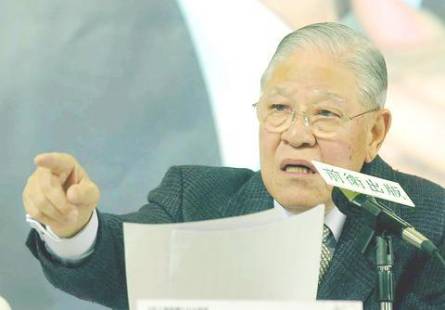
Former president Lee Teng-hui gestures as he speaks during a press conference yesterday announcing the release of a Chinese translation of his book Bushido Kaidai. Lee criticized Japan for appeasing China, saying it goes against the samurai spirit.
-----------------------------------------
On Feb. 18, 2004 ……
Taiwanese are the winners
Yang Ji-charng, Columbus, Ohio
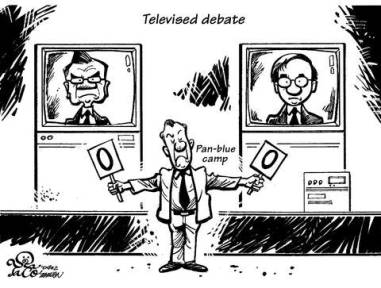
After twice viewing a video tape of the first presidential-election debate, I am very proud of the accomplishments of the Taiwanese people. Taiwan is a vibrant and energetic democracy and like Wu Fong-shan said, this is a small step for both candidates, yet a huge stride for Taiwan. However, there is room for improvement.
Both candidates failed to clearly respond to many answers and even tried to avoid them totally and this is a problem. Due to the debate format and time constraint no follow-up questions could be asked by the person who asked the original question.
One could see many differences between the two candidates in terms of style, skills, philosophy and belief. Their handling of the sovereignty issue and understanding of the referendum was very different. Their interpretation of economic growth and educational reform was also different.
Their tone was sometimes combative and confrontational but that is the nature of a face-to-face debate. Even though they shook hands and patted each other on the back, the two men were jostling for the position of alpha male. Both speeches were civilized and, in some cases, personal. However, one was blunt and the other more subtle in terms of personal attacks.
The biggest problem was the audience. They should have been courteous and played no part in the proceedings. Their applause for the candidate they supported was a distraction.
Who was the winner? Who looked more presidential? Who fumbled? Who looked more relaxed and confident? For many, the answer will not be clear until the result of the March 20 ballot. For now, the winner is the Taiwanese people.
-----------------------------------------
On Feb. 18, 2004 ……
-----------------------------------------
On Feb. 18, 2004 ……
A crucial moment is approaching
`China's saying that it has a reason for sending troops is merely an attempt at comforting itself.'
By Ling Feng
The closer we get to the March 20 presidential election, the more nervous Beijing gets. Apart from its mobilization of "foreign forces," two recent propaganda articles have also received a lot of attention.
One of the articles, signed by Zhong Wen and entitled "The Complex and Changing Situation in Taiwan," was published on xinhuanet.com on Jan. 26. It came from the Central Publicity Department's publication Current Affairs Reports. The other article, in last week's Outlook Weekly, was entitled "Experts discuss Taiwan's `referendum:' if [Chen Shui-]Bian prioritizes provocation, we will have a reason for sending troops."
The first article evaluates the situation in Taiwan during the past year. It points out that the historical process leading towards a solution of the Taiwan issue is approaching a crucial moment. Seemingly saying that China will look for a showdown over the matter, the article also, however, makes quite rational use of the "dichotomy method" in, for example, its view of Taiwan's referendum. It does not believe that the passage of the Referendum Law means that a Taiwanese independence referendum has become a fact, and even less that it constitutes Taiwanese independence.
The law does, however, provide the conditions for future independence activities, and there is, therefore, reason for concern. The widespread activities of Taiwanese independence and separatist forces further aggravate the tense cross-strait relationship. Given the joint effort of compatriots on both sides of the Taiwan Strait, however, the outlook for developing cross-strait travel and other exchanges remains positive.
The propounded view of current cross-strait relations, for example, is that although a serious challenge has been launched against the basic pattern of cross-strait relations, a pattern which has developed over a long period of time, no fundamental changes have taken place. In short, the article first talks about negative conditions, and then says that the bottom line, where it becomes necessary to launch a war, has not yet been crossed.
The article emphasizes that Chinese Premier Wen Jiabao's visit to the US last December to develop China's interests in the US had a major effect. Through firm struggle and hard work, China has managed to fundamentally suppress the risk of a public declaration of Taiwanese independence, and stop the worst-case scenario from materializing. It has also protected Taiwan's position as part of China, promoted cross-strait exchanges and contacts, and protected the basic stability of the cross-strait relationship.
The current strategic situation in the Taiwan Strait is, therefore, that the comparison of strength between the two sides continues to develop in China's favor, that cross-strait economic and cultural exchanges and individual contacts continue to develop, that a majority of the Taiwanese do not support independence, that a majority of countries around the world implement the "one China" policy and that the US government does not support Taiwanese independence, and restricts the Taiwanese separatist forces.
Obviously, the main thrust of the article is to confirm that the major successful efforts of Chinese leaders in blocking Taiwanese independence are approaching a crucial moment, but have not yet reached that moment.
These suggestions -- which point out that, despite the March referendum, this is not the time to start a war, seem to be aimed at the war-mongering hawks.
The second article was the Outlook Weekly interview with Luo Yuan, a guest researcher at the Taiwan Strait Research Center, and Wang Weixing. Luo is the director of research at China's Academy of Military Sciences.
In an interview with China News Service last November, he said that if Taiwan were to amend the territorial specifications in the Constitution of the Republic of China to "only include Taiwan, Penghu, Kinmen and Matsu," that would amount to a constitution for Taiwanese independence. It would cross China's bottom line for taking up arms, and would mean war.
Wang is a researcher at the Academy of Military Sciences' Strategic Research Department and considered an expert on Taiwan. The two men, advocating the use of arms to solve the Taiwan problem, represent the hawks.
Two or three years ago, they published a joint article, in which they said: "Taking a panoramic view of history, the unification of nations around the world has almost always been accomplished through the use of arms. The history of a nation's unification is a history of power struggles and life-and-death battles. In China's history, it has almost become a law that unification will follow a long period of separation, and each unification has been born out of armed force. Through nine major [national] unifications and three recoveries of Taiwan, not one has been realized by other than military means. Only the Communist Party of China places the focus on ethnic justice, and, in its magnanimity, love and benevolence, attempts to use peaceful means to realize the nation's ultimate unification."
Not only did they leave out the fact that separation tends to follow a long period of unity, but the whole article also reeks of blood. They do not expound any more palatable ideas in the interview with Outlook Weekly.
In the interview, Luo said :"The two sides of the Taiwan Strait have to this day never signed a peace agreement. We still find ourselves in a situation extending back to the civil war, with both sides still in a state of armed opposition. What do they think they're doing, demanding that China unilaterally withdraw its ballistic missiles?"
This shows that China completely ignored the good will displayed by Taiwan in abolishing the Temporary Provisions Effective During the Period of Communist Rebellion.
Some people in Taiwan are also unable to distinguish between their own side and the enemy, treating China as a friend and getting swept up in "China fever." In the end, they will be burned by fire.
Should we really not consider national security when discussing such things as the three direct links and investing in China?
The hawks believe the two sides of the Taiwan Strait remain in a state of armed opposition.
Wang said, "No country will accept the preposterous proposition of having two governments exercising national sovereignty on its own national territory." Didn't the Federal Republic of Germany and the German Democratic Republic and their governments co-exist on German soil? Not only do the Republic of China and the PRC co-exist, but they are also separated by the natural barrier made up by the Taiwan Strait.
Although Taiwan should discard Wang's perverted logic and hold its referendum to decide its future for itself, there is one sentence of Wang's that should be given further attention. Towards the end of the interview, he says that "Chen Shui-bian and his authorities prioritize provocation. When we send our troops, the punitive action will receive support and sympathy from both the international community and our neighboring countries." That means that even if China does resort to arms, it will be a punitive military action, because it does not have the military ability to occupy Taiwan.
Several options are open to Taiwan when assessing the meaning of the phrase "punitive military action." For example, a military blockade, firing a few ballistic missiles, or attacking, occupying and plundering the outlying islands before withdrawing its troops, as it did when launching a punitive military action against Vietnam in 1979.
The responses that Taiwan should prepare should include a referendum to decide the future of Taiwan. In fact, China's saying that it has a reason for sending troops is merely an attempt at comforting itself.
If China really does start a war and
destroys the cross-strait peace, it will have a serious effect on the global
economic and financial situation as a whole. Even though a few countries are
concerned over the issue of Taiwan's referendum, no country has yet come out in
support of China, saying it should launch an armed attack on Taiwan.
Will anyone come out cheering for
China if it tries to invade Taiwan? We can be certain that the US will not do
so, nor will Japan, nor France.
Ling Feng is a commentator based in New York.
-----------------------------------------