20040220
=======
Arm plan on Feb. 20, 2004 ……
Arms plan not tied to referendum
US WEAPONRY: The president said a
military procurement program will go ahead regardless of what voters say to the
referendum question on strengthening defenses
By Ko Shu-ling, STAFF REPORTER
President Chen Shui-bian and the Cabinet reaffirmed yesterday that the government will honor its NT$500 billion (US$15.1 billion) arms-procurement plan even if the public votes down the referendum question on defense reinforcement.
One of the referendum questions will ask voters whether the nation should strengthen its defenses in the face of China's missile threat, and whether Taiwan should hold talks with Beijing to establish a peaceful and stable framework for cross-strait interactions.
During a radio interview yesterday morning, Chen said that the NT$500 billion arms-procurement plan and the referendum are two very different issues.
"While the referendum question deals with future defense reinforcement projects, the NT$500 billion arms-procurement refers to an advanced anti-missile deployment plan the defense ministry has been working on since 1997," he said.
Chen made the remark in response to a question from the program's hostess, who questioned the necessity of the referendum in the wake of Minister of National Defense Tang Yao-ming comments on Wednesday that the plan to buy advanced anti-missile systems will not be affected be the referendum's results.
"Doesn't it sound ridiculous that the government will forge ahead with the arms-procurement plan if the public says no?" Clara Chou said. "Why do we need the referendum in the first place if its results are not legally binding?"
Echoing Chen's comments, Cabinet Spokesman Lin Chia-lung told a press conference yesterday morning that criticism the referendum contradicts the arms-procurement project was "untrue" and "erroneous."
"If the critics had studied the referendum question carefully, they'd have realized that the voters are not asked whether to purchase the anti-missile weaponry systems but whether to strengthen the nation's defense capabilities in the face of China's missile threat," Lin said.
He said the NT$500 billion special budget would help pay for the eight diesel-engine submarines, 12 P-3C Orion aircraft, anti-missile Patriot PAC-3 systems and four Kidd-class destroyers that US President George W. Bush promised to sell to Taipei three years ago.
Lin also responded to criticism from People First Party (PFP) Chairman James Soong that the referendum is a political gambit by Chen and a dirty trick to bamboozle the people.
Lin said that the referendum would have an impact on the government's decision-making process if voters said no to both questions.
"But we'd still be sending out a message to China and to the world that we're a peace-loving people and that we would strengthen our defenses in the face of China's increasing military threat," he said.
In related news, Premier Yu Shyi-kun is set to name five to seven Cabinet officials who will take part in the 10 televised debates on the referendum. Possible candidates include Taipei County Commissioner Su Tseng-chang, Kaohsiung Mayor Frank Hsieh, Mainland Affairs Council Chairwoman Tsai Ing-wen, Straits Exchange Foundation Vice Chairman Shi Hwei-yow, Minister without Portfolio Yeh Jiunn-rong and Cabinet Spokesman Lin Chia-lung.
Yu had approved a line-up consisting of five Cabinet officials and five academics on Monday, but the government decided to change the group after a coalition of predominately pro-blue political commentators launched a petition drive on Tuesday to be the "opposition" side for the debates. The pan-blue campaign headquarters has declined to take part in the debates.
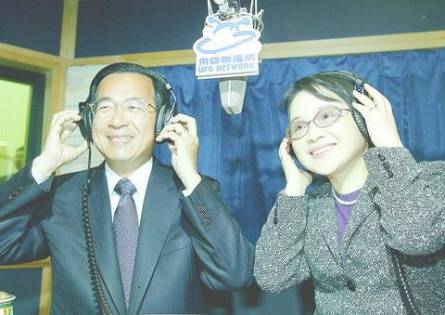
President Chen Shui-bian and radio-show host Clara Chou put on their
headphones as they prepared to go on the air for a one-hour interview broadcast
by the UFO radio station in Taipei yesterday morning. In the interview with
Chou, Chen discussed the presidential election and the referendum, the
military's arms-procurement plans and questions about his wife's stock deals.
Chen said he was confident of being re-elected.
-----------------------------------------
On Feb. 20, 2004 ……
Connery may join pro-Taiwan rally
THAT SAME OLD DREAM: The award-winning actor whose name is synonymous with James Bond will reportedly visit Taiwan to support the rally on Feb. 28
By Chang Yun-ping, STAFF REPORTER
The original James Bond, veteran actor Sean Connery, is rumored to be coming to Taiwan to join the "228 Hand-in-Hand Rally" slated to take place on Feb. 28 as a symbol of determination and unity of the people of Taiwan in protecting Taiwan from China's missile threats, the organizer of the event said yesterday.
"The chances are good that Sean Connery will come to Taiwan to join the `228 Hand-in-Hand Rally' if everything goes as scheduled," Peter Wang, deputy executive director of the Hand-in-Hand Taiwan Alliance, which is co-sponsored by the Taiwan Solidarity Union, the Democratic Progressive Party (DPP) and a number of activist groups.
Wang yesterday revealed that the Presidential Office was behind the invitation to Connery, who met President Chen Shui-bian on Nov. 3 in Panama City during Panama's centennial celebrations.
"The idea of inviting Sean Connery to visit Taiwan started at that time," Wang said.
Wang noted that Connery is expected to announce his itinerary at a press conference in Tokyo on Feb. 26 and will appear on stage in front of the Presidential Office at 2:28pm on Feb. 28.
However, spokesman for the DPP's campaign headquarters Wu Nai-jen yesterday shied away from giving a definite answer as to whether the academy-award-winning actor would come to Taiwan for the event.
"There are many important guests the organizer is trying to invite to participate in this activity, but we are not definite at this point who the guests are and what kind of promises have been made," Wu said.
During the centennial celebration in Panama last November, Connery took the initiative in approaching Chen by asking an unspecified ambassador to Panama to arrange a meeting with Chen.
In their meeting, Connery was quoted as having said that he was a fan of the president. For his part, Chen said he was a loyal Sean Connery fan.
"You have numerous fans in Taiwan and are welcome to visit any time," Chen told Connery, who starred as the charismatic spy 007 in several James Bond films, including Dr. No (1962), Goldfinger (1964) and Diamonds Are Forever (1971).
The chain will take place on 228 Memorial Day, with people from around the country joining hands to form a colossal human chain 500km long along the west coast and shouting "Taiwan yes, China no!" at 2:28pm.
The 228 Memorial Day is in memory of the victims killed during an uprising on Feb. 28, 1947 by native Taiwanese to protest against the corrupt Chinese Nationlist Party regime.
Connery is known for his passionate support of Scotland's independence and has publicly advocated its seperation from England, although he was knighted by Britain's Queen Elizabeth in 2000.
Though Connery is a native of Scotland and bears a tattoo proclaiming "Scotland Forever," he does not reside there. He had once publicly said in March last year that he believes Scotland will one day become independent and only then will he move back to Scotland with his wife.
-----------------------------------------
On Feb. 20, 2004 ……
History lessons that we must heed
`It would be on the consciences of democratic nations, particularly the US, if Taiwan is left without a choice and forced to buckle under Beijing's threats.'
By Chen Ching-chih
Beijing has never tired of claiming that Taiwan is part of China, despite the fact that Taiwan is by most standards an independent, sovereign state and the fact that the great majority of the people of Taiwan do not wish to live under communist rule. More importantly, China has nearly 500 missiles targeting Taiwan and has repeatedly threatened to take the island by force if it does not willingly become part of China.
China's ambition to annex Taiwan is real. The design to annex Taiwan, in more ways than one, resembles Meiji Japan's scheme to annex Korea about a century ago. It is, therefore, essential that we understand the route Japan took to annex Korea, which it then ruled until 1945 when Korea was liberated at the end of World War II. The Japanese case should serve as a lesson not only for Taiwan but also for the US and China.
Japan formally annexed Korea through
1910's Treaty of Annexation. Prior to this, it was mainly by resorting to war
and diplomacy that Japan had increasingly brought Korea into its sphere of
influence. As Asia's sole emerging, modern military power, Japan fought two
wars over control of Korea. In the Sino-Japanese War of 1894 to 1895, Japan
decisively defeated China and forced it to sign the Treaty of Shimonoseki, in
May 1895.
In addition to ceding Taiwan and
Penghu, China agreed to relinquish its suzerainty over Korea. Japan was thus
able to gradually bring Korea under its imperial wing. However, Japan still did
not have a free hand over Korea on account of the fact that imperial Russia,
likewise, had territorial designs over Korea as well as Manchuria. In the
Russo-Japanese War of 1904 to 1905, Japan defeated Russia and compelled it to
acknowledge its "paramount political, military and economical
interests" in Korea, according to the Portsmouth Peace Treaty of Sept. 5,
1905.
However, to complete its dominance over Korea, Japan had to seek the diplomatic support of other major powers. In early 1902, through the Anglo-Japanese Naval Alliance, Japan secured Britain's acceptance of its interests in Korea, in return for acknowledging Britain's interests in China and later India.
Of equal importance to Japan, however, was US acknowledgement that Japan would enjoy dominance over Korea in return for recognizing US interests in the Philippines. US Secretary of War William Taft reached an agreement on the matter with Prime Minister Katsura Taro in July 1905. US President Theodore Roosevelt subsequently confirmed the agreement.
With the major powers' explicit support, Japan imposed a protectorate on Korea through the Protectorate Treaty of November 1905. Objecting to this development, the Korean royal family dispatched envoys to the Hague Peace Conference in 1907, but the conference refused to consider the protest. Failure of the international community to come to Korea's aid ultimately emboldened Japan to force a treaty upon Korea in August 1910 providing for complete annexation.
Western countries, including the UK, the US and Russia, supported Japan's annexation of Korea as a policy that would help stabilize East Asia, which was seen as beneficial to all the major powers involved.
Japanese colonialists and imperialists believed that Korea and Japan had deep historical and cultural ties and that a big-brother relationship existed between Korea and Japan to justify the annexation. Koreans, however, did not approve; they resisted Japanese colonial rule by various means. Resistance culminated in a large-scale, anti-Japanese demonstration on March 1, 1919. Japan's brutal response resulted in the deaths of thousands of demonstrators. Clearly, the Koreans were hoping that the demonstration would be seen to have been inspired by the principle of self-determination, which US president Woodrow Wilson announced in 1918, and which therefore might win international support.
Unfortunately, no major powers or the newly created League of Nations showed any sympathy for Korea. Consequently, for 35 years, Koreans suffered under harsh colonial rule until liberation.
In the early 1940s, an increasingly militaristic and expansionist Japan attacked Western colonies, including the Philippines, Hong Kong, Singapore and Malaya. So in the long run, the interests of the Western powers were not served but damaged by sacrificing Korea in their appeasement of Japan.
Is the international community making the same mistake in their acquiescence toward the claim that Taiwan is a part of China?
Let us examine China's scheme to annex Taiwan. There are two major similarities between the Chinese and the Japanese scenarios. First, China is without doubt the dominant Asian power today as Japan was nearly a century ago. With its military might and growing economic power, China has the kind of leverage that Japan enjoyed in the early 20th century. Second, like Japan, China today is resorting to diplomacy as well as the threat of force to annex Taiwan. Beijing has claimed that China went to war against Japan for the sake of liberating Taiwan from Japanese colonial rule as well as to resist Japanese aggression against China. After Japan's defeat, according to the Chinese, Taiwan reverted to them. It was only because of the Chinese Civil War and its aftermath that Taiwan remained a separate jurisdiction. To annex Taiwan, Beijing insists that it will resort to force, if necessary.
In reality, according to the 1951 San Francisco Peace Treaty between Japan and the Allies, Japan renounced sovereignty over Taiwan but designated no recipient.
China, over the years, has manipulated all countries that have diplomatic relations with it into accepting its "one China" policy, which states that there is only one China and Taiwan is part of China. In addition, Beijing has done its best to diplomatically isolate Taiwan by opposing Taiwan's efforts to join the UN and other international organizations, including the World Health Organization.
In spite of these similarities, there are at least two essential differences between the Chinese case and that of Japan. First, unlike Korea a century ago, Taiwan has enjoyed significant support from the US. While the US does not have diplomatic relations with Taiwan, it nevertheless has become Taiwan's closest and most important military ally. By virtue of the 1979 Taiwan Relations Act, the US is obligated to come to the aid of Taiwan if and when the nation is attacked by China.
In reminding the Chinese of its commitment to Taiwan, the US must have learned from the Iraqi invasion of Kuwait in 1991 that ambiguity can only encourage an aggressive country into miscalculating the US' position.
In any case, it is not only the legal duty of the US to protect Taiwan in case of a Chinese invasion, but also its moral responsibility to do so. Any weakening of support would contribute to other countries turning against Taiwan, as seen recently in certain countries' negative response to Taiwan's plan to have a national peace referendum. No democratic country, especially the US which has made democracy and human rights the core of its foreign policy, should assist Beijing in coercing, however subtly, Taiwan to accept Chinese annexation. No country should sacrifice democracy and the human rights of the Taiwanese under the pretense of peace and stability in the Taiwan Strait.
In addition to strong US support, the people of Taiwan enjoy what the Koreans lacked a century ago. Like all other peoples, the people of Taiwan are entitled to the UN-guaranteed right of self-determination in a new era of human rights and democracy. Whatever future relationship Taiwan will have with China requires the approval of its people. There is no better way than calling a referendum to reach an unchallengeable decision on such a fundamental issue.
It would be on the consciences of democratic nations, particularly the US, if Taiwan is left without a choice and forced to buckle under Beijing's threats.
The Korean resistance against the Japanese should serve as a lesson for China not to resort to coercion in its attempt to bring Taiwan under its control. For all parties involved, the consent of the Taiwanese people is essential.
Chen Ching-chih is professor emeritus of history at the Southern Illinois University at Edwardsville and a researcher at the Los Angeles-based Institute for Taiwanese Studies.
-----------------------------------------
On Feb. 20, 2004 ……
-----------------------------------------
On Feb. 20, 2004 ……
China harassed Chen supporters: SEF
By Melody Chen, STAFF REPORTER
Beijing systematically harassed China-based Taiwanese business-people who openly supported the Democratic Progressive Party (DPP) in the 2000 presidential election, a government official said yesterday.
The persecution, which occurred in varying degrees, was widespread among Taiwanese businesspeople who showed they favored President Chen Shui-bian, according to Yen Wan-ching, deputy secretary-general of the Straits Exchange Foundation (SEF).
The semi-official foundation deals with cross-strait affairs and serves mainly China-based Taiwanese businessmen.
Hsu Wen-lung, chairman of the Chi Mei Cooperation, was one of the prominent victims of Chinese mistreatment, Yen said in a seminar hosted by the Institute for National Policy Research. The seminar was held to discuss the "China factor" in the coming presidential election.
"China tried to find fault with accounting and environmental management in our factory in Jiangsu Province after the 2000 election," said one unnamed official yesterday.
Yen said after the 2000 election, the foundation received numerous complaints from Taiwanese businesspeople about China's "unusual treatment."
Chinese officials surprised businesspeople by performing unannounced visits to check their accounting. Their products also underwent unusually strict customs checks and Chinese officials also harassed their workers, Yen said.
"Superficially, China's behavior seemed unrelated to politics. But later we found all these harassed businesspeople had one thing in common: they had all openly showed their support for Chen," Yen said.
Declining to reveal further details about the businesspeople's identities or the cities in which they were based, Yen said these people did not want their stories to be exposed.
"China's behavior made these businesspeople's lives very difficult. They wanted to do business in China. They wanted to make a living. But they had no channel to seek justice because China is not much of a law-abiding society," Yen said.
Several business leaders based in southern China, however, said they knew nothing about the situation revealed by Yen.
"Nobody around me has encountered anything like that," one said.
Yen said the mistreatment four years ago has made DPP backers among China-based businesspeople afraid of revealing their true political orientation.
"In China, everybody knows DPP supporters keep mum about their political stance," he said.
Those who favor the blue-camp alliance formed by Chinese Nationalist Party Chairman Lien Chan and People First Party (PFP) Chairman James Soong do not have the same cause for concern as DPP backers, Yen added.
Supporters of the China-friendly blue camp can voice their political tendencies because "they don't need to worry about China's reaction," Yen said.
Academia Sinica research fellow Joanne Chang, another speaker in the seminar, said thousands of overseas Taiwanese in the US have also been planning to return to Taiwan to cast their ballots in the election.
Having just returned from the US, Chang said despite the participation of China-based Taiwanese businesspeople and overseas Taiwanese from other countries, the outcome of the election is likely to be dominated by "the mainstream opinion of the people."
-----------------------------------------
On Feb. 21, 2004 ……
-----------------------------------------