20040222
=======
Support it on Feb. 22, 2004 ……
Lee whips up support in Hualien for Chen, rally
"Feb. 28 used to be a date that
caused serious pain, but it can now be a starting point for Taiwan's reflection
and rebirth. Feb. 28 should ... be a starting point for ... solidarity." --- Lee Teng-hui,
former president
ENCOURAGE: Former President Lee Teng-hui urged the nation at a forum opening in Hualien to cast their votes in the referendum and support the pan-greens
By Debby Wu, STAFF REPORTER
Former president Lee Teng-hui yesterday urged the public to take part in the hand-in-hand rally and referendum, and support President Chen Shui-bian in the upcoming presidential election.
He was speaking at the opening of a forum held in the Bellevista Hotel in Hualien by the think tank Taiwan Advocates to promote a new constitution. He specially acknowledged his supporters in the east, as Hualien is recognized as a pan-blue stronghold.
"Everyone says that eastern Taiwan is the only uncorrupted part of Taiwan. We therefore chose to end the forum here, because we want to consider Taiwan's future calmly on this uncorrupted land," Lee said.
He then urged the public to take part
in the 228 Hand-in-Hand Rally and referendum.
"Feb. 28 used to be a date that
caused serious pain, but it can now be a starting point for Taiwan's reflection
and rebirth. Feb. 28 should not be a starting point for division, but for
solidarity among Taiwanese people. We hope the hand-in-hand rally this year can
be the start of solidarity among all ethnic groups in Taiwan," Lee said.
Lee said that the rally was an opportunity to show China and the rest of the world the nation's determination to pursue peace and democracy and that Taiwan will defend itself when confronted by China's threats and prosecution.
"Everyone should participate in the referendum and not miss the historical moment. We'll use the referendum to tell the politicians that we, the people, are the real bosses; to tell China that we pursue peace; and to tell the rest of the world that a referendum is a basic right," Lee said.
Lee also urged the public to support President Chen Shui-bian in the presidential election.
"Let's use our ballots to reconfirm that Taiwan wants to go forward and stop the conservative powers from fantasizing about a future of their own making. Taiwan will be its own master and kiss the `One China' concept goodbye. Let's use our ballots to confirm that we want reform, progress and to be our own masters," Lee said.
Chinese dissident writer Cao Chang-ching again criticized China and the Lien-Soong ticket.
"This is the first time I have visited Hualien. I went around the place and really liked it. But there are also some Chinese officials who like Hualien a lot and said that if the Lien-Soong ticket won the election, Taiwan might accept the `one country two systems' concept and Chinese military ships can then come to Taiwan," Cao said.
"Let's use our ballots to vote out the candidates that the Communist Party likes. Don't let Hualien become communist China's military port," he said.
"I came to campaign not for Chen Shui-bian, but for the values of democracy and freedom," Cao said.
Lee Hung-hsi, a constitution expert, said that for a constitution to survive here, it needed to be written by the people and satisfy the needs of the country.
"But the current Constitution was written in China in 1947 and has nothing to do with Taiwan. Taiwanese don't respect that Constitution," Lee said.
Academia Sinica sociologist Michael Hsiao said that he never heard of people from eastern Taiwan talking about ethnic conflict, even though all four major ethnic groups were represented in eastern Taiwan.
"Taipei Mayor Ma Ying-jeou doesn't like people to talk about party assets because he said it would result in ethnic conflict. It's not ethnic conflict he is thinking about, but the conflict between the Chinese and Taiwanese.
"However, in the past few years Taiwanese have been re-categorized from two groups [Chinese and Taiwanese] into four groups [Chinese, Hokkien, Hakka and Aborigines]. Everyone has learned to respect and appreciate each other," Hsiao said.
Chin Heng-wei, a political commentator and editor in chief of Contemporary Monthly magazine, said that the pan-blue camp did not like a possible change to the status quo and it wanted to remain under "One China." The pan-green camp was fighting a tough battle, he said.
"But 2004 is an important time for the connection between Taiwan's democratization and Taiwanization. We should strive to have 22.8 million people out on the street on Feb. 28 to demonstrate our determination to the world," Chin said.
Other speakers included Hakka historian Lee Yung-chih and Robin Winkler, an American lawyer who has given up his US citizenship to become a Taiwanese citizen.
Hualien was the last stop in a series of forums held nationwide by Taiwan Advocates.
At the end of the proceedings, the audience and speakers joined hands to form a big circle on the square outside the banquet hall in practice for the 228 Hand-in-Hand Rally.
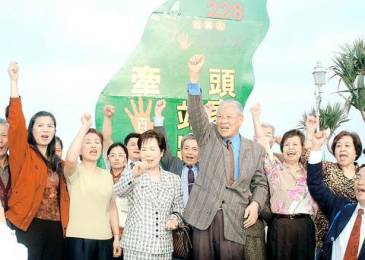
Former president Lee Teng-hui, fourth right, and his wife Lee Tseng-wen, fourth left, call for the public to participate in the 228 Hand-in-Hand Rally.
-----------------------------------------
On Feb. 22, 2004 ……
Lu urges ‘soft power’
Vice President Annette Lu urged the public yesterday to vote in the March 20 referendum and claimed that “soft and gentle power” can dissolve violence and create harmony. Lu made the remarks while attending the opening ceremony of the First Presidential Cup of the Tai Chi Chuan Championship held in Taipei County.
Emphasizing that the referendum was designed to show the public’s desire for peace, the vice president claimed that it is not just a re-election ploy. The referendum will ask voters if Taiwan should build up its anti-missile defenses and if the government should set up a mechanism for cross-strait interaction.
Lu expressed hope that the people will become their own masters and understand that Taiwan is “a place full of love and peace.” Turning to what she called “soft national power,” Lu said that such power is based on love and peace – just like Tai Chi Chuan’s theory of using soft power against violence. Soft national power is also aimed at promoting freedom, democracy, human rights and high-technology, she added without elaborating.
-----------------------------------------
On Feb. 22, 2004 ……
Japan beefs up security against terror
DEPLOYMENT BACKLASH: Although there was no new information of a terrorist threat in response to troops being sent to Iraq, 650 facilities were placed under guard
AP, TOKYO
Japan ordered riot police to patrol airports and guard nuclear plants and beefed up security at other key facilities nationwide, in a precaution against terror attacks as the country deploys troops in Iraq.
About 650 vital facilities, including US military bases, were put under increased surveillance, the Yomiuri newspaper and other media reported. An agency spokesman could not be reached yesterday to confirm that figure.
Authorities would not say if they had new information about a terrorist threat or reveal how many police officers would be mobilized in the buildup.
The National Police Agency ordered local law enforcement authorities on Friday to raise security around possible terrorist targets to its highest level since the US-led invasion of Iraq in March last year.
The alert sent a shiver through global financial markets, knocking the Japanese yen to a 10-week low against the US dollar on Friday.
It was issued amid concern about terrorist retribution as Japanese troops joined the US-led coalition in Iraq on a noncombat mission to rebuild its war-shattered infrastructure. This week a pair of crude mortars were fired at Japan's Defense Agency in a failed attack that police blamed on leftist radicals.
The National Police Agency said riot police armed with automatic rifles would guard international airports in Tokyo and Osaka and nuclear power and reprocessing facilities.
A police officer at Tokyo airport confirmed yesterday that riot police had been deployed but declined to elaborate.
Police were also mobilized and additional checkpoints set up around the prime minister's residence, the US Embassy, military facilities and national and local assembly buildings, the agency said. It also strengthened security at ports, railway stations and shopping malls.
In Washington, White House spokesman Scott McClellan said Japan was tightening security as it prepares to send troops to Iraq. Japan dispatched a destroyer and an amphibious vessel to the Middle East on Friday.
"Japan for the last few weeks has been taking some measures to improve the police preparedness as they prepare to deploy troops to Iraq," he said. "Japan has kept us apprised of the measures they are implementing."
Japan plans to send about 1,000 military personnel to Iraq on a noncombat mission in its largest deployment since World War II. About 120 ground troops are already in the southern Iraqi city of Samawah and Japan plans to increase their numbers to about 600.
Many fear that the dispatch could draw terrorist attacks in Japan. Last November an alleged al-Qaeda operative threatened to attack Tokyo if it sent troops to Iraq.
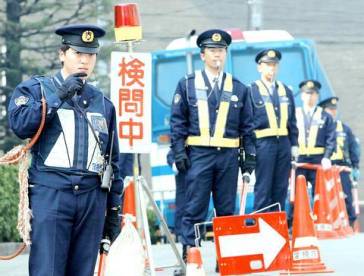
Japanese policemen yesterday stand guard at a security checkpoint leading to the US embassy in Tokyo.
-----------------------------------------
On Feb. 22, 2004 ……
-----------------------------------------
On Feb. 22, 2004 ……
Voters need details to make choices
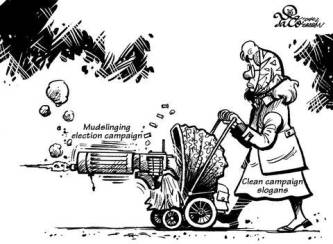
`The opposition parties should not stand in the way of corrective and remedial policies and then ask the DPP or Chen to take care of the problems alone.'
The first and second rounds of the presidential debates have been held. The purpose of such debates is to present the truth and help direct policies onto the right path. Therefore, more in-depth discussion should now take place with respect to some of the issues not fully elaborated during the debates.
In particular, we hope that the political parties and the public will carefully examine the candidates' proposals so that the people can understand the strong and weak points of the candidates' campaign platforms and policy-administration capabilities.
Focusing on the issues discussed during the first debate, it is worthwhile to examine the debate in terms of economic growth and who should be held responsible for recent unsatisfactory economic growth, if it is truly unsatisfactory.
Chinese Nationalist Party (KMT) Chairman Lien Chan said that economic growth last year and the year before were both lower than the average for growth in East Asian countries, and that our growth rate was behind that of countries such as the Philippines. According to Lien, President Chen Shui-bian should not claim that the economy is on the rise. These are criticisms often made by the pan-blue parties.
On the other hand, the Democratic Progressive Party (DPP) sometimes uses the fact that our growth rate is higher than those of other high-income-earning countries to argue that we are not so bad off after all.
KMT Vice Chairman Chiang Ping-kun has said that it is inappropriate to compare Taiwan's economic growth with that of the US, Europe and Japan. If the US and Japan are comparable to someone in his or her 30s, Taiwan is around 13, and therefore should experience faster economic growth. Chiang's statement demonstrates that it is not appropriate for Lien to compare Taiwan to the Philippines and other developing East Asian countries, because the lower a country's average income, the higher its economic growth typically is.
It is wrong to compare Taiwan with countries in which incomes are only around one-tenth of incomes in Taiwan.
For the same reason, it is not accurate for Chiang to say that it is best to measure economic growth against economic growth in the past. This is because it is impossible to compare a person's growth at the age of 20 with his or her growth at the age of 10.
Looking at the issue this way, while Chen's comparison of Taiwan with other countries grouped among the "four little dragons" of Asia is not entirely accurate, it is a more reliable way to go. Such a comparison indicates that our performance is indeed no worse than that of the other "little dragons." In other words, the KMT-People First Party (PFP) camp should no longer accuse the DPP of incompetence in economic policy.
The over-extension of loans by financial institutions has created a capital-shortage phenomenon and has generated problems for many business enterprises. This has been a major reason for the lack of economic demand domestically. Chen accused the pan-blues of pulling the government's leg by boycotting the approval of the Financial Reconstruction Fund to deal with the loan extension and loan-default problems. Lien, on the other hand, said that the percentage of loans going into default during the KMT era was only around 4.8 percent, and that it was only after the DPP came into power that the figure climbed to 8.04 percent.
Lien said the default problem was created by Chen and therefore he should take care of it. This is also an inaccurate statement. Many problems created during the KMT era, such as an excessive number of banks and poor management, were merely inherited by the DPP. The opposition parties should not stand in the way of corrective and remedial policies and then ask the DPP or Chen to take care of the problems alone.
In addition, problems in the finance sector have long existed. The nation's financial institutions are poorly run and supervised. Many loopholes exist concerning the internal management of many business enterprises as well. As a result, many businesses have been sucked dry financially and many financial institutions are on the verge of collapse. Many of the loans in default today already existed at the time of the local financial crisis in 1998. However, at the time, the KMT relied on postponing the due dates of the loans as a way to help out businesses. Some banks actually covered up their problems, keeping the public and the government's supervisory agencies in the dark.
Statistics indicate that after 1999 the finance sector extended only minimal loans to the private sector.
Today's existing defaulted loans were mostly made before 1997. The KMT and PFP should no longer shirk their responsibility for the loan defaults. Nor should they obstruct the government's efforts to engage in re-structuring of the finance sector.
The most fully-elaborated economic policy presented during the first debate was Lien's proposal to offer a preferential 18-percent interest rate for 50 percent of the pensions for seniors paid by labor insurance. The first problem with this policy is the funds required for implementation. Chen and the pan-purple alliance both think this will require NT$100 billion, creating a major hole in the treasury. But Lien believes that only NT$9 billion will be needed. The gap in the funds is a grave problem.
Both sides need to clearly explain to the people how they calculate their figures so that the people can decide for themselves more objectively whether to support such policies. At the same time, the people should be able to appraise the policy-implementation abilities of the two sides based on the accuracy of their respective calculations.
Lien made some effort to explain his calculations regarding his interest-rate plan during the debate. He deserves recognition for making an attempt. However, his explanation demonstrates a major flaw with the policy -- that is, many workers will suffer from unequal treatment under his plan. Lien indicated that the policy will benefit about 140,000 workers. This number is only a small fraction of retired workers, suggesting that most workers will not enjoy preferential treatment.
Lien said that not all workers will necessarily get the money and that only about 40 percent will reap any benefit. In other words, retired workers who cannot receive senior pensions as a result of unreasonable provisions in the labor law would not be able to enjoy preferential treatment to begin with.
Workers who are not qualified for such pensions are the real socially-disadvantaged workers who need the help of the government. If those who receive senior pensions use the money to start a small business because they do not have enough savings, they would not be able to enjoy the preferential interest rate either. In conclusion, this policy cannot help those who need help the most, so it is a policy that fails to conform to the spirit of justice and fairness.
The above-described policy was inspired by the preferential18-percent interest rate that applies to the pensions of civil servants. However, that policy has not only received harsh criticism from all sectors, but even the KMT decided when it was in power that people who retired after 1995 would no longer enjoy such preferential treatment. It is indeed puzzling that Lien has proposed such an unreasonable policy.
During the debate, Lien said that preferential interest rates for civil servants, teachers and members of the military originated during a very unique time in history. However, since the time is now different, why give more workers such preferential treatment? When the 18-percent interest rate was first extended, the prevalent market interest rate was more than 10 percent. The government only had to subsidize a small amount. Now that the market interest rate is only about 1 percent, the government would need to spend huge sums of money on the 18-percent rate.
The financial burden on the government is not very fair. That is why people oppose preferential rates.
Even more worrisome is the fact that when Lien first proposed this policy, public opinion was very much against it. Yet the KMT and PFP have shown no sign of changing their minds. The fact that such a policy is being proposed indicates that the analytical and research abilities of the pan-blue's advisors on financial and economic policies are not very good. This will lower the general public's appraisal of Lien and Soong's policy-implementation ability.
Hopefully, both the pan-green and pan-blue camps will present enough substance during the rest of the campaign for the voters to know how to cast their votes.
-----------------------------------------
On Feb. 22, 2004 ……
With optimism, Chen won again
The second round of the presidential debates is over. While many important questions have not been answered, at least one thing has been made clear.
In response to questioning from President Chen Shui-bian, Chinese Nationalist Party (KMT) Chairman Lien Chan indicated that he will not be picking up his referendum ballot on March 20.
Lien had tried to remain ambiguous on this point. Cornered, he finally had to take a stand. But now it is too late to salvage the image of indecisiveness that he projected through his prior ambiguity. In addition, he has now left himself vulnerable to accusations of being anti-democratic.
As referendums are the most substantive demonstration of the democratic principles of popular empowerment, Chen put it best when he said that "Lien wants the people to cast their votes for him" but "he does not wish to vote for the people."
Furthermore, it has become very clear by now that contrary to what the pan-blue camp claimed before the debates -- that the Democratic Progressive Party was reluctant to participate -- Lien was the one who was less than inclined to participate in the debates.
This is clear because Chen invited Lien to participate in two more debates and Lien did not respond. In response to further questioning during the press conference afterwards, Lien dodged the issue again.
Overall, with the policy proposals of the two candidates overlapping on many important domestic issues, the biggest difference between them continues to be the issue of cross-strait relations.
Chen's statement that the sovereignty of Taiwan is indisputable and is not an issue to be cast aside (as was previously suggested by Lien) seems so much more forceful, easy to understand and, frankly speaking, more moving than Lien's position.
Lien's same old tune about the Republic of China being the "one China" of the so-called "one China" principle just pales in comparison. This is because no one in his or her right mind could truly believe what Lien is saying, not even Lien and the pan-blue camp -- not when the whole world knows that the People's Republic of China is the "one China" in question.
Chen's frank and positive attitude on the issue of sovereignty is consistent with the overall theme of his statements during the debates and in fact with his entire election campaign -- "Taiwan Number 1, Reform Number 1."
The differences between the two campaigns' themes is also reflected in the candidates' statements during the debates about economic development. While both men spoke about the nation acting as a management-and-design center for Asia, Lien emphasized utilizing China as a manufacturing base, something that has strong appeal for Taiwanese businessmen. Chen on the other hand emphasized that, even in economic development, Taiwan should never be the vassal or appendage of any country (implying China), and then was quick to point out that relocating the manufacturing base to China could cost the local work force job opportunities.
On this issue, it is obvious that the two candidates are targeting different voter groups.
Overall, while Chen was very clear and consistent about his attempt to deliver a sense of optimism and confidence to the voters about the nation and the future, Lien had a very difficult time in attempting to paint a gloomy picture for the voters.
This has much to do with the fact that Lien is a milder and more passive person than Chen. Moreover, even for those who agree that life is tough these days, it is very hard for Lien to convince people that he understands their pain and suffering.
Under the circumstances, the KMT has much work to do in terms of building up a persuasive theme for its election campaign.
-----------------------------------------
On Feb. 22, 2004 ……
The fight down south
By Graham Norris, STAFF REPORTER
While the presidential candidates bicker over referendums, personal assets and dodgy donations in Taipei, an altogether more local campaign is being fought in the nation's second city.
In Kaohsiung, where a little over 1 million votes are up for grabs, Democratic Progressive Party (DPP) Mayor Frank Hsieh has been given the task of making sure the party gets far enough ahead of the pan-blue parties in the south to offset the DPP's weaknesses in the north.
At a luncheon recently with foreign journalists, Hsieh gave estimates of President Chen Shui-bian's support in every southern county. Hsieh, who won 50.04 percent of the vote in the 2002 Kaohsiung mayoral election, said he thought he could lift this figure to 55 percent. Chen, he said, wants 60 percent.
Hsieh is basing his campaigning efforts for Chen on his own achievements in Kaohsiung. He points to the beautification of the Love River, once a flowing cesspool through the center of the city but now the center of the festival celebrations in the city. He is also proud of cleaning up the city's tap water, which had become infamous for its foul smell.
It was Chen who helped Hsieh improve the tap water by leaning on the Taiwan Water Supply Corp, which had told Hsieh his desires for clean water were unrealistic. Re-elect Chen, Hsieh says, and Kaohsiung residents can enjoy the fruits of more cooperation with the central government.
The DPP's pride in turning Kaohsiung from a dirty port city into a place worth living in is apparent in the party's campaign headquarters, which is little more than a converted shop. Scenic pictures of the city, particularly taken from the banks of the Love River, adorn the meeting the room. Even larger photos are on a truck the party has converted into a mobile stage, an idea Hsieh had to save money on renting venues for campaign events.
The head of the campaign headquarters is Joe Chou, a shopping center manager when he's not campaigning for the DPP. Chou said that much of what Hsieh had achieved in the city was a result of central government funding that flowed south thanks to Chen.
"If the central government does not support Hsieh's ideas, then you can imagine he can not do a lot of things, because of the budget," Chou said. "The central government has been so supportive of Frank Hsieh. Traditionally the KMT only focused on the northern part, on Taipei. Now the southern citizens want their fair share. That's all we ask."
At spacious offices of the headquarters of the Chinese Nationalist Party (KMT)-People First Party (PFP) alliance, campaign manager Lin Hsiang-neng has his own estimates of support for the parties. He said KMT Chairman Lien Chan could rely on the support of a core of 39 percent of Kaohsiung voters, and the pan-green camp 35 percent or 36 percent.
For him, the difference in the outcome might be the weather. Lien and Soong combined beat Chen in the 2000 election by 53.25 percent to 45.37 percent, when the turnout was over 84 percent. But the pan-blue camp's support fell to 46.36 percent in the 2002 mayoral election, when the turnout was only 71 percent.
"No matter what the weather, the pan-greens will vote," Lin said.
Lin, a former chairman of the Council of Agricultural Affairs, thinks the vote-winner for the pan-blue camp is the economy. Chen has presided over the nation's first recession in living memory for much of Taiwan's young population, and Lin is putting the blame for this squarely at Chen's doorstep.
"Most people are disappointed with the economy, particularly the unemployment rate," Lin said.
Lien is the only one who can return the country to the boom times, Lin said. For Kaohsiung, this means expanding the airport and the deep-sea harbor and creating a free-trade port to attract more industry to the area.
"We want to establish Kaohsiung as a center of transport in the region," Lin said.
In particular, Lin said he expected Lien to stick to his promise of starting negotiations with China on establishing direct links across the Taiwan Strait. Lin pointed to Kaohsiung's slide from being the third largest container port in the world to sixth as an example of how the lack of direct links is hurting Taiwan.
Throughout Chen's term, Beijing has insisted that Taiwan accept its "one China" principle before negotiations on anything can proceed. But Lin said talks between Taiwan and China were more a matter of trust.
"We will not accept the `one China' policy as a fundamental condition," he said. "Beijing will soften their position to reach an agreement. If they have confidence in the KMT-PFP keeping the status quo, I believe Beijing will accept the three links."
Lin said the DPP regarded businessmen who invested in China despite the lack of direct links as betrayers of Taiwan, highlighting the divisive issue of identity that has once again appeared at election time.
With the KMT and PFP now fighting as one unit, "there is no problem for mainlanders in Kaohsiung to unify and support this campaign," he said.
But mainlanders make up only about 20 percent of Kaohsiung's population, and many ethnic Taiwanese regularly vote for the pan-blue parties because of what the DPP's Kaohsiung campaign manager says is brainwashing.
"We have been educated that we are all Chinese," said Chou, who spent 21 years living in Canada. "When I went abroad I read about Taiwan's history and it opened my eyes. I said, `Hey, I've been brainwashed.' I woke up earlier than other people. Others think the KMT is all the way right."
One issue that crosses ethnic lines is vote-buying. The KMT has been trying to shake off a reputation for electoral corruption, also known as `black gold' politics. Hsieh has said he is already aware of a scheme in this election whereby voters are paid NT$2,000 to give up their identification cards, which they would need to present when they vote, for election day. Both sides are hinting that they expect more shenanigans as the vote looms closer.
The city is also reeling from a vote-buying scandal in the city council. After elections in 2002, it was discovered that Chu An-hsiung had paid councilors NT$5 million to vote for him to become council speaker. Thirty-four of the council's 44 members were implicated in the scandal. All of them were expelled from their parties and many have been prosecuted. Chu himself failed to turn up to begin his jail sentence and is still on the run.
The fact that DPP, as well as KMT, councilors were found to have sold their votes has damaged the DPP's image as a party of reform and anti-corruption.
"We take the attitude that we're not going to hide away," Chou said. "We have to face the fact that some DPP people are going to take money. But looking forward, it's good that people who have damaged the DPP have been kicked out of the party."
The KMT says it has also changed.
"We won't spend even one dollar on vote-buying," Lin said. "Anyway, we don't have the money."
Lin's aide, city councilor Wang Ling-jiao, who was expelled from the PFP after being arrested in relation to the scandal but was later found not guilty, suggested Kaohsiung had moved on from the scandal.
"In the south, some candidates will buy votes," she said. "Local people don't mind this kind of issue."
-----------------------------------------
On Feb. 22, 2004 ……

-----------------------------------------