20040223
=======
A clean and fair campaign on Feb. 23, 2004 ……
Lee holds key to Chen's re-election
"In Taiwan, World War II is not
yet finished. It will end only when the international community recognizes the
right of Taiwanese people to create an independent state." --- Mart
Laanemets, a research fellow in the Center for Oriental Studies at the
University of Tartu in Estonia
By Chang Yun-ping, STAFF REPORTER
As the presidential election campaign enters its final month with the two pairs of candidates tied in a close race, former president Lee Teng-hui could hold the key to the success of President Chen Shui-bian's re-election bid by expanding the "pro-localization" vote base.
Although he retired after 12 years as president, Lee is not resting on his laurels. After handing over the reins of power to the Democratic Progressive Party (DPP) in 2000 and leaving the Chinese Nationalist Party (KMT) in the same year, Lee has played an active role in civic movements promoting the establishment of a Taiwan-centric identity and "building a complete nation of Taiwan."
With the various campaign activities picking up speed in the finishing stretch to the March 20 election, the biggest event exemplifying Lee's dedication to consolidating the will of Taiwan's people and his determination to help Chen's re-election will be the upcoming "228 Hand-in-Hand Rally," which is expected to attract more than 1 million participants around the country on Saturday.
One goal of the rally, which will take the form of a 500km-long human chain, is to drive home the message that Taiwan's people reject the threat of China's 496 missiles being pointed at them. It will also commemorate the 228 Incident of Feb. 28, 1947.
The chain will start at the "peace island" north of Keelung County, where many of the victims' corpses were buried in the aftermath of the 228 tragedy.
People will join hands all the way from Keelung, down along the western coast of Taiwan across bridges, along the beach and mountains, and then down to the southern tip of Taiwan's Oluanpi in Pingtung County.
"This is a historical event, because we are not only commemorating the tragedy that took place in Taiwan, we are also indicating our willingness to move forward. We are calling this event not only to protect Taiwan, but also as an event to promote reconciliation," DPP Legislator Hsiao Bi-khim said yesterday.
"We are reconciling the oppression and bitterness of ethnic conflicts of the past and moving forward in the spirit of solidarity to protect Taiwan from unwanted external threats," Hsiao said, adding that this is reflected in the event's name, because "holding hands" also means "spouse" in Taiwanese.
"It not only signifies the literal meaning of holding someone's hands, it also embodies the values of love and partnership," Hsiao said.
The idea of a "228 Hand-in-Hand Rally" was inspired by the 1989 Baltic Chain, in which 2 million people in the three Baltic countries Estonia, Lithuania and Latvia formed a 590km-long human chain to express their opposition to Russian occupation.
Following this massive event, the three countries started the process of holding referendums to vote for independence. In 1990, Lithuania became the first to declare its independence by means of a referendum, despite Russia's military threat.
Estonia and Latvia later used the same process to declare independence.
Mart Laanemets, a research fellow in the Center for Oriental Studies at the University of Tartu in Estonia and currently a Taipei-based academic, said yesterday that "the importance of the Baltic Chain is that people gained the confidence to demonstrate their willingness to pursue independence. After the human chain rally, there was no retaliation by Russian troops, and that helped us to gain the confidence to push for independence step by step."
Comparing Taiwan's internal divisions over the independence issue to a similar situation in Russia-dominated Estonia, Laanemets said that, before gaining independence, one part of the Estonian public supported independence while the other wanted to remain part of the Soviet Union. In Taiwan public opinion is divided between pro-unification and pro-independence factions.
Laanemets said Taiwan could take a leaf out of Estonia's book by bravely demonstrating the people's will and letting their voice be heard in the international community in order to gain more recognition for independence.
"Some historians said that, for Estonia, World War II ended only in 1994, three years after gaining independence, when the Russian troops left the country. The Cold War will end only in May this year when Estonia officially joins the European Union. In Taiwan, World War II is not yet finished. It will end only when the international community recognizes the right of Taiwanese people to create an independent state," the Estonian academic said.
"The Taiwanese people should not fear China, because we have learnt from experience that even a superpower like Russia, which possessed a massive military capability, would concede to Estonia's independence drive. The international situation changes and the people quickly learned to use this change to promote the independence movement," he said.
He said the people of Taiwan should strive to gain more international support, because the international community would put pressure on the Beijing government to change its attitude towards Taiwan.
The "228 Hand-in-Hand Rally" is not only the result of a close partnership between the Taiwan Solidarity Union (TSU) and the DPP, but also shows that the TSU, with Lee as its spiritual leader, has emerged as a formidable force consolidating grassroots pan-green supporters as well as having an increasingly significant effect of Taiwanese society.
Although the TSU has only 12 seats in the legislature, this small party has gained momentum in its social influence since its inception in 2001 by engaging actively in social movements and consolidating pro-independence forces.
Lee's promotion of Taiwan as a completely independent nation and building Taiwan's identity as separate from China has resonated with DPP supporters who found themselves estranged from Chen's move toward a more moderate approach to independence over the past four years.
The momentum for this "localization force" has seen significant growth since last year, notably resulting from China's mishandling of relations with Taiwan during the SARS outbreak, as well as a series of domestic campaigns that range from changing the name of Taiwan, promoting a referendum law and rewriting the Constitution to Saturday's human chain rally.
Chen Horng-chi, vice secretary-general of the TSU and a top aide of Lee, said "By promoting people's awareness to identify with Taiwan, we are not only consolidating the traditional base of support, the so-called fundamentalists' passion to vote for Chen, but this appeal is also gradually winning over the hearts of more and more swing voters."
Chen Horng-chi said that when the KMT regime's five-decade authoritarian grip and its rigid ideological education were brought to an end, people's minds started opening up and they learned to recognize Taiwan's value as an independent nation.
"These Taiwanese people used to be controlled by the KMT as if they were on a lead, but now they have been gradually awakened and that's why we see the increase of supporters for this `pro-Taiwanization' force recognized by more and more swing voters," Chen Horng-chi said.
Former president Lee, who was a member of the KMT during his 12 years as president, turned his back on the KMT's unification dream to energetically promote what is seen as the Holy Grail of Taiwan's future -- an eventual separation of Taiwan as independent from China and creating a unique national identity.
Since early last year, Lee has made it the TSU's priority to help Chen Shui-bian win re-election, which would promote the homegrown political power and increase the TSU's number of legislative seats in the legislative election at the end of this year.
Chen Horng-chi said that Lee has grave concerns about Taiwan's future, and regards the period until 2008 -- when China holds the Olympic Games -- will be a golden time for Taiwan to complete the process to transform itself into a "normal country."
Lee's industrious advocacy for Taiwan's future can be seen in his active participation in major social movements aimed at highlighting the country's plight of isolation from the international community as well as promoting Taiwan-centric values.
The think tank Taiwan Advocates, which had been founded by Lee, has been instrumental in initiating social movements to campaign for this cause, as well as delineating guidelines for Taiwan's future development.
Chen Horng-chi said the massive name-change rally that was held on Sept. 6 last year was the turning point for Chen Shui-bian's public support rate. Before the rally the president had lagged significantly behind the pan-blue alliance's joint presidential ticket of KMT Chairman Lien Chan and People First Party Chairman James Soong. However, after the rally the gap between Chen Shui-bian and the Lien-Soong ticket started shrinking.
In the Sept. 6 rally, led by Lee, more than 150,000 people took to the streets in Taipei to call for changing the country's name from "Republic of China" to "Taiwan."
The rally effectively destroyed the "one China" myth, on which both the KMT and China insisted, although with different interpretations, when Lee declared that the "ROC" didn't exist.
"The greatest thing about Lee is that he knows where Taiwan's danger lies -- the problem of the Taiwanese identity," Chen Horng-chi said.
Encouraged by the overwhelming support the name-change rally received, the DPP held a similar large-scale referendum march in Kaohsiung on Oct. 25 last year.
With increasing support for a deepening of democracy, Chen Shui-bian proposed on Sept. 17 last year to rewrite Taiwan's Constitution and urged the passage of a referendum law.
Unable to resist this growing trend, the pan-blue camp finally came to terms with the demand for a referendum and contributed to the passage of the Referendum Law (公投法). Lien also gave his approval to revise the ROC Constitution.
Lee is not only a vote magnet for Chen Shui-bian in solidifying fundamentalist support, but also attracts the "pro-localization" faction within the KMT.
The votes that Lien received in the previous presidential election largely resulted from Lee's support base. Whether Lee will be able to further sway this KMT "pro-localization" force in the upcoming presidential poll will be an important factor to determine Chen Shui-bian's chances to be re-elected.
Chen Horng-chi had also been a member of the KMT who later joined the TSU. He said the KMT's "pro-localization" faction was uncomfortable with Lien's joining forces with the PFP's Soong.
Soong has become a very controversial character following the exposure of the Chung Hsing finance scandal four years ago, which is widely believed to have resulted in Soong losing the 2000 presidential election.
Many "pro-localization" politicians in the KMT are upset about KMT and PFP teaming up for the presidential election.
"Judging by the results of the previous presidential election, the combination of Lien and Soong seems to be the perfect match. But many people have started to regret the pairing on this joint ticket," Chen Horng-chi said.
"They are now thinking that matching Lien with Taipei City Mayor Ma Ying-jeou (馬英九) would be a better combination than teaming up with Soong, who is too controversial. People now have a different picture from his previous honest and upright image when he served as the Taiwan Provincial Governor," Chen Horng-chi said.
However, Chen Horng-chi said that, despite being disappointed with Soong's performance, these "pro-localization" politicians would not opt for an approach opposing the process of democratization.
"They would remain observant but they wouldn't go as far as Soong, who said he wouldn't vote in the referendum," Chen Horng-chi said.
This dilemma has prevented the pro-localization KMT politicians from giving their full support to Soong. Instead, in the run-up to the March election, Lee is expected to play an important role to further sway their support.
The dilemma is also reflected in these politicians' limited leverage to win more support for the KMT.
"A KMT council speaker at the local government admitted to me that his individual influence to garner support for the Lien-Soong ticket is limited to people connected to him only, and it is very difficult to expand the support base to the community at large. This is because Lien and Soong have proposed no clear vision for the country," Chen Horng-chi said.
"That's why former president Lee has been seen joining in a nation-wide campaign tour to solicit local support," Chen Horng-chi said.
He said that KMT legislator Liao Fung-te once expressed this dilemma by saying, "I have to echo their words only because I am within this camp."
Concluding that Lee carries a lot of weight in converting the KMT's support to the pan-green camp in the run-up to the election, Chen Horng-chi said that Lee would further exercise his local connections accumulated through his 12 years of administrative experience as president, as well as in his previous office in the Taiwan Provincial Government to win more "pro-localization" votes.
On the other hand, Soong's local support, which originated from the monetary support he gave to the local government when he served as provincial governor, has faded during the past four years, Chen Horng-chi said.
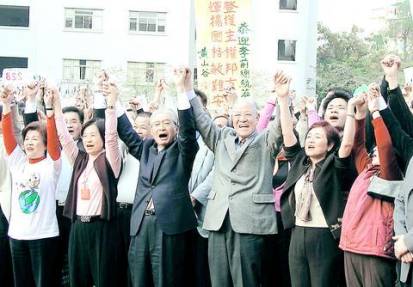
Former president Lee Teng-hui joins hands with members of the public during a visit to Kaohsiung Municipal Girls' Senior High School on Feb. 15.
-----------------------------------------
On Feb. 23, 2004 ……
Private eyes flourishing in China
SNOOPING AROUND: As China privatizes and Beijing loses some of its central control, certain duties that used to be carried out by police are done now by private firms, though their legal status is not clear
AFP, SHANGHAIS
Snooping into citizens' personal affairs, an activity once conducted by China's Kafkaesque network of Communist Party police, informants and traditional neighborhood committees, has, like so many other institutions in the country, been pushed in the direction of privatization.
Out of the upheaval of China's massive economic transformation that has set the country on course for full-fledged capitalism, the self-appointed state role of Big Brother is now being subjugated to the rules of the marketplace.
While China is by no means about to mount a private police force, its rapid modernization has pried open the door of opportunity for private eyes.
Rising crime, ranging from serial killings to drug trafficking to human smuggling, has forced China's over-stretched police to relinquish some of its once-formidable Gestapo-like power it used to exert over it citizenry.
Stepping into that policing vacuum are the growing ranks of well-paid gumshoes, who by unofficial estimates have swelled to more than 10,000 full-time Sherlocks.
In ancient China, wealthy traders used to hire the equivalent of today's modern detective agencies to help them transport goods and ensure personal safety.
Today, as China's economy booms but commercial laws remain opaque, fraud remains common and legal recourse remains hamstrung, the need for swindle-preventing information is paving the way for a renaissance of investigative firms.
"There is lots of demand in the investigation market, and we have plenty of room to develop, especially after China's entrance into the World Trade Organization," said Long Hao, general manager of Shanghai Zhiyuan Investigation, an outfit that focuses on corporate clients.
"Lots of foreign companies are rushing into China, and they are eager for the detailed information about China -- about their joint venture partners, their investment environment."
Corporate reconnaissance, insurance fraud, smuggling and kidnapping are all cases that China's estimated 1,800 private-investigator firms have been called upon to investigate.
"Sometimes the government's strength is not equal to its ability when it comes to the protection of intellectual property and fighting smuggling," said Zheng Yi, assistant to the chairman of the China Investigation Alliance, a quasi-regulatory body of Chinese investigation companies.
"The folk in these investigation companies are badly needed in these kinds of situations, and they contribute a lot to retrieving economic losses," he said.
Wearing dark sunglasses and incessantly looking around as if somebody might suddenly attack from behind, Sun Ping, a former Public Security Bureau (PSB) officer, said the work can be risky.
"Dangerous enough to make you hesitate and even hold back. You are [often] facing a group of desperados," says the 40-year-old former cop now working for one of China's more well-known agencies, Kedun Detectives in northern Liaoning province.
But the potential risks did not deter the 1.8m Sherlock Holmes fan from quitting his job at the PSB 10 years ago.
"I was obsessed with the idea of being a detective," he said.
Despite a very murky legal status, some 1,000 small private-eye outfits have sprouted up around the country in the previous two years or so, according to unofficial statistics.
Sleuth firms were banned only in name by the central government in 1993, after 39-year-old detective Huang Lirong was beaten to death by the owner of the herbal medicine shop he was investigating, according to state media.
Agencies then won greater legal status after a 2002 court ruling, although in reality hawkshaws continued to ply their trade as "consultants."
"It's legal to run an investigation company, as Chinese law doesn't explicitly forbid it," Zhang said.
Like some of his more disreputable counterparts in the West, Zhang spends a significant amount of time videotaping cheating spouses, which according to Chinese law is a legal means of proving infidelity.
To help women take advantage of a recent law that allows women filing for divorce to win greater financial compensation if husbands are found cheating, the Chengdu Debang Investigation company, employing 16 female investigators, opened last week in southwestern Sichuan province.
"More and more women are suffering from unfair treatment from their husbands ... that's why the center was opened," investigator Liu Li said by telephone from Chengdu.
"It's hard to imagine that there are so many husbands who have extramarital wives," she said.
-----------------------------------------
On Feb. 23, 2004 ……
War prevented another Pearl Harbor: Howard
"If you wait for perfect proof,
I've said it before, I said it a year ago, you would have another Pearl
Harbor." --- John Howard, Australian prime minister
AP, SYDNEY
Australian Prime Minister John Howard yesterday said that if the US and its allies had waited for definitive proof that Iraq had weapons of mass destruction, they would have faced "another Pearl Harbor."
Howard has come under fire from opposition lawmakers for his decision to send troops to fight alongside US and British forces in last year's invasion of Iraq based on intelligence reports that Saddam Hussein's regime was stockpiling weapons of mass destruction.
But he remains adamant he was right, even though no such weapons have been found.
"If you wait for perfect proof, I've said it before, I said it a year ago, you would have another Pearl Harbor," Howard told Australian Broadcasting Corp television.
A report from a Senate inquiry into the prewar intelligence that prompted Howard's troop deployment is to be released March 1. According to leaked excerpts, the report calls for a broader probe into flawed intelligence but clears Howard's administration of overstating the threat that Iraq posed.
But despite the apparent criticism of Australia's intelligence agencies, the government has no plans to expand its spy network, the attorney general said yesterday.
Canberra bolstered the country's domestic spy agency -- the Australian Security Intelligence Organization (ASIO) -- in the aftermath of the Sept. 11 attacks and doesn't need more agents, Philip Ruddock said.
"There's been a substantial increase in ASIO resources and there's been a substantial increase in the number of staff employed," he told Australian television's Nine Network. "ASIO has received very considerable additional resources and ... it's recruiting people that it needs."
Also yesterday, Howard said he wouldn't change the law to allow two Australian terror suspects being held by US forces to be sent home for trial.
The opposition Labor Party called Friday for new anti-terror legislation to be backdated to allow David Hicks and Mamdouh Habib to be tried in Australia.
Hicks and Habib are among hundreds of terror suspects being held at a US military prison camp in Guantanamo Bay, Cuba.
"It's fundamentally wrong to make a criminal law retrospective," Howard told Australian television's Nine Network.
"We don't support that and we won't support that," he added.
Hicks, a former Australian cowboy, was detained in Afghanistan late in 2001 for allegedly fighting for the Taliban. He is to appear before a US military commission to answer accusations that he is a "foreign combatant."
Habib was arrested in Pakistan and is alleged to have trained with Osama bin Laden's al-Qaeda terror network. His family says he was in Pakistan looking for a school for his children.
-----------------------------------------
On Feb. 23, 2004 ……
A new identity without a new state
`The strengthening of such a new identity will help increase social and civic awareness and to consolidate the Taiwanese people's unity. It will also create the economic value of differentiation in the global competition. Civic awareness will further change Taiwan's political culture and distinguish democratic Taiwan from dictatorial China in the international community.'
By Cho Hui-wan
The referendum issue has entered yet another phase. The government has rewritten the referendum questions -- from the original demand for China to withdraw its missiles deployed along its coastal areas -- to whether Taiwan should purchase more advanced anti-missile weapons, and establish a cross-strait confidence-building mechanism.
But the alliance of Chinese Nationalist Party (KMT) Chairman Lien Chan and People First Party (PFP) Chairman James Soong questions whether this referendum meets the criteria for the president to hold a "preventive referendum." They believe President Chen Shui-bian has acted in contravention of the law.
Obviously, the government switched
the focus of the referendum questions from China to ease massive US pressure.
But Washington repeatedly stresses that its concern is about Taiwan's
intentions in holding a referendum. The US still opposes the referendum if
Taiwan's intention is to set a precedent for a future referendum on Taiwan
independence.
What is the Taiwanese people's reaction to this significant event? They hope both the presidential election and the referendum will be over soon. After months of wrangling between the two camps, this reaction is normal. Still, the dispute over Taiwan's future will not end after the presidential election. Moreover, the differences in the candidates' views can push the populace to think about Taiwan's future.
After Chen proposed the referendum and a new constitution, he not only caused an uproar in Taiwan, but also shocked the US, which immediately expressed its concern. But the government, backed by public support, became even more aggressive. Some therefore predicted that Washington would give Chen the cold shoulder during his US stopover last November. Surprisingly, Chen's "glorious trip" ended gloriously. Not only did he receive a human rights award, deliver a speech and attend large-scale banquets with overseas Taiwanese, but New York dignitaries like Mayor Michael Bloomberg did not shy away from the media after meeting Chen. I interpret this reception as a US policy of "a new identity without a new state."
China's economy is growing rapidly and its military power is expanding. Its influence on Northeast and Southeast Asian countries has increased significantly, making it a challenger to the US hegemony in Asia. Before his US visit, Chen already made it known to the US government that he would reiterate his "five noes" publicly, making clear that the proposed referendum and new constitution would only deepen and institutionalize democracy.
Since Taiwan was not proposing a new state, and because it would be more able to tug at China's elbow with its new constitution and new identity, the Bush administration, with a hawkish ideology, supported Taiwan's posing a challenge to the Chinese Communist Party (CCP) to some degree.
Chen's election momentum received a great boost after his visit. To reverse the trend, the blue camp decided to support the referendum. Before the Referendum Law was passed by the Legislative Yuan, Washington strongly pressured Taipei to ensure that Taiwan would only pursue a new identity and not a new state.
Unexpectedly, Chen made a further move, demanding that the government hold a "preventive referendum" on election day. Beijing, already nervous when the blue camp stopped insisting on the "one China" principle, believed that a referendum would be a prelude to Taiwanese independence. To avoid repeating the mistake of arousing bad blood among the Taiwanese people by direct military threats, which previously boosted the "reactionary" forces, Beijing tried to pressure Taipei through Washington.
Taiwan's democracy and a new
constitution will increase its international visibility and help the US contain
China. But if Taiwan wants to build a new state, it will provoke a military
conflict with China and inevitably drag the US into the fight. This is not a
situation that the US is pleased to see at a time when it is busy dealing with
the reconstruction of Iraq and North Korea's nuclear threat. US President
George W. Bush therefore issued a serious warning during Chinese Premier Wen
Jiabao's visit that Chen should not attempt to change the status quo in the
Taiwan Strait unilaterally.
When both Taiwan's biggest threat and its most important protector are issuing warnings, it is time for the Taiwanese to think about their future.
Both camps say that they will provide a better future for the Taiwanese people. But where is Taiwan's future? Where are the blueprints of the candidates?
Does Taiwan's future lie in the pursuit of a normal "state"? Can the US policy of "a new identity without a new state," which is consistent with US interests, also gain optimum interests for the Taiwanese people?
Taiwan independence activists know that, with its military power growing by the day, China will enjoy military supremacy across the Taiwan Strait by 2010. They also believe that China is unlikely to attack Taiwan before the 2008 Beijing Olympics, which is considered a symbol of peace. If Taiwan does not promptly accomplish its independence before 2008, the chance of success will be slim in the future.
Nevertheless, international political observers all agree that although China understands the high price for attacking Taiwan, and hence will try to avoid it, Beijing will definitely be "forced" to use force should Taiwan declare independence.
In addition to the threat of military destruction, can Taiwan continue to prosper in the highly interactive and competitive globalized economy if it is cut off from one-fourth of its export market and disconnected from the world's largest market, even if it really accomplishes independence?
Due to the asymmetry in political clout and geographical size, and the difference in economic growth rates, people may fear that time is on China's side. Don't forget: The economic gap between China's urban and rural areas, and between its coastal and interior areas, as well as the gap between economic and political freedoms have all created pressure for China to change. The competition between Taiwan and China does not exist in isolation.
I believe that "a new identity without a new state" can be Taiwan's strategy in the short to medium term. The so-called "new identity" is not only international but also domestic.
The cultural revival policies of the local and central governments over the past few years -- such as teaching materials on local geography and culture, native language courses, and community-building -- have produced results. The public now have a deeper understanding of their hometowns and cultures, and are more willing to devote themselves to the cause.
The strengthening of such a new identity will help increase social and civic awareness and to consolidate the Taiwanese people's unity. It will also create the economic value of differentiation in the global competition. Civic awareness will further change Taiwan's political culture and distinguish democratic Taiwan from dictatorial China in the international community.
For the time being, Taiwan's interests lie in ensuring the continued existence of its ability and right to choose, or even creating room for other possibilities besides unification and independence. Wholehearted consolidation of a new identity is a practical and feasible direction for Taiwan. It is also welcomed by its most important supporter.
Cho Hui-wan is an assistant professor in the Graduate Institute of International Politics at National Chung Hsing University, and is currently a visiting professor at Duke University.
-----------------------------------------
On Feb. 23, 2004 ……
-----------------------------------------
On Feb. 23, 2004 ……
You can always vote no
At first we were tempted to write off those standing against the government's representatives in the referendum debates as the shameless has-beens and opportunists that most of them are. But then we should probably be glad someone is going to do this. After all, the pan-blue camp never tells the truth about its opposition to the referendum, namely that it is motivated by deference to Beijing's wishes. Rather it seeks to portray the referendum as illegal, which it quite obviously is not, or else the pan-blues would have mounted a legal challenge to it already; or simply pointless, asking questions about which there could be no disagreement. It's true that the questions are a little bland, though the fault for that lies with Washington, where the questions were all but drafted, rather than the government here. But if the pan-blue criticism of the seriousness of the questions is to be refuted, the best way to achieve that is to see a lively debate about them.
It is hard to predict what the antis are going to say in the debate, especially given that we have no final list of who they will be. But last Wednesday one would-be debater, Lo Chih-chiang of the Chinese Speech and Debate Association, drew attention to the fact that there were a number of different positions that could be taken apart from either not voting at all or voting yes. Good, though we disagree with the positions that Lo himself has taken.
The two questions are, as you are probably weary of hearing, whether Taiwan should increase spending on anti-missile defense and whether Taiwan should open some kind of negotiations with China.
Actually there are respectable "anti" positions on these questions, takers of which should run no risk of being labelled a stooge of China -- the common fear of the antis.
For example, do the kind of anti-missile defenses that Taiwan might buy actually work? The only really mature system is the Patriot PAC-3 and it has yet to be shown that this is effective. Remember how the first Patriots were praised during Gulf War I by the US Department of Defense, only for us to find out later on that they were utterly useless and probably never downed a single missile?
Then again, there is an old military maxim that the best means of defense is offence. We have seen a number of senior officers, both serving and retired, question Taiwan's devotion to missile defense against China's missiles, when a far more effective deterrent might be to create missiles of our own. Those who deplore any resulting arms race should take note that China can only threaten Taiwan because it runs no risk of retaliation. Up the risk factor to China and you might even bring it to the negotiating table.
Which brings us to the second
question. Should Taiwan talk to China? What for? Because its businessmen have
invested there? This has been going on for 15 years without discussions and it
doesn't seem to have been a handicap, looking at the investment figures.
Obviously there is nothing wrong with Taiwan and China sitting down together if
each is prepared to respect the other and negotiate in good faith. Experience
suggest that this is impossible with the communists. They will not respect
Taiwan. Why Taiwan should offer goodwill in order to be ritually humiliated is
a question that the "yes" voters should try to answer. What does that
Taiwanese ultranationalist Lee Teng-hui really think of the second question?
So there are arguments against and it would be a good thing for the referendum process to hear them. But whatever the result of the referendum, as we said last week, the most important thing is to have it. It is, as we said before but cannot say too often, the turnout alone that matters.
-----------------------------------------
On Feb. 23, 2004 ……
Hand-in-Hand Rally paves way for the rest
By Peter Wang
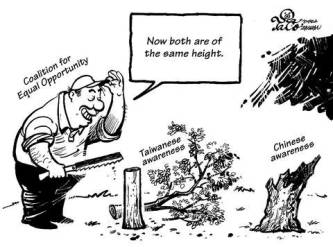
On Sept. 6 last year, more than 150,000 people converged in front of the Presidential Office under the blazing sun to take part in a demonstration calling for a change to Taiwan's official name. This massive march was organized by the Alliance to Campaign for Rectifying the Name of Taiwan, under the leadership of former president Lee Teng-hui.
The alliance planned to hold another 500,000-people demonstration on Mother's Day this year. But when I, along with the alliance's co-conveners, reported on the campaign to Lee, he reacted by saying that the March 20 presidential election will be the most important battle in the fight to safeguard local political power and that only then can we smoothly push forward a campaign to change Taiwan's official name.
Moreover, to help passionate supporters in southern Taiwan avoid the hardship of long journeys and to avoid wasting transportation resources, a provisional organization was established on Oct. 31 last year and the proposal by its secretary general Lee Ying-yuan was passed to hold a human chain rally.
I was instructed to inspect the planned event route. I and other staffers started off from Hoping Street on Hoping Island from the northern tip of Taiwan and traveled all the way down to the south along the north-south provincial highways. When we came to Huilung and Kueishan in Taoyuan and Hsinchu's Hukou Township, especially the sparsely populated areas in Miaoli, our blood ran cold and our palms started to sweat. We really thought that mobilizing a million people to form a hand-in-hand human chain along the roads in these remote areas is an impossible task.
When we came to Pingtung City and realized that the terminal point is on Chienkuo Road, we shouted unanimously in joy -- Hoping to Chienkuo (literally "peace" to "nation-building" in Chinese). Such a coincidence must be God's will!
Traditionally, in mass activities, the number of participants -- a few more or a few less -- is not the decisive factor in a rally's success. But in the million-people hand-in-hand campaign, no gap is allowed along the 500km-long route. Publicity and mobilization are required. Organizational work must be closely integrated. In particular, the grouping method used by combat troops is required to ensure the rally's success.
Luckily, Tainan County Commissioner Su Huan-chih, from President Chen Shui-bian's home town, gave 100 percent support by taking the lead in mobilizing 80,000 people in a successful rehearsal on Feb. 1. This has boosted morale and phone calls come through in endless streams from people who want to register with local campaign offices. People are determined to join in this activity to write a new page in history.
On the afternoon of Feb. 28, all the ethnic groups shall unite forces and the Taiwanese people shall stand up and line up along the north-south provincial highways for the hand-in-hand rally. Let our motherland Taiwan stand up -- this is the first goal. Then we Taiwanese people must express our demand for peace and rejection of missiles, practicing direct people power on March 20 to extend all-out support for the peace referendum. Let people be their own masters -- this is the second goal.
At the same time, we shall safeguard the native political power and support Chen's re-election bid. This is the third goal.
After the Taiwanese people have achieved these three goals, the projects to create a new constitution and rectify Taiwan's official name will be completed naturally.
Peter Wang is chief executive of the Alliance to Campaign for Rectifying
the Name of Taiwan.
-----------------------------------------
On Feb. 23, 2004 ……
Lien playing judge, Chen says
DEBATE: The president said the KMT chairman had no right to decide whether the referendum on March 20 is illegal, saying it was up to grand justices to make that call
By Huang Tai-lin, STAFF REPORTER
President Chen Shui-bian yesterday accused Chinese Nationalist Party (KMT) Chairman Lien Chan of being selfish and "playing judge" after his pan-blue opponent said he would boycott the referendum.
"It is an act of selfishness that Lien Chan said he would not pick up his referendum ballots yet at the same time asks others to vote for him [in the presidential election]," Chen said.
During Saturday's election debate, Lien, representing the KMT-People First Party (PFP) alliance in the presidential race, said that while he respected others' decision on whether to cast ballots, he would not be voting in the March 20 referendum, calling it illegal.
"What is an illegal referendum? Who has the right to call it an illegal referendum?" Chen asked. "Whether a referendum is legal should be left for the grand justices to decide."
"You [Lien] cannot claim yourself a judge and declare that something is illegal," Chen said.
Chen said the people of Taiwan should support the March 20 referendum in order to score a victory for the country.
"It would be a victory for China's Communist Party if the referendum fails," he said.
Chen also criticized the system endorsed by the KMT-PFP alliance of granting 18 percent interest rates to retired military personnel, civil servants and teachers.
"Why does Lien favor the 18 percent interest rate? Because he, as a former vice president, is the recipient of an 18 percent interest rate," Chen said at a meeting with labor union supporters in Taipei yesterday.
"[With the preferential rate] Lien gets a monthly income of approximately NT$400,000, which is more than [the monthly income] of Vice President Annette Lu," Chen said.
Meanwhile, Lien, branding Chen as capricious, said yesterday that more rounds of debate would be like "a bad drama that just doesn't know when to end."
At the end of Saturday's debate, Chen invited Lien to participate in another two debates. Lien then shied away from giving a definite answer.
Citing a poll that said 54 percent of respondents thought there was no need to have further debate, Lien said, "It is hard to focus on issues while debating with Chen because Chen is so inconsistent. I don't see the need to carry on a bad drama."
While the pan-blue camp's big boss declined more debate with Chen, Lien's campaign aides said yesterday that they would visit the Democratic Progressive Party (DPP) today and request a debate between the two camps' youth departments on enlistment.
During Saturday's debate, Lien proposed that young people perform only three months of national service and that the country abandon conscription.
Chen, pointing out that Lien's son has not done his military service, said conscription cannot be scrapped just because certain individuals do not want to do their military service.
Meanwhile, polls showed Chen and Lien were still neck and neck after Saturday's debate.
A poll conducted by the Chinese-language China Times indicated that 37 percent of viewers felt that Chen was more eloquent and quick-witted than his opponent, who received an approval rate of 28 percent.
A survey by the United Daily News suggested that 39 percent of viewers favored Lien's performance, while 38 percent thought Chen was a better debater.
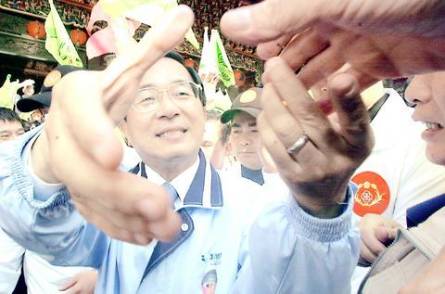
President Chen Shui-bian shakes hands with supporters during a ceremony at the Kuangchao Temple in Taipei's Wanhua District yesterday.
-----------------------------------------