20040224
=======
Love Taiwan on Feb. 24, 2004 ……
Chen invites election rivals to join human chain at 228 protest
By Chang Yun-ping, STAFF REPORTER
President Chen Shui-bian invited Chinese Nationalist Party (KMT) Chairman Lien Chan and People First Party Chairman James Soong to join the "228 Hand-in-Hand Rally" to protect Taiwan through peace and to heal ethnic tensions from the past.
"I would like to invite my respected rivals Mr. Lien and Mr. Soong to join me and Vice President Annette Lu in this event to protect Taiwan from external threats and from becoming a local government of somewhere else," Chen said yesterday at a press conference in Penghu.
Chen yesterday invited everyone in the nation, regardless of ethnic background, to join the human chain on Saturday.
He also encouraged people from Taiwan's island territories, such as Penghu, Kinmen and Matsu, to join the event.
The chain, which protests against China aiming nearly 500 missiles at Taiwan, will start from Hoping Island off the northern tip of Keelung and finish at Oluanpi in Pingtung County, stretching more than 500km along the west coast.
The rally was also intended to
facilitate ethnic reconciliation, Chen said.
"The hatred and prejudice that have resulted from the ethnic conflicts of the past will only come to an end when people are willing to embrace each other with love and understanding," Chen said.
"Some politicians weren't able
to face their confusion over their national identity, so much so that they
treated ethnic difference with hatred and hostility. This situation hasn't
changed over these decades and may not change. But hatred does not bring an end
to the tension; we must come to reconciliation," he said.
Chen also said that the event would demonstrate the people's desire for peace to both the international community and the Chinese government.
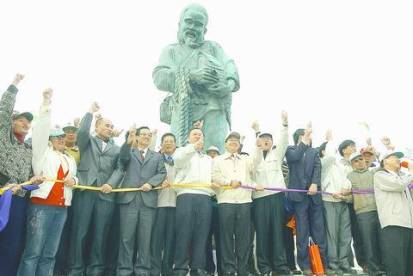
President Chen Shui-bian joins Penghu residents beneath a statue of a fisherman during a campaign stop in the island county yesterday.
-----------------------------------------
On Feb. 24, 2004 ……
Voters across the Strait belt out the blues
"The businessmen will not be
able to mobilize a large number of voters to go home. Only those who happen to
have their vacations coincide with the date of the presidential election will
actually go home to vote." --- Yen Wan-ching, deputy
secretary-general of the Straits Exchange Foundation
POLITICAL SPECTRUM: It's no secret that most China-based Taiwanese businesspeople support the blue camp. The question is how many will make the trip home to vote for the alliance
By Melody Chen, STAFF REPORTER
For the Democratic Progressive Party (DPP), there is one group from whom they do not expect support in the March 20 presidential election -- China-based businesspeople.
Their number, according to the Ministry of Economic Affairs, is about 650,000.
The figure covers only registered businessmen. The semi-official Straits Exchange Foundation (SEF), which handles cross-strait affairs, estimates there are 800,000 to 1.2 million Taiwanese businesspeople in China.
With about 12 million votes cast in the 2000 presidential election, analysts have been asking whether the million-strong Taiwanese business community in China could swing this year's election result.
This question has been reverberating in the minds of campaign managers from the DPP and the blue-camp alliance of the Chinese Nationalist Party (KMT) and the People First Party (PFP).
Even if the demographic's votes are insufficient to alter the election outcome, earning the community's support would still be a symbolic victory for the presidential candidates.
Even Chinese President Hu Jintao has courted these businesspeople by personally receiving them as VIPs in Beijing last December.
Both the blue camp and green camp are vying for the businesspeople's endorsement. Taiwan and China are also competing for their support. President Chen Shui-bian likened the group to his daughter in a gathering with the businesspeople earlier this month.
Chang Rong-kung, head of the KMT's mainland affairs department, believes China-based Taiwanese businesspeople could help his party return to power.
"More than 600,000 of the businessmen are eligible to vote. They can also solicit ballots [for the KMT] from their families, relatives and friends living in Taiwan," Chang said.
"The business community altogether may represent more than a million votes," he added.
Having campaigned for KMT Chairman Lien Chan in many Chinese provinces over the past six months, Chang was confident that about 70 percent of the businesspeople would vote for the blue camp.
Chang said the KMT has been listening to the group's opinions in order to shape the party's cross-strait policies. The three cross-strait links -- transportation, postal service and trade -- are the most urgently needed policy, he said.
The KMT is helping the businesspeople book air tickets to return to Taiwan for the election, said Chang, who set up many of his party's liaison offices in Chinese cities.
The KMT and PFP have been careful not to do anything to displease China in their campaign there, Chang said.
In contrast, Chen Chung-hsin, Chang's DPP counterpart and a legislator, did not go to China to seek support from the business community.
"It is easy for Chang to go to China because Beijing would give him permission. But it is very difficult for DPP officials to get China's permission to go there," Chen Chung-hsin said.
Complaining about Beijing's unequal treatment of KMT and DPP officials, Chen Chung-hsin nevertheless said he would not travel to China for campaign purposes even if China gave him permission.
"I don't want DPP supporters' identities exposed," Chen Chung-hsin said.
"Chang has spent most of the past six months in China and returned to Taiwan only occasionally, as if China is his hometown and Taiwan only his holiday destination," Chen Chung-hsin said.
Blacklisted
Last year, the Mainland Affairs Council invited Chen Chung-hsin to join a Taiwan National Day celebration in Hong Kong on Oct. 10.
"They [Hong Kong] would not grant me a visa until the afternoon of Oct. 9. You can see how difficult it is for me to be permitted entrance, even in Hong Kong," Chen Chung-hsin said.
Asked whether he is worried the DPP's support among the China-based Taiwanese business community may lag far behind the blue-camp's, Chen Chung-hsin said if this is the case, he could do nothing to reverse the situation.
"We will do our best, anyway. What else can I do?" he asked.
DPP backers in China know that revealing their political orientation would only bring them trouble. The SEF reported cases of pro-DPP Taiwanese businessmen being harassed by Chinese officials after the 2000 election.
Chen Chung-hsin said he did not know based on what evidence the blue camp boasted it could secure 70 percent of China-based Taiwanese businesspeople's votes.
"If they are happy to believe that's the case, let them be," Chen Chung-hsin said.
"To be honest, I really don't know how many votes the China-based Taiwanese business community can contribute to this election. But I am sure the blue camp's claim that the votes could be more than million is an exaggeration," Chen Chung-hsin said.
The number of China-based Taiwanese businesspeople who returned to Taiwan to vote in the 2000 election was reported to be from 2,000 to 20,000, but the exact count was unavailable.
In the election, the DPP needs to be realistic, Chen Chung-hsin said, acknowledging that Chen Shui-bian's failure to implement direct links has caused widespread discontent among the Taiwanese business community.
Realistic strategy
While the DPP estimated the votes it might be gaining from different ethnic and social groups, it presumed it would not have any votes from China-based Taiwanese businesspeople.
"We want to calculate votes in a way that is closest to reality so that we may shape the right campaign strategy," Chen Chung-hsin said. "Any votes from the China-based business community will be viewed as added value to our campaign."
The definition of a China-based Taiwanese businessperson is unclear, said Yen Wan-ching, SEF deputy secretary-general.
"That's why it is so difficult to count their exact number," he said.
Yen divided the China-based Taiwanese business community into three groups.
The first group is Taiwanese businesspeople who moved to China in the early 1990s for China's cheap labor and burgeoning market as Taiwan's manufacturing sector, the so-called "sunset industry," began to decline, particularly in central and southern Taiwan.
While the businesspeople were often owners of small and medium-sized businesses in Taiwan, Yen said, they grew in China such that their products now boast a 30 to 40 percent share of the global market.
Many of these businessmen are no longer who they were when they moved to China. Nowadays they are kings in their separate manufacturing sectors in the world market. They make toys, umbrellas, screws, lamps and many other products," Yen said.
"They are making global industries and they have global vision," Yen said.
The second group is tycoons and major industry owners who began investing in China in recent years. The group includes high-tech industries, many of which still base their headquarters in Taiwan but set up their manufacturing in China.
"Their management and production lines are closely connected with the Chinese market," Yen said.
The third group is small store owners, Yen said. These people sell food and groceries.
"They are the group of people that the government's [cross-strait] policies have little impact on," Yen said.
Yen estimates the number of businesspeople who can afford to return to Taiwan to vote would not exceed 50,000 due to the restricted number of airline tickets and their leave arrangements.
"The businessmen will not be able to mobilize a large number of voters to go home. Only those who happen to have their vacations coincide with the date of the presidential election will actually go home to vote," he said.
During a Lunar New Year conference hosted by the SEF for leaders of China-based Taiwanese businesspeople in Tainan earlier this month, the businesspeople asked Premier Yu Shyi-kun to do something to reform their image in the public's eye.
They understood their close relationships with China have caused some to question whether they still regarded themselves as Taiwanese or whether their business interests have made them more pro-unification.
Yen said it is difficult to judge whether China-based Taiwanese businesspeople's political orientation and recognition of their nationality has shifted as a result of their long-time residence and work in China.
Their urgent need for direct links may have switched their support to the blue-camp, which has enjoyed more cordial terms with China. However, it is also possible that their actual experience of living in China made them more aware of the differences between China and Taiwan.
"They may come to realize that China and Taiwan are different countries with different political systems and be convinced that Chen Shui-bian's `one country on each side' of the Taiwan Strait is the reality," Yen said.
Tony Cheng, chairman of the Taiwan Merchants Association in Shenzhen, says it is impossible he would confuse his view of who he is because he does business in China.
Cheng, who will be returning to Taiwan to vote for Lien, said he has no doubt he is Taiwanese.
"Taiwan's political system is fundamentally different from China's. When I retire, I will return to Taiwan. Taiwan has democracy," he said.
"We have no identity cards in China," Cheng said.
`Gray zone'
He said he would vote for the blue camp because its cross-strait policies are more likely to bring peace and stability between Taiwan and China.
"The last thing we would like to see is instability in cross-strait relations," Cheng said.
Chen Shui-bian, who insists on Taiwan's sovereignty, would not accept Beijing's demand to accept the "one China" principle as the precondition for both sides to open talks.
Frustrated by the president's handling of cross-strait relations, Cheng said Lien's proposal to "shelve Taiwan's sovereignty disputes" to seek negotiations with China may be feasible.
"We need to tolerate a `gray zone' in dealing with cross-strait affairs. Chen Shui-bian's zero-sum persistence simply does not work," Cheng said.
In Shenzhen, the number of Taiwanese businesspeople and their families amounts to around 80,000 and about 40,000 of them are eligible to vote.
"We hope to recruit at least 20,000 people to return to Taiwan to vote," Cheng said.
"We are the minority in Taiwan's electorate. But we are the crucial minority," he added.
Ho Fang-wen, president of Zhaoqing Taiwanese Businessmen Investment Enterprises Association in Guangdong, also said doing business in China has changed neither his political stance nor his perception of his nationality.
"I will come home to vote … but I won't say for whom," Ho said.
Hector Yeh, president of the Association of Shanghai Taiwan Businessmen Invested Enterprises, said that since he became eligible to vote, he has always supported the KMT.
He accused the DPP and the pro-independence Taiwan Solidarity Union (TSU) of being hostile to the China-based Taiwanese business community and said he would not expect such parties to implement policies that would benefit them.
Hostility
The DPP and TSU admit that some members in their parties dislike the businesspeople.
"We are not hostile to all of them, but we don't like some business leaders who urged [us] to put aside Taiwan's sovereignty in order to launch the three links," said TSU Legislator Lo Chih-ming.
The TSU also dislikes businesspeople who left their debts in Taiwan and invested their money in China, Lo said.
Formosa Plastics Group Chairman Wang Yung-ching, who has invested huge sums in China in recent years, is one of the bad examples of businesspeople who have bowed to China and opposed Taiwan's referendum, Lo said.
While China banned a KMT liaison office in Shanghai in order to avoid the allegation that it interfered with Taiwan's presidential election, a Shanghai businessman has been quietly encouraging his compatriots to return to Taiwan to vote.
Eric Teng, president of Shanghai's Broadway Plaza Hotel, organized a "Love and Peace Initiative" to help Taiwanese businesspeople book plane tickets to go home for the election.
Teng stressed his organization has not taken political sides.
While China closed the KMT liaison office in Shanghai, Teng's organization continued without being harassed by Chinese officials.
"Our activities are not politically motivated," he said.
Businesspeople are eager to go home to vote this time because over the past four years they felt "somehow the government did not pay enough attention to them," Teng said.
Businesspeople signing up to Teng's initiative came mostly from the Yangtze River Delta. Deng said his organization serves people regardless of their political orientation.
"We serve both blue-camp and green-camp backers," he said.
Teng's organization does not accept any political parties' donations and it refuses to "meddle with any parties," Teng said.
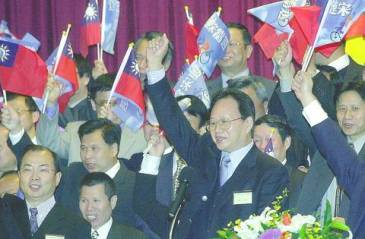
A support group of China-based Taiwanese businesspeople was established yesterday to campaign for Chinese Nationalist Party (KMT) Chairman Lien Chan and People First Party Chairman James Soong, at KMT headquarters in Taipei. The head of the group, Chang Han-wen, second right, leads members in chanting in support of the blue-camp candidates.
-----------------------------------------
On Feb. 24, 2004 ……
Connery battle boils over
FROM SOONG WITH LOVE: The PFP claimed that it had played a key role in convincing the veteran actor to avoid coming to Taiwan for the 228 rally
By Huang Tai-lin, STAFF REPORTER
Members of the Hand-in-Hand Taiwan Alliance yesterday lodged a protest in front of the opposition People First Party's (PFP) headquarters in Taipei, demanding an apology from party chairman James Soon for supposedly hindering Scottish actor Sean Connery from coming to Taiwan and taking part in the alliance's rally.
The protest was in response to PFP spokesman Hwang Yih-jiau's statement on Saturday that the award-winning actor's decision not to take part in the rally was a result of advice by the PFP. Connery's agent, however, said on Friday that the award-winning actor and Scottish-independence activist never intended to join the rally.
However, this statement from the actor's official representative appears to have had little impact on the growing controversy over his non-visit.
"[The rally] has nothing to do with politics but is just a happy linking-of-hands event in Taiwan," said Peter Wang, deputy executive director of the Hand-in-Hand Taiwan Alliance.
"Yet [Soong] came out to meddle in the event and make it a blooper in the eyes of the international community. James Soong should come forth and apologize to the people of Taiwan, and he should apologize to Sean Connery as well," Wang said.
Connery -- famous for his role as the original James Bond, among other notable roles -- was rumored last Thursday to be coming to Taiwan to join the "Hand-in-Hand Rally" slated to take place on Feb. 28. The rally, a human chain that organizers say will stretch across the island over a distance of more than 500km, is meant to protest China's targeting of Taiwan with missiles.
Hwang, who also serves as the spokesman of the pro-unification Chinese Nationalist Party (KMT)-PFP alliance, toned down his remarks yesterday, saying that Connery's decision not to join the Hand-in-Hand rally was strictly his own.
"It was based on the principle that we wished Connery not be misled and manipulated by the Democratic Progressive Party (DPP) that the PFP, via its channels, explained to him the truth and essence about the rally -- that the event involves Taiwan's election," Hwang said at a press conference at the alliance's national campaign headquarters.
"Out of respect for Taiwan's domestic election, it was Connery's decision not to come to Taiwan, and not one that resulted from any demands or hindering from the PFP," Hwang said.
Saying that the people of Taiwan hoped that Connery will one day visit Taiwan, Hwang said that both the alliance's presidential hopeful, Lien Chan, and his running mate Soong had promised that the alliance would invite Connery to take part in Lien's presidential inauguration this May as a guest of state if the Lien-Soong ticket won the election.
Charles Chen, president of the Madielih International Corp, told the Taipei Times in a phone interview yesterday that it was due to "political influence" that Connery canceled his rumored plans to take part in the 228 rally.
Stating that he had become acquainted with the James Bond star when he helped finance the production of Connery's 1995 movie, Entrapment, Chen said he had made a phone call to Connery on Sunday.
Chen said that during their phone conversation, which lasted for approximately 20 minutes, the actor told him that he had been invited to the 228 rally and had originally planned to come to Taiwan and take part in the event.
"While [Connery] refrained from making a clear explanation, he stated that it was because of political influence that he decided to cancel his plan [to take part in the event]," Chen said.
Although he is a registered member of the KMT, Chen said that he had no intention to meddle in political affairs as he regarded himself as strictly a businessman.
"Politicians should put aside their self-interest and party line and do what's good for Taiwan as a whole on the global stage," he said. "It's a shame that Taiwanese politicians are using domestic politics to become a laughing stock of the international community."
According to Chen, Connery would visit Taiwan "at a more appropriate time" later this year.
Meanwhile, stating that she was also a fan of Connery, first lady Wu Shu-chen yesterday expressed regret that Connery will not be coming to Taiwan to take part in the rally.
"What isn't good about having Connery come to Taiwan? For then he can get to learn more about Taiwan and have an accurate impression of our country," Wu said. "I don't understand why someone would take pride in saying that they had prevented [Connery] from coming to Taiwan."
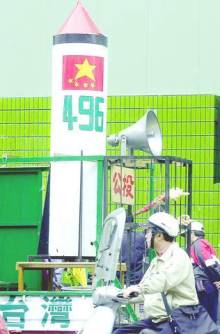
A man riding a motorcycle passes a mock Chinese ballistic missile as a group of supporters of the Democratic Progressive Party (DPP) unfurl a banner in front of the headquarters of the opposition People First Party (PFP) in Taipei yesterday to protest against PFP Chairman James Soong's alleged efforts that led to the scrapping of a visit by Hollywood star Sean Connery. The DPP said earlier Connery would attend the 228 Hand-in-Hand Rally sponsored scheduled for Feb. 28, but the report was rejected by Connery's agent. A PFP spokesman said Soong had played a role in stopping the visit.
-----------------------------------------
On Feb. 24, 2004 ……
Seoul sets goals for N Korea nuclear talks
"A freeze is meaningless by
itself ... It is only meaningful when it is the first step towards
dismantlement." --- Lee Soo-hyuck, South Korea's deputy foreign
minister
THREE-STAGE PLAN: The proposal for ending the impasse over Pyongyang's atomic-bomb program is a refined version of what the South presented last August
REUTER, BEIJING AND SEOUL
South Korea agreed plans yesterday with the US and Japan to freeze and dismantle North Korea's nuclear programs while China and Russia reached a separate consensus, two days before six-way talks on the crisis.
Analysts hold out scant hope of a breakthrough at the talks starting tomorrow, citing lack of trust between the two protagonists -- the US and North Korea -- in ending a dispute that has stoked regional tensions since late 2002.
It has taken six months to bring the six delegations back to the negotiating table after a first round of talks in Beijing last August failed to narrow the gap.
South Korean Deputy Foreign Minister Lee Soo-hyuck said the three goals for Seoul, the US and Japan were to persuade Pyongyang to accept a joint statement in which it pledges to dismantle its nuclear programs, set up a working group to regularize talks and agree to a date for a third round.
"The fundamental position of the three countries at this round is that all nuclear programs, including the highly enriched uranium program, must be dismantled," Lee told reporters after meeting the Americans and the Japanese in Seoul.
Lee, Seoul's chief negotiator, spelled out a three-stage plan for ending the 16-month-old impasse and rolling back Pyongyang's two programs for making atomic bombs. He said it was a refined version of what Seoul presented at the first round in August.
North Korea recently proposed a freeze in its nuclear activities in return for diplomatic concessions and aid as a first step towards a resolution of the dispute.
The US wants the North to commit to the "complete, irreversible and verifiable" scrapping of its atomic programs.
Phase one of Lee's announced plan would have North Korea declare its willingness to dismantle its nuclear programs and the US state its readiness to provide security guarantees. The pledges would be in writing, Lee said.
The second phase would start with a freeze of North Korean nuclear activities that, once verified through inspections, would be met by "corresponding measures," such as energy aid and other rewards, Lee said, calling a freeze "the start of dismantlement."
"A freeze is meaningless by itself," Lee said. "It is only meaningful when it is the first step towards dismantlement.
"There can be no freeze without verification," he said.
Host China, said Chinese Vice Minister of Foreign Affairs Wang Yi and Russian Deputy Foreign Minister Alexander Losyukov had reached a consensus but gave no details.
Xinhua news agency quoted Losyukov as saying Russia supported the North's proposal to freeze its atomic weapons program as one phase of the process.
Moscow's position was "very close" to that of China, Xinhua quoted Losyukov as saying, adding that both countries urged all sides at the talks "to show flexibility and sincerity."
Losyukov expressed cautious optimism amid signs the talks could go beyond the originally expected three days.
"We have some hopes for the better," he said after arriving in Beijing.
The US and Japanese delegations were due later, and the South and North Koreans were expected today.
Washington, Tokyo and Seoul have made clear to Pyongyang that the talks must cover not only North Korea's plutonium-based nuclear arms program, but a second suspected bomb-making scheme based on highly enriched uranium.
North Korea denies it has a program for enriching uranium to make bomb fuel. The US says Pyongyang officials had acknowledged such a program in October 2002 when confronted with evidence presented by US officials and only later denied it in the face of international criticism.
In a sign talks could go beyond a mere outlining of positions, China told Japan that the talks could run beyond Friday, a Japanese official said.
Reports from regional capitals suggested North Korea might be prepared to discuss the suspected uranium-enrichment program. Beijing wants the talks to produce, at minimum, a written consensus on points of common ground as well as agreement on a smaller working group that would meet regularly.
-----------------------------------------
On Feb. 24, 2004 ……
-----------------------------------------
On Feb. 24, 2004 ……
Lien makes promises he can't keep
During the second election debate last Saturday, President Chen Shui-bian made a remark that hit his opponent Lien Chan right where it hurt: "Because you are a candidate, you can make campaign promises freely. An incumbent president does not have the freedom to make promises at will." Chen's remark was a succinct description of the pan-blue camp's campaign strategy.
Certainly, Chen made numerous campaign promises during the 2000 election -- including stipends for senior citizens, farmers and fishermen. But Chen has made relatively few campaign promises this time. Being the incumbent, he knows the government's budget constraints and the difficulty of delivering on extravagant promises. Besides, his government's NT$500 billion national construction budget is still blocked by the opposition at the Legislative Yuan.
Lien has made a large number of promises -- an 18 percent preferential interest rate on deposits made by retired workers, a reduction of the military conscription period from the current 20 months to three months and an increase in the proportion of female legislators up to 30 percent, among others. Lien even boasted that Taiwan has the defensive capability to win the initial stage of a cross-strait war. Most of these policies are naive, while others are plain foolishness.
The government in the past granted a preferential 18 percent interest rate for servicemen, civil servants and teachers because these people had relatively low salaries. Over the decades, however, the policy created a heavy financial burden for the government and finally had to be terminated. Now only those who retired before 1995 still enjoy the special interest rate. Now, extending this largesse -- which in the past was only available to a small portion of society -- to retired workers will certainly cause a financial burden far beyond what the government coffers can endure. The policy is also unfair to other sectors of society. Apart from tax hikes, there is no way the government can pay for this perk. It is a typical pork-barrel policy, but the people have not been fooled. According to an opinion poll, 46 percent of respondents oppose the policy and 31 percent support it.
In the eyes of most Taiwanese men, serving in the military is a waste of time. Cutting it down to three months will create a serious national security burden. First of all, the purpose and usefulness of three months of military training needs to be clearly defined. Secondly, the entire strategic deployment, troop structure and personnel allocations need to be readjusted. Thirdly, large numbers of officers in command positions need to be laid off as the armed forces shrink. This will have a huge impact on the military and pose a major challenge for society as well.
China far outnumbers Taiwan in terms
of weapons that can be used in pre-emptive strikes -- missiles, fighter jets
and submarines. Qualitative superiority is all Taiwan has. Lien said Taiwan can
win in the initial fight against China. We wonder what he bases his ideas on.
China can, as Mao Zedong said, sacrifice a tenth of its population. How many
lives must Taiwan sacrifice in a first strike? Besides, Taiwan is gradually
losing its qualitative superiority due to the opposition's obstruction of arms
procurement budgets.
If Lien is truly concerned about
Taiwan's security, he should tell his party's legislators to support the arms
procurement budgets. He should also vote "yes" for both referendum
questions on March 20.
-----------------------------------------