20040225
=======
Lien’s sincerity on Feb. 25, 2004 ……
Lien has not been sincere to people of Taiwan: Chen
By Lin Chieh-yu, STAFF REPORTER
President Chen Shui-bian yesterday criticized Chinese Nationalist Party (KMT) Chairman Lien Chan as an insincere candidate, saying that Lien not only concealed his assets to evade taxes, but even deceived the electorate in the election campaign itself.
Whether Lien lied during the televised presidential debate last Saturday is now becoming a hot issue on which the Democratic Progressive Party (DPP) is developing its attacks, and Chen decided to fuel the fires personally.
In the book, Lien Advocates which Lien wrote himself, on page 22 it says, "On our view on `one China,' the KMT's position has never changed; we accept the goal of reunification." Then, on page 23, it says, "As far as methods of integration are concerned, the confederation is one which is worth considering; it preserves the notion that there are many possible routes to reunification."
"How can Lien deny that he has stated these positions?" Chen said during the weekly meeting of the DPP's Central Standing Committee yesterday afternoon.
In his book, Chen said, Lien not only raised the confederation system, but he also proposed extending the nine-year educational program to 12 years and expanding the diversified enrolment system. But during last Saturday's televised debate, he proposed completely different policies and even denied what he had advocated in the past.
"When I made my `five noes' statement in my inauguration speech to promise of defend the status quo in the Taiwan Strait, Lien just strengthens his `five noes plus one' to display his conservative and anti-reform thinking," Chen said.
Lien's "five noes plus one," according to Chen, means that Lien does not insist on protecting Taiwan's sovereignty, does not support any kind of reform, does not believe in the 23 million Taiwanese people, is not honest in reporting his family assets and is not responsible for his policies.
"The additional `no' is that Lien does not change," Chen said. "Because his stance of supporting `one China,' his relationships with corrupt figures, his anti-democratic personality, all have not changed."
Chen also criticized the Lien family for evading taxes, providing inaccurate declarations of their assets, including the concealment of the family's overseas property. He said all this amounted to a serious deception of the people.
"Honesty is a basic requirement for one who would serve as the head of state," Chen said.
Talking about his referendum plan, Chen asked how Lien and his running mate James Soong, chairman of the People First Party (PFP), dared to advocate opposing such a historical event.
"It just proves again that the pan-blue camp is only concerned about whether they will win and ignores the question of whether Taiwan will lose," the president said.
"The Beijing authorities played the `one country two systems' trick on Hong Kong, and now the KMT-PFP alliance is trying to play the same trick in Taiwan," he added.
Meanwhile, DPP legislator Tuan Yi-kang again said the Lien family has evaded up to NT$400 million in taxes.
Tuan cited official documents from Taipei City tax authorities on Monday to allege that Lien's daughter Lien Hui-hsin was once under investigation for tax evasion. Tuan said that Lien might have used his daughter's name to evade paying the gift tax.
KMT spokesman Alex Tsai and Lien Hui-hsin both denied Tuan's allegation.
Tuan vowed, however, that he would end his political career if Lien proved his innocence.
-----------------------------------------
On Feb. 25, 2004 ……
Forging a constitution to build a country
By Xiang Yang
Taiwan Advocates has held a series of forums on the creation of a new constitution and the recognition of Taiwan. Meanwhile, the organizer of the hand-in-hand rally is warming up for the activity. On Feb. 16, academics and experts presented a petition with more than 1,000 signatures to show their support for the referendum.
As the presidential election approaches, these three events can be interpreted from two points of view. First, from the "election strategy" point of view, they can be viewed as the green camp's campaign to support President Chen Shui-bian. Second, from the "public sphere" point of view, they can be seen as a mobilization effort aimed at strengthening Taiwan's self-awareness and national identity.
It is abnormal for a country to depend on civil groups and academics to develop its identity. These activities have highlighted our distorted and chaotic national image. Since these activities and the election campaign are taking place at same time, they may be seen as campaign rallies.
A new constitution and the referendum issues were first proposed during the martial-law era, and have been repeatedly discussed. They were not proposed just for this campaign. The meaning behind them is to normalize the nation through referendums and a new constitution, as well as to make the nation's image clearer. They are public issues related to the nation's future and cannot be dismissed as matters of party interest or strategy.
The pan-blue camp's frequent portrayal of the referendum as a symbol of war has its blind spots. There is a certain logic to the idea that holding a referendum may trigger war: China opposes Tai-wan holding referendums, period. If Taiwan holds a referendum, it will inevitably anger China and cause war and crises. But this assumption is questionable. If China attacks Taiwan when the nation holds a referendum, Beijing will prove it is an irrational and warlike regime that does not value democracy.
If that is the case, the Taiwanese people should consider more seriously: should we really allow such a regime to rule Tai-wan? Should we sacrifice our most basic human rights in exchange for peace? Or should we stand on the side of democracy and human rights, saying "no" to China's threats and "yes" to democracy? The answers are obvious.
This also applies to the referendum issue. The crafting of a constitution is related to the smooth operations of a country's constitutional system. It's not about the rise and fall of a party. Today, what the nation needs is a reasonable constitution that functions well, and there is an agreement between the ruling and opposition camps that the Constitution of the Republic of China is not suited to the current situation. That being so, it's not only necessary but also urgent to draw up a whole new constitution in accordance with the nation's political development, status quo, territory and population.
After six amendments, the Constitution tallies with neither political fact nor national needs. The Constitution will be meaningless if we dare not establish a new one due to Beijing's opposition. The PRC's Constitution is all we need if we have to live under China's rule. Is this really what the Taiwanese people want?
Constitutional creation can normalize Taiwan's politics; referendums can ensure that the democratic mechanism remains in our hands. It's the people's right and responsibility to build Taiwan into a normal and complete country through referendums and creating a new constitution.
This is a critical moment in history that none of us should run away from.
Xiang Yang is an associate professor in the department of language and communication of indigenous people at National Dong Hwa University.
-----------------------------------------
On Feb. 25, 2004 ……
Premier storms out of legislature
POLITICAL SPAT: After being called a `rascal politician' by two PFP lawmakers, Yu Shyi-kun led ministers in walking out of the session, saying he won't take questions until he gets an apology
By Debby Wu, STAFF REPORTER
Premier Yu Shyi-kun and his ministers stormed out of the legislature yesterday after two People First Party legislators called the premier a "rascal politician."
The legislative caucuses were unable to reach an agreement yesterday on how to resolve the interruption to the session and will continue negotiations today.
According to the Constitution, the premier is obligated to be available for questioning by legislators about his work. Failure to do so may result in a no-confidence vote and the dismissal of the legislature.
Yu withdrew from the question session after PFP legislators Yang Cheng Chin-ling and Chung Shao-ho called Yu a "rascal politician," and only took the words back reluctantly after being ordered to do so by deputy legislative speaker Chiang Pin-kung.
Yu, saying the charge amounted to character assassination, waved his hand to signal the Cabinet ministers present at the session to leave. Yu and the ministers then moved to the resting area outside the meeting hall, forcing a halt to the session.
Yu left the legislature at around noon and said he would return as soon as the legislature "gave him due fairness."
Yu returned to the legislature in the afternoon but he did not take part in questioning as caucus negotiations had failed.
The DPP caucus said Yu should refuse to take questions from the PFP caucus until the two legislators apologize.
The caucus demanded the two legislators to be sent to the discipline committee, saying they had violated regulations barring character assassination.
Yang Chen and Chung, however, refused to apologize. Led by PFP caucus leader Hsieh Chang-chieh and Chinese Nationalist Party caucus leader Liao Fung-te, they accused Yu of "trampling on democracy" and demanded that Yu apologize.
Legislative Speaker Wang Jin-pyng said, "The PFP originally proceeded with their question session out of kindness, to highlight the issue of Hakka council budget issues."
Wang did not comment on the "rascal politician" incident.
At around 4:20pm, Chiang announced the resumption of the question session.
"Legislators Yang Cheng and Chung and the PFP caucus have officially withdrawn the `rascal' remark, and we hope that government officials and legislators can respect each other -- that the legislators can question officials reasonably, that the officials can answer correctly and that the legislators leave enough time for the officials to explain their policies," Chiang said.
But several DPP legislators questioned Chiang about the apology.
Chiang then announced that the legislators were to take a break again and proceed with further negotiation.
Chiang announced the end of yesterday's session at around 5pm.
"The premier's question session needs further negotiation, and those who haven't finished their questioning will have to wait until Feb. 27," Chiang said.
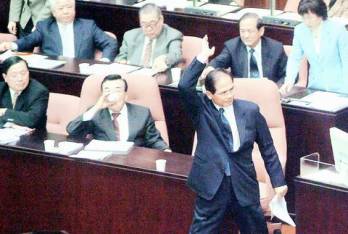
Premier Yu
Shyi-kun, front right, waves his hand to signal his Cabinet members to leave
the legislative floor after People First Party lawmakers Yang Cheng Chin-ling
and Chung Shao-ho called him a ``rascal politician'' at a question-and-answer
session yesterday.
-----------------------------------------
On Feb. 25, 2004 ……
Lien favors trade deal with China as step toward peace
AGENCIES , TAIPEI
Chinese Nationalist Party Chairman Lien Chan yesterday proposed the country sign a free-trade agreement (FTA) with China as a step toward political reconciliation. He said he would push for full economic integration with China if elected.
"The two sides should consider setting up a mechanism similar to an FTA. If it works well, we can then consider the establishment of a common market," Lien said.
He said economic integration with China would lead to political rapprochement.
"If everything goes smoothly, we can discuss formally ending the state of hostility and sign a peace accord that will ensure peace across the Taiwan Strait for at least 50 years," he said.
Lien also proposed that Taiwan and China put aside the sovereignty dispute to seek peace and cooperation.
"I think Taiwan and China should put aside the sovereignty dispute the same way countries who claim the Spratly islands put aside their dispute," he said.
-----------------------------------------
On Feb. 25, 2004 ……
US professor says Chen-Lien race too close to call
By Charles Snyder, STAFF REPORTER IN WASHINGTON
Despite the pan-blue camp's edge in most public opinion polls, the presidential election is "too close to call," and will hinge on the late decisions of a large number of undecided voters, a leading US scholar of Taiwan affairs said Monday in Washington.
And while the mudslinging will likely hurt voter turnout, it is still hard to say which side will be hurt more by that in the polls, Shelley Rigger, a professor at Davidson College, told a panel discussion hosted by leading Washington think tanks on the election.
While the Lien-Soong ticket has outperformed the DPP by 3 to 10 percentage points in recent polls, some 20 percent of the electorate is still undecided, "so there's a real possibility of a surprising result," said Rigger, who just returned from a trip to Taiwan, where she quizzed academics and observers on the outlook for the election.
"If I were the campaign manager for the pan-blue ticket, I would not be comfortable" with those polls, she told the Taipei Times. "But I would be more uncomfortable if I were the campaign manager for the green ticket. That's not a kind of lead that one sleeps well with."
The low turnout could be the main wild card, she indicated.
"There's a lot of frustration, disappointment and general disgust with the state of political plans that may cause voters to stay away from the polls," she said.
The mudslinging "may cause many people to say, I don't like any of these guys. I'm just not going to vote," she said.
Who would be hurt the most?
"Hard to say. On the one hand, DPP faithfuls are likely to turn out no matter what. On the other hand, the KMT is pretty skillful at using `incentives' to get voters to turn out, and also at using local networks and local factions, and may be able to mobilize the turnout."
Rigger specifically cited recent open letters run as newspaper advertisements condemning the dirty campaigning by both sides and bemoaning the failure to address meaningful issues. The letters were signed by a number of prominent academics and other political thinkers and leaders. She pointed out that one of the prominent signers was Academia Sinica president Lee Yuan-tseh, who endorsed President Chen Shui-bian publicly at the last minute during the 2000 presidential campaign.
"When [such a criticism] comes from somebody who gave a high profile endorsement of Chen the last time around, it has to be interpreted to some extent as a retreat or a withdrawal from that stance," she said.
"So that indicates that people who wanted to give Chen the benefit of the doubt are now trying to signal some disappointment and disaffection with the president."
She said it indicates that some people who endorsed Chen in 2000 are "signaling to the electorate that they are un-endorsing him."
Rigger said the US role in the election will be "extremely large," but criticized the Bush administration for sending confusing messages to Taiwan, especially when President George W. Bush publicly slammed Chen's referendum plan after a White House meeting with Chinese Premier Wen Jiabao on Dec. 9.
Washington's message has been received in Taiwan "in a way that leaves people open to a mixed message interpretation."
-----------------------------------------
On Feb. 25, 2004 ……
Freedom of speech for all
Alfred Tsai, National Taiwan University
Under an executive order from the Ministry of Education, college students must not openly express, on campus, their support for any presidential candidate during the official campaign period, which began on Feb. 21.
Nothing can be more repulsive to my freedom of speech. I simply want to hold up a campaign sign and walk around campus to express my support for a particular candidate, without using a megaphone and without blocking campus traffic. Is there anyone who would be hurt by my actions?
Some feel that students should go off campus to express their opinions. I want to tell them about the time in 1986 when 800 students gathered against school rules to hear speeches protesting censorship on campus.
I seek freedom of speech for the same reason that students shouldn't be asked to take their controversial writings and publications off campus.
Students have a constitutional right to express themselves through writing or parading a campaign sign. Why should students withstand a complete censorship of their political opinions when they do not tolerate a selective censorship of their writing?
Under the Constitution, any suppression of speech, a basic right, must be done by the legislature through passing a law, and not by executive order.
The Ministry of Education should apologize for depriving college students of their constitutional rights.
-----------------------------------------
On Feb. 25, 2004 ……
Lien is dangerous
Scott Simon, Assistant professor, University of Ottawa
The debate between Chinese Nationalist Party (KMT) Chair-man Lien Chan and President Chen Shui-bian last Saturday should be extremely unsettling to people living in Pacific Rim countries, including Canada, Japan, China and the US.
In the debate, Lien said, "The KMT supports limited war. We'll use the Taiwan Strait to win the first round and that will give us time to hold talks." He also repeated his claim that "one China" means the Republic of China (ROC). It seems clear from these comments that Lien does not recognize the facts of history. Since 1949, the Chinese Communist Party has been the sole and legitimate government of the PRC; yet Taiwan has not been administered by it.
Lien not only refuses to recognize these facts, but also threatens to use Taiwan as a military base for resurrecting the ROC. Last year, Lien helped organize an international conference in Taitung with the stated goal of combating communism. His outdated Cold War politics clearly threaten peace, stability, and environmental sustainability in the Pacific.
Lien is thus a menace to the peace and prosperity of the citizens of all countries in the Pacific Rim. I hope that the voters of Taiwan recognize Lien as a dangerous cold warrior and refuse to give him the power to threaten China in this way. Peace in the Taiwan Strait is in the best interest of all the countries of the Pacific Rim.
-----------------------------------------
On Feb. 25, 2004 ……
Barking mad over Hong Kong dogs
By Paul Lin
Hong Kong's Constitutional Development Task Force, headed by Chief Secretary for Administration Donald Tsang, visited Beijing earlier this month to discuss political reform in the territory. After Tsang, this "bad element remaining from the British days" who enjoys much prestige among the public but has been left suspended in mid-air by Chief Executive Tung Chee-hwa, won his appointment, he hinted at his local awareness by saying that he grew up eating Hong Kong rice and drinking Hong Kong water. The report he presented on his return from Beijing, however, shows that he obtained nothing for the people of the territory and the "imperial edict" he brought back has instead stirred up great waves.
Although he only met with lower officials -- Xu Ze, the deputy director of the State Council's Hong Kong and Macau Affairs Office and Li Fei, vice chairman of the Legislative Affairs Commission under the National People's Congress -- and a group of hired academics because no higher officials showed any concern for Hong Kong, the message he brought back was weighty and caused people in the territory to loose their breath.
The Communist Party cadres said that the majority of the "people" in the phrase "Hong Kong is ruled by the people of Hong Kong" should be patriots, but that general elections will not necessarily pick patriots. Ergo, there can be no general elections. These cadres also said that opposing legislation based on Article 23 of the Basic Law is unpatriotic.
An uproar then followed among the people of Hong Kong over having had their right to hold elections taken away by China, and the territory was turned upside down over the question of who is a patriot and who is not. Since those "patriots" came out one after the other to declare themselves bona fide "patriots," the democrats must be false "patriots."
This is, in fact, not wrong. The fight over who is a real and who a fake patriot has been going on ever since the PRC fought to establish itself, thus creating two China's in the 1950s. Clearly divided factions on the political left and right took form in Hong Kong. Those representing the PRC proclaimed themselves to be orthodox patriots, and after that, leftist schools became "patriotic schools," leftist newspapers "patriotic newspapers," leftist institutions "patriotic institutions," leftist individuals "patriotic individuals," and leftist companies became "patriotic companies" that used the famous slogan "love the motherland, use domestic goods" to sell cheap and substandard products. In the same way, everyone loyal to the Republic of China became "traitors."
Recently, however, a member of the NPC Standing Committee, Goldlion Group chairman Tsang Hin Chi has been called a false patriot.
Being a true king of counterfeit goods, Tsang loved France in the 1970s, when he manufactured fake neckties from Paris. Caught by the British colonial government twice, he was given lenient treatment the first time. The second time, as a repeat offender he was given a suspended sentence. His love for France didn't work out, and, angry with foreigners, he began loving China. Taking advantage of China's opening he used flattery and political donations to be appointed a member of the NPC's Standing Committee in 1993.
At the time, Hong Kong had two delegates to the congress. One failed to be re-elected because he couldn't overcome Tsang's financial power, and the other exposed how Tsang won over "public opinion" during NPC meetings by presenting gifts. When Hong Kong was ravaged by SARS last year, former Chinese president Jiang Zemin took refuge in Shanghai, while Tsang escaped to his family home in Meizhou. Where was the patriotism and love for Hong Kong in that?
Raymond Wu, another clown, is also an NPC delegate. He is a doctor, and because he also is well versed in the art of flattery, and because he is so shameless that he dares say what other people dare not, he was included by China in the patriotic camp in the mid-1980s and became China's Hong Kong authority on the Basic Law. He often receives attention for making unscrupulous and specious statements.
In the 1990s, Wu said that since the people of Hong Kong clearly knew there was no avoiding being raped by China in 1997, why not work together with Beijing to make it enjoyable? He knew clearly what Chinese rule meant, but not only did he sell out his own conscience by fawning on China, he also wanted other people to join him in this masochistic "pleasure."
Enjoying this current patriotic climax, this man naturally could not pass up the chance to do some shouting, so in one forum he said that "people in fact seem to be like animals. If you want a dog to jump, he'll jump higher and higher as long as there are biscuits. If ... the dog bites you and you give it a biscuit, that dog will no longer know how to jump. Dolphins are the same. The people of Hong Kong used to have the fighting spirit and the enterprising spirit, but no more. Why is that? They've been given too many dog biscuits."
When this mediocre doctor compares the people to dogs, it is obvious that China is their master. This kind of discourse conforms very well to China's theory that human rights mean survival rights.
Wu, however, is the true "patriotic dog," because he has all along shouted and jumped at his master's direction. But true Hong Kongers do not care for dog biscuits benevolently dispensed by a Chinese master. Over 500,000 people took to the streets to demonstrate their unwillingness to become dogs, and they continue to do so. Because they are unwilling to be dogs without hands, they use their hands to cast ballots, voting people from the democracy faction into district councils, and they continue to fight for the right to elect all the councilors in the Legislative Council, as well as the territory's chief executive.
If people who already are in a dog cage keep fighting, will the 23 million Taiwanese who are not yet in such a cage still want to become China's dogs? In Western countries, dogs are pets, but in China, dogs are trash. Otherwise, where would the Chinese curse "you're even worse than a dog or a pig" come from?
Some politicians in Taiwan advocate a "one China roof." What kind of roof is that? Judging from the Hong Kong lesson, it is the roof of a doghouse. Some Taiwanese politicians are afraid of losing their privileges, and over-the-hill politicians are running for the dog house because they want to become the Taiwanese equivalents of Tung and Wu. These people are getting ready to enjoy being raped -- as soon as China opposes something, they will oppose it, too, and if China opposes someone, they will start barking at that same person.
Taiwanese businesspeople in China differ from these people. They went there bringing their capital, knowledge and skills, and after having won their benefits, Chinese officials now humiliate these businesspeople with the condescending air of an alms-giver, using any reason, including charges of spying for Taipei, to arrest businesspeople as if they were catching dogs. Can Taiwanese businesspeople afford not to take the warning?
If the people of Taiwan do not want to become China's dogs, the Feb. 28 hand-in-hand rally really should be a rally to oppose becoming China's dogs.
Paul Lin is a commentator based in New York.
-----------------------------------------
On Feb. 25, 2004 ……
-----------------------------------------
On Feb. 25, 2004 ……
Voting for the future, not the past
Many people may be unaware that Hong Kong and Chinese intellectuals are now describing the presidential election as one in which voters will decide whether to elect their own president or to elect a "chief executive" who answers to Beijing. Beijing has long made it clear that it opposes any form of referendum or a new constitution in Taiwan. It is also against the idea that there is one country on each side of the Taiwan Strait. If voters elect leaders who meet China's demands, then future presidents will be like the chief executives of Hong Kong and Macau -- at Beijing's beck and call.
When this country held its first ever presidential election in 1996, China fired missiles into the sea off Taiwan's coast. Voters reacted by electing Lee Teng-hui, who angered Beijing with his advocacy of a "special state-to-state" policy for cross-strait relations. In 2000, voters once again used their ballots to shatter the threats made by former Chinese vice premier Qian Qichen, who warned that to opt for Chen Shui-bian was to opt for war.
Beijing is now ganging up with unscrupulous politicians in a number of other countries -- including some in Paris, Tokyo and Washington -- to try to put enormous pressure on Chen's referendum -- a democratic mechanism that Beijing is most fearful of. Should the electorate choose to give in?
Beijing is against Taiwan's referendum for the simple reason that it fears further consolidation of this nation's democracy. It poses a major threat to the Beijing authorities, who have long been reluctant to carry out democratic reforms. The Chinese people's desire for human rights, democracy and the rule of law will certainly receive a massive boost from the examples set by Taiwan. This country's democratization serves as a mirror that reflects the ugly face of the Chinese Communist Party.
The referendum is politically significant because it will reaffirm the nation's identity -- in addition to expressing the desire of the Taiwanese people to see the removal of hundreds of ballistic missiles that Beijing has deployed against their country. Once the referendum is held, any change to the nation's political structure -- including the enactment of a new constitution and reform of the legislature -- will have to be determined by its people via referendums. This will effectively exclude China's 1.2 billion people from Taiwan's affairs.
This is something that the pan-blue camp's leaders, who share a China complex, can hardly accept. Their sentiments are evident in Chinese Nationalist Party (KMT) Lien Chan's absurd claim that "one China is the Republic of China." The pan-blue camp's leaders still view the PRC and Mongolia as their nation's territory. They are still living in the lie that the Republic of China is China's "sole legitimate government."
Chen has made it clear that he will ensure that the referendum be held even if it costs him the election. The people of Taiwan can join hands and use their referendum ballots to say "no" to China loud and clear. Such an opportunity has not come easily and it should not be taken for granted.
The pan-blue camp must not get mired in their Chinese nationalist sentiments or try to obstruct the referendum through technicalities. Much less should they instigate riots to threaten the people. Their lack of confidence in the people -- and their blinding indifference to the best interests of the people -- has become their hallmark. The people should prove them wrong.
-----------------------------------------