20040227
=======
Referendum law needs revision on Feb. 27, 2004 ……
Referendum Law needs revision: Lu
"We finally made the
international community pay attention to us." --- Annette Lu,
vice president
RUSHED JOB: The vice president said year-end elections would produce a legislature that would be friendlier to the spirit of the referendum legislation
CNA , TAIPEI
Vice President Annette Lu said yesterday that the legislature to be elected at the end of this year will be better able to revise the Referendum Law to strengthen the nation's democracy.
During an interview at the Presidential Office, Lu said that when the legislature passed the law last November, it was done in a rush, and that there were some imperfections that required revision.
She said it would be difficult for the current legislature to revise the law because of the political make-up of the body, saying that after the March 20 election there would be a reshuffle of the political landscape.
She predicted that after the legislative election the structure of the legislature would be healthier.
"The new legislature can revise the Referendum Law to make Taiwan move toward solid democracy," she said.
At present the Chinese Nationalist Party (KMT) and the People First Party (PFP) dominate the 225-seat body.
Lu stressed that as the masters of a sovereign country, the people of Taiwan would have to take responsibility for their actions, and that people voting in the referendum will understand this because of their knowledge of world affairs and the accomplishments of democracy.
She said that the knowledge and world view of the people of Taiwan had reached a level unprecedented in four centuries and that this ability should not be underestimated.
"The people of Taiwan are well aware of the impact that they have on the world and the impact of the world on them," she said.
Turning to the international reaction to President Chen Shui-bian's referendum plans, Lu said that repercussions were expected.
"We finally made the international community pay attention to us," she said.
"Taiwan is rarely in the international spotlight, and from this perspective, we got what we wanted, although we had to pay a small price, too," she said.
Lu said that she would expand upon her vision for the nation in tomorrow's televised forum sponsored by the Central Election Commission for vice presidential candidates.
"My speech will focus on my vision for Taiwan's future development, including the consolidation of our young democracy as well as Taiwan's national identity and its movement toward globalization," she said.
Tomorrow's debate will be the only one to feature the candidates for the vice presidency.
"Because of my decision to attend the forum, I have had to drop my plans to take part in the `1 million people hand-in-hand' rally," she said, adding that she regretted not being able to join the rally.
Lu said PFP Chairman James Soong did not agree to her suggestion to ask the election commission to postpone the forum to the following Saturday to allow her to participate in the rally.
This story has been viewed 563 times.
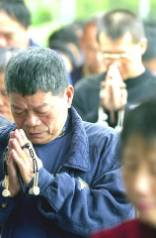
Lest We Forget
Relatives of victims of the February 28 Incident pray for their dead at a ceremony held at Taipei's 228 Memorial Park yesterday. The 1947 incident, in which the newly arrived Chinese Nationalist Party (KMT) administration ordered troops to murder, torture and detain tens of thousands of people, will be remembered tomorrow and marked by a nationwide human-chain rally.
-----------------------------------------
On Feb. 27, 2004 ……
Stop the fear-mongering, Soong
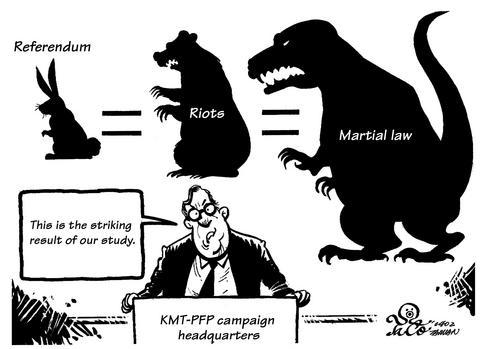
As if things are not already chaotic enough in the run- up to the presidential election, the pan-blues have started talking about the danger of riots by angry mobs over the result of the election and even the possibility of President Chen Shui-bian declaring a state of emergency and perhaps declaring the election results null and void. While certainly the government should be well-prepared to uphold law and order and ready for all possible contingencies, such statements by the opposition are nevertheless problematic in several respects.
On Wednesday, People First Party (PFP) Chairman James Soong openly attacked Premier Yu Shyi-kun, accusing him of meddling with the Central Election Committee's handling of the election so as to create conflicts and rioting, so that the administration could declare a post-election state of emergency. Other pan-blue lawmakers and politicians immediately parroted Soong's view, building up a sense of uncertainty and panic.
In response, the Executive Yuan made a U-turn, agreeing to the proposal about separating the voting for the presidential election and the referendum. Since this was the proposal endorsed and supported by the pan-blues, the move was obviously intended to end disputes over how the election should be administered and wild accusations about ulterior motives on the part of the Cabinet. Contrary to such groundless accusations, the last thing that the government and the ruling party want is a riot or a state of emergency.
It is ironic that the Soong and members of the pan-blues should be the ones warning about the possibility of a riot and the imposition of martial law. After all, in the past two presidential elections, the only riot that took place was staged in 2000 by KMT members who supported Soong -- who had run as an independent after he left the KMT because it had nominated Lien Chan instead of him for the presidency. The mob surrounded KMT headquarters for days demanding that then-president Lee Teng-hui step down from his job as party chairman as a way of showing accountability for defeat. Of course the facts that the divisions within the KMT and the split of KMT voters were the result of Soong's decision to run -- and that those divisions cost both Lien and Soong the election -- were completely overlooked by the angry mob. They needed a scapegoat for Soong's loss to Chen by just over 300,000 votes.
While it is the responsibility of the leaders and candidates of both camps to ask their supporters to show self-restraint before an election takes place, with the KMT's record it is imperative for pan-blue leaders to call on their supporters to show sportsmanship and respect for democracy, and not repeat their previous mistakes. However, the statements of Soong and other pan-blue camp members seem designed to accomplish precisely the opposite -- to inflame public sentiment through wild conspiracy theories and instill fear about the possibility of a state of emergency and martial law being declared. Such things are nothing to laugh at: people have vivid memories of the terror of the KMT's martial law era.
In contrast, the pan-greens, including Minister of the Interior Yu Cheng-hsien, have reassured the public that while the government is prepared for the worst, there will be no declaration of a state of emergency or imposition of martial law.
However, having gone through two presidential elections, one is inclined to believe that the people of Taiwan have enough maturity to respect the outcome of the election -- regardless of who wins.
-----------------------------------------
On Feb. 27, 2004 ……
Beware China's fifth-column efforts
By Chen Ching-chih
Beijing devised its so-called "one country, two systems" policy for enticing Taiwan to become a part of the PRC. The policy has since been applied to the absorption of Hong Kong in 1997 and Macau in 1999.
More than six years have passed since Hong Kong became a Special Administrative Region of China, yet Hong Kong has suffered a substantial economic downturn, and its autonomy and political freedom are in question. The way Beijing has dealt with Hong Kong, nevertheless, holds a valuable lesson for the people of Taiwan, who have wisely rejected Beijing's "one country, two systems."
Among others, Beijing's utilization of its fifth-column strategy in Hong Kong should be of particular concern to the people of Taiwan.
Yin Qian discusses China's fifth-column strategy in Hong Kong in his article "Beijing's Fifth Column and the Transfer of Power in Hong Kong: 1983-1997," in Hong Kong in Transition, The Handover Years.
Beijing has manipulated Hong Kong's humanitarian immigration program, which allows people in China to reunite with relatives in the territory, to serve its own purposes. In the 14 years from 1983, when China and the UK reached an agreement on the eventual handover of Hong Kong, until 1997, when the British officially handed over control of the territory to China, more than 83,000 "Chinese officials" entered Hong Kong as immigrants with false names and identities."
According to Yin's calculations, the 83,000 Chinese "fifth-columnists" constitute 1.4 percent of the territory's total population of 6 million and more than 9.12 percent of its active voters.
In substance, these people were employed by the Chinese Communist Party (CCP) as "an invisible hand for Beijing to level the political playing field [in Hong Kong], to boost its popular support and to consolidate its power from within. In putting in the fifth column, Beijing hoped that its future interests in the Hong Kong Special Administrative Region would be accommodated and its long-term political goals catered for."
Beijing's Ministry of State Security and provincial party authorities screened the candidates for the fifth-column unit. When selected, these Chinese were in their 30s and 40s, skilled and well educated. These people were urged to contact Xinhua news agency, Beijing's official representative agency in Hong Kong, from time to time, and to turn to Xinhua for assistance when "encountering difficulties." Yin argues that this is in fact a "reporting system as well as a surveillance mechanism."
Despite repeated denials of its existence by Beijing, "the fifth column in Hong Kong was an open secret and emerged to be a far from negligible political force," Yin said. In addition, while there have been minor changes in the application of the fifth column over the years, Beijing's goal in employing the strategy has remained unchanged "to expand the CCP's political power-base and to influence the future direction of Hong Kong."
It was for the purpose of influencing the direction of changes in Hong Kong that Beijing used the fifth-column strategy after it had already been assured of the return of the territory by 1997.
In line with the nature and the history of the CCP, Beijing has done virtually all it can, covertly as well as overtly, to compel the surrender of Taiwan which it has had no control over whatsoever. It has employed against Taiwan a strategy similar and yet more sophisticated than its fifth column in Hong Kong.
In the last decade or so, some 5,000 retired military personnel have moved from Taiwan to China to set up businesses and thus have become targets of recruitment as spies for Beijing. Taiwan has prosecuted several such people spying for China. In addition, close to a million Taiwanese in China are likewise targets of Beijing's recruitment as tools for its political campaign against Taiwan's continuing democratic reform. It has been widely reported, for example, that Beijing has been encouraging Taiwanese businesspeople to vote for its preferred candidate in the March 20 election.
China's efforts at meddling in Taiwan's coming election even include Chinese President Hu Jintao meeting with leaders of Taiwanese chambers of commerce in China.
One should also not ignore the ever-present threat of Chinese military intimidation. More weapons, troops and provisions have been moved into Fujian and Zhejiang provinces in the past month or so in Beijing's campaign to influence Taiwan's election.
In Taiwan itself, the number of Chinese immigrants hit 150,000 at the end of 2002. And today some 16,000 immigrant spouses from China are entitled to register to vote in the March election. This number is 0.1 percent of the total number of 16,500,000 voters.
To a large extent, according to Yin's definition, these people should be viewed as Beijing's "fifth columnists." Many Chinese wives of Taiwanese, for instance, appear to have been organized to demand for an expansion of their rights in Taiwan. And extreme China-friendly elements among the Chinese and their sympathizers have even boldly raised the PRC flag while parading in Taipei.
More importantly, according to the National Security Bureau, Chinese journalists, private Chinese citizens who frequently cross back and forth between Taiwan and China, and Chinese academics attending meetings in Taiwan have all attempted to influence Taiwan's presidential elections.
Beijing's effort, though more subtle this year than in the past, at influencing Taiwan's politics cannot be overstated. In the final analysis, such an effort must be viewed as a part of Beijing's elaborate scheme to annex Taiwan.
Finally, counteracting China's fifth-column activities is understandably difficult in a free and democratic society such as Taiwan. Nevertheless, the people of Taiwan should be fully aware of the possibility of sabotage engineered by Beijing's "fifth columnists" and their sympathizers. More importantly, the government must improve its techniques for identifying these Chinese subversives and preventing them from engaging in anti-Taiwan activities.
Chen Ching-chih is professor emeritus of history at Southern Illinois University at Edwardsville and researcher at the Los Angeles-based Institute for Taiwanese Studies
-----------------------------------------
On Feb. 27, 2004 ……
Beijing does not come in peace
By Wang Kun-yi
President Chen Shui-bian renamed the "defensive referendum" the "peace referendum" in the hope that Taiwan and China will establish a peaceful and stable interactive framework. Similarly, Chinese President Hu Jintao, during his visit to France, said his country is developing "peaceful diplomacy." When Chinese Premier Wen Jiabao visited the US last year, he even described China's rise as a "peaceful ascendancy."
Leaders from both sides are using the word "peace[ful]." But we have not seen China's "peaceful ascendancy" bring any peaceful prospect to the relationship across the Taiwan Strait.
Beijing's leaders chose the term "peaceful ascendancy" in response to the shift in US strategy. Since US President George W. Bush took office, the superpower has made efforts to realize its "imperial strategy." Through this strategy, generally called "unilateralism," the US has constantly used its military advantage to interfere around the world, establishing its global leadership and hegemonic system.
Out of fear of the US' imperial strategy and to avoid being pushed by international society to the front line vying for global leadership with the US, China has gradually adopted the concept of "peaceful ascendancy" after Hu took power, replacing the "great-power diplomacy" traditionally used during the Jiang Zemin era. Without the "great power" label, China can avoid the embarrassment brought by direct conflict with the US' power. Meanwhile, it can maintain strategic dialogue with the US.
However, what practical strategic moves should be expected during China's "peaceful ascendancy?" Chinese academic Sun Zhe points out three feasible directions. First, adopt an effective approach to interaction with other nations and promote the different values and national interests of China and other nations. Second, establish early warning systems to avoid differences in assessment and to adjust the diplomatic process. And third, recapitulate experiences and continuously expand successful diplomatic cooperation in a bid to expand and deepen the foundation for interaction with other nations.
The concepts of interaction, early warning and cooperation are the basic meaning of Beijing's "peaceful ascendancy" when building diplomatic relationships.
Deplorably, although China has these diplomatic ideas, it still adopts unfriendly measures to deal with Taiwan. In addition to its traditional tactics of targeting Taiwan with missiles, refusing to relinquish the use of military force and intimidating Taiwan to accept the "one China" principle, it has been applying pressure through the international community and publicizing the discourse that "opposing referendums is opposing Taiwanese independence."
This has misled the international community into believing that Chen attempts to change the status quo and has made the Taiwanese people feel China's ascent. But this is nothing more than an "ascendancy of hegemony." We can hardly see any "peaceful ascendancy."
During a hearing on Capitol Hill, US Deputy Assistant Secretary of State Randall Schriver pointed out that now only 6 percent of Taiwanese people accept unification with China and 20 percent support independence. Although a majority of people tend to prefer maintaining the status quo, aren't the increase and decrease in supporters for independence and unification caused by China's missile intimidation? If Beijing really believes this is a "peaceful ascendancy," how can they create so many supporters for Taiwanese independence?
Similarly, because China does not give up the use of military attacks against Taiwan, US Deputy Assistant Secretary of Defense Richard Lawless had to reiterate that the US is obliged to support Taiwan to maintain deterrent forces and to cooperate with allies to help it maintain sufficient defense capabilities. In the event of war, Taiwan would be capable of swiftly defeating China.
As long as China does not remove the missiles aimed at Taiwan and relinquish the use of military force against Taiwan, it cannot cover the fundamental of its "hegemonic ascendancy," no matter how hard it attempts to maintain a facade of "peace" in the international community.
Wang Kun-yi is an associate professor at the Graduate Institute of International Affairs and Strategic Studies of Tamkang University.
-----------------------------------------
On Feb. 27, 2004 ……
-----------------------------------------