20040301
=======
Cut legislature seats on March1, 2004 ……
Lin stages hunger strike to cut legislative seats
Former Democratic Progressive Party Chairman Lin YI-HSIUNG yesterday staged a hunger strike outside the Legislative Yuan in a drastic bid to push for the passage of a constitutional amendment on halving the number if its seats.
Lin and several members of his Nuke-4
Referendum Initiative Association sat outside the front gate of the Legislative
Yuan, demanding all caucuses to pass the amendment bill before the March 20
presidential election.
The relentless anti-nuclear activist announced that he will carry out the hunger strike for up to ten days and will recruit more civil groups to join him if he does not get a satisfactory response. He is expected to call a press conference with Academia Sinica President Lee Yuan-tseh on Saturday to jointly solicit support for their proposal to reduce the size of the Legislature.
DPP caucus official brought Lin flowers around noon to show their support, promising full support to their former chairman.
The opposition Kuomintang (KMT) caucus deemed Lin’s initiative a campaign poly. KMT officials charged that Lin is pushing for a constitutional amendment on legislative reforms to help boost Chen Shui0bian’s reelection bid.
The KMT’s ally, the People First Party, also stressed that halving the number of legislative seats is already a consensus among the ruling and opposition parties but there is no need to rush the legislation.
The Taiwan Solidarity Union (TSU), the DPP ally in the Legislature, voiced support for Lin. The TSU suggested that the proposal be separated from the rest of the constitutional amendment bills for a speedy screening.
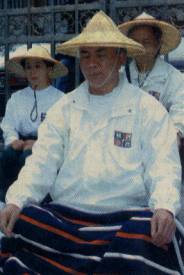
Lin Yi-hsiung, former DPP chairman, meditates as he stages a hunger strike in front of the Legislative Yuan to call for the reduction of the legislature by half.
-----------------------------------------
On March 1, 2004 ……
Bald men back referendum
REUTERS , TAIPEI
A hundred bald men ran a race yesterday to kick off President Chen Shui-bian's campaign to promote the March 20 referendum.
The race, held a day after the country's largest-ever protest against China, signified a play on words, since the Chinese for "referendum" is similar to the phrase "bald head."
The "Referendum 100" campaign follows Saturday's massive demonstration in which an estimated 2 million Chen supporters formed a human chain spanning the length of Taiwan to protest against China's pointing of nearly 500 missiles at the nation.
Analysts say the peaceful rally was Chen's best chance of boosting voter support in his difficult battle with Chinese Nationalist Party (KMT) Chairman Lien Chan for the presidency in the March 20 election.
Opinion polls last week had shown Chen and Lien running neck-and-neck, with a crucial fifth of voters still undecided.
"The Taiwanese people have expressed their incomparable will and determination to protect Taiwan's territory, sovereign status, democracy and economic prosperity, and to protect peace in the Taiwan Strait," Chen said yesterday.
"The Taiwanese people have expressed their incomparable will and determination to protect Taiwan's territory, sovereign status, democracy and economic prosperity."
President Chen Shui-bian
"On February 28, we joined hands. On March 20, we must take part in the referendum to save Taiwan," Chen said at the launch of the new "Referendum 100' campaign.
Chen said the "1" stood for his candidate number and the two zeros symbolized the two questions the referendum asks.
Voters will be asked whether Taiwan should increase its anti-missile defenses if China refused to withdraw its missiles, and if the two sides should open talks on forming a framework for peaceful and stable ties.
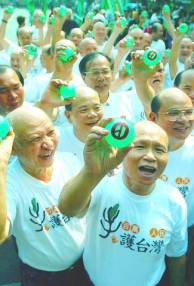
One hundred bald men hold up balls bearing the number ``one'' during a DPP campaign event in Taipei yesterday to encourage the public to vote for No 1 (Chen Shui-bian's candidacy number) on the presidential ballot and ``yes'' on the two referendum ballots.
-----------------------------------------
On March 1, 2004 ……
Rally could aid Chen's re-election
CLINCHER: The DPP said the passion people showed by turning out in such huge numbers at Saturday's rally would be reflected in their support for Chen Shui-bian
By Chang Yun-ping, STAFF REPORTER
The 228 Hand-in-Hand Rally, that received overwhelming support nationwide on Saturday, could secure President Chen Shui-bian's re-election bid, the Democratic Progressive Party (DPP) said yesterday.
Support for the rally, in which up to 2 million people held hands across the length of the country to protest China's missile threat, has not only created a new milestone for Taiwan's democratic development but has also boosted Chen's electoral prospects.
DPP Secretary-General Chang Chun-hsiung said the rally would be significant for Chen's campaign, and the passion people showed in turning out in such huge numbers would be reflected in support for Chen.
Chang said that since the two presidential debates were held, Chen's support rate has already began to show signs of exceeding that of his rival, Chinese Nationalist Party (KMT) Chairman Lien Chan.
The party said it predicted that the event would boost the party's support, with internal opinion polls showing increasing public approval as Feb. 28 approached.
Cheng Wen-tsan, director of the public affairs department of the DPP's campaign headquarters, said: "The 228 Hand-in-Hand Rally is indeed an important clincher in Chen's re-election bid. Before the rally, Chen's support rate was slightly behind the blue camp's Lien-Soong ticket. However, after the rally, we will see a jump in Chen's support."
Cheng said the event also sent an important message that "Taiwan is not China."
"The tremendous people power we saw demonstrates the people's consciousness in coming together when facing China's military threat," Cheng said.
To keep this momentum, the DPP campaign headquarters has planned 45 medium and large campaign activities from now till the election. It said that from today, there would be at least two campaign rallies each day, rising to four a day during the last 10 days of the campaign.
Cheng said the DPP hoped to remind people of the passion of the 228 rally and transform such feelings into support for Chen.
Wu Shu-ming, president of the Taipei Society, said the high turnout for the rally demonstrated the desire of people to be the bosses of their country.
The event not only demonstrated the will of Taiwanese people to China and to the international community, it also strengthened the confidence of Taiwanese people to be proud of having a unique national identity separate from China, Wu said.
-----------------------------------------
On March 1, 2004 ……
Anti-nuclear activists laud DPP's attitude
"We are not surprised at the
pan-blue camp's reluctance to liberalize the power industry." --- Shih
Shin-min, member of the Taiwan Environmental Protection Union
GREEN POWER: A questionnaire showed that the DPP is more in tune with global nuclear power trends than the KMT, which scorns renewable energy sources
By Chiu Yu-Tzu, STAFF REPORTER
President Chen Shui-bian's attitude toward nuclear power issues and energy policies is keeping abreast with global trends, whereas Chinese Nationalist Party (KMT) Chairman Lien Chan remains in favor of nuclear power rather than using renewable energy sources, a group of anti-nuclear activists said yesterday.
The No Nuke Taiwan Union, which was formed by activists from more than 88 civic and environmental groups early last month, sent a questionnaire containing 12 questions about energy policies and nuclear topics to the Democratic Progressive Party (DPP) and the KMT on Feb. 19.
According to the union's convener, Cheng Hsien-yu, the questionnaire was designed to determine both camps' attitude toward the promotion of renewable energy sources, the efficient use of energy, green industries, liberalization of the power industry, nuclear safety and other nuclear-related issues.
Cheng said that the DPP's attitudes are similar to those of environmentalists engaged in the promotion of sustainable energy sources, but that the pan-blue camp remained an advocate of policies that had been established by the former KMT government before the 2000 presidential election.
"For example, President Chen Shui-bian now prefers holding a referendum to decide the future of the Fourth Nuclear Power Plant, while the KMT's Lien Chan would like to have the construction completed at any cost," Cheng said at a press conference yesterday.
Shih Shin-min of the Taiwan Environmental Protection Union said it was a shame that the KMT's approach was so outdated.
"We are not surprised at the pan-blue camp's reluctance to liberalize the power industry," Shih said.
Mary Chen, chairwoman of the Homemakers' Union and Foundation, said the KMT's response to the questionnaire did not clearly explain how it proposes to restructure the country's energy supplies, how to deal with radioactive waste or how to ensure the public's safety.
She said that the pan-blue camp lags behind the DPP in its awareness of global trends in sustainable development.
However, Chen said that activists are slightly worried about the DPP's forthright answers.
"The DPP had to eat some of its words about environmental issues after its victory in the 2000 presidential election, including its promise to scrap the Fourth Nuclear Power Plant," she said.
"We estimate that only 20 percent of Taiwanese people are aware of nuclear power problems. That's not enough to enable us to phase out nuclear power plants in the nation," said the No Nuke Taiwan Union's deputy convener, Chen Jiau-hua.
According to the union, more than 300 workshops and forums will be held nationwide before July to promote sustainable development and energy-related issues.
Meanwhile, some anti-nuclear activists are set to start a 10-day nonviolent demonstration in front of the Legislative Yuan today by fasting in rotating groups to urge the legislature to halve the number of seats.
Former DPP chairman Lin Yi-hsiung, one of the founders of the Nuke-4 Referendum Initiative Association, will join other activists in the fast.
-----------------------------------------
On March 1, 2004 ……
Revenge or reconciliation?
Differences of opinion over Taiwan's history and future relations with China have once again appeared in the election, prompting fears that politicians will stir up ethnic rivalry for their own gain. But some believe that the divisions are now more blurred than ever and increasingly irrelevant to society
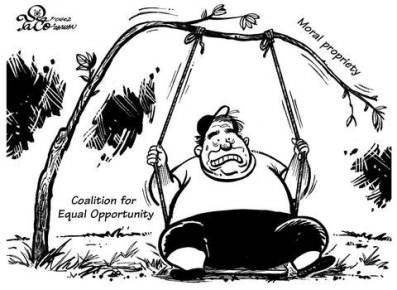
When internationally renowned film director Hou Hsiao-hsien formed the Coalition for Equal Opportunity last month to promote reconciliation and harmony among all ethnic groups in Taiwan, it caught the public's attention and stirred up quite a commotion.
The coalition's main aim is to urge local politicians to stop "manipulating provincialism and ethnic topics" for partisan interests.
It also called on local news media to monitor political parties' and individual politicians' actions instead of merely giving sensationalist coverage to their ethnically biased comments and behavior.
The coalition itself seems to be a mixture of people from different backgrounds. On its Web site (www.handinhand.org) it lists several well-known figures as its founders. There are Mainlanders like Hou, writers Chu Ten-wen and Chu Ten-hsin, who are sisters, National Taiwan University professor Hsia Chu-joe, notable Hokkien people such as Cloud Gate Dance Theatre founder Lin Hwei-min and women's group Garden Of Hope Foundation director Chi Hui-jung, and neo-Marxist pan-purple alliance members such as its convener, Chien Hsi-chieh, and the Awakening Foundation.
Mainlander's Anxiety
Yet it is Hou who speaks up most of the time for the coalition, and it was he who told the public not to join the 228 Hand-in-Hand Rally.
"Feb. 28 is a day of ethnic historic tragedy and not rites of celebration," Hou said. "Both camps should halt all campaign activities and face the unjustified suffering of history. If we cannot stop campaign activities on that day, the two camps should refrain from attacking their opponents with vicious speeches. There should be no discrimination, manipulation, and no ethnic division; do not add more sadness to a day of sadness."
Hou has always prided himself in making films like A City of Sadness, in which he said he approached the 228 Incident with a sympathetic eye for what the Hokkien people had suffered, and it indeed won the hearts of many Taiwanese, Hokkien and Mainlanders alike.
But his public announcement on the 228 Incident this time was not so welcomed by the Hokkien group, and his Mainlander identity was questioned right away.
DPP campaign headquarters spokesman Wu Nai-jen attacked Hou, saying that Germans would never ask Jews not to hold memorials for the Holocaust.
"What would really constitute damaging ethnic harmony is for the perpetrators and their descendents to point fingers at the victims and their descendents," Wu said.
Hou has since been labeled as a unificationist and his true intentions were questioned by the pro-independence groups, with some even accusing him of accepting funds from China for his movies.
Several critics, including Academia Sinica sociologist Michael Hsiao, have accused the coalition of talking about ethnic equality while largely ignoring Aborigines and Hakka people.
Hsiao said the coalition avoided talking about the conflict between the Mainlanders and the Hokkien and promoted a concept of ethnic equality without real content.
"They should be talking about the current problems faced by the Mainlanders, yet they don't talk about it," Hsiao said.
"They are actually trying their
hand at the de-Taiwanization of Taiwan. They are afraid of de-Sinicization of
Taiwan, and this highlights the anxiety of the Mainlanders. They are anxious
that Taiwan is becoming more and more like a country," Hsiao said.
"A major problem faced by the Mainlanders now is related to the election: they can only vote for the pan-blue camp and won't vote DPP, while Hokkien and Hakka people are more willing to make a choice between different parties. The Hokkien and Hakka people are enjoying democracy more," Hsiao said.
The coalition also appears to have some communication problems.
When Chi Hui-jung, one of the coalition's supposed founding members, was asked about her role in the alliance, she was surprised to hear she was even listed as a founder.
She explained that she went to only one coalition meeting and decided and then decided not to join the coalition.
"Ethnic education and social movement take a long time, yet these people do not have a long-term strategy and seem to be just trying to influence this election," Chi said.
Tuan Yi-kang, Democratic Progressive Party (DPP) legislator and the convener of the party's New Tide faction, disagrees with the coalition's concerns about the divisions between Mainlanders and Hokkien people.
As a second-generation Mainlander and a founding member of the Mainlander pro-independence group Goa-Sen-Lang Association for Taiwan Independence, Tuan has a powerful say in the DPP and society about the conflict.
"I feel that the conflict between the Mainlanders and the Hokkien people is calming down, and polls tell us the same thing," Tuan said.
"But the issue of the conflict between the two sides will always heat up during an election, and Hou's problem is that he does not understand the situation, the fact that the ethnic group most sensitive to the conflict now is the one with the worst anxiety, the Mainlanders, with them being the minority group in Taiwan," Tuan said.
Tuan said that when the coalition wanted to oppose the division between the ethnic groups, it should not aim at only one camp, the DPP, when the other side was actually playing at the same thing.
Like Chi, Tuan also thought that wounds took a long time to heal.
"The healing of the wounds from past oppression takes a long time, and forgiveness also takes time. The Hokkien people need to understand why the Mainlanders are so united and anxious, while the Mainlanders need to understand the Hokkien people's hostility toward them. The country should make the majority group feel safe, and the minority group feel at peace," Tuan said.
Undercurrent of Conflict
Wu Nai-te, another Academia Sinica sociologist, said that he found the ethnic issue had declined in importance from the previous election.
"It is a bit confusing why Hou and the coalition tried to speak up in this election because compared with four years ago, the conflict between the ethnic groups is not as fierce," Wu said.
Wu pointed out that conflict between the Mainlanders and the Hokkien people now was in politics, and it was not visible in society because of the lack of a cultural division of labor.
"Intermarriages, other frequent social exchanges between the ethnic groups and the lack of the cultural division of labor smoothed out the hostility between the groups," Wu said.
"Access to education is not so different between the two groups and Taiwan's fast economic growth has made the two groups not so unbalanced in economic and social status," he said.
"However, although the social gap has started to disappear, the political division has not gone away. It has remained and gained a new theme. Democracy has switched the political position of the ethnic groups, and now it is the Mainlanders, positioned on a politically disadvantaged side, asking for respect and recognition," Wu said.
Wu said the 228 Incident was pivotal in the conflict between the Mainlanders and Taiwanese.
"The problem with the 228 Incident is that it has not been properly dealt with. The government only tried to pay off the victims and thought it would pass," Wu said.
"There were thousands of victims
in the incident, yet there is no mention of any perpetrator. The past
government did not want to reflect on the issue, and that's one of the greatest
problems of the Lien-Soong ticket: they were part of that past," he said.
"However, at the same time, President Chen Shui-bian is taking sides with former president Lee Teng-hui, who also belongs to that past, so Chen cannot deal with the problem outright either," Wu said.
Yang Wei-chung, a 27-year-old second-generation Mainlander living in the Mainlander community Chengkung Public Housing Complex in Taipei, showed that while the politicians might be still using the 228 Incident to achieve certain political aims, it actually did not affect ordinary people's daily lives.
"For young people like us, we did not experience the incident personally, so we do not have that tragic feeling. Instead, we just feel curious about it," Yang said.
Yang pointed out that in daily life he did not feel any problem raised by his Mainlander status, and there is seldom argument about the 228 Incident between him and others.
Mainlander's Nostalgia
But the Mainlanders have reasons to identify with China. After all, it was where they were born and grew up, and most were forced to retreat to Taiwan without a choice after the KMT lost the civil war to the communists.
Kenneth Pai, son of KMT general Pai Chung-hsi and one of the most respected writers in Taiwan, was born in Guangxi Province in 1937.
He came to Taiwan in 1952 and graduated from National Taiwan University's Department of Foreign Languages and Literature in 1961. He continued his study in Iowa University in 1963 and started to teach at the University of California, Santa Barbara, in 1965.
In recent years he has been traveling between China, Hong Kong and Taiwan from his home in the US and has been energetically promoting Kun Opera, with Kun (Yunnan Province) being where he spent part of his childhood.
In Pai's stories, Hokkien and Mainlander elements are often intertwined. In his 1983 gay classic Crystal Boys, the gay hero was a second-generation Mainlander called Li Ching, who was banished from home because of his sexuality and hung out in Taipei's New Park, a favorite stamping ground for the gay circle back then.
With a twist Pai could not have predicted, New Park later became the 228 Memorial Park.
Pluralistic Identification
Stephane Corcuff, a professor of political science specializing in Mainlanders' issues from the University of La Rochelle, pointed out in his book Light Wind, Warm Sun: Taiwan's Mainlanders and the National Identity Transition that many Mainlander identify with more than one thing. Their identification with Taiwan does not prevent them from identifying with China or the other way around.
Corcuff said in an earlier interview that if the Mainlanders' concern with Taiwanese domestic politics and unwillingness to give up their pro-reunification stance was a contradiction, it could be explained by "the remaining impact of past political socialization and electoral politics."
"One of the main findings of the
research is that the Taiwanization of Mainlanders in Taiwan cannot be denied
and it is an inevitable process. It's a natural movement, but politics
constantly interferes with it," Corcuff said.
"Mainlanders have a pluralistic national identification, which comprises of China and Taiwan both at different degrees, changing from one person to another, but changing also in the same person at different moments," he said.
Wu Nai-te also considered the mainlanders to have pluralistic identifications, although he pointed out that the identification with China would be cultural rather than political, while the identification with Taiwan is a political one.
Michael Hsiao said that many mainlanders may not identify with China, and even if they do, they do not necessarily identify with the People's Republic of China, but rather the culture of greater China.
Tolerant society
Meanwhile, Chi Hui-jung is promoting a society that tolerates and appreciates pluralism.
"I hope that Taiwan can try to become a `salad bowl' like New York City, which contains different people and cultures with all keeping their own original faces rather than being a melting pot which devours and blurs the faces of different cultures," Chi said.
Yang Wei-chung agreed.
"I feel Taiwanese because I am living a Taiwanese life. Say if I should return to China now, I would not be able to adapt to the life there. However, it is hard to cut Taiwan completely from China; Taiwanese writing has often been influenced by Chinese writing. Taiwan is a tolerant place, and I would identify with a Taiwan that's inclusive of Chinese culture," Yang said.
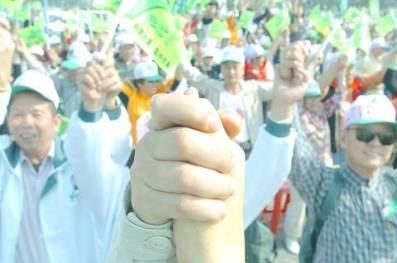
Participants join hands Saturday on Hoping Island in Keelung City, where the 228 Hand-in-Hand Rally began. Some 2 million people took part in the rally, forming a human chain 500km along the length of Taiwan down to Pingtung County. While the rally was intended to unite Taiwanese, it has also stirred up ethnic conflict. Film director Hou Hsiao-hsien, founder of the Coalition for Equal Opportunity, warns that politicians can use such events to divide ethnic groups.
-----------------------------------------
On March 1, 2004 ……
Chen: China has not reduced threat level despite overtures
CNA , TAIPEI
President Chen Shui-bian said yesterday that the Chinese military threat toward Taiwan has not been alleviated over the past four years.
Addressing an audience at the opening of an international symposium on Taiwan's national defense, Chen said the country's defense is a firewall against the People's Liberation Army (PLA).
Chen said that since he spelled out his "five noes" pledge during his inauguration in 2000 as a gesture of goodwill to China, he has not seen Beijing reduce its military threat toward Taiwan.
On the contrary, he said, China's arms buildup, particularly its missile deployment targeting Taiwan, has increased rapidly over the past four years.
The PLA's speedy modernization, particularly the improvement of the precision of its ballistic missiles and its large-scale deployment of missiles, is a factor contributing to the increasing changes in the military balance across the Taiwan Strait, Chen said.
Chen said that military intelligence indicates that the number of the PLA's tactical guided missiles increased 11-fold between 1995 and last year and is still rising at the rate of one every six days.
Facing Beijing's ever-mounting military threat, he said, the Taiwanese people must come together and throw their support behind the armed forces, while the government accelerates the modernization of its military, including the building of anti-missile preparedness.
Chen stressed that the factor of "people" stills plays an important role in efforts to upgrade Taiwan's overall defense capability and competitiveness. Thus, seeking to raise the caliber of military personnel is one of the goals of national defense reform, he said.
As commander of the country's armed forces, Chen said, it is his responsibility to ensure that national security is well protected. He added that he will refer to professional expertise from the Ministry of National Defense whenever making comments regarding military affairs.
Still, he said, he cannot agree with some of the "empty promises" made by his presidential rival about the nation's military recruitment and conscription policy.
Chen said that while he has advocated a system of recruitment for 10 years, he has also said that the policy on maintaining a standing army must be implemented step by step, with the country's national security being the ultimate goal.
Chinese Nationalist Party Chairman (KMT) Lien Chan said in a debate with Chen last week that he advocates a system of recruitment or drafting for the armed forces that would encourage more career soldiers and that compulsory military service should be shortened to three months instead of the current 20 months.
Commenting on Lien's remarks, Chen said Lien was issuing a campaign check that will bounce.
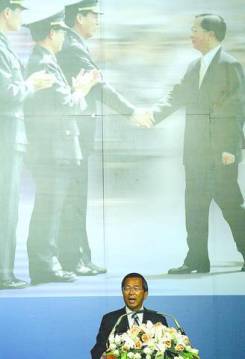
President Chen Shui-bian speaks at a Taipei seminar on the reform of the armed forces yesterday. Chen said that the Democratic Progressive Party has long advocated an all-volunteer military, but that the process must be carried out gradually, with national security as the ultimate consideration.
-----------------------------------------
On March 1, 2004 ……
Debate focuses on missile sentiments
SYCOPHANTIC?: While the independent slammed the referendum as an effort to suck up to the US, the pro-referendum speakers stressed its historical importance
By Ko Shu-ling, STAFF REPORTER
The first referendum debate kicked off yesterday with Cabinet Spokesman Lin Chia-lung speaking against independent Legislator May Chin, covering the first referendum question about China's missile threat.
In the referendum, voters will be asked whether the nation should strengthen its defenses in the face of China's missile threat and whether Taiwan should hold talks with Beijing to establish a peaceful and stable framework for cross-strait interactions.
Lin, donning a tie printed with Aboriginal totems, called on the public to take part in the nation's first referendum.
"What we want is genuine peace, not peace disguised under compromise or even humiliation," he said.
"It would be a victory for China if we failed in the referendum," he said.
A native of the Ataya indigenous tribe, Chin, wearing her tribal costume and a painted facial tattoo, called on the public to skip the referendum.
She said that the government should instead divert the NT$700 billion military procurement budget to social welfare and help underprivileged groups like the Aborigines improve their unemployment and tap water problems.
"China's military threats have been around for many years. There's only one reason why the DPP government wants to buy more weapons now and that is that they want to kiss the US government's ass," she said.
During his eight-minute opening speech, Lin said that he would like to see the momentum mustered during Saturday's human-chain peace rally carry over to the presidential election.
"Two million people came out [on Saturday] to send a message to the world that we love peace and we'll protect this land," Lin said.
"I'd like to see 20 million people take part in the election-day referendum to tell China and the world that we're against China's missile deployment and military intimidation," he said.
While some have questioned the necessity of the referendum, Lin said that there were two kinds of referendums: to resolve controversial issues and to consolidate public consensus.
"The election-day referendum has the functions of both," Lin said.
The referendum was not only
constitutional and legitimate but also necessary and urgent, Lin said, because
China has some 500 ballistic missiles targeted at Taiwan and the number
continues to grow at a rate of 50 to 70 more every year.
"We're very sorry to hear some politicians deliberately smear the referendum and bombard the people with a bunch of lies," he said.
Chin, however, questioned the necessity of the NT$700 billion military procurement budget.
"I don't understand what he [Lin] was talking about and I believe neither do the nation's 76,000 low-income families, the 500,000 unemployed, the 420,000 Aborigines and 200,000 [sic] mothers committing suicide with their children," she said.
Calling the referendum a "hoax," Chin called on the public not to endorse President Chen Shui-bian and Premier Yu Shyi-kun, who have made it clear that the government will honor the NT$500 billion (US$15.1 billion) arms-procurement plan even if the public votes down the referendum question on defense reinforcement.
While the Democratic Progressive Party (DPP) refused to accept the "one China" policy, Chin said that it "kidnapped" the Taiwanese people and forced them to embrace its ideals of "writing a new constitution" and "building a new country."
"Facing China's military threats, the DPP-led administration is planning to build the nation into a military stronghold ? It has spent NT$120 billion in military procurement over the past three years and plans to spend NT$700 billion more," she said.
"Military procurement has eroded our state coffers and our hopes," she said.
During the second part where three questioners filed one question each, Chin said that she was not a military expert but she was against the idea of buying more weapons to counter China's military threats.
"I find today's debate absurd because the government will still forge ahead with its military procurement plan," she said.
"I'm here to speak on behalf of the indigenous people and to call for a stop to the military competition across the Taiwan Strait," she said.
Lin, however, said that the government's spending on social welfare has increased by 4 percent since the DPP came to power while the military budget decreased over the years.
Only if the government strengthens its defenses can we talk with China at the negotiation table with equality and dignity, Lin said.
"We're not trying to engage in any military competition with China but to ensure our own safety," he said.
Citing the example of the "Koo-Wang talks", Chin said that referendum was not the only resolution for peace across the Taiwan Strait.
"Why don't we continue the same model and resume peace talks with China?" she asked.
Chin further proposed that cross-strait tensions could be easily resolved if Taiwan purchased a ballistic missile from China with a 10-year warranty.
During the seven-minute concluding statements, Lin again called on the electorate not to miss out on participating in the historic referendum and said that the referendum was the most peaceful, effective and cheapest way to have Taiwan's voice heard in the international community.
-----------------------------------------
On March 1, 2004 ……
Referendum has become Taiwan's destiny: Hsieh
By Jewel Huang, STAFF REPORTER
Kaohsiung Mayor Frank Hsieh, as the Cabinet's representative, yesterday debated against writer and political commentator Li Ao, with both of them failing to answer questions put to them by academics arranged to take part by the Central Election Committee.
The second question of the referendum proposed by President Chen Shui-bian is: "Do you agree that our government should engage in negotiations with China about the establishment of a peaceful and stable framework for cross-strait interactions in order to build consensus and for the welfare of the peoples on both sides?"
In the opening statement, Hsieh argued that it is the first time -- as well as a sacred opportunity -- for the people of Taiwan to voice their opinions about Taiwan's future to the international community through a referendum. Hsieh said the importance of the referendum is clear if people think about the whole issue, taking into account Taiwan's interests as a whole.
"We have to let the international community and China know about our people's firm opposition to China's missile threats and our goodwill in pursuing peace and the resolution to guard our land," he said.
"A referendum or the human chain rallies held on Feb. 28 are some of the best ways to express our feelings," he said.
Hsieh said that it would deliver a message to the international community that the people of Taiwan are split on their future if the referendum fails, and this would be a disadvantage for Taiwan when negotiating with China.
Hsieh urged the people of Taiwan to show their love for Taiwan by taking practical action.
"What we need is not metaphysical love. This is a critical historic moment for the people of Taiwan to show their love and resolution by casting their precious ballots," Hsieh said.
Li argued that the referendum launched by the Democratic Progressive Party (DPP) is a fake, as the DPP has been promoting the idea of Taiwan's independence and even put it into the party program.
Li asked why the DPP does not hold a real referendum on changing Taiwan's official name or the establishment of the Republic of Taiwan.
"I urged the courageous Taiwanese people to launch a referendum on Taiwan's independence.
"We will face the `one China' framework as soon as we start to negotiate with China. Taiwan has to deal with the name `Republic of China' since the `People's Republic of China' stands for the so-called `one China,'" Li said.
Although the CEC arranged three academics to put questions to both debaters -- Chao Chien-min, a political science professor at National Chengchi University; Lin Te-chang, head of National Sun Yat-sen University's NGO research center; and Yang Kai-huang a political science professor at National Donghwa University -- they did not reply directly to the questions in the following debate.
Chao asked what other issues, apart from the political issues, should the negotiators deal with to improve the cross-strait relationship and establish negotiations on a reciprocal basis?
Li did not answer the question but continued to describe his opposition and criticism of the referendum. He said that Taiwan would not necessarily lose out in negotiations, as long as negotiators possess eloquence like Hsieh.
Hsieh said that the interaction of business, the development of cities or a solution to international crime might be issues that could help cross-strait interaction.
He said that Taiwan's referendum could teach the Chinese people to think about their own situation and help China to become democratized.
In his closing statement, Hsieh said that Taiwan should find a way that would give it dignity when negotiating with China, and the referendum is the answer.
-----------------------------------------
On March 1, 2004 ……
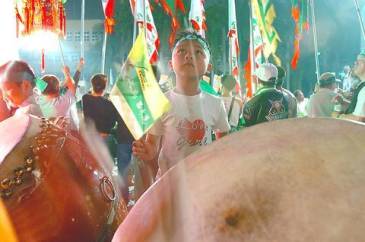
Marching to the beat
A boy is entranced by drummers during a DPP campaign event at Whachiang Senior High School in Taipei yesterday.
-----------------------------------------
On March 1, 2004 ……
Fugitives: corruption in business and politics
By Lao Pao
The nation's most-wanted economic criminals all happen to support one particular presidential candidate and oppose the other.
They act like Chinese Nationalist Party (KMT) Chairman Lien Chan's campaign chiefs, making comments that grab the media's attention. More absurdly, the pan-blue camp view them as God-sent helpers in its campaign against President Chen Shui-bian's re-election bid. It is truly an unbelievable political scene.
These criminals have one thing in common; that is, they all "do business" in China after leaving behind huge debts. As fugitives on the run, one might suppose they would keep a low profile. On the contrary, these criminals have pushed themselves into the limelight, speaking with straight faces and compelling confidence.
The only reasonable explanation for their weird behavior is that they have made deals with Beijing. Maybe in exchange for asylum, they not only need to bribe the Chinese officials with the money they stole from Taiwan but also have to act like Beijing-hired political roughnecks at critical times. Their situation is similar to some businesspeople who were accused of spying in China a while ago, who also had to censure Chen ruthlessly on television.
These criminals' pro-Lien rantings against Chen took place in China. A lot of unexpected things happen there anyway.
What worries us, actually, is Taiwan's media.
Most of Taiwan's media outlets chose to side with those criminals by echoing their theories and treating them as righteous, and our government as evil.
These fugitives are economic criminals and thieves. They are by no means "political prisoners" in the sense that international human-rights organizations understand the term. It does not make sense for the Taiwanese media to dance to their tune.
Is it possible that owners of these media corporations suffer from the same problem as these criminals -- that they face enormous financial debts and are trying to reverse the situation by helping corrupt political forces to make a comeback?
If so, then no matter how hard Chen tries to prevent the comeback of bribery and corruption, the public will not be informed correctly because the power to interpret news is in the hands of those whose interests are embedded in corruption.
Thus, it is not difficult to understand why Chen and Vice President Annette Lu pledged to run a clean campaign immediately upon the request of the National Association Promoting Clean Elections, while Lien and People First Party Chairman James Soong made up excuses for not signing it and in the end reluctantly signed their English initials only. How did the media interpret this? If the Taiwanese media also tilt toward China, they cannot be fair and objective in this presidential election but only create more obstruction for Chen in his re-election bid.
The reason why the economic criminals can flamboyantly criticize the president is because they are backed by the Chinese Communist Party as well as the pro-China media and politicians in Taiwan.
The pan-blues voluntarily embrace the red star flag. Politicians attempted to incite an international dispute over a recent custody fight between Taiwanese and Brazilian families and used the incident to attack the government. One pro-China media outlet even compared the incident to Taiwan's reluctance to return to China.
Obviously, this election campaign, entangled with the evil forces of China and the thieves that took away NT$2 trillion, is truly a complicated and difficult one.
Lao Pao is a commentator who focuses on politics.
-----------------------------------------
On March 1, 2004 ……
What is a "New Taiwanese?"
It is perhaps inevitable around the time of 228 Memorial Day that there is discussion of Taiwan's ethnic divisions and problems. This year it has been exacerbated by the presidential election. In the current atmosphere, where both sides see this election as make or break, the only thing that is surprising is that ethnic enmities haven't made their baleful influence felt more fully.
One of the interesting facts about ethnic campaigning in Taiwan is that it is always the pan-blues who speak out most loudly against it while they also benefit the most from ethnically motivated voting. The overwhelming majority of Mainlanders are pan-blue "iron votes." The pan-blues have always used ethnic campaigning to reinforce this by playing up a siege mentality among the Mainlanders, frightening them with tales of what a vengeful Hoklo-dominated Democratic Progressive Party (DPP) would do were it elected -- remember the canard about canceling veterans' pensions?
And yet while the pan-blues promote ethnic voting among their core constituency, they also denounce it elsewhere. This is for the obvious reason that the pan-blues cannot get elected on Mainlander votes alone -- there simply aren't enough of them. So the pan-blues manage to have their ethnic cake and eat it. They play on ethnic fears to keep Mainlanders loyal and denounce ethnic campaigning to win over Taiwanese votes.
This is not to say that the DPP is without fault. Partly because of its origins as a party of the Hoklo gentry deprived of its political rights by Mainlander incomers, its recognition of the rights of other ethnic groups has been patchy. Only since the DPP became the governing party has it obviously reached out to Hakka voters, and its relationship to Aborigines is still far from ideal.
Nevertheless, given that the DPP obviously can win an election on Hoklo votes alone, it has been remarkably restrained. What could be easier than a campaign based on "Taiwanese should not vote for Chinese"? Yet there has been none of this in the election campaign so far. It is ironic that though it is the DPP that practices restraint when playing the ethnic card, it is the pan-blues who make most of the criticism.
It was interesting to hear that one of the pillars of Chinese Nationalist Party Chairman (KMT) Lien Chan's administration, should he ever come to form one, will be the "principle of the New Taiwanese." We don't really know what this means and wish Lien would give us more detail. For there certainly is a sense of "New Taiwanese" which should overcome ethnic animosities, but we hardly see Lien as the man able to articulate it.
What this should be was symbolized by the 228 Hand-in-Hand rally on Saturday and, successful as that rally was in bolstering President Chen Shui-bian's election campaign, we feel that a bigger issue about solidarity between Taiwan's various ethnic groups was missed. The event was a campaign rally for Chen but it could have been much more. For what we saw on Saturday is what the New Taiwanese have to be. They have to be a united group which turn their backs on China. After all, this is why any person of Han origin is in Taiwan. It doesn't matter if they came to Taiwan in the 1630s to work for the Dutch, the 1940s to escape the Communists or yesterday as an illegal immigrant to escape the hellhole that is China today. All came to Taiwan to get away from China.
Turning your back on China and turning toward the opportunity that for 300 years Taiwan has represented -- that is a pretty good definition of what it means to be a New Taiwanese. It is hard, however, to imagine Lien embracing such a concept.
-----------------------------------------
On March 1, 2004 ……
Seeing the true colors of politicians
By Lin Shan-tien
The people of Taiwan have been casting votes for half a century. This has clearly taught us that voting in an indirect democracy has caused decisions on matters of public policy to be controlled by a small number of people, and that public opinion is not directly reflected in decisions on matters of major public policy. Since there is now a legal basis for it, the public can vote in a referendum on March 20, along with the presidential election. Being able to vote for a person and an issue in a single visit to the voting station saves both money and time. It offers indirect as well as direct democracy, and is a good opportunity for the people of Taiwan to express their opinion directly for the first time.
People of different opinions will naturally have different interpretations of every legal regulation. Article 100 in the old Criminal Code, for example, and the now abolished Statutes for the Punishment of Rebellion stipulated that anyone attempting to overturn the government should be given the death sentence. From the perspective of protecting the interests of the dictator or the government, anyone simply criticizing them in a public gathering would be seen as attempting to overthrow the government and could thus be sentenced to death.
From the perspective of the people being ruled, however, it would merely be an attempt at political reform, initiating liberal democracy, and promoting democratic thinking in a gathering, and not even a criminal offense. Or, for example, although many people in their quest for unification are going to China to ask Beijing to take up arms against Taiwan, they are not in violation of Article 103 of the Criminal Law, which stipulates that collusion with a foreign nation with the intent of making that nation declare war on the Republic of China shall result in the death sentence or life in prison.
Because many people in Taiwan today, including politicians, law enforcers or ordinary citizens, feel that China is our motherland, and therefore not a foreign nation as stipulated by the law, collusion with China does not constitute collusion with a foreign nation. Thus, the foreign aggression offense stipulated in Article 103 does not apply.
Part of the text which forms the legal basis for the upcoming referendum limits such a poll to "when the nation is exposed to an external threat which may change its national sovereignty." Regardless of whether you support the opposition or the governing party, everyone will agree that this means that a referendum can be held if the nation is exposed to an external threat which may lead to a change in national sovereignty.
People with different points of view have different interpretations of the words "nation," "external" and "national sovereignty." The China-friendly faction believes that "nation" means China, that "external" means foreign forces such as the US or Japan, but not China's military or non-military power, and that "national sovereignty" of course means the sovereignty of China. The Taiwan independence faction believes that "nation" means Taiwan, that "external" means foreign military or military forces including China, the US or Japan, and that "national sovereignty" of course means the sovereignty of Taiwan.
China's 1982 Constitution clearly states that "Taiwan is part of the sacred territory of the People's Republic of China. It is the inviolable duty of all Chinese people, including our compatriots in Taiwan, to accomplish the great task of reunifying the motherland."
Once the leaders of the People's Liberation Army (PLA) decide that the opportune moment has arrived to fire their missiles, Taiwan will suffer an instantaneous and life-threatening attack, and the risk of a change to its sovereignty.
Therefore, although Taiwan in fact is not exposed to an external attack at the moment, it is certainly exposed to an external threat, and this external threat poses the risk of changing the national sovereignty. However, the subjective understanding of people of different opinions can be diametrically opposed. In the eyes of the China-friendly faction, could it be an external threat if the PLA launches missiles against Taiwan? Not only would this not pose a threat to China's sovereignty, but it would mean the completion of "the great task of reunifying the motherland" that should be welcomed and encouraged by "all Chinese people, including our compatriots in Taiwan."
Based on the above understanding of sovereignty, the China-friendly faction must oppose the referendum in concrete action, forcefully claim that it violates the law, and try to prevent it taking place.
If not, would they not risk schizophrenia by cooperating with the government or the ruling party in organizing the referendum or by not opposing it?
Using direct democratic measures to allow the public to decide such major public issues relevant to national security is an exquisite step forward for Taiwan's democracy. But this simple and straightforward matter has created a great controversy where the key to support or opposition is whether you interpret and explain the Referendum Law from the perspective of the independence faction or the pro-China faction.
A lot of politicians are chameleonlike, and disguise their intentions in order to cheat voters. Examining their attitude toward the referendum allows us to understand their intentions.
Lin Shan-tien is a retired law professor.
-----------------------------------------
On March 1, 2004 ……
-----------------------------------------
On March 1, 2004 ……
Which referendum is the real one?
By John Diedrichs
President Chen Shui-bian raised a minor tempest last fall by calling a "defensive" referendum in conjunction with the March 20 presidential vote.
But even if Chen had backed down and withdrawn that proposal, this election would still be a pseudo-referendum on the future status of Taiwan.
This is not because people in Taiwan are in a rush to make that decision -- quite the contrary.
Under the status quo of de facto independence, Taiwanese people enjoy their highest standard of living ever. They are literate and ambitious and have arrived as a free and open democracy. Despite diplomatic isolation imposed from Beijing, they have also arrived as a significant economic player in several key industries.
No one in the world is more in favor of maintaining the status quo than the Taiwanese.
But the gathering threat from across the Strait demands a response, and the candidates present a polarized, binary choice between a status quo that leans toward independence someday and a status quo that leans toward unification someday.
The choice between unification and independence is nothing new.
The Mainland Affairs Council has conducted running surveys on this and many other cross-strait issues for over a decade. What's new in this election is the urgency of China's demands for capitulation, and the 496 ballistic missiles it has deployed as inducement.
China has declared its intention to take Taiwan by force "if necessary," and for several years has been steadily building up the military means to do so. It is possible the moment of truth could come during the presidency of whichever candidate wins the balloting next month. Given their parties' fundamental leanings, the two candidates will surely handle Taiwan's dealings with China in completely different ways.
In either case, the status quo is likely to change in some way during the next four years -- not on the question of independence or unification, but at other levels. Domestically, the demand for constitutional reform is on the rise. In foreign affairs, there is demand for increased participation in international organizations. At the cross-strait level, there is both demand for and fear of direct travel and postal and transport agreements with China -- the so-called "three links."
Direct links would be an economic windfall for Taiwan, which already accounts for 20 percent of China's foreign direct investment, twice that of the No. 2 investor, the US. But the direct links would also open the door wide to a sneak attack from China, just 145km away. This is the dilemma facing voters on March 20. Without question, direct commerce with China is essential to Taiwan's future, but unless Beijing renounces the use of force, direct commerce requires a level of trust which totalitarian China has repeatedly shown it does not merit.
Both presidential candidates support direct links, but Chen favors a more cautious approach than the "pan-blue" ticket led by Chinese Nationalist Party (KMT) Chairman Lien Chan and his running mate, People First Party (PFP) Chairman James Soong.
Chen's Democratic Progressive Party (DPP) and former president Lee Teng-hui's Taiwan Solidarity Union (TSU) together make up the "pan-green" alliance, which represents the majority "Taiwanese" demographic group, whose ancestors immigrated to Taiwan from China many generations ago. The pan-blue camp represents primarily the "Mainlanders," whose families came to Taiwan with the retreat of Chiang Kai-shek in the late 1940s, though it also draws substantial support from the business community and, ironically, Chen's own Hakka ethnic group.
There is deep-seated mistrust between the staunchest pan-green and pan-blue supporters, a remnant of the brutal subjugation of Taiwanese by some Mainlanders in the early years of KMT rule. But the vast majority of the electorate carries no grudge, and wishes only to move on from the past.
This moderate majority is not driven so much by the ideological passions of independence or unification, but by concerns over the economy, education, employment and other familiar issues. The undecided are torn between the pros and cons of both candidates. Chen's campaign evinces national pride, but his handling of the economy is openly scoffed at. Although Lien and Soong are seen as more capable in governing, their competence is tarnished by years of "black-gold" corruption and too-cozy associations with Beijing.
It is possible that Chen could lose the pseudo-referendum and win the real one.
Voters might elect the pan-blue ticket, signalling a desire for greater economic integration with China, but also approve Chen's "defensive" referendums, which would require the government to establish a peaceful framework for negotiations with China (essentially a call for China to renounce the threat of attack) and call for increased military spending if China should refuse to do so. That would indeed be an interesting, mixed message.
John Diedrichs is new-media editor for the Taipei Times.
-----------------------------------------