20040306
=======
It’s safe to vote on March 6, 2004 ……
The future is up to the people
Benjamin Adams, New Zealand
The March 20 election is, unbeknownst to most, an intriguing dilemma: whose election would most benefit the continuing democratization of Taiwan: the Chinese Nationalist Party (KMT) ticket or the Democratic Progressive Party (DPP)?
Democratization theory generally refers to distinct phases: transition and consolidation. While transition culminated in the election of President Chen Shui-bian, democratic consolidation is still an ongoing process as it necessitates the adoption of democratic codes of behavior at all societal levels and an acceptance of results delivered by the electoral process.
Consolidation of the political process is generally agreed to occur with the consolidation election -- a moment when the incumbent peacefully accepts electoral defeat, thereby further entrenching electoral rules.
This is particularly interesting in Taiwan as the consolidation election would require the replacement of a group of democrats with the remnants of the previous authoritarian regime. This results in the following problem: what would be better for Taiwanese democracy? The re-election of the democratic incumbent and delaying the moment of electoral consolidation or the empowering of a group with admitted authoritarian preferences?
Thankfully, no academics or self-styled experts need to make this decision. It is the Taiwanese people who are burdened with the critical task of determining their country's future.
-----------------------------------------
On March 6, 2004 ……
Rally turns 228 around
Yang Ji-charng, United States
With 2 million people forming a human chain to protest China's missile threat, Taiwanese turned a historically sad day -- the anniversary of the 228 Incident -- into a proud day in style. Those innocent lives lost under the brutal oppression of the KMT were not in vain after all.
An atrocity like the 228 Incident is only possible when people are ruled by a dictatorship. Last Saturday, Taiwanese stood up and said no to a dictatorial regime, just like in 1947. However, this time, they did not need to hide or run away for fear of being harmed. This time, with confidence and courage, they acted magnificently.
During the rally, they shouted slogans like "loving peace and democracy," "yes, Taiwan" and "no missiles."
This was a message that nobody should take lightly. Might does not make right. Even a superpower like the US realized this in Iraq.
Ironically, the human-chain event
would have been welcomed in those good old days when Chiang Kai-shek was in
power. The pan-blues are now describing these democratic actions, as well as
the coming referendum, as provocative to China and labeling the human chain an
ethnic manipulation to gain an electoral advantage.
This year Feb. 28 was a very special day for all Taiwanese. Their compatriots died 57 years ago without the protection of freedom and democracy, and now we were defending them on this memorable day.
-----------------------------------------
On March 6, 2004 ……
It's safe to vote for Chen, liberals say
WIN-WIN SITUATION: Regardless of whether Beijing issues threats or exercises restraint, the China issue works in Chen's favor, the president of Liberal International says
By Chang Yun-ping, STAFF REPORTER , IN KAOHSIUNG
China's reluctance to interfere in Taiwan's presidential election allows the Taiwanese people to vote with confidence for President Chen Shui-bian, said the president of Liberal International, a worldwide federation of liberal political parties.
"The Beijing authorities have clearly avoided any preference this time, that they are not going to interfere with Taiwan's election," Annemie Neyts-Uyttebroek, president of Liberal International and former Belgian deputy minister of foreign affairs, told the Taipei Times in Kaohsiung.
"This means the people of Taiwan should have the confidence to vote for Chen," she said.
China's taking a hard-line approach to threaten the people of Taiwan with a war if they voted for Chen in the 2000 presidential election helped Chen, as the public found Beijing's intimidation unacceptable.
She also dismissed the opposition parties' accusation that Chen's re-election would be destabilizing to Taiwan's future.
"It has not been the case of what the KMT [Chinese Nationalist Party] said in the previous election that if Chen became president, the future of Taiwan will become very uncertain and very dangerous," she said.
The Democratic Progressive Party (DPP) hosted the Liberal International Asian Conference along with the executive meeting of the Council of Asian Liberals and Democrats (CALD) from Thursday to today in Kaohsiung.
Neyts-Uyttebroek said Liberal International supports Chen and believes his re-election would further consolidate Taiwan's democracy and sustainable economic development.
"Chen's re-election is the strengthening of democracy in Taiwan. The campaign so far was absolutely peaceful. It's testimony to the political maturity of the Taiwanese people and the political party," Neyts-Uyttebroek said.
She also condemned a recent proposal by French President Jacques Chirac and German Chancellor Gerhard Schroeder to lift the EU's arms embargo on China.
"What I found very amazing in the lifting of the arms embargo is some European governments had taken the positions without even mentioning a number of conditions," she said.
"If we would eventually engage in the road of lifting the embargo, at least we should demand a number of guarantees from China, such as whether China is willing to engage in the worldwide effort to ban weapons of mass destruction, chemical weapons, and whether China would improve its human rights records," Neyts-Uyttebroek said.
In terms of cross-strait relations, given the growing economic attraction of China and the strengthening of democracy in Taiwan, Neyts-Uyttebroek expressed optimism that China's economic prosperity will bring peaceful developments to both sides.
"The changes in China are tremendous. People are encouraged to take all economic initiatives and develop economic activities. My feelings are that a majority of people in China realize that probably never before have the Chinese enjoyed as many possibilities as they do today. And they are not going to put that in jeopardy lightly," she said.
"From that perspective, there should be room for negotiations and peaceful talks."
Vice President Annette Lu and members Liberal International yesterday said the referendum is a necessary step toward democratic consolidation.
The CALD executive meeting also saw Chen take over the rotating chairmanship from his predecessor, Sukhumbhand Paribatra, former deputy minister of foreign affairs of Thailand and an incumbent MP for Thailand's Democratic Party.
Founded in 1993, CALD is a regional federation of liberal and democratic political parties and has eight member countries. The DPP is a founding member of the organization.
After assuming the rotating chairmanship, Chen appointed DPP Legislator Hsiao Bi-khim, director of the party's international affairs department, as CALD's secretary general.
-----------------------------------------
On March 6, 2004 ……
Wen Jiabao keeps vitriol against Taiwan in check
By Melody Chen, STAFF REPORTER
Chinese Premier Wen Jiabao played down the Taiwan issue in his speech to open a 10-day session of the National People's Congress yesterday, repeating China's insistence on the "one-China" principle as a precondition for opening cross-strait talks.
Analysts said the speech showed Beijing was trying to keep a low-profile ahead of Taiwan's coming presidential election.
In a speech that ran nearly two hours, Wen spent only 236 words on Taiwan, repeating Beijing's insistence that the "one country, two systems" formula would achieve peaceful unification with Taiwan.
"We will promote cross-strait cultural and economic exchanges and facilitate the implementation of the three direct links between China and Taiwan. The `one China' principle must be the precondition for both sides to reopen talks," Wen said.
Wen stressed that China firmly opposes Taiwan's independence.
Mainland Affairs Council (MAC) Vice Chairman Chen Ming-tong said that, although the Taiwan issue was not at the top of the agenda for the congress, Beijing would not miss the occasion to spread unification propaganda.
Beijing's propaganda is aimed at Taiwan's presidential election and the defensive referendum, Chen said.
The real difficulty in cross-strait dialogue is that Beijing has never admitted the existence of the Republic of China (ROC), he said.
Beneficial exchanges and developments in the cross-strait relationship are possible only when Beijing acknowledges the existence of the ROC and faces the Taiwanese people's determination to pursue peace, Chen said.
He said he was not surprised by some reports in foreign media that China has stepped up military efforts in light of the presidential election.
One of the five conditions set by the
late Chinese leader Deng Xiaoping for China to launch military attacks on
Taiwan is that Taiwan "infinitely procrastinate on talks with
Beijing," Chen said.
The military threat from China is why
the government here must carry out the defensive referendum asking the people's
opinions on strengthening anti-missile defenses, he said.
"Taiwan has no intention to ignite an arms race in the Taiwan Strait, but it must beef up its defense capacities," Chen added.
Emile Sheng, a professor of political science at Soochow University, said the balancing act of the US has kept China more muted than in previous presidential elections.
But Sheng said the US has also restrained the Democratic Progressive Party's (DPP) strategy of provoking China to boost President Chen Shui-bian's chances for re-election.
"The DPP's attempt to bait China's anger to win support for Chen Shui-bian has its limits. Chen hasn't mentioned his proposal for a new constitution for three months. The Constitution used to be one of his major campaign themes," Sheng said.
Chen Shui-bian shelved the plan possibly because of pressure from the US, Sheng said. The Constitution has been widely regarded as one of the president's steps toward Taiwan's independence.
The period from the March 20 presidential vote to May 20, the presidential swearing-in ceremony, will be the crucial period for Beijing to consider how to adjust its tone over Taiwan, Sheng said.
"If Chinese Nationalist Party (KMT) Chairman Lien Chan and his running mate, People First Party Chairman James Soong, are elected, China will feel relaxed because the pair are unlikely to pursue Taiwan's independence," he said.
But if Chen Shui-bian is re-elected, China will be on high alert, Sheng said.
-----------------------------------------
On March 6, 2004 ……
HK democrats oppose Taiwan's independence
"US-China relations will suffer
if the cause of freedom and democracy suffers in Hong Kong. That outcome would
not be good for people in Hong Kong, in Beijing or in the United States." ---
Randall Schriver, US deputy assistant secretary of state for East Asia
ONE CHINA: A group of top democracy advocates said in Washington that they are committed to China's policy of ``one country, two systems''
By Charles Snyder, STAFF REPORTER IN WASHINGTON
Hong Kong's top democracy advocates pledged their strong commitment to the "one country, two systems" concept and their equal opposition to Taiwanese independence in Washington on Thursday as they testified before a Senate subcommittee hearing called in response to Beijing's efforts to prevent universal suffrage in Hong Kong.
"We support a one-China policy and one country, two systems," Hong Kong Democratic Party founder Martin Lee told a hearing of the East Asia subcommittee of the Senate Foreign Relations Committee.
Later he told reporters: "In Hong Kong there is no question of independence. The Democratic Party is opposed to Taiwan's independence."
At the hearing, Deputy Assistant Secretary of State for East Asia Randall Schriver issued a stern warning to China on behalf of the US that relations between the two countries will "suffer" if China does not respect Hong Kong's desire for continued democratization.
In his testimony, Schriver warned that "it is important that China understand our strong interest in the preservation of Hong Kong's current freedoms, as well as our interest in the continued democratization of Hong Kong as called for in the Basic Law."
"US-China relations will suffer if the cause of freedom and democracy suffers in Hong Kong. That outcome would not be good for people in Hong Kong, in Beijing or in the United States," he said.
Lee and three of his supporters traveled to Washington at the committee's request to testify about China's moves to prevent Chief Executive Tung Chee-hwa's government from setting the stage for universal suffrage for the chief executive job by 2007, as demanded by many people in the territory.
They also spoke about Beijing's efforts to prevent pro-democracy activists such as Lee and his delegation from running for elected posts by labeling the activists as non-patriots, and therefore ineligible for leading Hong Kong.
Both Beijing and Tung have voiced strong opposition to the hearing and to Lee's trip to Washington as interference in internal Chinese affairs, reflecting what has become a new area of friction between the US and China in recent months over the Hong Kong democracy issue.
Meanwhile, in response to questions from subcommittee Chairman Sam Brownback, a leading supporter of Taiwan in Congress, Schriver would not draw a parallel between Washington's policy toward Taiwan and its policy toward Hong Kong.
"I think they are two very different cases and how we manage the policy is very different," Schriver said.
He said the only commonality is that US supports democracy in both places.
Regarding Taiwan, he said, "we're proud and we admire what they've done there."
In contrast, he noted, China sees a relationship between Taiwan and Hong Kong because the one country, two systems principle "was developed with Taiwan in mind, prior to the Hong Kong experience. So they have some incentive to want that to succeed [in Hong Kong], to do well so that it will be an attractive model to Taiwan."
He also pointed out that while China is trying to delay or block Hong Kong's democratization, Taiwan's democratization "has been rapid and been successful.
-----------------------------------------
-----------------------------------------
Crooks
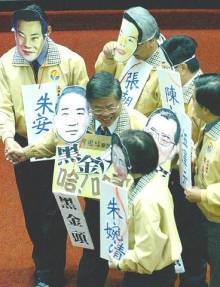
Taiwan Solidarity Union lawmakers put on masks of fugitives, such as Chen Yu-hao, Gloria Chu and Wu Tse-yuan, on the legislative floor yesterday. The legislators, also wearing masks of Chinese Nationalist Party Chairman Lien Chan and People First Party Chairman James Soong, say these fugitives may be welcomed back home if the blue camp wins the election because the alliance is the center of ``black gold'' politics.
-----------------------------------------

Lunch with the President
With the election just two weeks away, a new product to promote President Chen Shui-bian hit the market yesterday -- a lunch box. Some models yesterday displayed the green lunch box, which features the A-bian doll character and Chen's autograph on the front. Each lunch box costs NT$299.
-----------------------------------------