20040307
=======
It hostile toward Taiwan on March 7, 2004 ……
Annette Lu defends screening process for Chinese spouses
CNA , TAIPEI
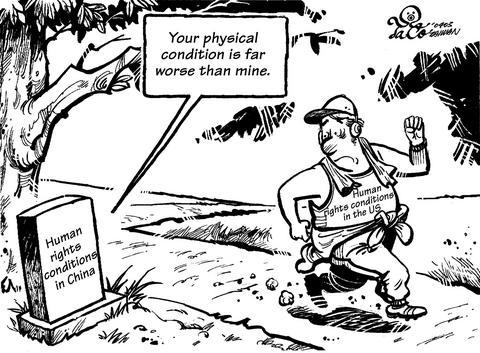
Imposing different restrictions on immigrants according to their country's attitudes toward Taiwan is not discrimination and does not constitute any violation of human rights, Vice President Annette Lu said yesterday.
Chatting with a group of journalists at an informal gathering in her office yesterday morning, the outspoken human rights activist, who heads a national human rights panel at the Presidential Office, came to the defense of the government for its decision that Chinese spouses coming to live in Taiwan must provide a financial certificate. The measure has since been overturned.
Lu said human rights can be divided into different categories, such as those for groups or individuals, as well as absolute human rights and relative human rights.
The human rights of a group prevail in cases that conflict with the rights of an individual. Individual human rights should be subordinate to group human rights, Lu said.
Noting that China is the only country out of the 192 states in the world that is hostile toward Taiwan and is building up its military forces with an eye to an invasion, it is only natural to somewhat restrict people's exchanges with China for the sake of national security, Lu said.
It is not a violation of human rights to discriminate between immigrants from friendly states and immigrants from bellicose states and impose different restrictions on them accordingly, Lu said.
She made the statement when asked to comment on measures subsequently dropped by the Ministry of the Interior that ordered Chinese citizens who want to reunite with their spouses in Taiwan to provide financial certificates proving that they have assets of more than NT$5 million.
This restriction, announced on March 2, was rescinded by the Ministry of the Interior the next day after causing an uproar among local human rights activists. They chastised the government for discriminating against Chinese and infringing on the human rights of both Chinese citizens and their Taiwanese spouses.
-----------------------------------------
On March 7, 2004 ……
Taiwan `allies' get tongue-lashing
POINTED REMARKS: China's foreign minister hinted that foreign countries were preventing unification; meanwhile the legislature increased military spending
AP , BEIJING
China's foreign minister lashed out yesterday at people he accused of having "ulterior motives" toward Taiwan, insisting in several minutes of pointed commentary that Beijing would brook no interference in the de facto independent nation's fate.
"No one will be allowed to use any means to split Taiwan from the rest of China," Foreign Minister Li Zhaoxing said on the sidelines of the National People's Congress, China's legislature.
Li's vehement comments on Taiwan were nothing new for China's government, but the fact that he made them was extraordinary. The issue is continually framed by Beijing as an internal affair that has no relevance to the Foreign Ministry.
But, said Li, "There's a lot I want to say." And he did.
"The Taiwan question bears on China's sovereignty and territorial integrity. To maintain national unity is the Chinese nation's most important mission," he said. "The Taiwan question has been complicated by some people unnecessarily, out of ulterior motives."
He added: "It's really a simple question. There is one China. Taiwan and the mainland are part of that one China."
"China's sovereignty and territorial integrity brook no division. In the end, this is an internal affair of China," Li said. "The Chinese people love peace, but we will not allow any external force to interfere in our quest for reunification."
He also reiterated that Taiwan was "the biggest issue in Sino-US relations." The US has diplomatic relations with China but, under US law, must guarantee Taiwan's security.
Li's comments came two weeks before Taiwan holds a presidential election and a referendum on public opinion about the missiles China has pointed at the island.
Also yesterday, China announced an 11.6 percent hike in military spending, a high-profile expression of support for the People's Liberation Army days before the referendum. The added spending is needed to improve the "defensive combat readiness of the armed forces under high-tech conditions," Finance Minister Jin Renqing said.
Jin didn't give a total for spending on the world's largest military but said outlays this year would increase by 21.8 billion yuan (US$2.6 billion), or 11.6 percent. Last year's announced military budget was 185.3 billion yuan (US$22.4 billion), an increase of 9.6 percent.
The official budget does not include weapons purchases, research and development and other costs. The Pentagon puts actual spending at up to four times the public figures.
China is struggling to make its poorly equipped 2.5 million troops more effective and to adapt to a high-tech world. It has given the politically influential military double-digit budget increases every year for 15 years -- except last year.
"We will focus on developing new and high technology weaponry and equipment, foster a new type of highly competent military personnel and promote modernization of our armed forces," Premier Wen Jiabao said Friday in his report to China's nominal legislature at the opening of its 10-day annual session.
Wen acknowledged the challenge of balancing national defense needs with the requirements of economic development -- especially the need to help the nation's struggling farmers.
-----------------------------------------
On March 7, 2004 ……
Strength, peace go hand in hand
By the Liberty Times editorial
Recently, during an international seminar on national defense held by the Institute for Taiwan Defense and Strategic Studies, Andrew Scobell, a research professor from the Strategic Studies Institute of the US Army War College, said that in facing China's military threat, Taiwan must demonstrate the determination to rise in self-defense in the event of invasion.
He also said that he believes that the strategy most capable of eliminating thoughts by the People's Liberation Army of invading is to display non-provocative war power. Moreover, Taiwan should continue to emphasize that its response to Chinese aggression will be a declaration of independence, he said.
This military scholar was not evasive about the question of possible change in the status quo in the Taiwan Strait. He reminded both the ruling and opposition camps that there is no need to be too fearful of Chinese repercussions or to excessively retreat and compromise in the face of Chinese military threats.
Scobell said that war power can be demonstrated through large-scale exercises and through good training of military officers and soldiers. However, a demonstration of the determination to counter a Chinese invasion would require a display of determination and will by the leaders and the people of the country.
In other words, the leader must have the courage and determination to counter overwhelming political, military, diplomatic and economic pressure from China, and to defend the interests of the Taiwanese people. He must not be a phony peace advocate who retreats in the face of threats.
The pan-blue camp's fear of provoking Beijing, and its policy proposal about casting aside the issue of sovereignty for now for the sake of illusory peace, run counter to the strategy pointed out by Scobell.
With respect to the 228 Hand-in-Hand Rally participated in by people across the country, the pan-blue camp not only did its best to blacken the name of the event and belittle it beforehand, but also criticized it afterwards. Such behavior is in total disregard of the prevalent sense of national identification and community that is built on mainstream popular will and the native consciousness of the nation. Members of the pan-blue camp ignore the fact that this sense of community and identity has become the core value of democratic Taiwan, and they even scornfully asked, "What is the big deal about holding hands."
Actually, the rally not only held special historical significance but also served as a "democratic stimulant" that warmed the hearts of the people. On this great day, more than 2 million people formed a human chain by holding hands at the same time to protest against China's deployment of missiles targeted at Taiwan. It was their way of humbly making the pro-peace and anti-war case and standing up against the bullying of the Chinese regime.
Scobell's wise words precisely explained the historical, strategic and cultural significance of the rally.
As a result of Chinese pressure and because of the political self-interests of various countries, the world has never treated Taiwan fairly -- though, during unofficial interactions, some countries have recognized and identified with the political and economic accomplishment of Taiwan from the standpoint of universal values, such as human rights, democracy and freedom.
However, in official international forums, Taiwan has not received the respect and equality it rightfully deserves. As a result of China's aggressive advocacy of the "one China" principle and its use of military and diplomatic leverage, Taiwan continues to be deemed part of China by most other countries. Moreover, it cannot be denied that as a result of the rapid economic growth of China over recent years, investors from many countries have been attracted into making investments in China. But the totalitarian nature of the Chinese regime has not changed despite the implementation of a capitalistic economic system in China. Beijing has never given up its ambitions to take over Taiwan.
Nonetheless, some members of the pan-blue camp continue to hold illusions about unification, denying the truthfulness of the "special state-to-state" discourse and hoping to establish an illusory "future China" through unification under a confederacy system. They completely disregard China's political and military intimidation.
Political parties can propose various policies in their efforts to win the presidential election. However, no party or individual should disregard national security and the people's welfare in view of their own interests. The threat posed by Chinese missiles is a reality. Such threats will only become more serious. Skepticism about the legitimacy of the referendum and the question, "Haven't we always faced military threats?" are unacceptable.
It is wrong to allow China to continue its missile expansion. To do so would be acting irresponsibly toward the country and the people. It would be extremely dangerous for anyone seeking the presidency to entertain this kind of thinking.
As indicated by Scobell, we must demonstrate non-provocative determination and war power. Both the 228 Hand-in-Hand Rally and the referendum for peace on March 20 are substantive means of demonstrating the will of the people of Taiwan. No one's self-interest should be allowed to hinder the popular will.
Actually, both the 228 rally and the March 20 referendum are part of a pro-democracy campaign for the good of the country. They should not be considered the campaign strategy of any particular political party or ethnic group. As an example, in the late 1980s, the three Baltic states, Lithuania, Latvia and Estonia, formed a 2 million-person human chain to protest against the Soviet Union and then held referendums to declare their independence from the Soviet Union, peacefully regaining sovereignty that had been lost for more than 50 years.
Popular participation in the 228 Hand-in-Hand Rally was a demonstration and reflection of popular will. Through coverage by the international media, Taiwanese people's determination to oppose missiles and demand peace has been made known to the people of the world. In Tokyo alone, more than 30,000 Japanese took the initiative to voice support for the rally. The impact of the rally transcends national boundaries.
Hopefully, the pan-blue camp will pay attention to the hearts of the people and give recognition to the Hand-in-Hand Rally and the March 20 referendum.
Members of the pan-blue camp should learn to realize where the popular will lies and not oppose it for the sake of opposing it. Otherwise, they will be discarded by the people for disregarding the popular will.
The 228 Hand-in-Hand Rally has put behind us the sorrow and tears underlying the 228 Incident and built a new atmosphere for ethnic harmony. As the presidential election draws near, hopefully voters will continue to feel this sense of unity and cast their sacred votes in the first-ever referendum on March 20.
Only in this way can Taiwan receive the respect due a sovereign country. China will no longer ignore the power of the Taiwanese people and will think twice before acting in haste. This is the only way for the democratic development of the 23 million people of Taiwan to be protected.
-----------------------------------------
On March 7, 2004 ……
Government is for the people
Joel Linton, Taipei
On Monday night I visited Lin Yi-hsiung, not at his home, but on the street, in the cold, in front of the Legislative Yuan. By then, Lin was on his tenth hour of a 24-hour fast to protest the Chinese Nationalist Party (KMT)-controlled legislature, which has not carried out its promise to halve the number of legislative seats.
I was amazed as I looked on. Lin and seven others were sitting still and silent. And I could feel the weight of their cause. Although cars were passing by, it felt silent and intensely earnest. Some of you might ask, why fast? I think that it sends a message loud and clear that this matter is not trivial.
Elected officials have to understand that the government is for the people. It does not exist to give them a thrill of power or to fill their bank accounts with cash. They must be accountable to the people who elected them.
I hope all Taiwanese will refuse to vote for anyone who remains in the old KMT way of thinking. I hope they remove from office all those who have shown themselves to be false. And if you want to see a contrast, please go out and visit Lin and others on the sidewalk fasting in front of the Legislative Yuan.
(Editor's note: Joel Linton is Lin Yi-hsiung's son-in-law.)
-----------------------------------------
On March 7, 2004 ……
Taiwanese identity not new
Sing Young, Taoyuan City
It has been repeated recently by the Western media that "a sense of a separate Taiwanese identity has emerged" ("Taiwanese identity in the spotlight," Mar. 2, page 4). The Western media may be discovering the existence of a Taiwanese identity now, but it is not one that has recently emerged, just as the Americas existed before Columbus laid eyes on them.
Almost all Western news media are either ignorant of or simply forget about the history of the Taiwanese identity: We used to be many groups of people (Aborigines and pioneer immigrants alike) co-existing on a Pacific island without a sense of "us"; then, for the first time, in 1895, we came together under the banner of "Taiwan Republic" (the first call for a republic in Asia) to deal with a sudden collective-existence issue. In the 50 years that followed, we further fought for our collective rights under Japanese rule.
The Taiwanese identity was born and grew between 1895 and 1945. Social, cultural, philosophical and political debates among us were much more active and livelier then than between 1945 and 1990. For instance, the first "[Taiwanese] homeland literature debate" occurred between 1930 and 1933, resulting in the sense shared among the intelligentsia that "One lives under the Taiwanese heaven and stands on the Taiwanese soil, one cannot realistically write about anything other than the people of Taiwan and their life."
The "emergence" of the Taiwanese identity that the Western media are witnessing now is really a "re-emergence," a coming out of the closet after hiding for many years under the Chiang family's terror.
We would give the thumps-up to the first Western media outlet that stops the practice of regularly regurgitating in their reports about Taiwan the mantra that "Taiwan split from China at the end of a civil war in 1949."
We existed before 1949; as ourselves, Taiwanese.
-----------------------------------------
On March 7, 2004 ……
China nixes US congressional trip
SINS OF COMMISSION: The group, which was refused diplomatic-status visas, has made itself unwelcome by criticizing China's military buildup
By Charles Snyder, STAFF REPORTER IN WASHINGTON
China has rejected a visa application by a US congressional commission to visit the mainland next week on official business, despite the group's official sanction by the State Department and Congress, and an invitation by the US ambassador to Beijing Clark Randt, in what some observers view as a major Chinese slap to Washington, the Taipei Times has learned.
Members of the US-China Economic and Security Review Commission, which has been critical of many of Beijing's actions, had applied for visas under their official passports issued by the State Department to meet with US and Chinese officials in Beijing as part of the commission's preparation for a biannual report on US-China relations due to be issued this spring.
But the authorities in Beijing on Wednesday refused to grant the visas, insisting the group travel on tourist visas under conditions that could have landed the members of the commission in Chinese prisons, a commission member said. The commission refused, and the trip was scrubbed.
The commission still plans to visit Japan, Taiwan and Hong Kong, and will be in Taipei during the presidential election, sources say.
It would have been the commission's second trip to China. The first, in 2002, came before the commission issued its first report on China's economic, military and political situation, which was highly critical of China's military buildup and other activities.
It is uncertain why China took such a hard line toward the second trip, commission members say. It might be that the Beijing authorities simply do not like the commission and what it has been saying and doing.
The denial of the visas comes to light in the wake of the appearance of Hong Kong's leading pro-democracy advocate, Martin Lee, before a Senate Foreign Relations Committee hearing on Hong Kong's democracy. Beijing has sharply condemned Lee's trip and the hearing as an interference in internal Chinese affairs, one of the most serious charges China can level against an outsider.
But commission members could not say whether the two events were directly linked, noting that China was "jerking around" the members on the visa issue well before the hearing or the Lee trip was scheduled.
In refusing to allow the group to travel on official passports, China laid down the following conditions for travel on non-official tourist visas, according to a letter the commission sent to Senate Majority Leader William Frist, a copy of which was obtained by the Taipei Times.
"1. That we state that we are not coming to China as members of the Commission; 2. that we state that are not conducting activities as members of the Commission; and 3. that we vow not to conduct activities that interfere in the internal affairs of China and Hong Kong."
Commission members view the first two conditions as insulting enough. But the third condition, they noted, could land them in prison, since China could view any effort to gain information or talk to Chinese people as interfering in the country's internal affairs, a serious crime that could carry long prison terms.
"We found that complying with these conditions would be inappropriate behavior for appointees of the Congressional leadership and would not allow us to effectively carry out our work on behalf of the Congress," commission chairman Roger Robinson and vice chairman Richard D'Amato wrote to Frist on Wednesday.
"We believe that accepting these conditions would threaten our standing as official representatives of the Congress, and moreover, would undermine the respectability of our Commission and the Congress," the letter added.
"Despite repeated attempts to negotiate a reasonable compromise," the letter to Frist said, "including offers to accept any category of visa on our official passports and not to travel under the name of the Commission, we regret to inform you that the Chinese Government refused to respond to our visa request prior to our communicated travel deadline of March 2."
The following day, China set down the travel conditions and the commission had to drop plans for the trip.
The commission was set up by Congress in 2000 as part of a authorization bill for defense spending for fiscal year 2001. The idea was to keep an eye on China's economic and military postures and how they might affect the United States and US-China relations.
In its 2002 report, the commission warned about China's military buildup, especially its missile buildup across the Strait from Taiwan and called for increased military operational integration between Washington and Taipei recommendations that infuriated Beijing.
It is understood that the commission is still trying to find an acceptable way to make the China trip at a later date.
-----------------------------------------
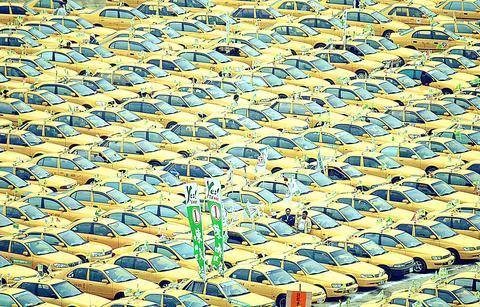
Yellows for greens
More than 500 taxi drivers park together to show their support for President Chen Shui-bian during an election campaign rally in Kaohsiung County yesterday.
-----------------------------------------
-----------------------------------------