20040308
=======
Martin Lee on March 8, 2004 ……
Hong Kong legislator gets trapped at airport
SCRUM: As Martin Lee Chu-ming returned from a trip to the US, the pro-democracy legislator found himself at the center of a shouting match and unable to leave
AP, HONG KONG
A top opposition lawmaker was trapped in Hong Kong's airport yesterday for nearly half an hour as his supporters and pro-Beijing protesters shouted at each other when he returned from a US trip during which he discussed the territory's fight for full democracy, police said.
Martin Lee Chu-ming was met at the airport with shouts of "traitor" by pro-Beijing demonstrators, while others called him a "running dog" for foreign countries, footage from local television showed.
Lee's supporters greeted him with a banner that read "Patriotic hero for democracy," and began yelling back at his deriders.
The verbal sparring among the crowd of about 100 hemmed Lee in for nearly 30 minutes at the airport, police spokesman T.K. Ng said. He was eventually led out by a police escort.
The pro-democracy lawmaker headed a delegation to Washington this week to brief US administration officials and senators on Hong Kong's battle for democratic reform. He met with US Secretary of State Colin Powell and National Security Adviser Condoleezza Rice.
The visit drew strong protests from Beijing officials. Some called Lee "a clown" and accused Hong Kong politicians of inviting foreign meddling in China's affairs.
Lee said the visit was only meant to communicate Hong Kong's situation to US officials, adding he will continue to do what he thinks is right for the former British colony, returned to China in 1997.
"Many officials' criticisms went too far and were improper," Lee said.
"Looking at what the central government leaders said in the past two days, they didn't say Hong Kong cannot have democracy," he said.
Many Hong Kongers are demanding the right to pick their leader and all lawmakers.
Hong Kong's political leader was elected by an 800-member elite committee loyal to Beijing, and ordinary citizens were allowed to choose only 24 out of 60 lawmakers in the 2000 elections -- though that number will rise to 30 in the next contest in September.
Full democracy is set out as a constitutional goal in Hong Kong, but there is no timetable.
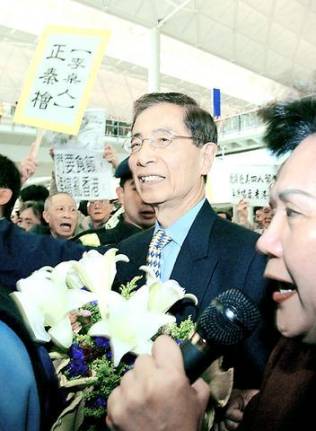
A group of pro-China activists holds placards and surrounds democracy activist Martin Lee Chu-ming at Hong Kong's airport yesterday.
-----------------------------------------
On March 8, 2004 ……
`Threats never bring reconciliation'
"The wording of a referendum is
of course very important. In politics, if you think you are going to lose a
referendum, what you usually do is complain about the wording. To say that the
wording is very bad usually means `I think I am going to lose.'" --- Lord John
Alderdice, deputy president of Liberal International
Lord John Alderdice, deputy president of Liberal International, a world federation of liberal political parties, visited Taiwan last week to participate in the Liberal International Asian Conference that was held in Kaohsiung. Alderdice also serves as the speaker of the Northern Ireland Assembly. Alderdice talked to `Taipei Times' staff reporter Chang Yun-ping about the Democratic Progressive Party's (DPP) current presidential campaign. The DPP joined the federation in 2001 and President Chen Shui-bian was awarded its international freedom prize in the same year.
Taipei Times: You were here four
years ago to witness President Chen Shui-bian's first presidential campaign.
What do you think of his second campaign and its meaning for Taiwan's
democratization?
John Alderdice: The previous election was an extraordinary event, not just for Taiwan, but it was also very important for Chinese communities worldwide. What President Chen did by winning a democratic election was to demonstrate that democracy is not something alien to the Chinese people. On the contrary, when the Chinese people have the opportunity to elect a government democratically, they do so with enthusiasm.
President Chen's election will represent the best hope and future for the people of Taiwan. In the four years since he was elected, Chen has been successful in bringing Taiwan and the views of Taiwanese people onto the international stage. This has not been easy, because it's no great secret that Beijing does not assist the people of Taiwan to present their views of Taiwan internationally.
In a very gracious and courteous way Chen has helped to point out that Taiwan has led the way in democracy for the people of China. It's been appreciated. In Europe there has been a greater understanding of the issues from a Taiwanese point of view. I think the way President Chen and Vice President Annette Lu have conveyed the situation has raised awareness of it throughout the world.
TT: Chen's opponents criticized him for performing badly in the past four years and now demand a change of power, but the president insisted that four years are not enough to allow him to bring about the necessary reforms. What do you think of this?
Alderdice: I think for most governments in democratic countries, four years is a relatively short time to achieve major changes. That was one of the comments, for example, that [British Prime Minister] Tony Blair was making when the election came up for him some time ago -- that he had started after many years of Conservative government. But he needed a second mandate.
The United States constitution also recognizes that the president may serve, if they are elected, a second mandate but not more -- which I think recognizes that four years is really not enough for someone to achieve what they want to achieve.
TT: China is still posing a military
threat to Taiwan. Chen has taken a strong stance on Taiwan's sovereignty, but
his rival, Chinese Nationalist Party (KMT) Chairman Lien Chan, asserted that
the controversial sovereignty issue should be put aside to resolve the
stalemate in cross-strait dialogue. What's your view on this?
Alderdice: My experience [in the Northern Ireland peace talks] was that as long as people were trying to force others to accept their position, there could be no reconciliation for peace. For some centuries, Britain tried to force its will on the island of Ireland. But that was not successful. We had the IRA terror war for 30 years, and that didn't work either.
In the end, everyone has to recognize that the principle of consent is critical to the resolution of any problem. Whatever outcome is achieved, people have to have a say over their own sovereignty. With sovereignty I mean the sovereignty of a country. It's not the sovereignty of a party, not the sovereignty of a piece of ground. It's the sovereignty of the people.
And you don't bring the people together by forcing them together. Once we came to that very fundamental democratic understanding, we could go on to have a possibility of talks. Sometimes it takes a long process of a negotiation, but threats, violence or political force never bring peace or reconciliation. That's been our experience.
TT: So do you think the Taiwanese
people should make their own decisions on independence?
Alderdice: I get the sense that in Beijing there is an assumption that if the people of Taiwan are allowed to make decisions about their own future, that will inevitably mean that they will become independent. That might well be the future, because it doesn't say very much for the confidence of people in Beijing about the attractiveness of their offer [for unification with Taiwan].
I was always struck by those countries that have to put wars around themselves to keep their people in. It doesn't suggest they are a very attractive place. There are other countries that have to build barriers to keep people out, because so many people want to come.
That says something about the attractiveness of those countries. What we always want to see is people becoming self-confident and being able to build relationships. And if things in China are attractive, free and people are given the opportunity, why shouldn't it be something that's appealing?
But if it is conveyed as something authoritarian and restrictive, of course it may not be very attractive to people in Taiwan.
TT: Do you think the referendum would
help the Taiwanese to build up self-confidence?
Alderdice: It seems quite clear to me that if a country wants to have a referendum, wants to consult the people about what they think it entirely has the right to do so. I am always suspicious when another country says, "No, you can't ask people what they think." Why not? The referendum is a matter for the people here to decide. It's a matter for the people here, not for the people in Washington or London or Beijing or anywhere else to say, "No, no, you can't express your wishes, you might get it wrong, you might make a mistake, and you might say something that we don't want to hear." That's not very democratic.
TT: What do you think of the 228
Hand-in-Hand Rally, in which nearly 2 million people came out to protest
China's military threat?
Alderdice: I was struck by a comparison in my own mind. In the run-up to the war on Iraq, Prime Minister Tony Blair told us that within 45 minutes there could be warheads operations from Baghdad. The result of that was to have a war. That's one way of dealing with the problem.
We are here in Taiwan, where we know without any shadow of a doubt that it is a question of seven minutes, not 45 minutes. It's not a question of maybe there are [missiles], maybe there aren't. It's quite clear. And what's the result? The result is people holding hands across the island. The result is having a democratic referendum.
Now that's a very liberal way of dealing with things. That's not going to war. That's a very peaceful way of expressing people's views. I think it's a very reasonable and constructive way to respond.
The fears of Taiwanese people are understandable, and they respond in a peaceful demonstration like this. Of course that's the right way and the best way. What is the alternative? To say nothing? It seems to me what that protest will say is not "we don't want to have a relationship with you," it seems to me it says, "Don't you understand that a fist is not the way to build a friendship? It's holding hands together that's the way to build a friendship."
TT: Here in Taiwan we have the debate
about whether the referendum is legal. A referendum would usually address the
controversial nature of a question. But here the opposition parties claim that
the referendum doesn't serve that purpose. In view of this, do you think the
referendum should still be held?
Alderdice: The wording of a referendum is of course very important. In politics, if you think you are going to lose a referendum, what you usually do is complain about the wording. To say that the wording is very bad usually means "I think I am going to lose."
So if there are people here who say that it's not a legal referendum, the wording is wrong and not the right questions and so on, that suggests to me they are not very confident that they are going to win. Because if they are confident that they will win, I don't think you will hear those arguments. These are very old political tricks that are made all over the world. We all see them everywhere.
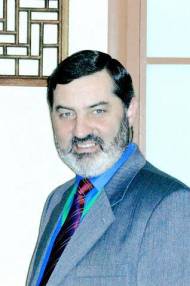
Lord John Alderdice, deputy president of Liberal International and speaker of the Northern Ireland Assembly. He has been actively involved in the Northern Ireland peace process and was one of the key negotiators of the Belfast Agreement signed on Good Friday in 1998.
-----------------------------------------
On March 8, 2004 ……
Make your voice heard, `yes' side argues
REFERENDUM DEBATE: A TSU legislator urged people to send a message about China's missile threat, while a former Control Yuan member said the vote was unconstitutional
By Lin Chieh-yu, STAFF REPORTER
Taiwan Solidarity Union (TSU) Legislator Lo Chi-ming squared off against former Control Yuan member Yeh Yao-peng yesterday in the third televised debate on the anti-missile referendum.
Lo said the referendum gives Taiwanese people the chance to make the international community hear their voice.
Yeh, meanwhile, accused President Chen Shui-bian of violating the Constitution to satisfy his political interests.
The referendum will ask voters: "If China refuses to withdraw the missiles targeted at Taiwan and does not give up its military threats, do you agree that the government should buy more anti-missile weapons and equipment to strengthen Taiwan's defense capabilities?"
Lo said, "If the result of
Taiwan's first referendum is invalid [due to less than 50 percent of eligible
voters casting ballots] or if half of voters choose not to enhance the
military's anti-missile capabilities, then how could Taiwanese people expect
the international community to assist Taiwan in defending itself against China
in the future?"
"Those who oppose the referendum use all-out efforts to censure President Chen but say nothing to blame China," Lo said. "They just can't see any threat from those 500 missiles as well as its huge armaments expansion; rather, they point the finger at Taiwan's democratic development."
Yeh, also a former DPP legislator, insisted that the referendum is unconstitutional.
"According to the ROC Constitution, even though the president has the right to issue an emergency decree, it still needs the approval of the Legislative Yuan," Yeh said.
He said Chen's moves will lead to a dictatorship.
"Minister of Defense Tang Yao-ming told the public that the referendum's result will not change the government's budget for anti-missile equipment. Why should the government implement this referendum?" Yeh said.
"The ruling DPP and President Chen just try to sway the public by using emotional discourse, such as by saying the referendum is a universal value and a mechanism to secure Taiwan's sovereignty. However, they avoid rational discussion," Yeh said. "How could the president ignore the spirit of the Constitution?"
When asked by moderator Lo Chih-cheng, a political science professor at Soochow University, whether the missile threat shows China's intention to invade Taiwan, Yeh said Taiwan should rely on a political strategy to protect itself rather than on an arms race.
"I believe that China has no capability and inclination to attack Taiwan for the time being," Yeh said.
Lo Chi-ming said that a US evaluation of China's military has already warned that Beijing is prepared to launch military action against Taiwan at any moment.
"Moreover, even the advertisements of the People's Liberation Army clearly used a slogan about liberating Taiwan as soon as possible," Lo said. "How could anybody ignore China's intention?"
-----------------------------------------
On March 8, 2004 ……
Don't negotiate with Beijing, unificationist says
By Jewel Huang, STAFF REPORTER
Participants in a televised debate yesterday on the cross-strait stability framework spent little time dealing with the referendum question itself and focused on whether the referendum should be held at all.
Democratic Progressive Party (DPP) Legislator Chiu Tai-san debated with Timothy Ting, a sociology professor at National Taiwan University, on the question of whether to pursue cross-strait negotiations.
The referendum asks: "Do you agree our government should engage in negotiations with China about the establishment of a peaceful and stable framework for cross-strait interactions in order to build consensus and for the welfare of the peoples on both sides?"
Broadcast on China Television Co, the debate was moderated by Central Election Commission member Chang Cheng-hsiung. A panel of three academics raised questions in the course of the debate.
The three panelists were: Chao Chien-min, a political science professor at National Chengchi University, Yang Kai-huang, a political science professor at National Donghwa University, and Hsu Szu-chien, assistant research fellow at the Institute of International Relations at National Chengchi University.
Although the panelists tried to guide the two debaters back to the referendum question, Chiu and Ting traded blows over whether to support the referendum during most of the debate.
On behalf of the "yes" side, Chiu said the March 20 vote is "absolutely legal and constitutional."
"Many people claimed that the referendum is illegal, yet they didn't seek an interpretation from the Council of Grand Justices," Chiu said. "They simply consider themselves grand justices."
Chiu also said many opponents confused the referendum with the emergency decree.
Chiu read the contents of Article 17 of the Referendum Law and pointed out that the law allows the president to initiate a referendum when the nation faces external threats to its security.
"If China steadily increasing its military budgets and weaponry and deploying 496 guided missiles targeted at Taiwan cannot be counted as a threat, then what is a threat to Taiwan?" Chiu said.
Chiu stressed that the result of the referendum will send the message to China that the people of Taiwan are against missile threats and desire peace.
"It will also help Taiwan's representatives when negotiating with China," Chiu said.
Chiu urged people not to give up their rights and to be the nation's masters.
Ting, a former president of Gallup Taiwan, representing the "no" side, said he opposed the referendum being held on the same day as the presidential election because it is "obviously a political tool manipulated by Chen to boost his re-election campaign."
Ting said he supports referendums but is opposed to the upcoming one. Ting wondered why the DPP did not hold a referendum on the Fourth Nuclear Power Plant or on reducing the number of legislators, saying this showed the DPP's intention to cheat people out of their votes.
As for the question itself, Ting said he objected resuming negotiations with Beijing because "the Chinese Communist Party [CCP] is too fearful and artful."
Ting said, as a Mainlander in Taiwan, he has witnessed how terrifying the Communist Party was because his grandfathers were killed by the party.
"Taiwan had better not provoke the CCP giant," he said.
Ting argued that Taiwan should interact with China more in terms of economics and culture, and should avoid discussing political issues.
"It is favorable for Taiwan to postpone the negotiation with the CCP," Ting said. "The later we negotiate with the CCP, the better."
"As long as Taiwan does not declare its independence and keeps its name as the Republic of China, the CCP cannot find any excuse to assault Taiwan," Ting said.
-----------------------------------------
On March 8, 2004 ……
DPP appropriates `black gold' theme
"While they themselves are
`black gold,' it's a ridiculous irony that they wanted to organize a march appealing
to the eradication of `black gold' politics." --- Chen
Shui-bian, president
CL EANING UP: Faced with embarrassment over their past record, the pan-blues changed the theme of an anti-corruption rally leaving the DPP to pick up the idea
By Ko Shu-ling, STAFF REPORTER
The Democratic Progressive Party (DPP) said yesterday it would hold a march against "black gold" in Kaohsiung on March 13, the same day as a march planned by the pan-blue camp.
"Since the pan-blue camp doesn't have the guts to address the issue, we, the DPP, feel obligated to take up the cause for the sake of the nation's economic, political and social development," said DPP campaign spokesman Wu Nai-jen.
Wu made the remark in response to the pan-blue alliance's move to change the theme of its March 13 rally from "anti-black-gold politics" to "change the president, save Taiwan and oppose Chen Shui-bian".
The alliance hopes the rally will draw over 2 million people, seeking to compete with the turnout of the DPP's human-chain rally.
President Chen Shiu-bian yesterday mocked the theme of the blue camp's rally.
"While they themselves are `black gold,' it's a ridiculous irony that they wanted to organize a march appealing to the eradication of `black gold' politics," Chen told a grassroots campaign rally in Taipei City's Tatung District.
Wu said the DPP's decision to organize a march against "black gold" shows its determination to eliminate dirty politics.
"We're thinking of hanging up the pictures and names of the nation's 10 most wanted fugitives to show the government's determination to catch fugitives and to encourage the public to help the government wipe out `black gold,'" he said.
DPP Legislator Chen Chin-jun said at a press conference yesterday that, "It was a joke that the pan-blue bloc wanted to launch an anti-black-gold march while over 45 percent of the public considered it synonymous with `black-gold.'"
The blue camp changed the name of the march because it knew it was not in a position to make such an appeal, Chen Chin-jun said. He said he wondered why the blue camp, if it did care about Taiwan, was absent from the Hand-in-Hand Rally on Feb. 28.
"No matter what name it changes the march to, it still opposes reforms," he said. "If it genuinely wants to push for reforms, it should return its NT$190 billion of [stolen] assets back to the people."
People First Party (PFP) Legislator Lee Yong-ping denied the alliance had ever committed to the anti-black-gold theme.
Lee's remark contradicted those of
PFP Legislator Pang Chien-kuo, who doubles as the KMT-PFP alliance's spokesman,
who said last week the March 13 event would be used to combat "black
gold" and corruption.
Lee said people confused the march
with a campaign against "black gold" because when PFP Chairman James
Soong first spoke of the march in a speech last week, he was questioning the
relationship between the DPP and fugitive tycoon Chen Yu-hao.
"Besides, we don't think being
against `black gold' alone encompasses the scope of our appeal and
dissatisfaction with the performance of the DPP," KMT Legislator Hung
Hsiu-chu said at a press conference with Lee and other pan-blue legislators.
Hung called on those who found the performance of the Chen administration unsatisfactory to join the march this coming Saturday.
Former president Lee Teng-hui last week called the alliance's planned march an absurd activity, saying it doesn't make sense for the people responsible for "black gold" to oppose it.
-----------------------------------------
On March 8, 2004 ……
-----------------------------------------