20040309
=======
SARS hero on March 9, 2004 ……
`SARS hero' blasts Beijing for Tiananmen Incident
REUTERS AND NY TIMES NEWS SERVICE , BEIJING
A military doctor who exposed China's SARS cover-up last year was questioned yesterday over a media leak of a letter he wrote to top leaders asking for a reappraisal of the 1989 Tiananmen Incident pro-democracy protests.
A source close to Dr. Jiang Yanyong said officials from his hospital came to his home yesterday and asked him how his letter to the Communist Party's 24-seat Politburo had reached the media.
"He told them he didn't leak the letter and that he didn't know how the outside world knew about it. He told them they could conduct an investigation into it," the source said.
Jiang, met by two reporters outside his 12th-story flat in western Beijing, waved his hand and said: "No filming."
"The timing is too sensitive," the 72-year-old surgeon said, apparently referring to the 10-day session of the National People's Congress underway in Beijing.
He declined further comment because of a gag order from the People's Liberation Army, imposed after he blew the whistle on the SARS cover-up last year.
Reporters obtained a copy of Jiang's typewritten letter on Sunday and reported that he had asked the government to reverse the official verdict that the Tiananmen Square protests were a "counter-revolutionary rebellion."
Hundreds, perhaps thousands, of pro-democracy demonstrators were killed in a crackdown on the protests, centered on Tiananmen Square, on June 3 to June 4, 1989.
"The mistake made by our party should be resolved by the party itself," the letter, dated Feb. 24, read. "The sooner and the more thorough the better."
"Year after year, with no correction of the mistake, people feel more and more disappointed and angry," Jiang wrote.
Analysts said rehabilitation of the protesters was unforeseeable in the near future because such a move would be politically sensitive.
It could split the party and trigger a power struggle, they said. Some top leaders involved in, or who benefited from, the army crackdown on the protests are still alive or in power today.
Party leaders labeled the protests a "counterrevolutionary rebellion" and have justified the use of military force as necessary to maintain stability. But this official version of history infuriates many Chinese, even if few dare speak about it publicly.
"The vast majority of people I know in every quarter of society are all clear in their hearts that the June 4 crackdown was absolutely wrong," Jiang wrote. "But because of the pressure from above, they haven't dared to speak their mind."
Analysts said Jiang's letter would embarrass and anger Beijing, but he was unlikely to be jailed for fear of a backlash.
Jiang is a hero to many Chinese for exposing the SARS cover-up. His revelation led to the dismissal of the health minister and the Beijing mayor and prompted truthful, open reporting of the epidemic.
The party's propaganda tsars have blacklisted Jiang, who was called "the honest doctor" by the magazine Caijing, known for pushing the limits of government control.
Jiang recalled watching in horror as 89 patients with bullet wounds were brought into the emergency ward of the No 301 Military Hosp-ital, where Jiang was chief surgeon, during a two-hour period on June 3 and 4, 1989, the letter said.
-----------------------------------------
On March 9, 2004 ……
Nobel Peace Prize winner facing fine
"Williams not only joined a
street parade with Lu but also showed up in the DPP rally. She has obviously
violated the law." --- KMT Legislator Sun Kuo-hwa
NO FOREIGNERS ALLOWED: The Nobel laureate wished Annette Lu success in the election, and now faces a fine of up to NT$5 million for violating the law
By Melody Chen, STAFF REPORTER
Nobel Peace Prize winner Betty Williams was facing a fine of between NT$500,000 and NT$5 million yesterday after the Taipei City Election Monitoring Group, an agency of the Taipei City Government responsible for supervising the legality of election campaign activities, decided she should be fined for stumping for the Democratic Progressive Party's (DPP) presidential campaign.
The peace activist from Northern Ireland appeared at an election rally on Sunday night with Vice President Annette Lu, where she read a declaration of women's rights and wished success to Lu's re-election bid.
Election Monitoring Group said Williams' appearance was in violation of Article 96 of the Election and Recall Law which bans foreigners from publicly stumping for election candidates.
The group said it would inform the DPP, which invited Williams under the Taiwan Foundation for Democracy's (TFD) auspices, of the actual amount of the fine by letter in the next few days.
Williams was officially invited to visit Taiwan by the TFD, a government organization supervised by the four major political parties.
The TFD paid about US$40,000 for Williams' trip.
Although the TFD sponsored William's trip to Taiwan, it was the DPP that invited her and organized her activities here.
Vice Minister of Foreign Affairs Michael Kau said the fees the TFD paid for Williams' trip were taken from the organization's budget for political party projects. The money is apportioned to the four main political parties according to the number of seats they hold in the legislature.
Kau, who is also the TFD president, told the legislature yesterday he did not know Williams would appear in the DPP rally.
"Williams not only joined a street parade with Lu but also showed up in the DPP rally. She has obviously violated the law," said Chinese Nationalist Party (KMT) Legislator Sun Kuo-hwa.
Kau said the TFD did not know the details of William's itinerary and did not know that she intended to stump for the DPP at the rally Sunday.
Sun said he believed Williams flouted the law unintentionally and advised the TFD to inform foreign guests it invites of related regulations concerning their activities here so as to prevent similar situations from happening again.
According to Kau, the Ministry of Foreign Affairs has invited more than 40 groups of foreign election-observers to Taiwan and the Government Information Office has invited 30.
The Mainland Affairs Council also invited election observation groups from Hong Kong and Macau.
"Williams would not feel wronged if the foundation had informed her of the regulations," Sun said.
DPP Legislator Lin Chung-mo, however, said the monitoring group imposed the fine on Williams because of Taipei Mayor Ma Ying-jeou's double standards.
The DPP presidential campaign headquarters condemned the fine as a "great disrespect and insult" to the Nobel laureate and demanded the monitoring group review its decision.
Lin cited examples of how Ma, one of the KMT's future presidential hopefuls, once flouted the law when he was campaigning for Taipei mayor by soliciting votes on the streets earlier than the legally-appointed time.
Lin also questioned whether KMT Chairman Lien Chan, the opposition presidential candidate, also violated the law yesterday by declaring James Heckman, winner of the 2000 Nobel Prize in Economics, as his government's economic advisor if he is elected.
Ma emphasized yesterday the monitoring group fined Williams "in complete accordance with the law."
Late last night, the Centrtal Election Commision said that the decision whether or not to fine Williams was its decision alone, and would be based on evidence supplied by the monitoring group.
-----------------------------------------
On March 9, 2004 ……
Pan-blues make fools of themselves
President Chen Shui-bian and Vice President Annette Lu caught up with their competitors and took a lead in the polls after the Hand-in-Hand Rally grabbed international attention on Feb. 28. This has sent the pan-blue camp into a state of anxiety.
Holding large-scale rallies to show public support is a necessary tactic during the final, decisive stages of election campaigns. But the pan-blue camp has never been good at organizing mass rallies. Because the ticket of Chinese Nationalist Party (KMT) Chairman Lien Chan and People First Party Chairman James Soong cannot afford to lose momentum, the pan-blue camp must hold a large-scale rally to try to stoke the campaign's fires. This is the primary motive behind the pan-blue rally slated for this Saturday.
Though it is a feeble attempt at imitation, it is a necessary effort for the pan-blue camp to make.
As for the purpose of the rally, it really doesn't matter. That was why the pan-blue camp initially planned to call its event an "anti-black gold" rally. Before long, however, the pan-blue camp found out that the theme amounted to political suicide because the Taiwanese public knows about the KMT's time-honored tactic of using local factions to consolidate central government power -- by allowing these factions to gobble up local resources.
The public is even more resentful
about the KMT's tangled relationships with its cronies in business. "Black
gold" was precisely the reason that the KMT lost the 2000 presidential
election. Now, who can believe the KMT when it says it has transformed itself
into an angel of justice, a crusader against black gold?
The KMT apparently saw an opportunity to brand the ruling Democratic Progressive Party (DPP) a corrupt "black gold" party after the media reported accusations from businesspeople like Chen Yu-hao and Chang Min-chiang that some DPP officials had taken bribes. At least, the KMT probably believed such a tactic could counter the DPP's key campaign strategy of highlighting the KMT's corruption.
But many questions remain about the accusations from Chen Yu-hao and Chang. Much of the media and the public have suspicions about the political motives behind their accusations. By hyping the "black gold" allegations against the DPP, the pan-blue camp may have also stoked the electorate's resentment of the KMT's corrupt politics. The pan-blue camp may have lost more than it has gained.
DPP people were greatly excited when the pan-blue camp said it wanted to organize an "anti-black gold" rally. Many DPP people said they would take part in the rally. This could have transformed the pan-blue rally into a pan-green rally.
Former president Lee Teng-hui also poured cold water on the pan-blue camp, saying "Black gold people opposing black gold -- ludicrous." This set off alarm bells in the pan-blue camp, which then dropped the absurd idea of holding a rally against black gold.
In its anxiety, the pan-blue camp came very close to turning itself into a big joke.
Yesterday, the pan-blues gave up the idea of cheating the public with that ridiculous cause. Instead, they decided to use "Save Taiwan, replace the president" as the theme of the rally.
To flex muscle and grab power is the political purpose behind the pan-blue camp's rally.
The Feb. 28 Hand-in-Hand Rally is now on record as the largest mass rally in the country's history. Everyone is curious how the pan-blue camp plans to attract people to its rally on Saturday.
-----------------------------------------
On March 9, 2004 ……
Chen deserves to win
By Jason Lee Boon Hong, Singapore
I refer to the article "Foreign journalists to flock to Taiwan" (Friday, March 5, page 4).
It is no surprise that foreign journalists and news organizations are keen to report on the presidential election. Beyond the historic referendum to be carried out on March 20, the fact is that the choice of Taiwanese voters on that day will have a huge impact on the world in general.
It is no exaggeration to state that after the events which occurred in the past four years, a victory for Chinese Nationalist Party (KMT) Chairman Lien Chan and People First Party Chairman James Soong would indicate to the world that Taiwan does not value democracy, freedom and independence.
Five key factors point to a win by President Chen Shui-bian and Vice President Annette Lu: the candidates' backgrounds, the events that have transpired in the past four years, the Hong Kong July 1 demonstration, the influence of former president Lee Teng-hui and the actions of China.
Unlike Lien, Chen grew up with a humble background, and that certainly speaks of his ability to empathize with the less fortunate in society. Lien and Soong have been embroiled in financial scandals, which have yet to be resolved. Also, at the age of 68, is Lien able to relate to the feelings and aspirations of the younger, modern Taiwanese? Chen is only 53. Lien has also frequently modified his views and actions over the past few years. From supporting the view of "special state-to-state relations between Taiwan and China," as espoused by his former party chairman Lee in 1999, Lien has now indicated that he would prefer a peaceful reunification of the two countries. The Chen-Lu partnership has worked considerably well for the past four years, and will a Lien-Soong partnership work as well, given that in 2000, they launched ferocious attacks on each other?
While economic growth in the country has not been as ideal as in the 1990s, voters should note that Taiwan has enjoyed a better economic growth rate than the EU and Japan, with a lower unemployment rate than Hong Kong and the EU. The World Economic Forum's Global Competitiveness Report also ranked Taiwan as fifth in the world and first in Asia last year.
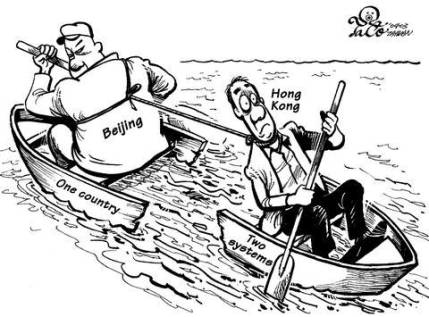
The fact that 500,000 people participated in a mass demonstration of protest against the administration of Hong Kong Chief Executive Tung Chee-hwa on July 1 last year would surely have strengthened the drastic possibility of Taipei following the path of Hong Kong, should the voters elect a pro-unification candidate, namely Lien.
While blame for the lack of economic growth in Hong Kong since 1997 could be attributed to the 1997 financial crisis, Sept. 11 or SARS, Taiwanese have seen how Hong Kong has not developed more freely in terms of individual freedom since 1997.
Despite China's lack of aggressive threats this time round, other issues such as China's opposition to Taiwan's joining the World Health Organization, especially with memories of the SARS outbreak a year ago, have irked and upset many Taiwanese and international observers, that instead of it being purely a medical and social issue, the Chinese have turned it into a political issue.
Lee has been widely regarded as the founding father of democracy and economic development in Taiwan. It is probably no exaggeration to say that Lee is probably regarded in Taiwan what Lee Kuan Yew is to Singapore or what Mahathir Mohamad is to Malaysia. Would voters want to see Lee's fight for democracy disappear overnight?
The presidential election will shape Taiwan in the coming years.
On paper, both Lien and Chen have the experience and potential of ruling the country, with the former having served as premier and vice president from 1993 to 2000, and the latter having served as Taipei mayor and president.
The key factor is, "Which candidate would safeguard the interests of Taiwanese in the years ahead?"
As a foreign observer, I have to state categorically that only with a Chen victory could Taiwanese remain optimistic about the future.
A Lien victory would only spell "reverse development" for Taiwan. And that would indeed be a shame, considering the efforts of Lee and Chen to build Taiwan on a forward platform. I believe many neutral observers share the same thoughts. Ultimately, the destiny of Taiwan lies in the hands of the voters, who I think will make the right and only choice -- that is to vote for Chen. A victory for Chen equates to a victory for Taiwan.
-----------------------------------------
On March 9, 2004 ……
All China understands is power
By Jeff Hockett
One party has diligently invested in, researched and deeply thought about the best way to influence the minds and votes of the Taiwanese people: the Chinese Communist Party.
Many Taiwanese people will vote for the Chinese Nationalist Party (KMT) simply because they are upset about how bad things are now and they blame President Chen Shui-bian.
Some uncurious and politically uninterested KMT voters are unable to offer positive reasons that they believe the KMT is more capable of dealing with the issues they complain about. They even find it difficult to identify what Chen did or didn't do to cause the malaise (that is, unemployment) they believe this country is suffering from. In fact, they may not know a single relative or friend who is genuinely having a hard time finding a job, but they believe unemployment is more serious and widespread than it is because they have heard it from some media sources and take it as fact.
But not all votes for the KMT are devoid of any attempt at logical thinking.
One of the most reasonable rationales
I've heard for voting for the KMT is that it will create stability with China,
which is claimed to have been shattered by Chen. But frankly, I don't see how
any legitimately democratic nation's desire to exercise its freedom of
expression and state its independence could complicate relations with any other
legitimate country. If there is a crisis or danger of instability, it clearly
comes from China and its threats.
But KMT voters prefer to blame the object of China's illegitimate threats (that is, movement toward independence) rather than putting the blame where it rightfully belongs: China's illegitimate threats.
It is amazing how these threats have worked in the way China cleverly intended for them to work, and how Taiwanese people seem unaware of or unbothered by this tampering with their voting freedoms (the ultimate freedom of expression) by China. Many voters seem resolved to vote for a certain party, not according to reason or the logic of any argument set forth by any candidate, but rather because of an unhealthy fear of China.
Fear is an effective weapon commonly used in dictatorships and communist countries to curb the free, genuine expression of their people. It outrages me that China can have the power to use threats (which are used to control the "opinion" of its own people) in this democratic country so as to influence the voting behavior of many Taiwanese people. This should not be so.
If there were no threat of military action, most Taiwanese people would have no reason to oppose statements about the country's de facto independence. But their freedom to vote for what they would logically desire has been seriously impaired. They really don't have the freedom to vote if they fear the possibility of China's authorities bringing them back into line for voting the "wrong" way.
That isn't freedom.
But for many of these voters, China, with its crude intimidation and fear tactics, has been allowed to take away their freedom to express this nation's self-identity.
Many people talk about China as if it were superior to Taiwan and unstoppable. They talk of a China that is solely responsible for Taiwan's future job market and economic success. Therefore, the thinking goes, stability must at all costs be maintained, even if it means forfeiting national pride and sovereignty, if Taiwan's economy is to be maintained or built. Aren't Taiwanese people sufficiently innovative and haven't they shown themselves to be economically successful in the past without China's help?
Taiwan should start seeing itself as its own asset instead of looking to China, the US, the UN or any other agency for legitimacy or economic success. Many fear that Taiwan would be hurt economically due to a severed relationship with China, but often fail to realize how much more it would hurt China, which is just now beginning to experiment with free market ideas in limited areas.
In order to negotiate with an authoritarian government successfully, a democratic nation must be as strong as or stronger than the dictatorship. The failure to work toward and envision a strong Taiwan has handicapped the nation's capability to negotiate with China on an equal or superior footing.
One area that creates superiority (or equality) is a strong, robust national defense. This is indispensable if Taiwan wants to reduce tensions with China, enjoy the right to express self-identity without fear or manipulation and foster a healthy pride.
China won't negotiate logically like a democratic nation unless it is forced to. It doesn't have to -- it has more weapons with which it can bully, and no accountability to its own people in the form of elections with which it can be restrained.
The only type of logic that authoritarian countries like China will listen to is force, and that is the only effective argument that Taiwan should offer to China.
The US has been pushing Taiwan to spend more on defense for a long time.
This has also been one of Chen's aims, but it has been blocked by the KMT. Until Taiwan has military assets sufficient to express its opinions about its own sovereignty without fear, it will be forced to rely on the opinions of other powerful nations like the US and China, who do have these assets.
The KMT would apparently attempt to create stability by throwing up the white flag. It would curb the expression of Taiwan's people by caving in to China's demands. In essence, the KMT would link the prosperity, victory and future of Taiwan to the success or failure of relations with one country.
If it does that, it implies that the other country is superior. Is that such a noble platform?
Jeff Hockett is a freelance writer based in Taipei.
-----------------------------------------
On March 9, 2004 ……
-----------------------------------------