20040311
=======
Believing in the people on March 11, 2004 ……
Believing in the people
`A real leader must be able to point out the direction for the people and map out a future instead of trying to gain support by wishing the country bad luck and withdrawing from reality.'
In the second half of a two-part
exclusive interview with the `Taipei Times,' President Chen Shui-bian promises
to continue promoting democratic reform and the establishment of a Taiwanese
identity.
By Lin Chien-yu, Staff Reporter
Taipei Times: You have promised to expedite the formulation of a new constitution once you take office for your second term, with the goal of having a draft of the constitution approved by referendum in 2006 and formally brought into effect when the new president takes office in May 2008.
The US and the international
community are concerned that this might in fact be the path toward Taiwan's
independence, although you have promised that the terms of reference for the
new constitution will not change the status quo and have emphasized that
constitutional reform is a process on which the survival of Taiwan's democracy
depends, and has nothing to do with independence or unification.
But, if a majority of the people called for changing the country's flag, name or territorial boundaries, would your government push that kind of constitutional reform? Or would it ignore the will of the people and just avoid such sensitive topics in order to preserve stability in the Taiwan Strait?
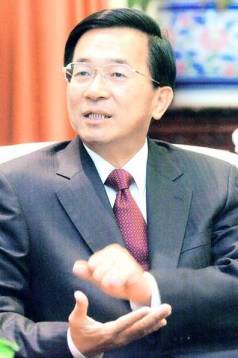
President Chen Shui-bian speaks to the Taipei Times on Tuesday.
President Chen Shui-bian: I announced my "five noes" in my inauguration speech in 2000. I cannot say one thing in 2000 and then say another once I get re-elected. I have stressed many times that we must maintain the status quo, maintain Taiwan's current sovereignty, democratic development and economic affluence, maintain peace in the Taiwan Strait.
Not only do we want to maintain the status quo; we also want to avoid the status quo being changed unilaterally. The kind of constitutional reform we wish to promote -- including when we have been re-elected -- will be promoted on the basis that it preserves Taiwan's status quo; that Taiwan's status quo will not change.
The current constitution was ratified in 1947 in China in a process in which the people of Taiwan did not participate, a process to which they did not agree. Of the 175 clauses in the constitution, at least two-thirds need amending.
These include the questions of whether to go the American route and establish a presidential system of government, or take the British course and establish a cabinet government, and whether we should have three branches of government or maintain the current five.
As far as the election of the president is concerned, should we opt for a simple majority or an absolute majority? Should we have two tiers of government or three? In addition, on basic human rights, economic development, compassion for the weak, there are many issues that are affected by the articles of the Constitution.
If we are to create additional posts, such as deputy premier and deputy speaker of the Legislative Yuan, we will need to revise the constitution. If we are to reduce the voting age by two years from 20 to 18, we will need to revise the constitution.
TT: Each time there is an election,
there are always people who bring up the topic of an ethnic melting pot and
accuse others of harming ethnic minorities. Which party do you believe is doing
the most to promote ethnic harmony, and which is doing the most to promote
conflict? When you have been re-elected, what will you do to deal with the
ghost of ethnic strife, which haunts Taiwan?
Chen: I have always believed that Taiwan's multiethnicity is one of the resources of which we can be most proud. In the past our ethnic differences allowed the Chinese Nationalist Party (KMT) to promote a one-party state, with the ethnic minorities on the sidelines, using them, controlling them. But the Democratic Progressive Party (DPP) respects ethnic minorities. Now, all ethnic groups can express themselves, freely develop and pursue their dignity and their own future. In the past, when immigrants from China wrote letters to their relatives in China, they risked being arrested. The DPP was the first party to call for them to be allowed to visit their relatives in China. Also in the past, the Hakka and Fujian dialects and other native tongues almost disappeared under KMT suppression, but the DPP established a Hakka Affairs Commission, Haaka radio and TV stations, enabling Hakka culture to put down roots. The DPP promotes and has implemented education in one's native tongue; we renamed "Chiehshou Road", "Ketagalan Boulevard," called the Aboriginal people by their rightful names and signed a New Partnership agreement with Aborigines to promote their autonomy.
The problems facing Taiwan right now are not ethnic problems, but problems of legitimacy. True instability comes from KMT Chairman Lien Chan's constantly changing position on cross-strait relations. The people of Taiwan are unhappy with his understanding of nationality; they are unhappy with his running mate, People First Party (PFP) chairman James Soong's insistence on "one China under one roof."
For my part, I insist on three things to bring about ethnic harmony. First, I insist on ethnic equality, including equality of opportunity, resources and rights. No ethnic group is superior, much less inferior, to any other. Let's allow ethnic groups to get on with each other on an equal and peaceful footing. Second, I insist on a diversity of values: continued support for the cultural resources of all ethnic groups, respect for ancient ways of life, encouragement for creativity and interaction between different cultures all contribute to Taiwan's special character and all are capable of contributing to Taiwan's future and its heritage. Third, I insist on democracy and freedom. The greatest safeguard for all ethnic groups is a democratic and free society, because it is only within a free and democratic society that we can achieve rational change and replace confrontation with humanity. We share a common identity, which is that we are all citizens of this great country.
TT: There is no doubt that Taiwan has an emerging national consciousness, which is different from the Chinese consciousness that the KMT tried to impose after 1949. Some people have, however, expressed frustration with the pace of the reform of institutions to reflect this new national awareness. These people ask why the DPP government hasn't done more to move education and culture -- even national symbolism -- away from the Sinocentric system of the KMT.
What kind of measures would you like
to implement in your second term to build a stronger Taiwan consciousness?
Chen: In the past four years, the government has strongly promoted Taiwanese consciousness. More than 50 percent of the people see themselves as Taiwanese rather than Chinese. This is what we have achieved in promoting Taiwan's self-awareness. Of course this is not enough.
A lot of people still see the enemy as their place of origin, and still see Taiwan as part of China, as a subsidiary or constituent of China.
We keep trying to explian that Taiwan's culture is like an ocean, and is fed by hundreds of rivers. Hundreds of years of different cultures have merged into this society and made a rich soil in which Taiwanese culture can grow.
Whether it's the culture of Spain, the Netherlands, the Qing Dynasty, Japan, even the USA or other countries, all can become part of Taiwan's culture.
Some say that the promotion of
"Taiwanese consciousness and Taiwanese recognition" is
"de-Sinicization". This is incorrect. Our aim is to consolidate
Taiwanese consciousness. What this means is that Chinese culture is only part
of Taiwan's consciousness, not vice versa.
In order to strengthen these
concepts, our task is to make Taiwan a normal, complete, great and beautiful
country. That's why we need to push for the new constitution. As a nation,
Taiwan is still incomplete and abnormal. We wish to complete a new constitution
that corresponds to the current state and can be ratified by all citizens. This
would be my main task in my second term.
Therefore, we wish to pass a new version of the Constitution through referendum by the end of 2006, and commence its application on May 20, 2008, during the new president's inauguration.
Campaign Promises
TT: The peaceful transfer of power
was a milestone for Taiwan's democratic development. However, when leading the
nation to continue to march on the path of democracy, the rule of law and reform,
you obviously have suffered many obstacles during the past three years. What
was the most difficult challenge and what was the greatest achievement by your
administration?
Chen: The 54-year rule under the KMT have created many complicated problems, and these need to be solved step by step. We have made progress in many fields, such as the nationalization of the military, bringing the intelligence agencies under control, promoting neutrality in the government, and the independence of justice system in past three years. As for other issues, we are confident we will conquer the remaining obstacles in the next four years.
Since my inauguration on May 20, 2000, the world has experienced an economic downswing; therefore, boosting the economy is one of the key administrative issues on my agenda. Over the past three years, many governments have been aggressively executing plans to enhance investment opportunities, help private enterprises with their business transformations, and develop knowledge-based economies.
The Executive Yuan has proposed the "Challenge 2008 ? Six Year National Development Plan," which is a blueprint giving a head start for my administration. This plan aims to push for the elimination of political and financial corruption.
At the same time, the government also plans to develop the nation's semiconductor and flat-panel industries over the next few years, each with a production value exceeding NT$1 trillion.
During the next six years, the funding for science and technology research and development will be increased to account for 3 percent of the nation's GDP.
Once I win my re-election bid, my administration will terminate three major problems: the chaos of the political scene, the Legislative Yuan's continual conflicts and Constitutional disorderliness. We will endeavor to normalize the interaction between the DPP and the opposition alliance as well as cross-strait relations. We also expect that after the legislative election later this year, the interaction between the Cabinet and the Legislative Yuan will be improved.
TT: In the first year of your administration,
you officially announced that the construction of the Fourth Nuclear Power
Plant would cease. However, under pressure from the Legislative Yuan, which was
dominated by opposition parties, your decision was overturned. Will you bring
up the controversial issue again in the future? Has former DPP chairman Lin
Yi-hsiung (林義雄) ever expressed his opinions on
the matter to you?
Chen: The anti-nuclear movement is not motivated by any political ideology, but by the desire for sustainable development in Taiwan. We can't leave our future generations with the problem of nuclear waste, the toxicity of which lasts for tens of thousands of years. It's not only selfish, but also irresponsible. The decision to halt construction was made based on the premise that Taiwan would not suffer from power shortages even if the power plant does not exist. Unfortunately, most people have only focused on the possible financial loss resulting from the halt rather than future expenditures in dealing with radioactive waste caused by the completion of the construction. At that time, the Legislative Yuan remained dominated by opposition parties, so we had no choice but to reverse our decision to stabilize the political situation.
The relaunching of the construction led to the establishment of a widespread desire to turn Taiwan into a nuclear-free nation. The newly-established Environmental Basic Law also clearly proclaimed the goal. So the law makes Taiwan officially the first nuclear-free country in Asia. In the legislative elections, both the DPP and I hope to mobilize people to hold a referendum on the issue at the same time.
The future of the nuclear power plant will be finally decided by the people.
Final phase
TT: You have appealed to the public to consider a leader's personal traits, and if you wanted to elaborate to an international audience about the differences between you and Lien, which leaders and lessons from history can you offer as examples?
Chen: In this election, the two sets of candidates have formed a strong contrast. Lien and I are from different backgrounds, have different beliefs, represent different generations and have very different personal traits. I believe in myself, believe in the people, believe in Taiwan and am not afraid of difficulties and will persist to the end.
Meanwhile, Lien does not persist, does not support, does not believe and he is dishonest, irresponsible and has not changed.
I think that the issues faced by every leader are unique, and a leader has to find the answers himself. Whether you are talking about Kennedy, Roosevelt, Churchill or Gandhi, the challenges and environment they faced were not the same and they had different styles in dealing with the issues.
But they all have the same personal traits: they were all aggressive and persistent. What is more important, they all believed in the people and believed they could conquer all difficulties by standing firm on the side of the people.
A real leader must be able to point out the direction for the people and map out a future instead of trying to gain support by wishing the country bad luck and withdrawing from reality.
Lien became the candidate for the pan-blue camp because the old power in the pan-blue camp wanted to have one last try at repressing the new generation, and it was also a convenient way for the KMT and PFP to dive up the power between the two parties.
Lien's moral defect lies in his long-term accumulation of personal assets and his deep involvement and relationship with corrupt criminals in the past. Further, he has been weak and wavering on the issue of national identification, and this is something that is not acceptable in Western democratic societies. A candidate with such qualities could never even become nominated, so it is very difficult to think of an example with which to compare Lien.
TT: In the last presidential
election, KMT candidate Lien and PFP Chairman James Soong, who ran as an
independent candidate, together won around 60 percent of the vote, while you
won 39 percent. There are only about ten days of campaigning left. All the
pollsters say the two camps are neck and neck. Will you prove the pollsters
wrong?
Chen: In this election, while I'm happy for Lien and Soong to have come together because they have demonstrated that one and one do not always make two. All the polls, taken together, show that they don't have anywhere near the 60 percent support rating that they enjoyed in 2000 and that, when I win this year's election, it will be despite Lien and Soong forging an alliance.
It's clear from the opinion polls that the Chen-Lu ticket enjoys the support of about 40 percent of voters. We have not merely retained the support of the 39.3 percent, who voted for us in 2000 because, of the 80 percent of voters who have expressed a preference, 40 percent have declared for us. If we take account of those voters who have not yet expressed their preference, then I have already gained the support of approximately 50 percent of the voters and am effectively in the lead. I believe that the margin of victory in this election will be between 3 and 5 percent, or between 300,000 and 500,000 votes.
Four years ago, the polls put the Chen-Lu ticket ahead by only 0.4 percent just two days before the election, but our eventual margin of victory was in fact 2.7 percent. In the opinion polls in the current campaign, we've already destroyed the myth that one and one always equals two and exceeded our previous level of support of 39.3 percent. The Chen-Lu ticket is in the lead, but we mustn't be complacent. I am confident of being elected, however, because if you believe in Taiwan and believe in the people, you will win.
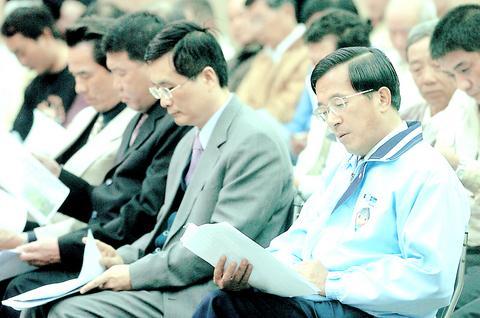
President Chen Shui-bian reads documents at a campaign event in
Taichung County last Friday.
-----------------------------------------
On March 11, 2004 ……
Lien family's stake in a company in California disputed
By Debby Wu, STAFF REPORTER
Democratic Progressive Party (DPP) Legislator Tuan Yi-kang offered fresh evidence yesterday that he said showed that Chinese Nationalist Party (KMT) Chairman Lien Chan had lied about his family's ownership of a company in the US.
The KMT declined to respond.
Last month Tuan said that the Lien family owned a company in California and that in order to evade taxes it did not list the company as among its assets. In response, the KMT produced a document from the State of California that it said proved that the Lien family had long ago sold the company.
Two days ago Tuan produced evidence that he said showed that the document from the KMT, which lacked a state seal, had not been processed by the State of California but instead was only an application form that anyone could download from the Internet and proved nothing.
Tuan also showed what he said was an official document from California with the seal affixed.
Yesterday Tuan produced a document from the State of California, signed by California Secretary of State Kevin Shelley on March 2, apparently certifying that the company was still owned by the Liens.
Attached to the document were two pages of company statements apparently showing that Lien's wife, Lien Fang Yu, was the president of the company; that his two children, Lien Hui Hsin and Lien Sheng-wen, were on the board of directors in 1995; and that the company's president and board members had not changed up through Jan. 9 of this year.
Tuan said that he had been in contact with the California government and was told that there had been no changes in the company directors.
"The Lien family said that my documents were forged, but if the company had really been sold, there would have been related documents," Tuan said.
"The Liens have been unable to offer any," Tuan said.
The KMT seemed to show little interest in fighting with Tuan over this issue again.
"We have offered the document from the California secretary of state and explained the situation, and we are not interested in responding again," KMT spokesman Alex Tsai said.
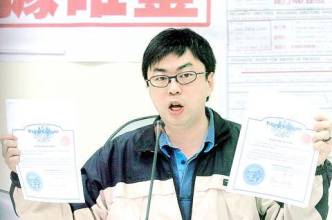
DPP Legislator Tuan Yi-kang holds a press conference yesterday to accuse KMT Chairman Lien Chan of lying about his family's assets in the US.
-----------------------------------------
On March 11, 2004 ……
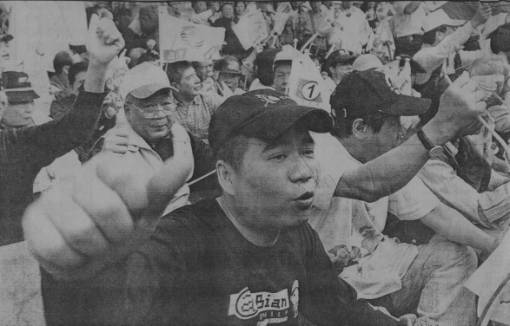
Less Lawmakers, Please
Hundreds of people from several non-governmental organizations yesterday stage a protest in front of the Legislative Yuan in Taipei, demanding that the legislature pass the bill to halve the number of legislative seats before March 20.
-----------------------------------------
On March 11, 2004 ……
Lee: China's `empire' will deteriorate
DOWNFALL: Lee Teng-hui said yesterday that China's dictatorial ways will bring about minority uprisings and lead to economic ruin.
By Chang Yun-ping, STAFF REPORTER
Former president Lee Teng-hui said yesterday that China's deep-rooted imperial character will bring about an economic collapse and an uprising by ethnic minority groups that are oppressed by Chinese rule -- and that this will cause the downfall of the Chinese tyranny.
"China's deep-rooted imperial character will hamper modern China from fitting into international society. Eventually China will turn into a debacle, with uprisings from minority groups oppressed by China and the falling-apart of the economy," Lee said at a press conference that marked the release of The New Chinese Empire, a book by Ross Terrill, a US expert on China issues.
The book is a Chinese translation of Terrill's The New Chinese Empire, and What It Means for the United States, which was published last year.
Terrill, who holds a doctorate in political science from Harvard University, was, in 1964, one of the first scholars to enter China during the rule of the Chinese Communist Party.
Once honored by Chinese leader Mao Zedong and deemed a prominent figure welcome in China, Terrill changed his outlook on China after the Tiananmen Incident in 1989 and started work on The New Chinese Empire.
Lee and Khedroob Thondup, a member of the Tibetan parliament-in-exile, presided over the book's release.
The book says China's status as an empire derives from its dictatorial rule that rejects the pursuit of democracy in Taiwan and Hong Kong and among minority ethnic groups in places such as Tibet and Xinjiang. The progress of China's political liberation, Terrill says, is far behind that of its economic development.
Lee said yesterday that China's practice of socialism has isolated the country from other modern nations and that restrictions on its economy have crated a huge gap between rich and poor.
"China's imperial national consciousness respects no national boundaries and therefore it claims sovereignty over any group having any relations with China -- including its hard-line belief that Taiwan is part of China," Lee said.
Lee said the book provides insight into questions such as how to see through the guile of the so-called "greater Sinocentric consciousness," how to deal with the emergence of a Chinese empire, whether Chinese civilization will leave a legacy to the modern world and whether the future of China is as rosy a picture as many think.
Terrill makes seven predictions about China's future, including continued authoritarian rule; a gradual falling-apart of the rulers' political grip -- following the path of South Korea and Taiwan; a collapse like that of the former Soviet Union; transformation into a terror state; the development of fascism in China; and finally, after long-term turmoil, the development of a democratic federation.
Lee said Taiwan's democracy is a precious experience for the Chinese population living under authoritarian rule.
"No place in China has become a full democratic entity as Taiwan has. Look at Hong Kong and Tibet and you'll see that China can't tolerate the existence of democracy. Once they come under China's rule, people will lose freedom of speech and other inherent human rights," Lee said.
Lee urged people not to become bewildered as a result of "Sinocentric consciousness," but rather to take a firm stance on improving Taiwan's democracy.
-----------------------------------------
On March 11, 2004 ……
A `Taiwan first' policy will help the economy
By Huang Tien-lin
On Feb. 28, 2 million people took part in a hand-in-hand rally aimed at protecting Taiwan, demonstrating the people's will and expressing their voices to the world. Encouraged by this, the TAIEX index soared by 137.89 points to 6,888.43 on March 1. It was another example of my theory that "a successful referendum will boost the stock market and help Taiwan's economy." The fortunes of a nation lie in its national will. History has clearly shown us that the higher national unity is, the better the domestic economy, just as a country's economy will surely decline if the public's national will loosens and their national unity collapse.
Under the former Chinese Nationalist Party (KMT) government's rule in the 1990s, financial and economic officials had mistaken China as Taiwan's hinterland. They thought that the future of Taiwan's economy would be in China, and therefore promoted "cross-strait reconciliation" and the "1992 consensus," driving both businesspeople and their massive capital to China.
As a result, the nation's economy drastically declined, as Taiwan dropped from the first to the last place among the "four Asian tigers" -- Hong Kong, Singapore, South Korea and Taiwan. Low-priced shares nicknamed "egg shares" or "dumpling shares" were everywhere in the stock market. Even the so-called "land mine shares" -- shares of listed companies with financial difficulties -- were frequently seen. Runs on several local banks occurred one after another.
By 1998, a financial crisis had gained utmost urgency. The blue-camp officials were nervous and had no choice but to fork out NT$200 billion to stabilize the stock market. This showed that not only did the business policy of embracing China's resources and cheap labor fail to help Taiwan's economy, but it also accelerated the accumulation of bad loans and raised the unemployment rate.
August 2002 was a turning point for the economy, as President Chen Shui-bian clearly told the World Federation of Taiwanese Associations that there is "one country on either side" of the Taiwan Strait, awakening people's will and bringing a new hope to the country. Stimulated by this, the economy and stock market started to prosper again. His pledge of this stance and the referendum proposal made on Aug. 12 last year further strengthened people's confidence. The policy of investing in Taiwan first has been spiritually armed, and the nation's economy has started to take off ever since.
The success of the million-people-hand-in-hand rally on Feb. 28 was yet another demonstration of the people's will, and a reconfirmation of the policies of "Taiwan first" and "Taiwan's economic independence." The strengthening of the public's recognition of the nation has certainly stimulated the vigor of the economy. The significant rise in the stock market on March 1 did not happen by chance.
I want to appeal to the people: do not solely attribute this wave of economic recovery and stock market's performance to the US economic recovery and floating money worldwide. The US economy was prosperous when the blue camp was in power in the 1990s. But the performance of the US stock market did not stimulate Taiwan's stock market at that time. Thus, the improvement of a nation's objective environment also depends on the subjective environment while boosting its domestic economy.
I hope that the public can cherish these fruitful results. Whether the referendum is held successfully and whether Chen is re-elected are crucial to the continuation and further prosperity of such results. If the referendum and Chen's re-election bid succeed, the economy will further prosper, and the rise of the TAIEX index to 10,000 points can be expected at that time.
Huang Tien-lin is a national policy adviser to the president.
-----------------------------------------
On March 11, 2004 ……
No change in cross-strait military tensions, CIA says
"We were left with the
impression that the `Kitty Hawk' would represent a show of force. That's my
interpretation." --- Bob Yang, the leader of a Taiwanese-American
group seeking support for the referendum
By Charles Snyder, STAFF REPORTER IN WASHINGTON
US intelligence has not yet detected any military moves by China to try to influence Taiwan's presidential election, CIA Director George Tenet says.
But despite the lack of any publicly-released information on Chinese military activity, the role of the aircraft carrier USS Kitty Hawk as a potential monitor and deterrent to a military threat by China remains uncertain less than two weeks before the election.
Tenet, appearing before the Senate Armed Services Committee, told the committee that with respect to the security situation in the Taiwan Strait as the election approaches, "there are no movements by Chinese military forces nor preparations for exercises to attempt to influence events in Taiwan."
He did not give details or elaborate.
Meanwhile, the Kitty Hawk, a mainstay of the US Seventh Fleet, was scheduled to leave Hong Kong yesterday after a five-day port call, but in keeping with its policy of not announcing ship movements, the Pentagon has not released any details of the carrier's plans after departing from the territory.
The carrier battle group arrived in Hong Kong Saturday from Shanghai, where it stopped off after leaving its home port in Yokosuka, Japan, earlier this month. The Kitty Hawk is the only permanently forward-deployed -- meaning based outside of the US -- aircraft carrier in the US military.
Fanfare
Beijing news media paid great attention to the visit, which would seem to belie speculation that the recreational stopover is part of a mission to keep tabs on the situation in and around the Strait in the runup to Taiwan's presidential election.
The Hong Kong visit by the Kitty Hawk is "absolutely not coincident with" Taiwan's elections, the official Beijing newspaper People's Daily quoted the commander of the Kitty Hawk battle group, Rear Admiral James Kelly, as saying on Sunday.
"It has nothing to do with the election," the newspaper quoted him as saying.
Nevertheless, speculation about the Kitty Hawk's role gained attention last week when Deputy Assistant Secretary of State for East Asia Randall Schriver mentioned the sailing to Hong Kong in a meeting with Taiwanese-American groups seeking Bush administration support for Taiwan's referendum.
During a discussion of the US defense posture in the Western Pacific, Schriver said "the USS Kitty Hawk carrier group is not on its way to Hong Kong," Bob Yang, the leader of the Taiwanese group, told the Taipei Times after the meeting.
Schriver "did not attach any significance to it. He would leave it up to our interpretation," Yang said.
"We were left with the impression that the Kitty Hawk would represent a show of force. That's my interpretation," Yang said.
A US official, however, termed the Kitty Hawk trip a "routine operation" for training with a Hong Kong port call.
He did, however, hint at a Taiwan-related role for the Kitty Hawk.
Supporting role
Discussing the mission of America's more than 150,000 troops based in the Asia-Pacific region, the official said their role was for "the general purpose of supporting our allies, supporting peace and stability, and supporting the various commitments we have, and that would include those under the Taiwan Relations Act."
That act, enacted after Washington recognized Beijing diplomatically in 1979, committed the US, among other things, to retain the capability to help defend Taiwan against hostile Chinese military actions.
However, a US military official in the naval command in Hawaii doubted that the Kitty Hawk's mission involved Taiwan. The warship was scheduled to leave its home port in the middle of last month, but it was held up with a steam leak that had to be fixed, he said. That means, he contended, that the trip was not meant to coincide with Taiwan's election.
In addition, he noted, Beijing approved the visit.
"I just can't imagine" that China would approve a visit that had something to do with Taiwan's election, he said.
Besides, such an election monitoring role would be seen as "escalatory" and the US would not take a step to escalate tensions in the region at this time, he said.
-----------------------------------------
On March 11, 2004 ……
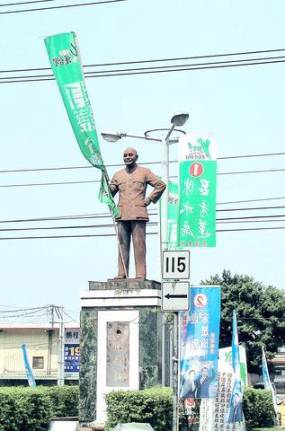
Pro-DPP dictator
A statue of the late dictator Chiang Kai-shek holds a hand-in-hand rally banner for the Democratic Progressive Party-Taiwan Solidarity Union camp in front of the Yangmei train station in Taoyuan County yesterday. Both the pan-blue and pan-green camps are scrambling to place their campaign banners at public venues nationwide in the run-up to the March 20 election.
-----------------------------------------
On March 11, 2004 ……
Voting with confidence in the future
During an interview with this newspaper (published in two parts, yesterday and today) President Chen Shui-bian said an election victory for him on March 20 would be significant for Asian democracies because it will make the nation the first Asian country to break free from the shackles of its ancient regime and move toward a mature democracy. He also reminded everyone that a victory for him would also mean that the voters had chosen not to yield to China's intimidation or any type of international pressure, but rather to walk their own path.
With the political forces of the ancient regime waiting for an opportunity to make a comeback, and in the face of young democracies the world over which are also facing similar situations, it is hard not to agree with Chen. Just as he pointed out in the interview, the biggest danger for those countries pursuing democracy is the question of whether their peoples are ready to accept the pain of reforms.
Looking at countries in Asia, Latin
America and Eastern Europe which have recently emerged from authoritarianism,
it is clear from their development that democratic reforms are a long and messy
road. For example, the people may lose their desire to continue on the path of
reforms due to the temporary pain of the reforms. Reactionary conservatives can
still make a comeback. Voters in these countries appear to have a short memory,
and -- amid the pain and chaos of the early days of reforms -- some begin to
long for the stability and economic order they remember from the authoritarian
system. Prime examples of such wayward nostalgia are South Koreans who long for
a leader such as Park Chung-hee, who ruled the country with an iron fist for 18
years, and the recent Mao Zedong fever in China. The remnants of the ancient
regimes can make a comeback with new slogans and new packaging.
The nation is at a crossroads -- it will either deepen its democracy or regress. It is time to remind the voters and the friends of this country that the people must stand firm on the ideals of democratic reform. Voters must make the correct historic choice. All those countries friendly to Taiwan should view the March 20 election with sympathy and support the universal values of democracy and reforms.
It has not been easy for the Taiwanese people to gain an opportunity to hold their first national referendum. The Chinese Nationalist Party (KMT) and the People First Party (PFP) have shown their clear contempt for the referendum and have launched a drive to dissuade people from voting in it. They even echoed Beijing's opposition to such referendums. They have used Chinese nationalism to mobilize the pro-unification groups and oppose the referendum in an attempt to eliminate the momentum of reforms and the rise of a Taiwanese consciousness.
The lackluster performance of the nation's economy in the past four years has fueled some people's discontent and their willingness to blame Chen despite the fact that the global economy has also been in the doldrums during this time. Some voters yearn for the days of the bubble economy under the KMT, when the stock market seemed to rise every day. They forget the pyramid schemes that collapsed and the embezzlements that robbed many people of their savings.
Fortunately the global economy has been recovering. The success of the Chen government's financial reforms are paving the way for a better future, just as the people's enthusiasm for democratic reforms will signify the arrival of spring for the nation's politics and economy. Chen's re-election would also be a shot in the arm for countries facing a similar situation.
-----------------------------------------
On March 11, 2004 ……
-----------------------------------------