20040312
=======
Legislative reform on March 12, 2004 ……
Camps split on agenda for legislative reform
By Ko Shu-ling, STAFF REPORTER
The pan-green and pan-blue camps will resume their fight in the legislature today over how legislative reforms are to proceed.
An earlier consensus reached by the legislature's Constitutional Amendment Committee said that all nine amendments should be reviewed by the committee before proceeding to the second and third readings and then to the National Assembly.
The National Assembly convenes only when constitutional reforms or national boundary changes have been passed by the legislature by a three-quarters majority or when a move to impeach the president or vice president has been passed by a two-thirds majority.
Determined to pass before the presidential election the constitutional amendment to halve the number of legislative seats, the Democratic Progressive Party (DPP) and Taiwan Solidarity Union (TSU) caucuses said yesterday that they are set to propose a change to today's legislative agenda.
They would like to see an additional plenary meeting on March 18 for the second and third reading of the constitutional revision to halve the number of seats.
Although the Chinese Nationalist Party (KMT) and People First Party (PFP) caucuses said they welcome the plan, they want to bundle the seat-reduction plan with eight other constitutional changes.
The Constitutional Amendment Committee approved during its first preliminary review session on Wednesday reducing the number of seats from 225 to 113 by 2008 and to lengthen legislative terms from three years to four.
They also agreed to change the way legislators are chosen from the current multi-member district, one-vote electoral system to the single-member district, two-vote system.
The remaining eight constitutional amendment issues include adjusting the terms of Control Yuan members, lowering the voting age and revoking compulsory military service.
DPP caucus leader Tsai Huang-liang said the pan-blue camp should endorse the seat-reduction proposal today because it could not afford to let the public think that it opposes legislative reforms.
"I hope they mean it this time when they pledge to push for legislative reforms. We'd really hate to see them boycott the initiative again," Huang said.
Huang said it would make sense to push through the constitutional amendments on which the rival camps agree and continue to negotiate over those they do not.
TSU caucus leader Chen Chien-ming questioned the motive of the pan-blue camp's insistence on reviewing all eight constitutional amendments.
"The only explanation I can think of is that they want to stall the process of [passing] constitutional amendments as long as possible and make legislative reform difficult for everyone," he said.
KMT caucus leader Liao Feng-te, who branded the pan-green proposal as "grandstanding," said the pan-blue camp has requested that the bundle of proposals be pushed through to second and third readings.
PFP caucus leader Hsieh Chang-chieh said that although the PFP caucus hoped to take care of all nine amendments before the presidential election, the party would like to see a comprehensive and well-thought-out overhaul of the Constitution rather than piecemeal changes.
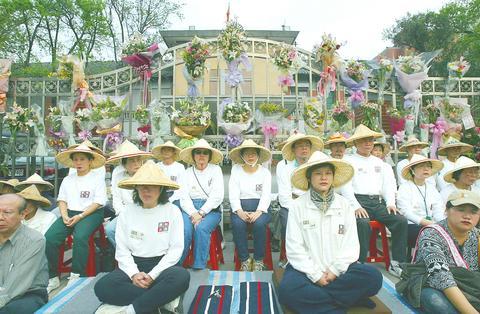
Supporters of President Chen Shui-bian stage a hunger strike outside the legislature yesterday to demand the number of seats be halved to make legislators more responsible.
-----------------------------------------
On March 12, 2004 ……
Reform is not an election gimmick
Ruling and opposition party legislative caucuses finally reached a consensus on Wednesday to halve the number of legislative seats. For the first time, the Legislative Yuan is initiating a constitutional amendment, which, if successful, would be the nation's seventh constitutional amendment. This is indeed a great step forward for politics in this country. Although legislators were reluctant to support a reform which will cost many of them their jobs, election pressures left them no choice but to sign.
Downsizing the legislature and implementing a single-member district, double-ballot system are both measures that are long overdue. The number of legislative seats will be cut from 225 to 113, 34 of which will be held by legislators-at-large. The number of female or male lawmakers will be required to be at least 30 percent of the total. These measure will also help improve the quality of lawmakers, since those marginal legislators who have specialized in eccentric measures to attract the support of a mere 5 percent or 10 percent of voters in an electoral district will not be re-elected. This will also consolidate and deepen party politics and greatly improve the nation's political culture.
Two important questions, however, remain.
First, are the parties really serious about passing this constitutional amendment? Will they pass it before the presidential election or will it be put aside until after the election? Government and opposition finally agreed to the reform plan, but their political concerns are all too obvious. Aside from responding to advocates of legislative reform, the rush to pass the proposal before polling day also stems from the parties' electoral concerns.
Viewing legislative reform as its main battlefield, the Democratic Progressive Party (DPP) demanded an extraordinary legislative session next week to deal with the proposal. To avoid being attacked over the legislative reform issue, the Chinese Nationalist Party (KMT) and the People First Party rushed to sign the document and emphasize that they supported the guaranteed quota for women. The Taiwan Solidarity Union made a U-turn to support the single-member district system. Will their promises remain valid after pressure is removed?
Second, is this the proper process for a constitutional amendment? Will the mere promotion of legislative election reform achieve the goal of a thorough reform of the government? A review of the process on Wednesday indicates that all involved were hasty and slipshod, but any effort to amend the Constitution should be carried out according to the strictest standards.
According to the spirit of Council of Grand Justices Interpretation No. 499, a review committee should call a public hearing to hear public and scholarly opinions on a constitutional amendment, allow the legislators proposing the amendment to explain their reasoning and proceed from a general debate to debating each article in order to give the issue thorough treatment. These steps are missing.
The parties have either overlooked or put aside accompanying issues that also require legislation such as whether the right to unseat the Cabinet and dissolve the legislature should remain once legislators' terms have been extended to the same length as the presidential term. Rushing legislative reform prior to the presidential election will create constitutionally-related problems, and this is not good from a long-term legal perspective.
Legislative reform should be initiated as soon as possible, but the constitutional amendment process requires great care and continuity. The piecemeal approach of previous amendments must not be repeated, or it would be better to write a new constitution in 2006. The people are monitoring the ability of all the parties to deliver on their legislative reform promise.
-----------------------------------------
On March 12, 2004 ……
Buddhists blast pro-blue monk
`INAPPROPRIATE': Two of Master Wei
Chueh's disciples tore up the certificates proclaiming them Buddhists after he
encouraged people to boycott the referendum.
By Chiu Yu-Tzu, STAFF REPORTER , WITH AGENCIES
Buddhist Master Wei Chueh is terrifying people by calling on Buddhists to support the pan-blue camp and not pick up referendum ballots on March 20, Buddhist Master Shih Chao-hui said yesterday.
Buddhist leaders yesterday held a press conference at the Legislative Yuan to condemn Wei Chueh's "inappropriate behavior."
"Buddhist monks and Buddhist nuns never lie. How can he use his alarmist talk to terrify people? It's spreading wild rumors to blind the mind of the people," said Shih, who is also an associate professor at Hsuan Chuang University.
"His anti-democratic words and deeds humiliate Buddhist circles," Shih said.
On Tuesday, Wei expressed his support for the pan-blue camp when the alliance's presidential candidate, Chinese Nationalist Party (KMT) Chairman Lien Chan, and his running mate, People First Party (PFP) Chairman James Soong, visited the Chung Tai Chan Monastery. Wei Chueh, who is the head of the monastery, also branded the referendum illegal and urged Buddhists to boycott it.
Wei Chueh also said that the proposed Religious Groups Act, which had been drafted by the Executive Yuan as part of a Democratic Progressive Party (DPP) initiative, infringed on religious groups' independence in financial and personnel matters. He said the law would further "destroy religionists."
Shih said yesterday that the Chung Tai Chan Monastery might end up being the most terrible religious monster in Taiwan, because it arbitrarily did illegal things, such as occupying state-owned lands.
She added that the opulent monastery in the center of the country was a galling shame to Buddhists.
"The over-commercialized Chung Tai Chan Monastery's use of political leverage to influence the Religious Groups Act is absolutely inappropriate," Shih added.
Lin Jung-chih, secretary-general of the Chinese Buddhist Temple Association, said that Wei Chueh's criticism was nonsense, because the current draft of the law was based on common sense and had been endorsed by members of a religious counsel under the Ministry of the Interior, including representatives from the monastery.
Lin Pen-hsuan, an assistant professor in both religion and sociology at Nanhua University, said the act was aimed at establishing sound regulations for "religious corporate organizations."
He had drafted the law along with representatives from five major religions about three years ago.
Lin Pen-hsuan said that the only voice against the law had been raised by the Chung Tai Chan Monastery.
"They are reluctant to make their accounts transparent and to deal with illegal construction problems," Lin Pen-hsuan said.
He said the Legislative Yuan's evaluation of the proposed act had been suspended.
Meanwhile, Lin Pen-hsuan said, KMT Legislator Huang Chao-shun and PFP Legislator Shen Chih-hwei have proposed another version of the bill which would enable dishonest religious groups to dodge problems about financial transparency and illegal construction.
Two of Wei Chueh's disciples tore up the certificates proclaiming them Buddhists at a DPP office in Taichung yesterday to express their disappointment.
Chuan Chieh, who had been following Wei since 1994, said that she had heard of many accusations concerning the acquisition of land after the 921 earthquake in 1999. Chuan Miao said that he would enjoy his precious democratic right to participate in the referendum.
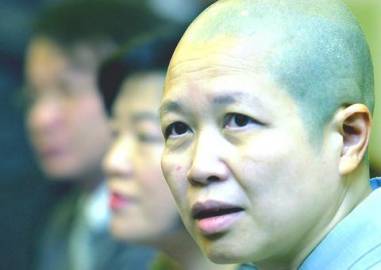
Buddhist Master Shih Chao-hui speaks at a press conference held at the Legislative Yuan yesterday to condemn Buddhist Master Wei Chueh for calling on Buddhists to support the pan-blue camp and abstain from voting in the referendum.
-----------------------------------------
On March 12, 2004 ……
If the blue win, whither Taiwan?
By Paul Lin
We are less than two weeks away from the presidential election. Both sides have made campaign promises. Ignoring the question of whether these concrete promises will be realized, let's make an overall assessment of what the new political and economic situation in Taiwan will be depending on whether the pan-blue or pan-green ticket wins.
A win by President Chen Shui-bian and Vice President Annette Lu would bring powerful momentum to the Democratic Progressive Party (DPP) in the December legislative elections and the hope of changing the party's difficult situation which results from the fact that the DPP holds less than half of the legislative seats. Such an outcome would lead to political and social calm and an improvement of the political friction that followed on the nation's first transfer of political power.
It would become possible to carry out reforms with greater boldness and resolution, and the economy, already improving as a result of external factors, would grow even stronger following the implementation of the 10 Major Infrastructure Projects. We can already see the recent strength of the stock market's performance, which leads the economy.
As for the cross-strait relationship, China continues to exercise its evil influence, but it will in the end have to face reality and strike up a dialogue with the DPP. Legislative elections of course mean contradictions between the two green-camp parties, the DPP and the Taiwan Solidarity Union (TSU). However, given that a strong local awareness is the fundamental ideal of both parties, and that there is still a great difference in real power between the two, these contradictions will not be too great.
Diplomatically speaking, because the referendum avoids the unification/independence issue, the US' worries and China's strong reaction have already subsided, but the government still wants to mend the Taiwan-US relationship in order to build mutual faith, in particular as the result of the US presidential election still is an unknown variable. A win by Chen would make that an even more difficult task. Pro-Taiwanese forces in Japan will kick up a fuss and increase the pressure on the Japanese government's pro-Chinese policies.
But a win by Chinese Nationalist Party (KMT) Lien Chan and People First Party (PFP) Chairman James Soong would lead to a host of new situations on which no one has a handle.
Because of Soong's outstanding vote record in the 2000 presidential election, both he and his party members feel wronged by his having to condescend to accepting the vice presidential seat. They are therefore determined that they should be rewarded with the most important post, that of premier, and an increased influence on policy-making. In addition to PFP members, there is also the possibility that at least some people in the KMT will side with Soong on the issue.
This means that there is not a great possibility of Legislative Speaker Wang Jin-pyng getting that post, and he may only get the KMT chairmanship. It is also difficult to say whether he will be able to hold on to the speakership following the year-end legislative elections.
The KMT and the PFP will also have difficulty taking a unified approach to both the allocation of Cabinet posts and the legislative elections, and we are certain to witness a fierce struggle between the two parties. KMT bureaucrats are more conservative and glib, and more concerned about personal political relationships. This is not the case in the PFP, the members of which are younger, more hardworking, and full of ambition. This can be seen from their malicious political style, the way they balk at nothing and their disregard for national security issues, which is also the reason why they split from the KMT. This will become a big headache for the KMT.
The KMT-PFP split highlighted the cross-strait relationship. The strength of the KMT's localization faction stopped the party from going too far on the "one China" issue, but Soong has to this day not changed his mind on the "one China under one roof" idea. Beijing must be raising the price for clandestinely helping Lien and Soong's campaign.
Because both Lien and Wang have been smeared in various degrees by wavering over the "one China" issue, China will support the PFP in the struggle between the KMT and the PFP, thereby giving the PFP the upper hand when it is time to divide Cabinet seats and make cross-strait policy.
On economic issues, the KMT and the PFP are taking advantage of the economic revival by claiming all the credit for themselves. But it is hard to say whether it would be a good or a bad thing if they were to come up with some fancy new ideas on economic policy in order to highlight their own achievements.
On foreign policy, because the PFP is
closer to China than the KMT is, their criticism of the Chen government's US
diplomacy is especially strong. Unlike Lien, Soong does not travel to
Washington to show goodwill towards the US by, for example, agreeing to
purchase US military equipment if elected. There will thus also be differences
between Lien's and Soong's policies on the Taiwan-US relationship.
It is strange that although Soong sent his son to the US to give himself room for retreat, he has never said anything positive about the US. He clearly does not want to offend Beijing, and he will therefore be friendlier towards China than towards the US. Soong's leanings toward China will speed up the process of Sinicizing Taiwan.
The 2008 Olympic Games in Beijing will be a moment of crucial importance for Taiwan. In the period leading up to the event, Beijing will apply heavy pressure, using every trick in the book to make Taiwan participate in the games as a local government entity. That period will also see yet another presidential election in Taiwan. Will some pan-blue camp politicians uncertain of election get the idea that, rather than ending up with nothing, they could maintain their power by becoming a [Hong Kong-style] chief executive? When that happens, it will become necessary to hold a referendum in order to give a voice to public opinion. That is why the upcoming nationwide referendum is so important.
Paul Lin is a commentator based in New York.
-----------------------------------------
On March 12, 2004 ……
Peace, freedom are good
Ching Li, Changhua
The record turnout of participants in the 228 Hand-in-Hand Rally last week established a milestone in Taiwan's democratic movement.
People from all walks of life joined together on this historic day of sorrow and turned it into a day of hope for peace and freedom in the future. The rally brought the people together, definitively and positively demonstrating the common moral principles shared among them to stand for and protect their beloved homeland called Taiwan.
Through the rally, the people have not only demonstrated their resolve to safeguard the country's democratic values, but also made a plea to the international community to lend its support to Taiwan's pursuit of long-lasting peace and freedom. As it turns out, the free world responded positively to their plea.
The solidarity among the people has been greatly solidified by the rally, which will definitely help them in their pursuit of a free and democratic society. Remember: united we stand; divided we fall.
-----------------------------------------
On March 12, 2004 ……
Just say no to China
Daniel McCarthy, Salt Lake City, Utah
On March 20, much more will be at stake in the election than whether the voters have more confidence in the ability of one candidate over the other to manage the economy and preserve peace. At stake is Taiwan's status as a sovereign nation.
If the people re-elect President Chen Shui-bian, the international community, and most particularly the US, will receive a clear and unambiguous message that Taiwan wishes to remain a sovereign and independent state, and that its people reject the idea of eventually falling victim to Chinese tyranny. The US and the rest of the world will then adjust their view of Taiwan and will accommodate it as a sovereign state.
The US State Department seems already prepared for this shift, and President George W. Bush's conservative base of support is already demanding it. The only minor stumbling block is China's "assistance" with the North Korean problem, but Washington's illusions on that point are quickly vanishing.
If, however, KMT Chairman Lien Chan is elected president, then the US is likely to view that as a message that the people intend to eventually fall under Chinese sovereignty.
Consequently, the ballots for the election could appropriately be rewritten to: "Do you wish to be ruled by China? If YES, then vote for Lien, if NO, then vote for Chen.
-----------------------------------------
On March 12, 2004 ……
-----------------------------------------
On March 12, 2004 ……
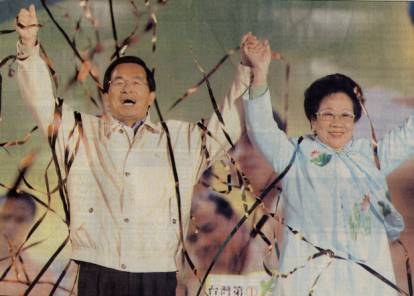
HAND IN HAND
President Chen Shui-bian and Vice President Annette Lu greet supporters during on election campaign rally in Sanchung, Taipei County. Foreign journalists usually report that Chen favors independence for Taiwan. They also report that China doesn’t want to see Chen re-elected.
-----------------------------------------