20040313
=======
Why? Chinese fear democracy in Taiwan on March 13, 2004 ……
Hong Kong shows that China fears democracy
By Parris Chang
Before its takeover of Hong Kong, Beijing promised the people of Hong Kong and the international community the following things.
First, China would abide by the "one country, two systems" model, under which Hong Kong would be allowed to maintain political, economic and social systems different from China's for at least 50 years. Second, Hong Kong would be ruled by Hong Kong people, meaning that, according to the Basic Law, the chief executive and Legislative Council members would be locally elected, and would not be officials appointed by China.
The reason that the late Chinese leader Deng Xiaoping was so lenient toward the territory was that he wanted to attract Taiwan with the Hong Kong model, thus achieving peaceful unification.
Since its return to China in July 1997, the situation in Hong Kong has deteriorated from the time when it was a British colony. Although people still dance and gamble on horses in Hong Kong, business has been hollowed out, the economy is sinking, unemployment is soaring, real estate prices are falling sharply and personal assets are shrinking. People are unhappy with Beijing-appointed Chief Executive Tung Chee-hwa's performance. However, despite Tung's approval rating of not much more than 10 percent, he is still firmly backed by Beijing.
As the Chinese government has kept none of its promises, 500,000 Hong Kong people took to the streets on July 1 last year. They protested the Tung administration's plan to force the passage of legislation based on Article 23 of the Basic Law, aimed at restricting people's freedom. Under such pressure, Beijing could not but order the local government to withdraw the bill.
On Jan. 1, hundreds of thousands of people once again marched through downtown Hong Kong to ask for democracy. They demanded that the chief executive be directly elected. They did not want a candidate appointed by Beijing and elected via indirect elections. They also requested that all seats in the Legislative Council be filled through direct popular elections.
Beijing ignored these appeals.
Beijing's new restrictions on Hong Kong's self-rule policy means that many Democratic Party members, such as legislators Martin Lee and Emily Lau, will not qualify for the next legislative election.
Why is China so afraid of Hong Kong's democracy? Some believe that China's leaders are worried that the democratization of Hong Kong and Taiwan will advance political reform in China, encouraging the Chinese to demand direct elections for mayors, provincial governors, representatives to the congress and even president.
The Beijing authorities have an indescribable fear of real democracy. They believe in one-party dictatorship with political power in the hands of a few. The "centralized democracy" they have advocated is nothing but a gimmick that facilitates the attempt of the few to exercise control over the majority.
Unfortunately, Hong Kong democracy advocates, such as Lee and Lau, still support the "one country, two systems" model and oppose Taiwan's independence.
Hopefully, they will come to understand that the existence of a democratic Taiwan is beneficial to Hong Kong because it places some restrictions on Chinese actions in Hong Kong.
Absurdly, some people in Taiwan also support the "one country, two systems" model. But just look at what has happened in Hong Kong over the past few years. Beijing's promises are completely worthless. In view of the Hong Kong example, I call on Taiwanese people to open their eyes.
Parris Chang is a Democratic Progressive Party legislator.
-----------------------------------------
On March 13, 2004 ……
Chiou urges boycott of newspaper
"How can it betray the basic
principles of news reporting in this way?" --- Chiou I-jen,
secretary general to the president
`UNFAIR': Chiou I-jen said people
shouldn't buy the `United Daily News' since its election coverage is biased in
favor of the KMT and PFP.
By Lin Chieh-yu, STAFF REPORTER
The Democratic Progressive Party (DPP) again condemned the United Daily News yesterday for allegedly serving as a mouthpiece for the pan-blue camp, saying that the public should not only censure such an unfair newspaper but also stop buying it.
"It is fair to say that the United Daily News is being completely unfair in its coverage of election news when it doesn't mention a word about concrete charges made by the DPP but makes a great thing out of unsubstantiated rumors made by the pan-blue camp," said Chiou I-jen, executive manager of the DPP's campaign headquarters.
"What kind of media self-regulation is this?" Chiou said.
Chiou, who is also secretary general to President Chen Shui-bian, said that the DPP is not concerned about what the newspaper chooses to publish but instead about the criteria on which it makes its decisions.
"How can it betray the basic principles of news reporting in this way?" Chiou asked.
On Thursday, DPP Legislator Lee Wen-chung provided evidence that he said supported a charge that NT$36,280,000 -- which has been the source of allegations of wrongdoing against former Pingtung County commissioner Wu Tse-yuan and Chinese Nationalist Party (KMT) Chairman Lien Chan -- constituted illicit funds, and was not a loan as the two have said.
On Wednesday and Thursday, DPP Legislator Tuan Yi-kang provided what he said was evidence that Lien's wife, Lien Fang Yu, had concealed assets owned by the family in the US and other countries.
The United Daily News did not cover these stories yesterday.
The material that Tuan presented was a document signed by California's secretary of state purportedly showing that Lien Fang Yu holds a directorship in 1140 Galaxy Way Inc, and purportedly shows that documents, letters and telephone records released by KMT spokesperson Alex Tsai are not legitimate.
"Yesterday all the TV stations asked Lien about this and he didn't dare respond, but the United Daily News can simply ignore all that and say nothing at all about the evidence produced by the DPP," Chiou said.
Chiou also said that People First Party Legislator Chou Hsi-wei made a reckless charge on Thursday, accusing first lady Wu Shu-chen of investing NT$170 billion in the stock market.
"Anybody with common sense knows that she couldn't possibly have invested NT$170 billion," he said.
"But the United Daily News nevertheless printed a two-page article on the matter in its Friday edition, turning mere rumor into a news report, without once seeking confirmation from either the presidential office or the DPP's campaign headquarters," Chiou said.
He said that these two episodes show that the paper has abandoned all media ethics and professionalism.
"This kind of reckless conduct causes anger and resentment," he said.
"Next magazine has reported many times that Lien's family has extensive assets overseas on which it has evaded its tax liabilities. But when the United Daily News mentions the Next stories it never says anything about Lien Fang Yu's 1140 directorship. Isn't that electoral bias?" Chiou said.
"The media are an integral element of democratic politics. They have to be self-governing, self-regulating, but they also have to strictly observe media professionalism," he said.
"The United Daily News is neglecting to report some news, turning other news into advertisements and making itself into a pan-blue mouthpiece," he said.
"DPP headquarters will devise a slogan to stop the KMT and call on consumers not to spend money on this kind of mouthpiece, but rather to ditch the United Daily News," he said.
In response, the United Daily News issued a statement yesterday saying that its operating principle is to monitor developments in news events and determine whether or not the events present any new information.
"Both the Wu Shu-chen story and Lien Fang Yu story have been covered by our newspaper, and due to the limited news pages we have, we have to make choices about whether events represent new developments. These are normal procedures for news editing, please do not misunderstand," it said.
-----------------------------------------
On March 13, 2004 ……
KMT apologizes about Hitler ad -- but not to Chen
AGENCIES , TAIPEI
The pan-blue camp apologized yesterday for a campaign advertisement that compared President Chen Shui-bian to Nazi leader Adolf Hitler after it was condemned by the nation's small Jewish community.
Hitler's photograph featured prominently in five full-page newspaper advertisements for the Chinese Nationalist Party-led (KMT) opposition that called on voters to end Chen's "dictatorship" on election day.
The Democratic Progressive Party (DPP) and Jewish leaders criticized the ad, which took the election campaign to a new level of bitter personal attacks.
The KMT apologized to the Jewish community over the ad, which refers to Chen by his nickname A-bian, but said it would not apologize to the president.
The KMT said it would pull the ad, although at first it only said it would drop the Hitler photograph and modify the wording if it ran the ad again.
"We express our most sincere apology to anyone in the Jewish community who felt offended by this advertisement," said KMT spokesman Justin Chou.
"We were only trying to emphasize a certain aspect in A-bian's personality. In the ad, we did not mention the Jewish people nor the Holocaust, but still, we apologize" Chou said.
"But we are certainly not going to apologize to Chen Shui-bian," he said.
The KMT attack follows a newspaper ad placed by the pan-green camp which pictures Chen alongside four world leaders, including British prime minister Winston Churchill and US president John Kennedy, under the headline: "Only the real leaders know what peace means."
The ad referred to the so-called "peace referendum" being held the same day as the election.
In response the KMT's ad, headlined "Change President, End A-bian's dictatorship," says: "A-bian puts his pictures by those of Churchill and Roosevelt."
"But in fact he is becoming more like Hitler. The DPP is also becoming more authoritarian under A-Bian."
"Only a dictator equals himself as his country. A-bian thinks he is a symbol of democracy but he is hostile to those who oppose him, treating them like enemies," it said.
It features a grainy photograph of Hitler with Italian Fascist leader Benito Mussolini in the background.
Taiwan's only rabbi, Ephraim Einhorn, had called on the KMT to apologize to the president, saying he was "shocked and disturbed" that Chen could be compared to a man who ordered the murders of 6 million Jews.
"I am sick to my innermost being. It's a terrible thing to have done," he said.
"To have the legitimately elected president of the country compared to, or associated with, the monster of all ages is something that I find terribly, terribly difficult to come to terms with," Einhorn said.
Israel's representative to Taiwan, Ruth Kahanoff, was reluctant to comment on the ad because she didn't want her remarks to be construed as an attempt to interfere in the campaign or support a candidate.
But she said, "We are not happy about any trivialization of Hitler and what he did to our people."
DPP Legislator Hsiao Bi-khim said: "I find it incredibly offensive. I think most people will find it outrageous."
-----------------------------------------
On March 13, 2004 ……
Seat reduction vote slated for March 19
REFORMS: Legislators yesterday agreed to vote on a bill that would reduce the number of seats in parliament one day before the presidential election
By Debby Wu, STAFF REPORTER , WITH AP
The Legislative Yuan yesterday agreed to vote next week -- one day before the presidential election -- on a bill that would slash in half the number of seats in the 225-member parliament.
But several opposition lawmakers accused the Democratic Progressive Party (DPP) of rushing the decision on a major constitutional revision to attract voters in the March 20 presidential poll.
Legislative caucuses yesterday morning reached agreement that the constitutional amendment would get its second and third reading on March 19.
The caucuses also demanded that the Constitutional Amendment Committee expedite the process for reviewing other articles, including one that would abolish the National Assembly, which convenes only when constitutional reforms or national boundary changes have been passed by the legislature by a three-quarters majority or when a move to impeach the president or vice president has been passed by a two-thirds majority.
The legislature also agreed to hold an additional session on March 18 to discuss the bill governing political donations.
The Constitutional Amendment committee approved a draft bill on Wednesday that said parliament should be reduced to 113 seats in 2008.
It also agreed that legislators' terms should be extended from three years to four.
Meanwhile, Chinese Nationalist Party (KMT) Legislators Apollo Chen and Hsu Chung-hsiung, and People First Party (PFP) Legislator Sheu Yuan-kuo have started a petition drive to cancel the decision to vote on the amendment.
"We want all the articles to be fully discussed and reviewed by the Constitutional Amendment Committee first," Chen said regarding the purpose of the petition.
"Rushing the article through before March 20 is irresponsible and amounts to breaking the political speed limit," Hsu said.
"Many legislators disagree with the constitutional amendment, but they are too afraid to speak up. The real problem with the legislature does not lie in the number of seats, but rather in its quality, and to improve the quality, we should focus on the election system and constituency," he said.
Some DPP legislators agreed that it is necessary to pass all the constitutional amendments in the committee before sending them back to the legislature, and that the legislative reform should be more comprehensively discussed, but they still supported passing the articles before the election.
"The article that was passed on Wednesday was not comprehensive enough. The committee did not consult the experts' opinions The legislative procedure for the amendment is problematic," said DPP legislator Chen Chin-te.
"Although I think the current articles can be improved, I would still like to have the article on halving the legislative seats passed before the election, otherwise there is no knowing what will happen to the amendment," said DPP Legislator Lee Wen-chung.
Although Lee attended Chen, Hsu and Sheu's press conference, he did not sign their petition.
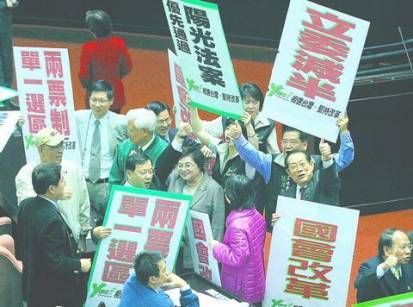
A number of DPP legislators yesterday wave placards inside the Legislative Yuan, claiming that they are the real contributors to the nation's legislative reforms. Their placards read ``legislative reform,'' ``halving the legislature,'' ``pass the sunshine bill first'' and ``single-member district, two-vote system.''
-----------------------------------------
On March 13, 2004 ……
Chinese with ROC IDs can vote: MAC
CIVIC RIGHTS: Approximately 16,000 Chinese living in Taiwan -- primarily spouses of Taiwanese and their relatives -- can vote in next week's presidential election
By Melody Chen, STAFF REPORTER
About 16,000 Chinese people who have obtained Republic of China identification cards will be eligible to vote in the March 20 presidential election, Mainland Affairs Council Vice Chairman Alexander Huang said yesterday.
According to Huang, 13,000 out of the 16,000 are Chinese spouses and the rest are the spouses' relatives.
They enjoy the same right as Taiwanese citizens to cast ballots in the presidential election as well as in the referendum, which will also be held on March 20, Huang said.
The council could not estimate how many Chinese spouses will cast votes on election day, Huang said.
According to the Statute Governing the Relations between the People of the Taiwan Area and the Mainland Area, Chinese spouses must wait for up to 11 years to get identification cards.
Meanwhile, about 15,000 China-based Taiwanese businessmen will return to Taiwan for the presidential vote through the "small three links" established among Kinmen, Matsu and China's Fujian Province, Huang said.
A special "small three links" project to serve businesspeople going home for the vote will be in operation from Thursday to March 30.
The businessmen will be able to use the links if, at customs in Kinmen or Matsu, they show work permits and credentials issued by the Ministry of Economic Affairs to permit their investment in China, Huang said.
Businessmen or their employees without ministry credentials who wish to use the "three small links" can register with Taiwanese businesspeople's associations by March 20, Huang said.
The businesspeople's associations will pass along the names of people who have registered to the semi-official Straits Exchange Foundation, which will send the names to the Immigration Bureau so that the businessmen and their employees can be cleared at Kinmen and Matsu customs, Huang said.
President Chen Shui-bian announced last month that all China-based Taiwanese business-people, their Taiwanese employees and families could use the links to go home.
Before Chen's announcement, only Fujian-based Taiwanese businesspeople were able to use the links.
However, although the government has expanded the links service to all China-based Taiwanese businesspeople along with their Taiwanese employees and families, other Taiwanese people living in China, including students, are still barred from using the links.
-----------------------------------------
On March 13, 2004 ……
Two heads aren't better than one
By Mac William Bishop
The pan-blues do not care about
Taiwan. They care only about attaining power, and their misconceived dreams of
grandeur endanger the survival of Taiwan as an independent and democratic
state.
Depending on your point of view, the chaotic dissonance of the pan-blues' policy statements has been either intensely amusing or deeply depressing. What their statements have not been is coherent and practical.
Most worrying of all are the deep ideological rifts between Chinese Nationalist Party (KMT) Chairman Lien Chan and People First Party (PFP) Chairman James Soong.
Should this mismatched duo become responsible for anything more consequential than making a photocopy, it will be disastrous. And I would suggest letting one of their colleagues use the copy machine. Maybe Taipei Mayor Ma Ying-jeou could do it.
In any event, the rift is increasingly evident, and the hackneyed attempts at papering over the lack of consensus simply highlight the dysfunction of the pan-blue alliance. Consider the statements made by Lien and Soong regarding the nationwide referendum.
Lien tells us that he will not take part in the ballot, but will respect the people's choice in the matter. This well-planned policy stance appears to embrace all the philosophical elements of "well, I dunno, so, you know, uhhh ... whatever."
Meanwhile, Soong says the "illegal" referendum should never take place, and it would be better to ignore it altogether. Of course, it has never occurred to Soong that instead of throwing a tantrum ("I don't wanna play referendum"), he would do well to propose an alternative solution to the issues involved. But that would require forethought and a belief system, instead of mere malignant opportunism.
Of greater import is the inability of Lien and Soong to share an opinion about how to deal with China. Lien calls for a "confederation" and says that Taiwan ought to just focus on economic integration with China, leaving the "political" cross-strait issues to future generations. Does Lien actually believe that politics and economics have nothing to do with each other?
Then, Soong calls for "one China under one roof," buying into the intellectually bankrupt and historically inaccurate pan-Chinese nationalist uberkultur myth.
What "one roof" would mean in practice isn't clear (Does it mean one government? One leader? Perhaps an actual Great Roof, to accompany the Great Wall?). But certainly what "one China under one roof" means for Taiwan is not political autonomy.
So how will the KMT-PFP reconcile these positions if they attain power?
What will they actually do about the threat from China?
Pretending that the Chinese are not expanding their missile forces and overall military capabilities in order to force a solution to the "Taiwan issue" on terms favorable to Beijing is irresponsible.
Were it not for the possibility the pan-blues could win the election, it would be easy to mock the disjointed and nonsensical campaign strategies employed by the KMT-PFP alliance. The "313 Rally" is an especially fitting symbol for the pan-blues.
Some people might wonder why the KMT-PFP chose today for their counter-rally.
A close reading of Taiwan's history will clarify this matter immediately. The rally will be held on the important and auspicious date of March 13 because ... it's a Saturday.
And what does the KMT tell us we will celebrate on this, our most revered last Saturday before the presidential election?
Well, anti-black-gold, of course. It's an anti-black-gold rally. It's anti-black-gold Saturday.
Apparently they were so flustered by the success of the 228 Hand-in-Hand Rally the pan-blues thought their best move was to throw together their own rally around a generally inoffensive theme. In a stunning display of political acumen, they never considered that the DPP would then simply say "Hey, we're against corruption, too. See you on Saturday!"
This is precisely what the DPP did.
So the KMT-PFP had to change tactics again.
The organizer of the pan-blues' election campaign, Legislative Speaker Wang Jin-pyng, pre-empted any further incursions by the DPP on the sacred March 13 holiday by declaring that the purpose of the rally was "change the president."
Quite a subtle message, really.
So now the DPP can't take part. Brilliant.
There is a colloquial American term that applies to the pan-blues' planning. It is "piss poor."
If the pan-blues can't even manage a pep rally, how can they run a country?
And equally important, if Lien and Soong are thrown into a panic because of a peace rally, what would they do if there was a real crisis in cross-strait relations?
Mac William Bishop is a political commentator based in Taipei.
-----------------------------------------
On March 13, 2004 ……
The referendum serves all of Asia
While some people around the world were concerned about whether China would react in a military way to the peace referendum on March 20, most overlooked the fact that Taiwan would also be holding a peaceful presidential election -- and a referendum on the future of Asian democracy.
To look on the bright -- and constructive -- side, if the election and referendum proceed in a smooth and orderly way, without sparking significant cross-strait tensions, Taiwan could be in the vanguard of building a new Asian democracy. This notion of "new Asian democracy," characterized by people's power to achieve a deepening of democracy through institutionalized mechanisms, will have unprecedented effects on major nations in the region.
Asia has become a focus of democracy theorists' attention in recent years because of its democratic consolidation. Both South Korea and Taiwan accomplished the first peaceful transfers of political power in their history. Hong Kong residents, after experimenting with China's formula of "one country, two systems" for some years, took to the streets in protest of Beijing's infringing on their human rights.
The Asian community captured worldwide attention for its potential to internalize democratic principles in people's daily lives.
Good news does not last long. In three global waves of democratization, many countries -- including some in Asia -- have completed transfers of political power but are either still mired in trouble, or old authoritarian conservative political forces have made a comeback because the people could not put up with the pain of reforms.
Cronyism still plays a role in some Southeast Asia democracies, which led to the resignation of presidents in the Philippines and Indonesia. Former South Korean president Kim Dae-jung's term was marred by his involvement with bribery for peace negotiations with the North. Kim's successor, Roh Moo-hyun, has been having a hard time dealing with domestic forces and was impeached by parliament yesterday.
Overall, Asian democracy seemed to have lost its historical momentum at the turn of the new century.
But the political landscape in Asia will be shaped by a new round of elections this year, which will open another gateway for building Asian democracy. Taiwan's election will be followed by congressional elections in Malaysia and South Korea, and presidential elections in the Philippines and Indonesia this summer. Taiwan will have legislative elections before the end of this year. Thailand may have parliamentary elections early next year.
If President Chen Shui-bian is re-elected, Taiwan will be the first among Asia's new democracies to defeat its ancient regime in its evolution from authoritarianism to democracy.
Since Chen's challenger -- Chinese Nationalist Party (KMT) Chairman Lien Chan, along with his running mate People First Party Chairman James Soong -- were both defeated in the last presidential election, their attempt to regain power is widely perceived as a resurgence of the conservatives and the old regime.
Moreover, Chen's referendum will bring about further democratization in Asian countries.
Indonesia and South Korea have both expressed interest in introducing referendums to solve policy and political disputes. Hence, Taiwan's implementation of the referendum mechanism could help establish an example for its Asian allies.
What distinguishes Taiwan from China
is this nation's embrace of and adherence to democracy. A "peaceful
framework for cross-strait stability and interaction," embedded in the
second referendum question, will demonstrate Taiwan's desire to solve
cross-strait differences through democratic means.
In this regard, the peace referendum should be valued by the entire Asian community.
-----------------------------------------
On March 13, 2004 ……

-----------------------------------------