20040314
=======
Progress and decline on March 14, 2004 ……
A choice between progress and decline
"If the KMT can't even solve its
own problems related to the party assets, how could it prove to the public that
it has the determination to conduct reforms if it regains power?" --- Michael
Hsiao, Academia Sinica sociologist and national policy advisor to the president
Since the KMT has been opposing the
reform measures proposed by the DPP, their definition of change could mean no
reform at all, according to political analysts
By Chang Yun-ping, STAFF REPORTER
This year's presidential election, in which the two opposing political camps are running a neck and neck race, is an acid test of whether Taiwan can further deepen its democracy and continue domestic and constitutional reforms that will ensure the country's overall development, according to political analysts.
It is a race that leaves voters with a choice between progress and regression.
President Chen Shui-bian of the Democratic Progressive Party (DPP) terminated the Chinese Nationalist Party's (KMT) five-decades-long grip on political power in the 2000 election by defeating the other two candidates, Lien Chan and James Soong, who were both members of the KMT at the time.
While this democratic feat wrote a new chapter in Taiwan's fledgling democracy, the DPP, as the county's first opposition party, which has now become the governing party, faces tremendous difficulties in implementing reforms. Unaccustomed to the role of an opposition party, the KMT has fiercely opposed the DPP's reforms in the past four years.
Vice President Annette Lu summed up the challenges the DPP has faced since 2000 when she said, "A new democratic government may find it difficult to implement reforms, because those who enjoyed privileges in the authoritarian era are reluctant to give up their power and wealth."
Chiu Hei-yuan, political observer and sociology professor at National Taiwan University, said the biggest difference between the DPP and KMT's winning the election would be accelerated reforms if the DPP wins, and stagnation if the KMT gets voted in.
"The DPP and the KMT have striking differences in terms of their political characters, which will lead to an entirely different administrative outlook for the country. The differences lie in that the KMT is conservative in reforms, while the DPP asserts progressive reforms," Chiu said.
"Politically, the KMT has been talking about change, which is the party's main slogan in the current presidential campaign, including its strong campaign appeal to change the president. But change could be progressive or regressive.
"Since the KMT has been opposing the reform measures proposed by the DPP, their definition of change could mean no reform at all," Chiu said.
According to Chiu the reforms advocated by the DPP are aimed at promoting a political system that is diametrically opposed to the old KMT system. If the DPP is re-elected, it could continue its reform measures with more efficiency and confidence.
"Those reforms that have been introduced by the DPP government, including the financial reforms and the elimination of corruption, could come to fruition. Being re-elected would boost the DPP's confidence to comprehensively conduct its reforms, but the party would no longer be able to blame the opposition parties for obstructing reforms," Chiu said.
The situation would be very different if the KMT wins the election. The pan-blue camp is expected to discard the reforms advocated by the DPP and go back to its conservative policies.
The KMT has accused the DPP of stirring up chaos in the education system, although the current situation can be traced back to when Lien was premier. Now the KMT is insisting on a conservative approach to restore a modified joint entrance examination system -- a flawed and much criticized system that has had a profound effect on education -- to replace the multiple enrollment schemes for high school students.
In addition, the KMT is likely to procrastinate on judicial reforms, including the passage of the Organic Law of the Judicial Yuan, which is aimed at establishing a simplified and more efficient judicial system.
The Organic Law of the Judicial Yuan has been pending final approval by the Legislative Yuan for more than a year. According to this bill, the Administrative Supreme Court, the Supreme Court and the Government Official Evaluation Committee will be dismissed and replaced by three new departments under the Judicial Yuan. The new bodies will be the Civil Court, the Criminal Court and the Administrative and Evaluation Court.
"Lien had promised to accelerate the passage of the law during the presidential debate last month. However, when the bill's lobbyists visited him to ask for his support, he simply gave a few perfunctory words and then nothing happened," Chiu said.
In addition, the KMT also opposes the legislation of the Religious Groups Act, which was drafted by the Executive Yuan as part of a DPP initiative, saying the law would infringe on religious groups' independence in financial and personnel matters.
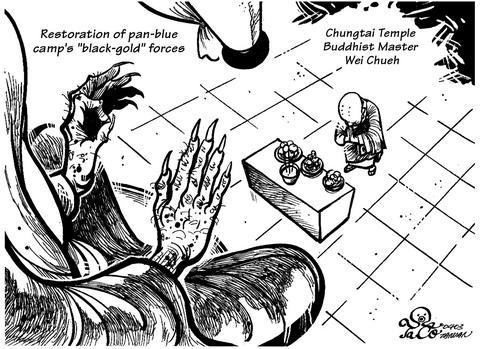
The KMT's opposition to the bill helped it to win the support of Buddhist Master Wei Chueh, who said the law was "destroying religionists" and even called on his followers to boycott the referendum.
Academia Sinica sociologist and national policy advisor to the president Michael Hsiao agrees with Chiu that a DPP victory in the election will accelerate domestic reforms, while the KMT will slow the progress that has been made in deepening democracy.
"If the KMT can't even solve its own problems related to the party assets, how could it prove to the public that it has the determination to conduct reforms if it regains power?" Hsiao asked.
"There is no doubt that if the DPP wins the election, those reforms proposed by the DPP, such as the legislative and constitutional reforms, could be dealt with more promptly. However, if Lien is elected, it would be basically impossible to look forward to the KMT initiating reforms, because in the past four years they have done nothing to promote reform," Hsiao said.
That would lead to social instability, as the public would not be able to put their trust in the government. Political stability is also at stake, Hsiao said, expressing doubts as to how the KMT and People First Party will work together in a coalition, as they have much to resolve in the balance of power between the two parties.
In terms of cross-strait relations, Hsiao said a DPP election victory would bring a more clear-cut policy asserting a firm stance on Taiwan's sovereignty.
"The DPP is clear about its Taiwan stance and China will have to come to terms with the reality that China is China, Taiwan is Taiwan. There might not be immediate breakthroughs, but both sides will be able to understand the other's stance clearly," Hsiao said.
However, if the KMT wins the election, Hsiao said, cross-strait relations might move toward a pro-China approach.
"The KMT has been unwilling to clearly define its stance on the relations between China and Taiwan in the run-up to the presidential election. It will be forced to come up with a policy if it regains power, but we don't know what that stance that will be. However, during the ensuing period of ambiguity, China might cash in on the situation and do something to push Taiwan into a difficult situation," Hsiao said.
"Since the KMT has refused to take a stand in the past few years regarding cross-strait relations, people are worried as to where the KMT would lead the country," Hsiao said.
As for whether Taiwan's economy would benefit from a change of leadership, Hsiao expressed doubts about the necessity of such a result.
"The KMT boasts that it created economic prosperity for Taiwan. However, the economic issue should not be simply treated as a domestic matter. Other factors, such as the global economy, influence the economic performance of the country. During its five decades in power the KMT had the opportunity to pursue its economic policy in a consistent manner. But comparing the KMT's 50 years with the DPP's four years, the DPP should be given more time to demonstrate its ability to achieve what it wants to do," Hsiao said.
Political commentator Pu Ta-chung said Chen's re-election, which would give the DPP a second mandate as ruling party, will be a positive lesson to the world's other young democracies.
Pu said a democratic exchange of power like the one brought about in 2000 is very difficult to survive in the early stages, especially when the young and inexperienced ruling party is faced with complicated national affairs, such as economic problems.
These are the problems that Russia and its former satellite states such as Romania, Hungary and Poland faced when the Soviet regime collapsed and was replaced by democratic governments.
"Because of the lack of experience, the young democratic governments of these countries were soon faced with grave economic burdens, making the democracy a total debacle in these countries," Pu said.
"Economically the old power might be able to bring in stability, but politically it creates a setback to the democratic development," Pu said. "It's a pity that the people in eastern Europe and Russia have lost their faith in democracy because of these economic problems."
The importance of the DPP being re-elected is that the whole world is watching whether Taiwan will be able to advance its democratization and pass through the painful process of transition. The question is whether the people of Taiwan can stand the test of time to consolidate their democracy.
Chan Shi-kuei, publisher of the New Taiwan Weekly, said the presidential election will determine the future of Taiwan's democracy.
Comparing the democratic standards of Chen and Lien, Chan said it's not difficult to see that Chen's proposals for the referendum and a new constitution are consistent with the core value of democracy.
However, Lien's statements about "putting aside the controversy of the sovereignty issue," an approach that favors China and undermines Taiwan's sovereignty, are at odds with the interests of Taiwan, Chan said.
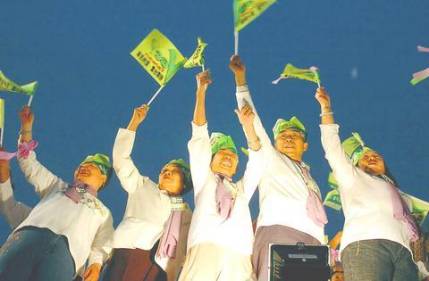
Democratic Progressive Party supporters wave flags during a campaign rally in support of the March 20 referendum in Kaohsiung last night.
-----------------------------------------
On March 14, 2004 ……
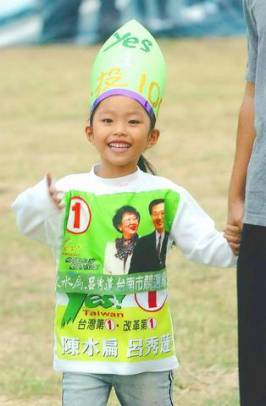
A young girl shows off her T-shirt bearing a photo of President Chen Shui-bian
and Vice President Annette Lu at a campaign rally in Kaohsiung yesterday.
-----------------------------------------
On March 14, 2004 ……
Lien, Soong hold dramatic rally
PROSTRATION: The pan-blue candidates led their supporters in giant rallies across the country yesterday, as the events climaxed when the duo got on their knees
By Huang Tai-lin, STAFF REPORTER
Hundred of thousands of pan-blue supporters yesterday took part in a series of nationwide marches and rallies organized by the opposition Chinese Nationalist Party (KMT)-People First Party (PFP) alliance against President Chen Shui-bian.
The event, which took place throughout the nation's 25 cities and counties, climaxed when the alliance's presidential candidate, KMT Chairman Lien Chan, made a dramatic gesture in Taipei and prostrated himself, kissing the ground alongside his wife Lien Fang Yu and KMT Secretary-General Lin Fong-cheng in front of the Presidential Office.
Lien said the move was meant to demonstrate his love for Taiwan.
Shortly before Lien's surprise prostration, PFP Chairman James Soong -- who led the march in Taichung City -- also knelt on the ground with his wife, Chen Wan-shui, and kissed the ground.
Locked in a neck-and-neck race against the incumbent president, the pan-blue camp's marches yesterday were largely interepreted as the final push ahead of next Saturday's election.
The event was also regarded as a move to counter the DPP, which had narrowed Lien's lead with a stunning turnout at the 228 Hand-in-Hand Rally. At that rally, 2 million supporters formed a human chain across the nation on Feb. 28 to protest China's threats to Taiwan.
Prior to his kissing the ground, Lien called on the crowd to support his presidential candidacy in the upcoming presidential election.
"Today we are gathered here with one appeal, which is to change the president and save Taiwan," the pan-blue presidential hopeful said. "In order to save Taiwan, we must stage a second transfer of power on March 20, the election day."
Lien said that he would not seek a second term in office should he win the upcoming presidential race.
Lien then branded Chen's proposed referendum, which is slated to be held alongside next Saturday's election, as "a mere drug aimed at anesthetizing the people and shifting their attention away from the DPP's poor performance."
Accusing the DPP administration of pushing the country into economic dire straits during its past four years in office, Lien pledged that his government would assemble a team of experts and professionals to "help lead Taiwan into economic prosperity."
"In comparison, the DPP administrative team is like a firefly while that of the KMT-PFP alliance is like the moon," Lien said.
Touching upon the issue on cross-strait affairs, Lien said that "the Republic of China is a sovereign state which we can not, and will not allow to be swallowed, merged or united with the People's Republic of China.
Saying that Taiwan would never negotiate under the military threats posed by China, Lien called on Beijing to remove its missiles targeted at Taiwan, adding that he wishes to reopen dialogue with China should he be elected on March 20.
Blue, white and red balloons were released in front of the Presidential Office amid an array of performances, including hip-hop dances, aboriginal performances and other entertaining spectacles of song and dance.
People in the crowd waved ROC flags and Lien-Soong campaign flags while others held up placards that read "Replace Chen Shui-bian" and "The President of Unemployment Must be Unseated."
Participants of all ages blew horns and whistles, while others beat pots and pans, shouting "Change the President, Save Taiwan"
Some pan-blue die-hards had even decorated their pets with ROC flags and Lien-Soong banners, while other pan-blue faithfuls wore red bands on either their head or around their arms with the words "try hard" written on them.
"We really have not been happy during the past four years of Chen Shui-bian's presidency," said a 40-something pan-blue supporter surnamed Wang, as he stood in the gathering at Ketagalan Boulevard with his wife.
"The pan-blue camp will surely win [the election] with the force of three parties," said the pan-blue faithful, referring to the KMT and its two splinter groups, the PFP and the New Party.
When the clock hit 3:20pm -- the number that coincided with the presidential election date of March 20, pan-blue supporters fervently waved flags and banners in the air and shouted the slogan "Change the President, Save Taiwan" while others blew horns and whistles, showing their desire to change the president.
The pan-blue alliance's spokesman, Alex Tsai, last night claimed that the nationwide marches had drawn over 3 million people, although the exact number of participants was difficult to verify as the police refused to give an estimate.
Former premier Sun Yun-shuan, who has long been wheelchair-bound because of a stroke, stood on stage with the help of others, spoke to the crowd in a feeble voice and urged them and their friends to support Lien.
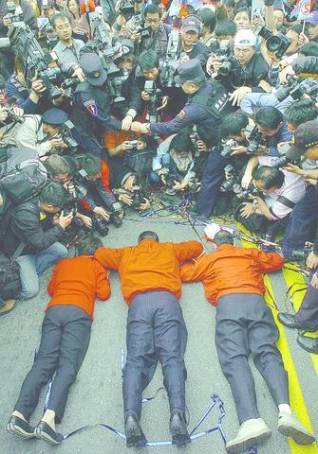
KMT Chairman Lien Chan, center, his wife Lien Fang Yu, and KMT Secretary-General Lin Feng-cheng kiss the land to show their love for Taiwan during a campaign rally held in Taipei City yesterday afternoon.
-----------------------------------------
On March 14, 2004 ……
Chinese efforts to thwart support of Taiwan backfire
By Charles Snyder, STAFF REPORTER , IN WASHINGTON
Taiwan supporters in the US Congress and the Chinese Embassy in Washington have mounted a war of words over congressional moves to endorse next Saturday's referendum, but the Chinese actions are apparently backfiring by convincing more and more lawmakers to sign a letter expressing US backing for the referendum, congressional staffers say.
The congressional letter, which is being circulated by Representatives Peter Deutsch, a Florida Democrat, and Dana Rohrabacher, a California Republican, was sent to House members Thursday morning.
But even before that, Chinese Ambassador Yang Jiechi, hearing of the efforts, sent an e-mail letter to House members urging them not to sign the Deutsch-Rohrabacher letter.
That action, aides to the two representatives say, piqued the representative's interest -- and perhaps resentment -- resulting in a flood of phone calls to the two authors even before the Deutsch-Rohrabacher letters reached the members' offices.
The ambassador "is doing our legwork for us," an aide to Deutsch told the Taipei Times.
Deutsch reacted sharply Friday to the Chinese letter.
"The lobbying effort by China against my letter of support for the Taiwan people's democratic rights is chilling," he said in a statement.
Despite the ambassador's efforts, "the United States must always stand by democratic principles. I call on the Bush administration to do the same."
As a result, the letter, which a congressional aide said was originally "not meant to be a big deal," has blossomed into a major issue on Capitol Hill. Since the ambassador sent his e-mail "we have been receiving lots of calls," an aide said.
And, although the letter signing effort was limited to the House, word of the effort has reached the Senate, and a number of senators have also called seeking to sign on.
The idea of a letter arose after the Republican congressional leadership earlier this year refused to allow consideration of a resolution or bill formally committing Congress to backing the referendum.
That, in turn, Taiwan's congressional supporters say, was because Bush opposed any pro-Taiwan legislation in advance of the election, in keeping with the administration's suspicion of the referendum, which Bush voiced last December after meeting with Chinese Premier Wen Jiabao.
In the letter, addressed "To the people of Taiwan," the representative's say that "we believe that you, the people of Taiwan, have consistently demonstrated your passion for human rights, transparency, and the democratic process.
"Your 23 million citizens have earned the right to decide for yourselves the issue affecting your well-being and security. You have earned the right to hold exclusive responsibility for determining the future of Taiwan and to exercise democratic processes.
"This includes holding referenda free from intimidation or threat of force from any country including communist China."
In a cover memorandum attached to the letter, Deutsch and Rohrabacher urge their fellow lawmakers that, "as we have in the past, the US must support the right of the Taiwanese populace to speak its mind through a peaceful voting process."
It is not clear how many lawmakers have agreed to sign, but congressional staffers say that at this time they expect some 20 signatures. However, with the growing interest spurred by the Chinese e-mail, they say this could very well grow by the time in the middle of this week that they stop collecting signatures and try to circulate the letter in Taiwan.
In his letter, Yang quoted Bush's comments after the Wen meeting, in which Bush voiced opposition to President Chen Shui-bian's decision to hold the referendum as possibly changing the "status quo" in the Strait.
He also quoted in part a subsequent comment by Secretary of State Colin Powell in which he said, "we don't see a need for these referenda." At the time, Powell also said that it was up to Taiwan to decide whether or not to hold a referendum.
"President Bush and former President Clinton have all made it clear that the United States does not support `Taiwan independence,'" Yang claimed.
Yang expressed "grave concern" over the congressional letter, and charged that Chen is using the referendum only for his own political gain.
-----------------------------------------
On March 14, 2004 ……
DPP vows to root out corruption
By Melody Chen, STAFF REPORTER
As opposition backers converged for marches yesterday morning, thousands of Democratic Progressive Party (DPP) supporters hoisted brooms high in the sky in a symbolic gesture to wipe out "black-gold" politics.
Branding the Chinese Nationalist Party's (KMT) half-century long rule over the country as a "black-gold" regime, the DPP showed large photos of Taiwan's 10 most-wanted fugitives outside its local campaign headquarters across the nation.
To challenge the KMT-People First Party (PFP) alliance's marches around the country, President Chen Shui-bian and Vice President Annette Lu's campaign teams launched the "Grand Green Sweeping" activity to kick a series of events over the weekend.
Ridiculing the blue camp's decision not to call its marches an "anti-black-gold" campaign, Chen said: "The KMT didn't dare to make `anti-black gold' the theme of the marches. It knows doing so would hurt itself because it has been practicing black-gold politics."
"The blue camp opposes A-bian but not black gold," Chen said.
For the "Grand Green Sweeping," every DPP local campaign headquarters recruited 100 people, each holding a broom and standing in front of the photos of the fugitives.
At 10am sharp, the groups lifted up their brooms and started sweeping the fugitives' photos.
The fugitives included former chairman of Tuntex, Chen Yu-hao, who accused Chen Shui-bian of receiving political donations from him, former KMT legislator Wu Tse-yuan and notorious bank robber Chen Yi-hua.
At the DPP national campaign headquarters in Taipei, Presidential Office Secretary-General Chiou I-jen, Taipei County Commissioner Su Tseng-chang and DPP Deputy Secretary-General Lee Ying-yuan led supporters in sweeping the criminals' photos.
"The DPP believes in Taiwan and the people. It will insist on reform. I believe President Chen and Vice President Lu will continue efforts to wipe out black gold after they are re-elected," Su said.
DPP campaign spokesman Wu Nai-jen said that compared to the DPP's 228 Hand-in-Hand Rally, which aimed to safeguard Taiwan's safety and development, the KMT's marches yesterday achieved nothing but to display the blue camp's opposition to President Chen.
"In terms of the two events' historical significance, the 228 event is undoubtedly more meaningful than the blue-camp's rally yesterday. The 228 Hand-in-Hand Rally will be the one that leaves its mark in history," Wu said.
Meanwhile, to show their determination to curb bribery in the election, a group of Ilan investigators launched an anti-bribery parade, which attracted thousands of participants.
A small crowd of President Chen backers was seen in the parade. They painted their faces black to imitate Bao Qingtian, a legendary 11th-century judge with a dark face.
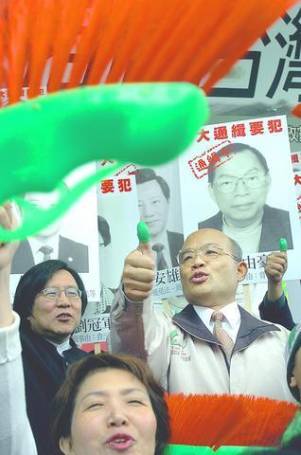
Taipei County Commissioner Su Tseng-chang, right, and Presidential Office Secretary-General Chiou I-jen, left, make a thumbs-up sign and wave brooms during a rally yesterday aimed at showing DPP determination to clean out ``black-gold'' politics.
-----------------------------------------
On March 14, 2004 ……
Soong's kneeling a planned highlight
"In practice, Soong should not
be the only one to kneel down. It would make more sense if all the people
around him did the same." -- Hwang Yih-jiau, PFP
lawmaker
BAD TIMING: The pan-blues' election
platform revolves around being able to run Taiwan better than the DPP, but
yesterday they were unable to synchronize their watches
By Brian Hsu, STAFF REPORTER , IN TAICHUNG
People First Party (PFP) chairman and pan-blue camp vice presidential candidate James Soong and his wife Chen Wan-shui yesterday brought to a high election fever in Taichung by kneeling down to kiss the ground in the largest rally that the blue camp has held in the central city in the lead-up to the March 20 presidential elections.
Soong's move nearly caused the situation to get out of control, however, as supporters and TV cameramen surged forward. Security personnel had to swiftly intervene to prevent a possible accident.
Soong claimed that over 300,000 people took part in the rally.
After the rally, Soong would not comment on his "kissing the land," except to say that it had been planned in advance but was only known by top-level blue-camp campaign staff.
The problems Soong's kneeling caused were the result of a failure by the blue camp to synchronize Soong's kneeling down and that of Nationalist (KMT) Chairman Lien Chan, the blue camp's presidential candidate.
The Taichung rally was one of a number or campaign rallies held simultaneously around the country.
An official with the PFP, who spoke on condition of anonymity, said that according to the initial plans, Lien should have been the first to kneel down to kiss the ground, which was to be followed by Soong and those leading rallies elsewhere in the country.
The time set for the synchronized move was at 3:20pm, but due to errors in communication links Soong did not make the move until 3:26pm, a little ahead of Lien in Taipei who was apparently also confused about what caused the glitch.
PFP lawmaker Hwang Yih-jiau, Soong's most trusted aide, said he did not know details about the planned synchronized move at yesterday's rallies across the country.
"It has been kept top secret in the blue team. Only a small number of people knew about it. In practice, Soong should not be the only one to kneel down. It would make more sense if all the people around him did the same," Hwang said.
Soong's kneeling down was not beyond the expectations of the green team. President Chen Shui-bian, presidential candidate of the Democratic Progressive Party (DPP), had predicted in a recent rally that Soong or Lien would resort to kneeling down as the presidential election neared.
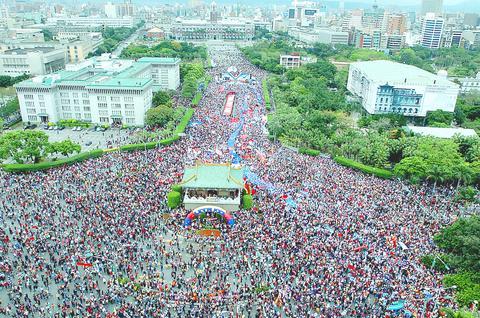
Thousands of supporters of the Lien Chan- James Soong presidential ticket gather on Katagalan Boulevard in Taipei during the pan-blue camp's 313 Rally yesterday.
-----------------------------------------
On March 14, 2004 ……
Pan-blues make foolish promises
`If one-third of our young men are to be recruited every year, and if they all are to be top-quality soldiers, their salaries will have to be a lot higher than current salaries in the private sector. The government will therefore have an additional NT$200 billion in salary expenditure each year, something that the nation's finances will not be able to bear. The rush to implement an all-volunteer military force is simply an unrealistic policy.'
By the Liberty Times editorial
The presidential election campaign has entered its final, most intense stage. Both sides not only issue promises to attract votes but also put forward their opinions on the nation's future. Voters will have to use their intelligence to decide whether these opinions stand up to scrutiny.
In the recent dispute over an all-volunteer army, Chinese Nationalist Party (KMT) Chairman Lien Chan and People First Party (PFP) Chairman James Soong have advocated recruiting 200,000 soldiers in four years and requiring only three months of military service under the conscription system. This is a plan that might win votes, but it is also a plan based on a complete lack of foresight.
It means that 50,000 soldiers would
have to be recruited annually for the next four years, though only 160,000 men
will turn 20 each year during that period -- which also means that only about
160,000 men will be added to the workforce each year. If the military were to
absorb nearly one-third of these men, wouldn't universities and industry
experience a shortage of talent, and wouldn't the military be certain to
recruit many unsuitable men?
Last month, the Ministry of Defense called for 647 volunteer officers but only managed to recruit 298. How could we possibly succeed if we suddenly had to recruit one-third of all the men turning 20? And do one-third of our young men want to be soldiers for the rest of their lives?
Even if the nation's most popular industries -- the electronics and information industries -- were to try to recruit 50,000 men annually for four years in a row, they would encounter great difficulties.
If one-third of our young men are to be recruited every year, and if they all are to be top-quality soldiers, their salaries will have to be a lot higher than current salaries in the private sector. The government will therefore have an additional NT$200 billion in salary expenditure each year, something that the nation's finances will not be able to bear. The rush to implement an all-volunteer military force is simply an unrealistic policy.
In addition, the pan-blue camp proposes a "1 million PhD" plan to produce 1 million doctorates. Although this makes an attractive slogan, we wouldn't have enough talented people to produce that many PhDs even if we implemented the plan over a 40-year period. The current under-25 population, together with those who will be born over the next 15 years, totals about 7.5 million. This is the demographic pool out of which we will educate our doctoral degree holders over the next 40 years.
If we want to educate 1 million doctoral degree holders, one of every seven or eight people must earn a doctorate. This is impossible. Based on these proportions, 40,000 people would have to earn a doctorate each year, about the same number as earn doctorates each year in the US. But the US population is more than 10 times that of Taiwan, and there are also many foreigners earning doctorates in the US.
Let's examine the question further by examining students' scores in last year's university entrance exams.
If we were to take 15,000 students from the humanities group and 25,000 from the science group and put them on the course to a doctorate, those scoring at least 280 out of 500 in the literature group and those scoring at least 198 in the science group would qualify for the program.
Apart from a few exceptional cases, would students with such low scores be capable of coping with doctoral studies?
What's more, many students above the standard aren't interested in pursuing doctoral studies to begin with.
The blue camp also claims that it will balance the national budget within six years but does not talk about raising taxes. This is another meaningless policy idea. After several years of streamlining government expenditures, there is not much space left for savings in costs.
The nation's tax revenues only account for around 13 percent of GDP, the lowest among major countries. The figure in advanced countries is usually 18 to 20 percent or even higher. It is obvious that if we are to balance the budget, we must raise taxes on a large scale.
The blue camp claims that the government's tax revenues have declined during the Democratic Progressive Party's (DPP) rule, and that if its presidential ticket is elected, the blue camp will bring about an economic recovery, thereby raising tax revenue on a large scale.
Before 1995, the nation's tax revenues accounted for 18 percent of GDP, but the percentage declined year after year. It fell to 13 percent in 2000 and has remained at that level since. In the first half of 2000, when the KMT still governed the country, both the annual budget and the tax rate were decided by the KMT. That year, economic growth reached 6 percent, higher than in the preceding few years.
Tax revenue as a proportion of GDP in 2000 was thus a result of the tax system and tax reduction policies set by the KMT, and not the result of either the DPP's rule or the economic downturn.
This shows that neither KMT rule nor an economic recovery will automatically lead to an increase in tax revenues as a proportion of GDP.
Hence, in light of the government's tax revenues and its deficit, and the hundreds of billions of NT dollars worth of campaign promises made by the KMT, even the simplest algebra shows that it's impossible for the government to bring its revenues and expenditures into line without a drastic tax increase.
During a debate between the presidential candidates, President Chen Shui-bian questioned Lien's advocacy of relocating Taiwan's manufacturing industry to China lock, stock and barrel.
Lien has not responded to Chen's question.
If Taiwan's entire manufacturing industry is relocated to China or other countries, over 2.5 million workers would lose their jobs.
This is the equivalent of the total number of jobs in the commercial and transportation sectors put together.
In other words, the unemployment caused by the relocation of manufacturing industry can never be absorbed by other industries, and may even cause a chain reaction in other industries (the service sector, for example). Under such circumstances, we really do not understand how Taiwan's economy will improve and how tax revenue will be increased.
We are examining the blue camp's campaign promises in this way mainly because we believe that any policy involving national development has to be legal, reasonable and feasible, and not made recklessly, without foundation in reality.
Politicians should value honesty and credibility. They should not build an imaginary future to attract votes by making promises that will burst like bubbles once they are elected.
Such actions not only deceive the voters but also bankrupt the credibility of the politicians themselves.
-----------------------------------------
On March 14, 2004 ……
Lien's bait and switch
Kris Liao, California
Chinese Nationalist Party (KMT) Chairman Lien Chan has been using bait-and-switch tactics to trick and trap voters lately.
First, in his debate with President Chen Shui-bian, Lien proposed shortening military service to just three months and eventually phasing out the compulsory service system ("Lien wants to speed up volunteer military service plan," March 6, page 3), perhaps intending to attract young voters.
However, in my opinion, Lien is sending a message that `"If I am elected as president, I will proceed with unification with communist China," which is the only enemy Taiwan currently has. So after unification, Taiwan will no longer have any imminent enemy -- hence compulsory military service will no longer be needed.
I hope the media and the voters will carefully analyze the hidden motives of a head of state who thinks that Taiwan would not need military power to protect the country's sovereignty.
Second, in an interview with Eastern Television, Lien pledged to donate his salary to charity if he is elected. Lien's gesture is truly laughable. If he is truly concerned about poor people, especially students who could not afford college tuition, he would surely long ago have returned the KMT's vast assets to Taiwan's government and people, to whom they legally belong.
Lien instead hid his party's assets by investing in a trust fund operated by a Swiss bank ("KMT says it'll move its funds to Switzerland", Jan. 23, 2003, page 3). No wonder foreigners have second thoughts about investing in Taiwan because Lien himself has no confidence in his own country.
Third, the KMT announced that it would hold a 313 rally to drum up support and to promote anti-"black gold" and anti-corruption.
This is hypocrisy. The KMT's corruption has been known around the world for decades, and black-gold politics is the party's specialty -- all documented in the history books.
So if Lien or his party is hoping to regain the trust of the people, he should be bold enough to return the party assets, not his future salary, to the people to whom they are long overdue.
Finally, I wish there were a third referendum on the ballot to ask the voters the following: "Should persons who own property outside of Taiwan be allowed to run for president?"
-----------------------------------------
On March 14, 2004 ……
-----------------------------------------
On March 14, 2004 ……
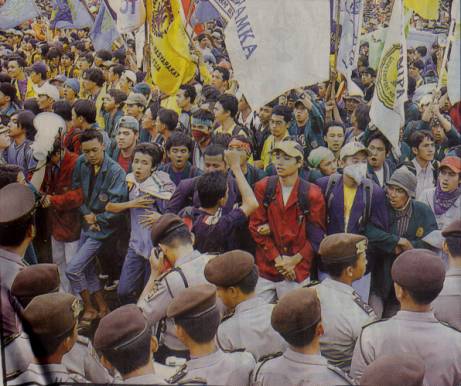
Students and laid-off workers from the state-owned aircraft manufacturer PT Dirgantara Indonesia (DI) hold a protest in front of the parliament building in Jakarta.
-----------------------------------------
On March 14, 2004 ……
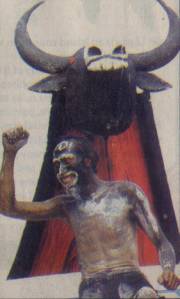
Supporters of the Justice Party, cheer during an election campaign parade making the official start of campaigning in Jakarta, Indonesia.
-----------------------------------------
On March 14, 2004 ……
People power for sale in democratic Indonesia
In a slum just a stone’s throw from the gaudy mansions of Indonesia’s elite, Rizal trades in human flesh and misery. Angry students, the urban poor, the rural poor, supporters, opposers, all can be arranged for a price.
“Over the years, I’ve had orders for people from the parties of two presidents, but I’ll work for anyone,” says the 30-year-old Jakarta man, one of thousands of Indonesians who make a living arranging mobs.
In the world’s fourth most populous country, politics has traditionally been about crowds – huge, noisy and sometimes violent masses.
However, Rizal’s is an industry which has blossomed since mobs took to the streets in 1998, ousting former autocratic president Suharto and giving birth to a shaky democracy.
Because political rallies and political campaigns in Indonesia are still mass based, rather than rooted in issues, some parties need to reassure themselves and their competitors that they have followers, so they rent mobs, Dewi Fortuna Anwar, a political analyst and former presidential advisor, said.
And it’s an industry many see getting a boost from the country’s first democratic presidential elections this year.
Twenty-four parties have the green light to participate, virtually guaranteeing that no party will win a parliamentary majority on April 5 and that the presidential race in July will go to a runoff.
Analysts say large rallies are a certainty and some fear the tension could spur violence.
New arrivals in the capital of the sprawling equatorial nation of some 17,000 islands and 210 million people are struck by the vast number of public demonstrations.
“Demos,” as they are known locally, take place on an almost daily basis, snarling traffic as crowds march and wave banners.
What is not immediately obvious to the casual observer is that many are carefully stage-managed pieces of political theater rather than expressions of ordinary Indonesians’ aspirations.
“If a politician disagrees with another, he organizes a protest,” says Rizal, clad casually in blue jeans, a green T-shirt.
Rizal said one mob organizer he knew had already had his first election-related job, helping to created a virtual crowd by buying supporters’ identities for one political party so it could meet the threshold required to run candidates.
“Students can be a good source of income too. A recent job I had was for university students who wanted to protest corruption outside the attorney general’s office. They wanted 100 people.”
As a professional go-between, he explains, he receives “orders.” He can rustle up 100 demonstrators at a moment’s notice, or, given a little more time and working with others in the business, he can lay on a cast of thousands.
Dozens of Jakarta slums and even whole villages outside the capital have become fertile recruiting grounds.
Demonstrators receive anything from US$1.8 to US$6 each, a boxed lunch and a bottle of water before being loaded into buses or trucks and driven to the demo site, where they are given banners to wave and headbands or T-shirts.
If everything goes smoothly, they disperse – or are dispersed by club-wielding police – a few hours later.
“It’s the responsibility of the person ordering the protest to pay the medical bills,” said Rizal. “I don’t think it’s wrong. People choose to sell their support because they are poor and need the money.
-----------------------------------------